Why Can’t You?

One of my favorite motivational quotes of all time comes from Antony Hopkins in the movie, “The Edge”.  They are stranded in the woods and he is tyring to  psyche up Alex Baldwin’s character to help him kill a bear.  Killing a bear seems like such an impossible task.  It’s fraught with danger.  It’s incredibly risky.  Unbelievable hard.  But they must do it.

Hopkins tells him – “What one man can do, another can do!”

Now, most of us will probably never be in a situation where we must kill a bear for survival.  But look at it as a metaphor.  The bear is any seemingly insurmountable task in your life.  Any goal that you long to achieve, yet seems unconquerable.  Doesn’t make a difference what it is – what one man can do (or woman, we’re equal opportunity here!), another can do!

It bugs to no end when students place highly skilled martial artists like Morihei Ueshiba, founder of Aikido, or Masaaki Hatsumi, head of the Bujinkan Dojo, or even Bruce Lee, founder of Jeet Kune Do on pedestals and hold them up as unreachable and impassible icons.  Are they great?  Yes, of course.  Are they worthy of our respect and admiration for their skill and achievement?  Hell yeah!  But are they an enigma?  Are they once in a generation geniuses that the rest of us mere mortals cannot hope to reach?  No.  Not at all.  They are men.  Human beings like you and me.  They put in ungodly amounts of hard work, study, and practice to reach the peak of their craft, but what one man can do, another can do.

Thomas Edison failed thousands of times before he successfully created the light bulb.  No, that’s not a typo.  Thousands.  What if he gave up after the first failure, or the hundredth, or even after the thousandth failure?  Where would we be?  In the freakin’ dark, people, that’s where!

Do you want the martial skill of a Hatsumi?

The legacy of a Steve Jobs?

The money of a Bill Gates?

The body and fitness levels of an elite athlete?

The strength of a world champion strongman?

Go out and get it.  What one man can do, another can do.  Why can’t you?


The Warrior’s Key to Greatness – The Way Lies in Training!

Throughout history a few exceptional martial artists have stood out from the rest of the budo landscape.  Millions of people from every country and culture on the planet have trained in innumerable styles and arts across the centuries, yet we only know a small number of them by name.  These men distinguished themselves and rose to the very uppermost levels of physical, mental, and spiritual skill in their respective arts and in some cases even took their talent to such heights as to create an entirely new martial art.  Looking back at them today, we are awed and inspired by the levels they achieved through their single minded determination in reaching a goal, dogged pursuit of excellence in their craft, and amazing amount of self-sacrifice. 

Why are They Different? 

What made these men different?  What pushed them to greatness?  What did they do differently or more productively that propelled them to prominence?  Why were their names and storied passed down through the years, sometimes centuries?  In essence, what one factor do all great martial artists have in common regardless of style, country, or culture?  And, more importantly, how can we learn from them and apply it to our own training?  Remember, we stand on the shoulders of giants, not to imitate them, but to be able to look farther.

 Quotes from the Greats

Instead of listening to my opinion today, why don’t we go directly to the sources themselves?  Here are some cool quotes I’ve complied by some of the greats talking about their own training. 

Morihei Ueshiba – Aikido 

“The instructor can only impart a small portion of the teaching; only through ceaseless training can you obtain the necessary experience allowing you to bring these mysteries alive.  Hence, do not chase after many techniques; one by one, make each technique your own.”

“Always imagine yourself on the battlefield under the fiercest attack; never forget this crucial element of training.”

“This old man must still train and train” – said shortly before his death.

Gozo Shioda – Aikido 

“Kokyu power is produced when we push ourselves to the limit, making the most efficient use of the capabilities that lie within our own bodies.”

“Even though the body has its limits, until your death, the strength of your spirit is limitless.  This is precisely why, in the martial arts, there is no such thing as deteriorating as you age.”

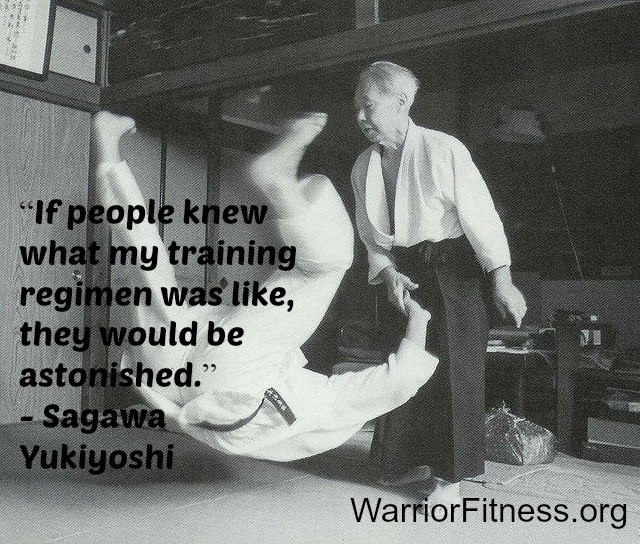
Yukiyoshi Sagawa – Daito Ryu 

“Intermittent training, no matter how intensive, is utterly useless.  You must practice every day for your entire life.  That, and only that, is true training, or shugyo.”

“People who think they can ignore training their bodies and only work on techniques are amateurs.  They don’t know anything.  Actually, if you can’t prepare your body properly, you have no hope of ever perfecting your technique.”

“No matter what level of mastery you attain, you will never achieve perfection.  You should therefore never, ever assume that what you have achieved is good enough.”

“If people knew what my training regimen was like, they would be astonished.”

Masaaki Hatsumi – Bujinkan Budo Taijutsu 

“Modern budo students often forget to practice by themselves.  I used to practice by myself.  When there was no teacher, I found the secret teachings by my own desire.”

 “Studying for oneself and making one’s own discoveries is much more important than group learning, and this applies equally well to martial arts.  As I often say, ‘Life is all about solitary training.’  This is because I want serious practitioners to discover the tricks of the trade for themselves.”

Miyamoto Musashi – Niten Ichi Ryu 

“From the time I was young I have set my mind on the Way of Martial Arts, practiced the one subject of swordsmanship with my entire being, and experienced various and different understandings.”

“See to it that you temper yourself with one thousand days of practice, and refine yourself with ten thousand days of training.”

“Never depart from the way of martial arts.”

Yamaoka Tesshu – Muto Ryu 

“Study hard and all things can be accomplished; give up and you will amount to nothing.”

“If you want to obtain the secrets of such wonderful techniques, drill yourself, harden yourself, undergo severe training, abandon body and mind; follow this course for years and you will naturally reach the profoundest levels.”

Inspired yet?  Ready to train and push yourself to the next level?  Check out the new solo training sensation – Warrior Fitness Guide to Striking Power and get started today!


Create Your Own Adversity!

“Let me embrace thee, sour adversity, for wise men say it is the wisest course.”  ~William Shakespeare

Philosophers and sages throughout the ages have consistently extolled the virtues of facing adversity for the purposes of becoming a better, stronger person.  No matter what form this adversity takes, wisdom dictates that it must be faced head-on, weathered through, and successfully beaten by coming out the other side, maybe scarred, but assuredly battle-hardened and spiritually tougher.   Oftentimes, adversity comes to us unbidden simply due to the path we choose to follow, or even for no fathomable reason at all.  It tends to be one of those things life throws at us unexpectedly to “help” us prove our mettle and forge our character.

It has been said that “God comforts the disturbed and disturbs the comfortable”.  If this is so, perhaps creating your own adversity isn’t a bad thing at all. 

The goal in creating your own adversity is to design a challenge that will push the limits of your physical strength, mental toughness, and spiritual fortitude in order to propel you forward to the next level in your training.  For the warrior, this process is known as Shugyo.  Shugyo (修行) may be defined as “conducting oneself in a way that inspires mastery”.  These periods of severe training were usually undertaken by warriors to achieve a type of enlightening experience which opened their minds by destroying their concept of previously perceived limits.  It is the same for us today.

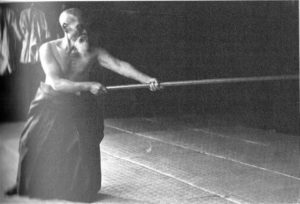
Ueshiba Morihei, the founder of Aikido, was well known for taking his students up into the mountains for periods of Shugyo.

 “Once a year, Morihei took several of his best disciples to train with him on Mount Kurama, located near Kyoto. The small group lived on rice, pickles, miso soup, and wild herbs. Morihei would rise at five AM to pray. After morning prayers and misogi, they would swing heavy swords five hundred times and then practice footwork. From ten AM to noon they trained in body techniques. Afternoon training ran from three to five PM; the disciples took turns acting as Morihei’s partner as he ran through series after series of techniques. In the evenings the disciples would review the day’s training. Every three days, Morihei would announce at midnight ‘time for night training’…”
Excerpt from “Invincible Warrior”, by John Stevens pg. 125

Now, do you have to seclude yourself in the mountains for several days in order to practice Shugyo?  No.  For most of us, that’s not realistic or practical, but that doesn’t mean we can’t create the same type of experience for ourselves.  So, how do we do it?

Create Your Own Adversity!

Caution:This type of training is not for everyone.  Before you begin, there are a few common sense type precautions you should take.  First, prepare adequately.  For example, you would not go out to run the NY Marathon tomorrow if you’ve never run more than 5 miles.  Second, if you decide to conduct your Shugyo outdoors, let someone know where you’re going, what you’re doing, and how long you’ll be gone, or better yet, take them with you!  Third and most importantly, think before you do and plan accordingly.

1.  Pick a time or day that has personal significance to you – it can be your birthday, New Years Day, or the anniversary of something important in your life.  Is this absolutely necessary?  No.  You can pick next Tuesday if you’d like, but I think tying your Shugyo to a significant day makes it more special.

2.  Decide what form your Shugyo will take.  This must be unique to your goals and capabilities.  Choose something that is currently beyond your reach, but not so far as to make it completely unattainable.  You want to focus and hone your physical, mental, and spiritual abilities, not your imagination.  Some examples are:

  • Run a marathon
  • Climb a mountain
  • 1000 cuts with a heavy bokken (wooden sword)
  • 1000 Kettlebell snatches
  • 1000 reps of any basic techniques or combination of techniques
  • Sparring 20 opponents in a row, nonstop
  • 1000 Push-ups/Squats/Sit-ups

While any of the above would more than qualify as Shugyo, my personal preference is to plan an entire day where the whole becomes greater than the sum of the individual parts.  Some recommendations for the parts are:Junan Taiso warm-up, run (distance TBD by you), practice the basic strikes, kicks, and footwork of your particular martial art, Bujinkan Budo Taijutsu for me (high reps to push your limits, of course!), weapons practice (sword cuts, spear thrusts, bo swinging, etc.), high repetition bodyweight exercise(s) or workout with weights (dumbbells, kettlebells, clubbells, sandbags), end with an extra long yoga session to wring out all the tension accumulated throughout the day followed by meditation and rest.

3.  Create a training program to get you there.  Let’s face it, most of the above examples are not something most people can decide to do in a day, they take time, preparation, and work to bring the goal within reach.  Remember the “6 P’s”: Proper Prior Planning Prevents Poor Performance!

4.  Get to work!!

Creating your own adversity through Shugyo has the effect of focusing not just your mind, but your entire being for the purposes of expanding your potential.  Push yourself harder than you ever thought possible and blow through your preconceived limitations – remember, the only limits that truly exist are those set up in your own mind – there are no limits! 


“God brings men into deep waters, not to drown them, but to cleanse them.”  ~John Aughey