Embrace the Suck!

No one wants to work hard for anything anymore.  It’s true.  Take a look around at our modern culture.  Instant satisfaction is everywhere from fast food to movies on demand.  We literally have to wait for nothing.  And, while the convenience is great and quite useful for the most part, it has also has had a deleterious effect on our lives that is sometimes overlooked or unseen.  It has eroded our patience and destroyed our work ethic – at least when it comes to the really hard stuff like physical development and skill acquisition.  Why?  Because these things are not and cannot be had instantaneously.  They require consistent practice and drive.  I mean, c’mon they now have pills to take that burn fat while you sleep?  Are you kidding me?  How lazy can we be?  By the way though, if you get your diet correct and even skip a meal once in a while, you will burn fat while you sleep without the damn pills, but that’s another blog post….

As you may have noticed, martial arts training and conditioning to develop the proper levels of fitness, mechanics, technique, attributes, and that  all elusive sense of flow can be difficult, repetitious, and sometimes downright boring, to be honest.  So how do we keep going in our daily training?  How do we push ourselves through the plateaus and dry spots with enough intensity and consistency to break through to our own personal greatness? (See what some of the historical martial greats had to say about it in this article here.)  My advice is to embrace the suck – yeah, the suck.  Learn to love it.  Crave it.  Become friends with it.  So when it hits, you not only can push through it, but actually embrace it.  Dostoyevsky said to “love your suffering.”  The Chinese martial artists call it, “eating bitter.”  We here at Warrior Fitness call it “embracing the suck!”

Does this make you weird?  Well, yes, but only in some circles.  But for the most part it earns you respect.  Why?  Because most people can’t do it.  Being able to embrace the suck and keep going  distinguishes you.  It differentiates you from the pack.  It makes you a leader.  If you want to be a leader, there’s only one way to do it – lead from the front.  That’s the only way to inspire people – by your own example.  What example do you set for your students, your family, your friends, your kids?

Learning to embrace the suck allows you to, as the great method acting coach Stanislavsky once wrote, “make the difficult habitual: what is habitual will become easy, and what is easy will become agreeable.”  So even embracing the suck is a process which allows us to continue to train with greater intensity and focus, and thus push through even greater levels of suck.

However, the best part about embracing the suck is when the suck ends and you come out on the other side.  You’ve fought the good fight, pushed through the barrier, and overcome the adversity once again.  You’re a stronger person for it.  You know it.  I know it.  So go out and live it!

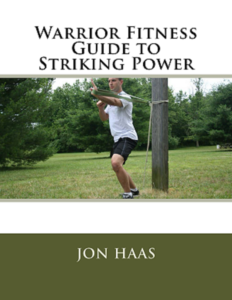
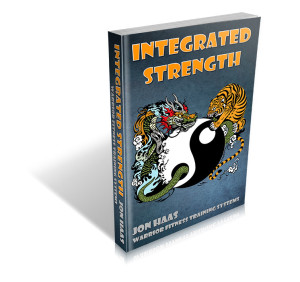
The Warrior Fitness Guide to Striking Power is Here!

by Jonathan Haas, founder of Warrior Fitness Training Systems

  • Specific Physical Preparedness for ALL striking arts from old school Traditional Martial Arts to modern MMA!
  • Learn how to build a powerful structure to stabilize punches, kicks, and martial movement!
  • Discover how to use low-tech, high yield tools to strengthen strikes throughout a range of motion!
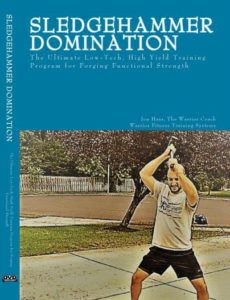
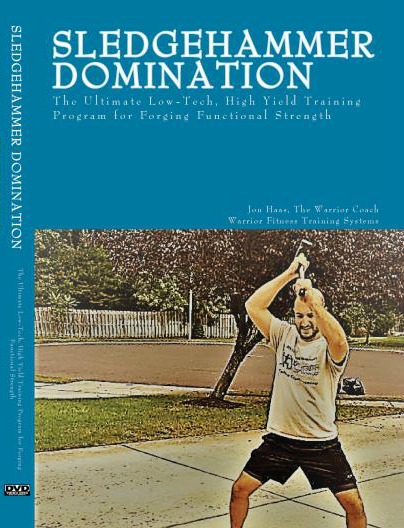
  • Sledge Hammer for force production, rotational strength, grip strength, and old school conditioning!
  • Medicine Ball for explosive strength and rotational strength!
  • Resistance Bands for force production, rotational strength, increased stabilization!
  • Bodyweight Exercise and Isometrics for structure and stabilization!
  • Discover how to use Intelligent Tension rather than general tension to power strikes!
  • Learn Breathing and vibration exercises for recovery and restoration!
  • Over 50 pages of pure, 100% actionable content – no fluff, no BS, no filler!
  • Sample Workouts!

Buy Now for only $15 USD!!

Buy Now

Warrior Fitness Guide to Striking Power is a downloadable e-book. No physical products will be shipped. After you order, you will get INSTANT ACCESS to download the e-book and all the bonus reports onto your computer. The e-book format is adobe acrobat PDF, which can be viewed on Mac or PC.

Special Offer – Warrior Fitness Book + T-Shirt!

Special Combination Offer

(good while supplies last!)


Pick up a copy of the book,


Warrior Fitness: Conditioning for Martial Arts, and


a Warrior Fitness T-Shirt for only $29.95!!


Warrior Fitness Book + T-Shirt (size)

The Top 7.5 Reasons Warrior Fitness is for You

Since Top 10 lists have been so overused of late, especially in the internet blog area, here are 7 and a 1/2 reasons why the Warrior Fitness program is for you.

1.  No gym memberships required!  Still paying for a gym membership you don’t use, or not getting the results you want from your gym?  Start thinking outside the gym with Warrior Fitness!

2.  Low-tech fitness solutions.  Don’t have the budget for expensive training equipment?  Warrior Fitness offers a complete body-weight workout for strength and conditioning.

3.  Quality workouts that work around your schedule.  It doesn’t take hours in a gym to achieve the results you’re looking for.  Our program encourages quality over quantity.  Got 15 minutes?  Then you have time for a workout.

4.  Lose fat, gain lean muscle.  Our workouts are short, but intense to encourage lean muscle growth while stimulating fat loss.  No more boring hours of mindless cardio!

5.  Sample workouts and programing guidance.  Do some fitness training manuals you’ve purchased in the past leave you wondering how to put it all together or how to fit into your schedule?  Warrior Fitness provides sample workouts you can follow or use as templates to create your own.

6.  Ongoing support and new ideas.  Got questions?  Send us an email.  Post a question in the comments section.  We’re here to make sure you are successful!

7.  Fully integratable with your martial arts training.  Ever wonder which fitness programs make sense to use within the context of your martial arts training?  Ever feel like you may be hindering your progress by the type of workouts you’re doing instead of enhancing it?  Since the program is designed by a martial artist with 30 years of experience and a fitness training background, Warrior Fitness provides a clear path to integrating your fitness and martial arts.

7.5  Comprehensive!  Warrior Fitness covers not only strength and conditioning drills, but joint mobility, flexibility, breathing exercises, workout recovery, and more!

Battling Demons

To get good at any discipline, you must practice every day.  To become great, you must practice all the time.  The problem is, with so many pressures, responsibilities, and draws on our time in daily life, how does one manage to train every day?

For me, it’s a daily battle with my demons.  These are the insidious little creatures that lurk in the dark recesses of my mind.  Their sole purpose being to distract me from becoming the person I want to be.  They rationalize and cajole to pull me off the path of self improvement.  The path of training.  For others, the path may be their daily struggle to make good food choices and lose weight, or it may be the daily battle to study at night while working a full-time job in order to earn that MBA.  The path is personal.  The demons are universal.

Currently I train for a few minutes every morning which provides the dual function of waking me up and setting me on the right path for the day.  It primes my muscles, movements, and nervous system for the more involved training I will perform later that night.  Additionally, I will train during the day at odd intervals when I have a few minutes of down time.  These little periods provide the consistency I need to help me keep going.  But, as I stated above, the bulk of my training is done at night after putting the kids to bed.  Usually around 9 pm or so I head down the basement to my home gym.  This is my dedicated training spot.  For me, it helps to focus my efforts since the only thing I do there is train.  It’s minimalist with very few distractions.  Perfect for doing the work.  For the most part, I beat the demons by just getting downstairs and setting foot in the gym.  Getting there is the most difficult part, but once there, the demons are beat and the daily training progresses.

Sometimes, like last night, the battle isn’t won by just getting to the gym.  Last night was different.  I was tired.  I was comfortable sitting on the couch watching TV with my wife.  The kids were asleep.  The house was quiet.  Peaceful.  I thought that the demons hadn’t even shown up to fight because getting down there was so easy.  Once I was in the gym though, they attacked.  It was a sudden, violent onslaught that took me by surprise!  “You’re tired,” they told me. 

“You don’t need to train anymore today…”,

“You did enough over the weekend.  Relax.  Take it easy.”, 

“Why don’t you just go to bed early for a change?  You need your rest!”

On and on it went, not just verbal but real feelings of being sleepy.  Feeling like I should go upstairs and go to sleep.  I almost gave in.  Almost succumbed.  Almost quit.

But mental fortitude kicked in.  Training kicked in.  The battle was on!  I heard myself talking to one of my training buddies saying – “you have to train every day.  You have to want it bad enough.  How do I do it?  Well, it’s like brushing your teeth, Dude.  You just do it every day (usually twice!) no matter what.”  This began the rally.  But it was far from won.  What won the battle once and for all (at least for last night) was the fact that I just started doing my solo conditioning exercises.  I was in the right place.  My mindset was returning.  But the way to win the battle is to simply begin doing the work.  Understand that your training is a necessary part of becoming who you want to be.  Understand that daily training is a necessary part of that process.  And get it done.

Ukemi Flow Conditioning Workout

This one is for all the martial artists out there –  I created the following ukemi conditioning workout for myself a few years ago to specifically target the transitions between my rolls and begin to unlock flow.  Additionally, it has the effect of really getting your heart pumping and makes a great workout!  Start out slowly and smoothly by practicing for the first few rounds.  Groove the movement and then begin to increase the speed.  Remember, you do yourself and your training a disservice if you rush through the movements simply to say you accomplished the workout.  Flow is not something you do, it’s something you allow – you have to be able to get out of your own way!  That being said, give this a try and let me know how it works for you.

Ukemi Flow

  1. Begin in Shizen No Kamae (natural stance), squat down to ball of foot squat
  2. Zenpo Kaiten (front roll) over the right shoulder
  3. Ushiro Kaiten (back roll)
  4. Stand up into Shizen No Kamae (natural stance), squat down to ball of foot squat
  5. Zenpo Kaiten (front roll) over the left shoulder
  6. Ushiro Kaiten (back roll)
  7. Stand up into Shizen No Kamae (natural stance)
  8. Yoko Nagare (side roll) with the leg crossing in front to the right
  9. Yoko Nagare (side roll) with the leg crossing in front to the left
  10. Stand up into Shizen No Kamae (natural stance)
  11. Zempo Ukemi (forward break fall)
  12. Stand up into Shizen No Kamae (natural stance)
  13. Yoko Nagare (side roll) with the leg crossing behind to the right
  14. Yoko Nagare (side roll) with the leg crossing behind to the left
  15. Stand up into Shizen No Kamae (natural stance) – repeat!

Start out with 4 rounds of 3 minutes each with a 1 minute break between rounds.  Use the minute break to get your breathing back under control and shake out the tension.  When this becomes easier, decrease the rest period to 30 seconds between rounds. Finally, try to perform the Ukemi Flow continuously for 12 minutes.  You can also adjust the difficulty level of the flow by adding directional leaps at the end of each roll.  Or, it can be made easier by performing it from kneeling in Seiza no Kamae instead of standing.

Notes: Make sure you warm-up with brief joint mobility session prior to the workout.

Got your own version of an ukemi-specific workout?  Please share with us in the comments section below!

A Day in the Life…

At the suggestion of my good friend, and West Coast Buyu, Dave Furukawa, I am presenting a look at one of my daily workouts.  Please see Dave’s comments on my previous post here for reference.

This is a record of my activity from yesterday, Memorial Day 2010:

Morning

Life begins early here, even on long holiday weekends, since our 19 month old, Juliana, doesn’t distinguish weekends from weekdays yet!  So at 6 am I was up making coffee and searching through her Elmo DVDs to find the particular episode she wanted that morning.  As the coffee was brewing I began working through my joint mobility routine in the kitchen.  Each joint from neck down to ankles and toes is rotated through its entire range of motion to flush the joints with synovial fluid and increase blood flow to the surrounding muscles.  This has the effect of lubricating the joints and removing the “rust”, as well as awakening the entire body.

As interest in her Elmo episode waned and Juliana wandered off to “read” her books and play with toys, I began working through San Shin no Kata, the Bujinkan basic movement exercises.  Each movement was practiced stationary, then walking forward and backward with emphasis on using the spine to generate power for the movements.

Mid-Afternoon

In the afternoon I took the kids to the playground.  My older daughter, Caitlin, rode her bike while I pushed the baby along in her little buggy.  As I walked each step was coordinated with breathing to work on breath capacity.  For example, inhale for 5-steps, hold on the inhale for 5-steps, exhale for 5-steps, then hold on the exhale for 5-steps.  This can be done continuously with the same pattern or you can alter the number of steps for each breath cycle up or down to make it easier or more challenging.  See my post entitled Breathing 101 for more breathing related exercises.  At the playground, in between pushing the kids on the swings and taking the little one down the slide, I used the monkey bars for random amounts of pull-ups and chin-ups.

Evening

Finally got the kids to bed around 8:30 and went down to the basement gym for my workout proper.  My current program is geared towards developing unarmed striking power and basic weapons work. 

  • Brief joint mobility warm-up
  • Suburi with Yari (spear) – 3 rounds of 10 thrusts from Seigan no Kamae, 10 thrusts from Jodan no Kamae, each side
  • Suburi with heavy bokken – 3 rounds of 10 cuts from Jodan no Kamae, advancing and retreating
  • Swipes with 15 lb clubbell – 3 sets of 10
  • Mills with 15 lb clubbell (think omote shuto type movement) – 3 sets of 10
  • Reverse Mills with 15 lb clubbell (think ura shuto type movement) – 3 sets of 10
  • Clean to Order with 25 lb clubbell – 3 sets of 5 each arm
  • Clean to Order with 45 lb clubbell – 1 set of 5 each arm
  • 5 minutes of various yoga asana to cool-down

This is just a quick glimpse into a much larger program that I am testing on myself for eventual release.  For more information on my previous programs, please check out my ebook, Warrior Fitness: Conditioning for Martial Arts.

Fitness Requirements for Bujinkan Martial Arts Training

As a 20 plus year veteran of Bujinkan martial arts training, as well as being the owner/founder of Warrior Fitness, one of the things I pride myself on is my ability to access the fitness needs of my fellow martial artists, particularly those who train in the Bujinkan.  A common misconception that you’ll hear bandied about from dojo to dojo all across the world is that strength, and by association overall, general fitness, is not required.  I think this has to do with a fundamental misunderstanding of how we train.  In class, when practicing techniques, it is imperative to be as efficient in one’s movement as possible, and thus avoid using excess, unnecessary power (read – strength).  In order to accentuate the study of distance, timing, angling, and space management, one must put strength on the back burner in the dojo to avoid powering through the movements and missing all the wonderful subtleties that taijutsu has to offer.  However, in an actual conflict, you can and in fact, you must, use all your power, including strength, to survive.  As Jack Hoban said in his interview here, “real fights are very physical – tiring and punishing”.  Anyone who thinks physical fitness isn’t required in the traditional martial arts is really just kidding themselves.

Bujinkan Practitioners and Fitness

Why do Bujinkan practitioners need fitness training?  Fred Hatfield, aka “Dr. Squat” once wrote, “Optimal physical conditioning provides the platform from which the skills can be used.”   Meaning that the specific physical skills of taijutsu must be built upon a solid foundation of basics, like sanshin no kata and kihon happo, and even more fundamental, a strong budo-body.  Without this platform in place your martial art skills are like a house built on sand. 

From the book, Warrior Fitness: Conditioning for Martial Arts:

 ”Since combat occurs in a volatile and unpredictable atmosphere, training must prepare the warrior to adapt. Remember that the goal of all the exercises in this manual is to develop the ability to control the degree of tension in our body and be able to utilize just the right amount of force at the appropriate moment. This way we may be able to sustain activity for longer and longer periods of time without exhausting ourselves.”
 

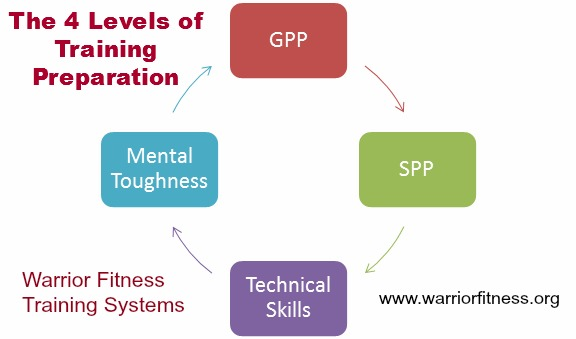
 The first step in ensuring you are building skill on top of a solid foundation is General Physical Preparedness (GPP).  The goal of GPP is enhanced work capacity.  This is the ability to run faster, jump higher, and hit harder.  When work capacity increases, it allows the budding warrior to adapt more easily to increases in both mental and physical demands.  In other words, it increases your capacity and level of readiness to absorb higher levels of specificity.  In a martial art as seemingly limitless as Budo Taijutsu, one must possess the endurance to “keep going!”

In the forthcoming part 2 of this series on fitness for Bujinkan practioners, we’ll look at some examples of GPP type exercises and how to incorporate them into an overall training program.

For more information on increasing your level of readiness for martial arts training, please see the book on Warrior Fitness here.