What Does a Ninja Need?

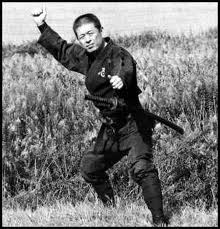
Historically, ninja were the consummate combination of super spy / super soldier.  They possessed outstanding levels of fitness due to their intensely physical training and highly demanding mission requirements.

Their levels of fitness and training have been the subject of many stories and the genesis for many myths surrounding them.

How did they do it?

How did they train?

What type of methodology did they employ since creating this kind of warrior certainly required a very diverse fitness profile?

Ninja fitness needs were much more multi-faceted than most physical pursuits.  They had to be as they were at once a combination of Olympic decathlete, Navy Seal, and martial arts master rolled into one.  Let’s examine this a little more closely though, what kind of qualities did they possess and what did they need to be able to do?

Ninja Must Possess …

  • Strength
  • Agility
  • Coordination
  • Excellent balance
  • Flexibility / Mobility
  • Whole body power
  • Endurance

Ninja Must Be Able to….

  • Move silently
  • Run fast
  • Walk far
  • Leap high
  • Climb trees, walls, castles fortifications, etc.
  • Wield weapons
  • Fight unarmed – striking, kicking, grappling, locking, choking, etc.
  • Roll / fall / dodge / avoid
  • Crawl
  • And more…

As you can see from the 2 lists above, the ninja had a wide range of skills and abilities that had to be supported by a comprehensive fitness program keeping him at the top of his game.

Remember that for a ninja, fitness wasn’t just a nice to have; it was an absolute necessity to accomplishing his mission and getting him home safely.  And the kicker is, they did it all with little to no fitness equipment.

Certainly a 16th century ninja did not possess a Gold’s Gym membership.  Nor did he own an Olympic weight set or have a stair master at his disposal.  And, while kettlebells and dumbbells would have been great, he most likely had never laid eyes on either one.

So here we have one of the most highly trained and fit agents the world has ever seen created without the use of modern training equipment or modern training methods.

What might some of this training looked like?

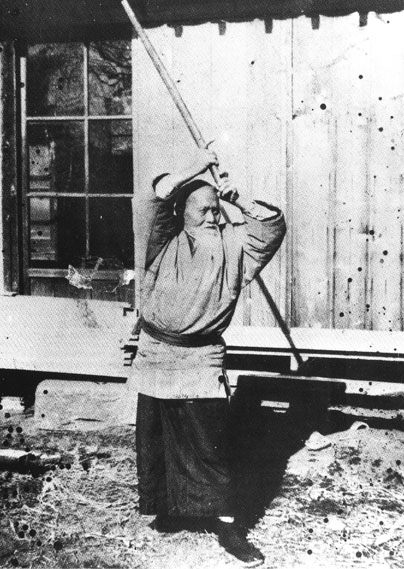
I’m glad you asked.  One of my favorite scenes in Hatsumi Sensei’s early Bujinkan training videos (DVDs now for you younger folks!) comes from Shinden Fudo Ryu.  Here’s a short clip I found on Youtube.  This stuff is seriously old school!

“One trains using the things of nature to make the body strong” – Hatsumi Sensei

What if we were to take the spirit of historical ninja fitness training and combine it with a little modern sports science and know how?

Modern methods allow us to take advantage of periodization, or programing and organizing training, to create a comprehensive fitness plan which will apply logical sequences to get the most out of each session.  Protocols like HIIT, high intensity interval training, will be utilized to maximize both aerobic and anaerobic endurance in the same short, high intensity session.

Advances in recovery work from such sessions will allow us to recover faster thus making gains greater, and increasing our overall general physical preparation (GPP) will allow us to push higher into more sophisticated training.  Effectiveness and efficiency will be combined in order to allow for shorter training sessions which maximize the use of one’s time.

As the ancient ninja did, we will create a strong, supple, highly conditioned warrior and accomplish this with little to no fitness equipment.  We will, as Hatsumi Sensei says in the video clip above, use the things of nature to make the body strong.

If I were able to point to just one resource for the warrior that combines old school training with modern sports science, I’d look here… Ninja Missions <<==
 

The Warrior’s Key to Greatness – The Way Lies in Training!

Throughout history a few exceptional martial artists have stood out from the rest of the budo landscape.

Millions of people from every country and culture on the planet have trained in innumerable styles and arts across the centuries, yet we only know a small number of them by name.

These men distinguished themselves and rose to the very uppermost levels of physical, mental, and spiritual skill in their respective arts and in some cases even took their talent to such heights as to create an entirely new martial art.

Looking back at them today, we are awed and inspired by the levels they achieved through their single minded determination in reaching a goal, dogged pursuit of excellence in their craft, and amazing amount of self-sacrifice.

Why are They Different?

What made these men different?

What pushed them to greatness?

What did they do differently or more productively that propelled them to prominence?

Why were their names and storied passed down through the years, sometimes centuries?

What one factor do all great martial artists have in common regardless of style, country, or culture?

And, more importantly, how can we learn from them and apply it to our own training?  Remember, we stand on the shoulders of giants, not to imitate them, but to be able to look farther.

 Quotes from the Greats

Instead of listening to my opinion today, why don’t we go directly to the sources themselves?  Here are some cool quotes I’ve complied by some of the greats talking about their own training.

Morihei Ueshiba – Aikido 

“The instructor can only impart a small portion of the teaching; only through ceaseless training can you obtain the necessary experience allowing you to bring these mysteries alive.  Hence, do not chase after many techniques; one by one, make each technique your own.”

“Always imagine yourself on the battlefield under the fiercest attack; never forget this crucial element of training.”

“This old man must still train and train” – said shortly before his death.

Gozo Shioda – Aikido 

“Kokyu power is produced when we push ourselves to the limit, making the most efficient use of the capabilities that lie within our own bodies.”

“Even though the body has its limits, until your death, the strength of your spirit is limitless.  This is precisely why, in the martial arts, there is no such thing as deteriorating as you age.”

Yukiyoshi Sagawa – Daito Ryu 

“Intermittent training, no matter how intensive, is utterly useless.  You must practice every day for your entire life.  That, and only that, is true training, or shugyo.”

“People who think they can ignore training their bodies and only work on techniques are amateurs.  They don’t know anything.  Actually, if you can’t prepare your body properly, you have no hope of ever perfecting your technique.”

“No matter what level of mastery you attain, you will never achieve perfection.  You should therefore never, ever assume that what you have achieved is good enough.”

“If people knew what my training regimen was like, they would be astonished.”

Masaaki Hatsumi – Bujinkan Budo Taijutsu 

“Modern budo students often forget to practice by themselves.  I used to practice by myself.  When there was no teacher, I found the secret teachings by my own desire.”

“Studying for oneself and making one’s own discoveries is much more important than group learning, and this applies equally well to martial arts.  As I often say, ‘Life is all about solitary training.’  This is because I want serious practitioners to discover the tricks of the trade for themselves.”

Miyamoto Musashi – Niten Ichi Ryu 

“From the time I was young I have set my mind on the Way of Martial Arts, practiced the one subject of swordsmanship with my entire being, and experienced various and different understandings.”

“See to it that you temper yourself with one thousand days of practice, and refine yourself with ten thousand days of training.”

“Never depart from the way of martial arts.”

Yamaoka Tesshu – Muto Ryu 

“Study hard and all things can be accomplished; give up and you will amount to nothing.”

“If you want to obtain the secrets of such wonderful techniques, drill yourself, harden yourself, undergo severe training, abandon body and mind; follow this course for years and you will naturally reach the profoundest levels.”

Inspired yet? 

Ready to train and push yourself to the next level? 

Check out the new solo training sensation – The Integrated Strength Program – and get started today!

integratedstrength3D1


Double Your Training Without Doubling Your Training

In my teacher’s and my own dōjō (道場 – “martial arts training hall”) we spend a lot of time cultivating our skills as uke. An uke (受け) is a martial arts student who, during a given training session, “receives” a technique from another student acting as the tori (取り). Wikipedia defines the difference as one “who completes a successful technique [tori] rather than who initiates one [uke].” Having a good uke as a training partner is very important, but being a good uke is paramount.

The role of uke often gets a bad rap. Too many times I have seen students relegate themselves to becoming little more than an “I attack, then stand around while the other guy does something to me” participant. When it’s time to be uke, the “pause” button gets pressed and human punching bags are born. That doesn’t seem right, does it?

It certainly doesn’t feel right, at least not to me.

Continue reading

The Warrior Fitness Guide to Striking Power is Here!

by Jonathan Haas, founder of Warrior Fitness Training Systems

  • Specific Physical Preparedness for ALL striking arts from old school Traditional Martial Arts to modern MMA!
  • Learn how to build a powerful structure to stabilize punches, kicks, and martial movement!
  • Discover how to use low-tech, high yield tools to strengthen strikes throughout a range of motion!
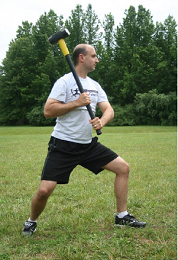
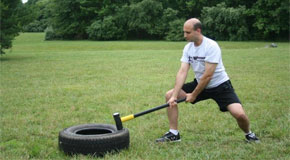
  • Sledge Hammer for force production, rotational strength, grip strength, and old school conditioning!
  • Medicine Ball for explosive strength and rotational strength!
  • Resistance Bands for force production, rotational strength, increased stabilization!
  • Bodyweight Exercise and Isometrics for structure and stabilization!
  • Discover how to use Intelligent Tension rather than general tension to power strikes!
  • Learn Breathing and vibration exercises for recovery and restoration!
  • Over 50 pages of pure, 100% actionable content – no fluff, no BS, no filler!
  • Sample Workouts!

Buy Now for only $15 USD!!

Buy Now

Warrior Fitness Guide to Striking Power is a downloadable e-book. No physical products will be shipped. After you order, you will get INSTANT ACCESS to download the e-book and all the bonus reports onto your computer. The e-book format is adobe acrobat PDF, which can be viewed on Mac or PC.

Blind Spots

A few years ago I traded in my 2000 Honda Civic for a 2007 Civic. The minute I sat in the seat of this streamlined, yet economical car, I knew it was the one I would own. The way it shifted, its responsiveness to the road, the look of the dash, how the seat seemed to perfectly fit my body, somehow it just felt right and even though I wasn’t planning on buying another car with a manual transmission, I knew this would be the car that I would drive home that day. Training can be very much like as well, often it just “feels right” somehow.

Although the car felt good and right to me; one of the things that I immediately noticed was that it had many blind spots that my other car didn’t have… well, wait a minute, re-thinking that, it wasn’t that my other car didn’t have any blind spots, it’s that I got used to them and I eventually learned how to see around them, so much so that I almost didn’t even know that the car had any blind spots at all. Now, that I have owned this current Civic for a few years now, I don’t notice the blind spots that were so apparent when I first bought it. It is funny to think that once these blind spots were so apparent and difficult to see around, and now my mind has trained itself to see around these dangerous short comings and it is once again giving me the illusion that those spots aren’t even really there at all!

This same concept also applies to training and life. Each method, system and person has its blind spots; things that are just taken for granted and often overlooked until something happens to change that perspective. Growth and evolution sometimes can be a smooth, natural progression and other times, it can be challenging, difficult and cause great conflict.

How a system or person approaches their training be it martial arts, military tactics, verbal communication, health and fitness, strength, conditioning, world philosophy, politics, economics, science, etc., is due to a variety of reasons, including, but not limited to, the environment, context, past experiences, education, conditioning, limitations, strengths, objectives, philosophy, preference, etc.  There are many ways to do many things, all aren’t right, nor are all wrong; however, some ARE better than others for sure. Many believe they have the corner of the market on the “right” way to do whatever they are trying to accomplish. This attitude lends itself to stagnation, justification and conflict with self and others. It is good to be confident; however growth and progress means change and change sometimes can be tough and take you places that were never anticipated.

“1500 years ago, everybody knew that the Earth was the center of the universe. 500 years ago, everybody knew that the Earth was flat. And 15 minutes ago, you knew that people were alone on this planet. Imagine what you’ll know tomorrow.”

 ~Agent K (played by Tommy Lee Jones) talking to Will Smith’s character in the movie Men in Black.

Ok, so let me rein in this article a little bit to focus on the point I am trying to impart:

Always be open to the idea that no matter how good you or your training are, there are blind spots. Things that you just don’t see, obstructions that you have been looking around for so long you no longer see them.  This is why not only instructors, teachers and coaches are necessary, but also having the “beginners mind.” Like the old Zen story about the student coming to a teacher with an empty cup so to speak. We all need to be perpetual students, remain flexible, seek to improve, be curious, and keep our egos in check.

A saying I frequently use is, Learn like you know nothing, perform like you know everything.” This means keeping an open mind when learning, but when it comes time for action, whether in life, in the sports arena, or during a real conflict, where hesitation can cost you more than a trophy; (in the moment) do what you think you need to do with confidence.

No matter if today was your first day training or you’ve been at it for forty years, whether you are training the Israeli Defense Force, for the UFC, or just for fun, here’s your homework:

What are your blind spots? (In training and in life?)  Uncovering those blind spots is a process that never ends. Remember it’s a journey not a destination. Enjoy the ride!

Keep going.

~Craig Gray

www.roninempowermentgroup.com

www.rgi.co

Craig Gray is a world traveler, speaker, trainer and Subject Matter Expert (SME) for numerous law enforcement agencies as well as Nationally Syndicated Talk Radio Show Frontlines of Freedom & WZZM TV 13 Web Community. Craig is responsible for creating the MCOLES (Michigan Commission of Law Enforcement Standards) approved Krav Maga Self Defense for Law Enforcement Training Program. Craig is one of twelve hand picked instructors with Resolution Group International a conflict resolution training organization developed for the needs of military, law enforcement and business organizations. He is an adjunct instructor for hand to hand combatives and warrior ethics at the Homeland Security and Protective Services Academy within the Gerald R. Ford Job Corps. Craig also serves as education director for Her Survival Guide an organization that teaches empowerment skills, risk management and conflict resolution skills to college bound girls and their mothers.

Ninja Endurance – Part II

In part one of Ninja Endurance called,  How to Train for the Endurance of a Ninja, we discussed strength endurance and I provided a sample workout to help you build yours.  Here in part 2, I ‘d like to delve a little deeper into the whys of endurance training and how specifically high intensity interval training is an excellent choice for it.

What is Endurance?

Endurance is defined as being able to keep going without fatigue setting in, or being able to push oneself through fatigue.  Essentially, it is the ability to resist or bear fatigue.  What is fatigue?  Fatigue is weariness or exhaustion from exertion, or the temporary loss of power to respond.  An equally critical corollary to the definition of endurance, especially for the warrior,  is that your level of endurance also determines how quickly you are able to recover between bouts of activity.  Combat, like life, does not happen at one constant rate of speed.  It is multi-faceted in nature.  There will be periods of brutally intense activity followed by lulls in the action, again followed by another flurry of activity.  Being able to use those lulls in action to recover is a critical ability for the warrior.

Steady state cardio, Long Slow Distance (LSD) training simply will not cut it.  Running on a treadmill may be appropriate for a hamster in a cage, but human beings require more.  Long distance running can be beneficial for mental toughness and/or active recovery, but it should not be the primary focus of a warrior’s endurance training.  So then how should we train to maximize our ability to endure?

Warriors Need to HIIT!

High Intensity Interval Training (HIIT) is one of the best ways to train for endurance.  It will enhance all 3 energy systems in the body (2 anaerobic and 1 aerobic – see here for an overview), as well as prime the nervous system to recover automatically during lulls in activity.  Simply put, HIIT alternates periods of high intensity exercise with periods of rest and recovery.  It can be performed with almost any exercise and can be utilized both with and without equipment.  The variety and adaptability of this style of training is second to none in results.

How else does improving your endurance through this type of conditioning aid your martial arts training?  I’m glad you asked!  If the benefits discussed above weren’t enough, consider that having a high level of conditioning also aids in learning new skills.  How’s that possible?  To put it simply, when the central nervous system (CNS) is fatigued, the body cannot effectively process new skills, especially technically advanced skills.  So, in essence your lack of a general level of fitness and conditioning will actually impede your learning process as you will tire more readily and not have the ability to recover quickly enough during training.  Want to train more, at a higher level, for a longer period of time?  Want to get more out of your training time both at home and in the dojo?  Want to build new skills and enhance your technical arsenal?  Get yourself in shape!

There are several sample conditioning workouts here on the Warrior Fitness site.  Here are a few examples:

Workout of the Week #1


Workout of the Week #5


Stay tuned for more Warrior Fitness style conditioing workouts to help you get and stay in fighting shape!

The Top 7.5 Reasons Warrior Fitness is for You

Since Top 10 lists have been so overused of late, especially in the internet blog area, here are 7 and a 1/2 reasons why the Warrior Fitness program is for you.

1.  No gym memberships required!  Still paying for a gym membership you don’t use, or not getting the results you want from your gym?  Start thinking outside the gym with Warrior Fitness!

2.  Low-tech fitness solutions.  Don’t have the budget for expensive training equipment?  Warrior Fitness offers a complete body-weight workout for strength and conditioning.

3.  Quality workouts that work around your schedule.  It doesn’t take hours in a gym to achieve the results you’re looking for.  Our program encourages quality over quantity.  Got 15 minutes?  Then you have time for a workout.

4.  Lose fat, gain lean muscle.  Our workouts are short, but intense to encourage lean muscle growth while stimulating fat loss.  No more boring hours of mindless cardio!

5.  Sample workouts and programing guidance.  Do some fitness training manuals you’ve purchased in the past leave you wondering how to put it all together or how to fit into your schedule?  Warrior Fitness provides sample workouts you can follow or use as templates to create your own.

6.  Ongoing support and new ideas.  Got questions?  Send me an email.  Post a question in the comments section.  I’m here to make sure you are successful!

7.  Fully integratable with your martial arts training.  Ever wonder which fitness programs make sense to use within the context of your martial arts training?  Ever feel like you may be hindering your progress by the type of workouts you’re doing instead of enhancing it?  Since the program is designed by a martial artist with 30 years of experience and a fitness training background, Warrior Fitness provides a clear path to integrating your fitness and martial arts.

7.5  Comprehensive!  Warrior Fitness covers supremely functional strength and conditioning drills, joint mobility, flexibility, breathing exercises, workout recovery, performance enhancement for martial arts, internal strength development, and more!

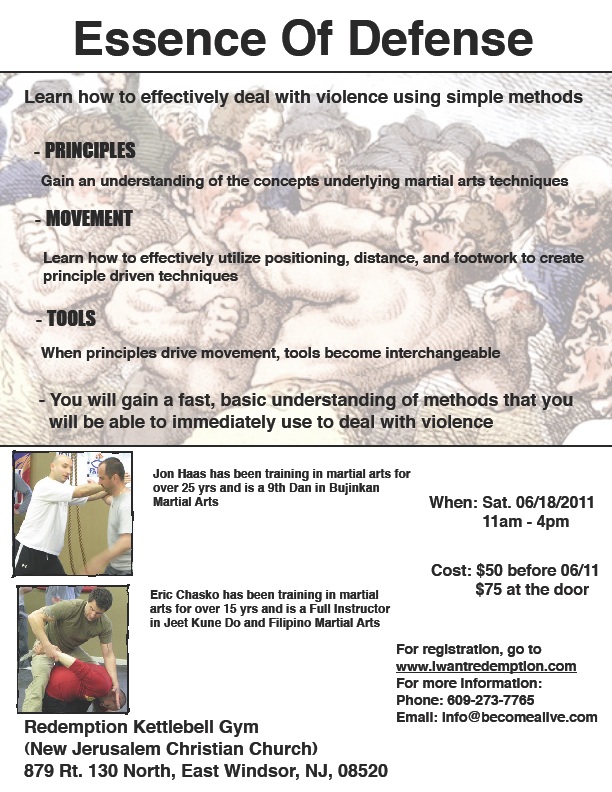
What is the Essence of Defense?

What exactly is the essence of defense?  Suppose you took a martial art(s) and stripped it down to its core principles and functional movements to allow it to be employable with any tool whether it be empty-hand, blunt weapon, edged weapon, long weapon, hidden weapon, or improvised weapon?  What you would have is a fast, effective, no-nonsense approach to communicate years of martial arts training in a short span of time.  This approach would make self defense methods immediately accessible to people who may not want, or have time, to devote decades to becoming effective at defending themselves.  Suppose you want to have the confidence and ability to protect yourself and your family from sudden violence, but don’t want the trappings of tradition and the hours of perfecting forms and kata?  What if the essence of defense could be extracted by 2 highly experienced martial arts practitioners, refined, distilled, and communicated not over years, but in the course of a seminar?

Principles:

  • Get off the line of attack
  • Counter-attack
  • Intercept/destroy the attack
  • Unbalance the opponent
  • Continuous movement
  • Escape
  • Much more….

Movement:

  • Positioning
  • Footwork – angles, distancing
  • Safe space
  • 3 dimensional movement
  • Much more…

Tools:

  • Body weapons
  • Blunt objects
  • Edged weapons
  • Improvised weapons
  • Hidden weapons
  • Much more…


Who should attend The Essence of Defense seminar?

  • Military
  • Law Enforcement Officers
  • Anyone who wants a working knowledge of practical martial arts principles that allows them to create their own techniques in response to a specific threat of violence. 

When:  Saturday, September 8th from 11 AM to 4 PM

Where: Redemption Kettlebell Gym in Robbinsville, NJ

Cost: $65

Who:  Eric Chasko is a fully licensed instructor in Jeet Kune Do/Filipino Martial Arts with over 15 years experience.  

Jon Haas is a 9th dan in Bujinkan Budo Taijutsu with over 30 years experience.

For more information and to sign up, please go to http://www.iwantredemption.com/

See you there!!

Battling Demons

To get good at any discipline, you must practice every day.  To become great, you must practice all the time.  The problem is, with so many pressures, responsibilities, and draws on our time in daily life, how does one manage to train every day?

For me, it’s a daily battle with my demons.  These are the insidious little creatures that lurk in the dark recesses of my mind.  Their sole purpose being to distract me from becoming the person I want to be.  They rationalize and cajole to pull me off the path of self improvement.  The path of training.  For others, the path may be their daily struggle to make good food choices and lose weight, or it may be the daily battle to study at night while working a full-time job in order to earn that MBA.  The path is personal.  The demons are universal.

Currently I train for a few minutes every morning which provides the dual function of waking me up and setting me on the right path for the day.  It primes my muscles, movements, and nervous system for the more involved training I will perform later that night.  Additionally, I will train during the day at odd intervals when I have a few minutes of down time.  These little periods provide the consistency I need to help me keep going.  But, as I stated above, the bulk of my training is done at night after putting the kids to bed.  Usually around 9 pm or so I head down the basement to my home gym.  This is my dedicated training spot.  For me, it helps to focus my efforts since the only thing I do there is train.  It’s minimalist with very few distractions.  Perfect for doing the work.  For the most part, I beat the demons by just getting downstairs and setting foot in the gym.  Getting there is the most difficult part, but once there, the demons are beat and the daily training progresses.

Sometimes, like last night, the battle isn’t won by just getting to the gym.  Last night was different.  I was tired.  I was comfortable sitting on the couch watching TV with my wife.  The kids were asleep.  The house was quiet.  Peaceful.  I thought that the demons hadn’t even shown up to fight because getting down there was so easy.  Once I was in the gym though, they attacked.  It was a sudden, violent onslaught that took me by surprise!  “You’re tired,” they told me. 

“You don’t need to train anymore today…”,

“You did enough over the weekend.  Relax.  Take it easy.”, 

“Why don’t you just go to bed early for a change?  You need your rest!”

On and on it went, not just verbal but real feelings of being sleepy.  Feeling like I should go upstairs and go to sleep.  I almost gave in.  Almost succumbed.  Almost quit.

But mental fortitude kicked in.  Training kicked in.  The battle was on!  I heard myself talking to one of my training buddies saying – “you have to train every day.  You have to want it bad enough.  How do I do it?  Well, it’s like brushing your teeth, Dude.  You just do it every day (usually twice!) no matter what.”  This began the rally.  But it was far from won.  What won the battle once and for all (at least for last night) was the fact that I just started doing my solo conditioning exercises.  I was in the right place.  My mindset was returning.  But the way to win the battle is to simply begin doing the work.  Understand that your training is a necessary part of becoming who you want to be.  Understand that daily training is a necessary part of that process.  And get it done.

Knowing is Not Enough!

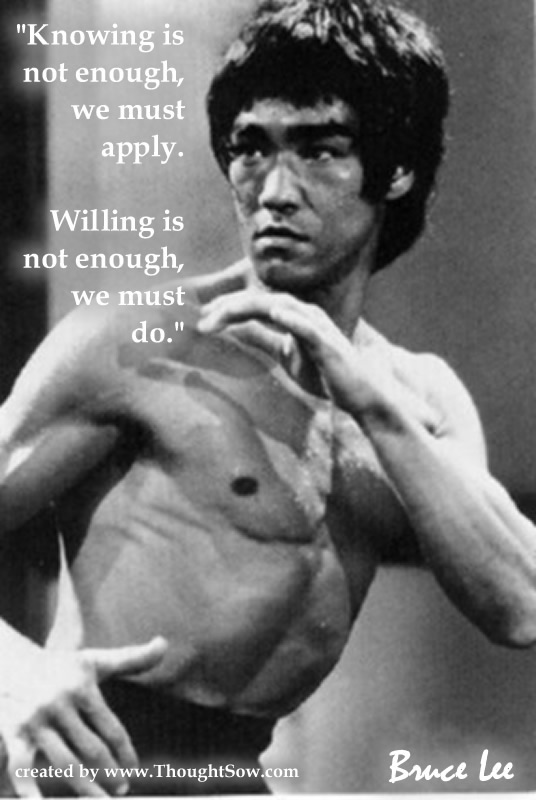
With the proliferation of the Internet and the incredible wealth of resources available in book, DVD, and digital formats, many of us already know more than enough to be martial arts masters!  Yep.  You heard me right – you know more than enough right now to be a master martial artist.  Cool, eh?  Heck, some of us even have more disposable information on budo history, lineage, techniques, kata, and principles at our fingertips than all of the past generations of Bujinkan Soke combined!  Think about that for a second.  Now, at this time in history, the sheer amount of knowledge in the form of information available to us is greater than at any other time, and it’s only going to continue.  Yet, with all of this knowledge, why aren’t we all amazingly skilled?  Why do the legendary feats of past budoka seem so remote and unachievable to us today?  Why are there so few with real skill among the millions of people practicing martial arts worldwide?  Because knowing is not enough, that’s why!  Hatsumi Sensei has emphatically stated on many occasions, that “budo is not an academic subject.”  Why then do we continue to view it as such?  There has only ever been one way to become as highly skilled at a craft as to be called a master.  “Knowing is not enough, we must apply.  Willing is not enough we must do.”    

Is Your Cup Already Full?

Another way we limit ourselves is by equating knowing with being able to do.  For example, when your teacher demonstrates a fundamental principle of movement for the hundredth, or maybe hundred thousandth time, do you smile smugly to yourself and think, “I know that already”?  Maybe you have.  I know I have.  I admit it.  But this type of attitude makes us lazy.  It lowers our skill level because it allows us to hold fast to the superficial without the hard work of plumbing the depths.  It lets us check those basic movement(s) or principles of movement off our mental list and move on to something more advanced; more worthy of our time (we may think)… big mistake.  If we were truly honest with ourselves, we’d be asking a different question.  The better, more appropriate question to be asking ourselves is -”how well can I do that?” or “How well do I truly understand those movement(s) bodily, not intellectually?”   This is hard though because most often the most authentic answer we can give ourselves is, not well enough.   Watch your teacher closely.  Look deeper.  Pay attention because there’s always more.  Be careful.  Practice.  Practice.  Practice!