
Ninja Walking

The following article is an excerpt from Warrior Fitness: Conditioning for Martial Arts…  Enjoy!

Proper walking is footwork training for budo. How we walk in day-to-day life is how we will walk (move) in combat. Efficiency in more complex movement begins with efficiency in simple movements. How can we expect to move with ease in the chaos of a combative environment when most of us have trouble walking with natural gait? Walking is a ubiquitous activity that many people simply take for granted. They move through the day without any awareness of the strain they place on their knees, hips, and lower backs by their poor movement patterns. Just a little awareness will do wonders for your balance, posture, and lightness of step. When Hatsumi Sensei first came to the U.S., of the things he noticed immediately was how heavy and inefficiently people walked. His comment was that most people walked “like Frankenstein”!

 Walking Exercises:

1. Stand in shizen no kamae (natural posture) and balance on one leg. Lift the other foot a few inches off the ground and then lower again in a slow, controlled manner using the flexing of the grounded leg to regulate the descent. Gently bounce a few times getting the feeling of how the grounded leg’s flexion and extension controls the lowering of the other foot. The balance on your leg should be such that you are able to lower the opposite foot to the ground in any direction and easily maintain kamae (balance). Switch legs and now balance on the other leg while lowering the foot.

2. Stand in shizen no kamae (natural posture). Use your right hip to lift the right foot off the ground. It will feel strange at first since this is not a very commonly used muscle action, but once you get used to it, it will become an efficient way of lifting the leg. With the right leg lifted, pull back with the right shoulder.  Notice how this has the effect of creating a slight torque in the spine and moves the right foot forward at the same time. Release the tension in the spine by placing the right foot down in a forward step. Feel how the release of tension propels the body forward and allow it to create the same lift from the hip and pulling back of the shoulder on the left side.

3. Combine the previous two exercises together and begin to walk.

 4.  Another idea to try when walking is to alternate periods of normal, regular breathing with holding your breath for duration when “full”, after an inhale, and when “empty”, after an exhale. Try inhaling for a count of 5 (steps or seconds), hold your breath for a count of 5, exhale for a count of 5, and finally, hold your breath empty for a count of 5 while walking. Repeat as long as you can continue the pace. Note that 5 is just an arbitrary number and can be raised or lowered to suit your own needs. This practice will help you to understand how your body can function during situations when you must suddenly hold your breath yet still continue to work. Another benefit of this exercise is that it also helps the body to process oxygen to brain, heart, and other working muscles more efficiently.

Don’t forget “light feet and soft knees” when walking!

A Case for Mini Workouts

These days everyone is short on time.  Most are content to allow the daily grind and family time to fill their days while lamenting about the fact that they have no time for working out.  The complaints are common and heard often.  But somehow these same people are able to find time to watch an hour or more of TV every night before going to bed.  Now, I’m not going to ask you to forego your Thursday night Lost episode in favor of hitting the gym for an hour, so don’t worry – just using the ability to watch TV as an example of “finding time”.  While it may be a stretch for many people to find 45 minutes to an hour each day for exercise or martial arts training, how about just finding 5 minutes?  Surely everyone can find a spare 5 minutes even a few times a day, right???

Recently, as my own daily grind has become busier and busier, I have been finding just how effective mini workouts can be to fill in the gaps in one’s training.  These types of workouts are often overlooked because their brevity.  How can one possibly get a complete workout in 5 minutes?!  Well, you can’t.  But that’s not the point.  The effects of mini workouts is cumulative.  In other words, they add up over time.  They are not meant to completely replace your regular training, they are meant to enhance it and compliment it.  They are an effective way to keep yourself on track and focused while short on time.  Remember, the goal of the mini workout is not to be too complicated or over-involved.  Make them short, sweet, and to the point!

Examples of Mini Workouts

Here are just a few ideas I’ve found that make ideal mini workouts:

  • 10 push-ups + 10 v-ups + 10 squats (repeat 3 x’s)
  • Finger tip push-ups (see how many you can do)
  • Tabata exercises (pick any one)
  • 5 Kettlebell Snatches (each side) + 5 Kettlebell Swings (each side) + 10 Hindu Push-ups (repeat 3 x’s)
  • Isometrics
  • Breathing exercises
  • Joint mobility work
  • Pull-ups (5-4-3-2-1 rep scheme)

Mini Workouts for Martial Arts

The mini workout should be an essential aspect of any martial artist’s training.  It is said that great martial artists are training all the time.  Well known and respected masters from Musashi to Tesshu to Ueshiba toHatsumi Soke have constantly extolled the importance of solo-training and dedicated practice.  While mini workouts do not form a complete picture of solo- training, they do play an important role.  In the future, I’ll be sharing a more extensive look at solo-training for martial arts, particularly for Bujinkan practitioners.  But for now, here’s a short list to get you started:

  • Ukemi practice – mix up rolls, change directions freely, roll over obstacles
  • San Shin no Kata
  • Solo flow drill – move continuously for 5 minutes. Flow from strikes to kicks to leaps to rolls, from kamae to kamae – be creative!
  • Kamae work in a mirror
  • Striking practice
  • Junan taiso (see above!)

Make sure to make time for mini workouts!

The “Incomplete” Kihon Happo DVD Review

Chuuto Hanpa Kihon Happo or, The “Incomplete” Kihon Happo, is a new DVD by Bujinkan instructor, Rob Renner.  Rob has been training in the Bujinkan since 1986 and living in Japan since 2005.  He trains with Hatsumi Soke and the Shihan, senior instructors, typically 5 to 6 days a week.

This DVD is, as Rob points out, not the “official” version of the foundational techniques of the Bujinkan, but rather a synthesis of each Japanese Shihans’ take on the techniques as studied and interpreted by Rob.

The DVD begins with Rob’s expanation of Hanmi, or “half-body” kamae.  This incomplete Ichimoni no Kamae has the hips at a 45 degree angle forward to facilitate structure, stability, and mobility instead of the traditionally taught kamae with the hips completely sideways while the head looks forward.  Not only is Rob teaching 1/2 kamae, but as each technique is analyzed, he shows how to utilize 1/2 the distance, and 1/2 the time as well to create more efficient, and effective, technique.

Each technique of the Kihon Happo is then presented, first as they are usually performed in Bujinkan Dojos worldwide, followed by a discussion of common problems and mistakes when done as shown.  Make sure to pay attention here as you may recognize some of your own mistakes.  This discussion alone is worth the price of the DVD! 

Rob then moves on to demonstrating and explaining how to use the principles of Bujinkan Taijutsu to effectively do the techniques.  Each section begins with a quick bulleted list of principles that will be taught for each technique.  This is an effective way to prepare the audience for the material to be reviewed in the section and also serves as an effective reminder as the same principles are presented, and added to, each time.  Throughout the principle-based discussions, Rob constantly stresses the importance of correct kamae by using hips, knees, feet, and shoulders in alignment to be able to control distance and move in any direction. 

In the Torite Goho section of Kihon Happo, Rob makes a very important distinction between translating kuzushi as “breaking balance” versus “breaking structure”.  When you break an opponent’s structure, he is still very much on balance, but simply can’t generate force in any meaningful way.  And, since his balance is not compromised, he still believes in his mind that he is okay.  Hmm… sounds like kyojitsu to me.  However, when breaking an opponent’s balance, his body will automatically endeavor to correct it and suddenly you’re in a fight.

Kihon Happo Techniques Taught on the DVD

Koshi Sanpo:

  • Ichimonji no Kata
  • Jumonji no Kata
  • Hicho no Kata

Torite Goho:

  • Omote Gyaku
  • Mushadori
  • Onikudaki
  • Ura Gyaku
  • Ganseki Nage / Musodori

In the final section of the DVD, Rob uses the Torite Goho to show examples of Hatsumi Sensei’s movement as it is today.  This is done by following all the principles espoused in the earlier parts of the DVD and through manipulation of the kukan and kyojitsu.  It’s a great way to wrap up, pull everything together, and show a progression of the material all at the same time.  This is a very well done DVD with tons of detailed instruction.  Highly recommended!

For more information, and to purchase the DVD, please see Rob Renner’s website, Bujinkan Zeropoint Dojo.

Breathing 101

I was planning to title this post, “Breathing for Dummies” after the famous how-to guides, but I realized most dummies aren’t interested in bettering their health, fitness, and extending longevity in their sports, martial arts, or activities.  Plus, I dislike the subtle insult of refering to my readers as “dummies”.  Nor would I want dummies for readers anyway.  So instead today we will go over Breathing 101.  These are what I consider to be the most effective ways to integrate breathing exercises into your daily training, and use them to increase lung capacity and efficiency of how your body processes oxygen.  We will look at several different exercises that will enable you to lower your heart rate, blood pressure, and stress levels, as well as to increase energy.

Breathing as a Bridge

You may not be aware that breathing is a bridge between our voluntary and autonomic nervous systems.  Meaning breath is plugged into both.  The autonomic system will keep you breathing continuously without your conscious control, or sometimes, without even your awareness of it going on.  But, you also have the power to override that control and decide at any moment to take a deep breath or hold your breath.  What does this mean to you though, right?  Well, here’s what it means, you have the power, at any time, to consciously choose to influence things like your heart rate and blood pressure which are not under your conscious control.  Now that’s fascinating to me!  Because breath is tied into both systems it can be used like a bridge to gain access to aspects of your body that you cannot directly control.  How do we do this?

Try This Experiment

Take your pulse.  Count beats for 10 seconds then multiply by 6.  If you’re sitting and relaxed, that number should be your resting heart rate.  Now, inhale as deeply as possible and hold your breath and tense your whole body for a few seconds.  Are you red in the face?  Take your pulse again.  What happened?  Your hear rate jumped up and your blood pressure spiked right along with it, right?  Now try exhaling for a count of 6, but don’t inhale yet.  Extend the pause before the inhale a little bit.  Feel more relaxed?  Check your pulse.  It should have dropped.  Pretty cool, eh?  And this is just the beginning.

The Exercises


Relaxing Breath (Square Breathing)

This is very similar to the experiment we did above.  The basic premise of our ability to influence the autonomic nervous system is that inhalation increases heart rate, which subsequently increase blood pressure, to a slight degree, while exhalation lowers heart rate and blood pressure to a slight degree.  During our normal cycle of breathing, these changes are too minute to register, or even notice.  But, by gradually lengthening our breath and extending the pause before inhaling and exhaling, we compound the effect.

  1. Begin by exhaling through the mouth for 5 seconds.
  2. Do not inhale.  Try to extend the breath pause for 5 seconds.
  3. Before tension begins to creep in, inhale for 5 seconds.
  4. Hold the breath on the inhale for 5 seconds.
  5. Repeat the cycle 10 times.
  6. As this becomes easier, and your capacity expands, try increasing the duration to 6, 7, 8 seconds.


Energizing Breath

In this breathing exercise we will utilize a protocol founded by yoga and improved upon by Russian sport science and martial art.  Here we will divide the breath into 3 levels: clavicular (upper level), intercostal (mid level), Diaphragmatic (lower level).  This exercise will focus only on the clavicular, or upper level.  I first learned this exercise, and several others including the next one below, about 10 years ago from my good friends Dave Rusin and Oleg Yakimovich who are ROSS Russian Martial Art instructors.  More information about ROSS can be found at their website here.  Check it out!

  1. Exhale through the mouth in a short, quick burst by compressing the upper chest.
  2. Do not actively inhale.  Allow the inhale to happen by relaxing the muscles in the chest.
  3. Repeat rapidly 20 to 40 times.
  4. Build up to where you can perform continuously for 60 seconds.
  5. If you become dizzy, stop and sit down!

Restoring Breath

Here again we will depend on Russian sport science and martial art for our technique.  This one is literally a life saver when doing high intensity anaerobic workouts!  It can be used in between exercises as well as in between sets, during the rest period, and at the end of the workout to normalize breathing and dramatically lower heart rate.

  1. Forcefully exhale as deeply as possible by rolling your shoulders forward, tilting the pelvis up, and contracting the core strongly.
  2. Pause before the inhale for a few seconds.
  3. As stated above, do not actively inhale.  Allow the breath to be sucked back in through the nose as your body returns to a natural standing posture. 
  4. Repeat for about 60 seconds, or as long as needed.

Try these out and let me know how they work for you.  Any questions, please feel free to contact me here.
So Ya Wanna Be a Ninja?

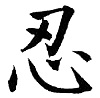
Masaaki Hatsumi, Grandmaster of the Bujinkan Dojo, once stated, “endurance is of primary importance for the ninja.”  One definition of endurance is the ability to resist fatigue.  Looking at the kanji (Chinese character) for Nin, there is the ideogram for “sword” over the ideogram for “heart” giving Nin a meaning of, “even though you hold a sword over my heart, I will endure.” 

How many of us training in the Bujinkan, or any other martial art, can truthfully claim that ability?  How long can you train?  How far can you push yourself?  In martial art, endurance, or the ability to “keep going” is defined in years, not minutes, hours, or days.  How can we create an effective training program that will instill in us the ability to continue, to endure?

Physical Endurance

Let’s begin by examining the concept of physical endurance.  There are 3 basic types of physical endurance:

  1. Aerobic endurance
  2. Anaerobic endurance
  3. Strength endurance

We discussed the body’s 3 energy systems and how using the Tabata Protocol can effectively improve both the aerobic and anaerobic systems here.  Strength endurance is defined as the ability to effectively maintain muscular functioning under work conditions of long duration.  There are two basic ways to increase the ability of your body to do more physical work.  One is the continuous adding of weights, sets, reps, and time to push the body to create an adaptation to allow it to perform more work for a longer duration.  As we discussed previously in the article on GPP, the body’s capacity is expanded.  Progress is incremental and continuous for as long as one is able to keep increasing driving forces in the body.  The next one, however, is often overlooked in our “just add more volume” culture.  More is always better, right?  If one vitamin is good for you, take 4, that’s even better (please dont’!).  But, there is another way to allow the body to continue training in addition (no pun intended) to adding more work.  By removing restrictions in your body, like unnecessary tension or extra body weight or lack of flexibility/mobility in a particular area, you then free up resources in your body that were spent holding that tension that you weren’t even aware of on a conscious level.  These restrictions, once removed, allow even greater leaps in performance than simply adding more work.  When the 2 are combined, it’s a powerful combination!

How Do We Program It?

By programming our workouts so that we effectively build in both the removal of restrictive forces, while also increasing driving forces, we can maximize our progress.  This idea is present in traditional methods of Hatha Yoga in the form of balancing strength and surrender.  Contrary to popular opinion, yogi’s do not simply work to become more flexible.  They actively work to increase both strength and flexibility as complimentary opposites in order to achieve a state of balance.  Now, I’m not asking you to become a yogi here, merely pointing out that this is not a new concept at all, but has been used by traditional arts for thousands of years.  Our program for developing ninja-like endurance will utilize both joint mobility exercises and yoga asana (poses), as well as breathing exercises, to aid in the removal of restrictive forces binding your training and slowing your progress.  Next week I will be putting out an article on breathing exercises that can be used for relaxation, stress management, removing residual tension, and also for increasing energy – keep your eyes out!

For an example of some easy yoga postures that can start helping you right now, head over to my good friend Josh Sager’s excellent blog, Fretterverse, and check out my article on Yoga for Guitarists.   A free sample joint mobility training program can be obtained simply by signing up for the Warrior Fitness Mailing List at the top right of the page.  Sign up now and begin working on removing restrictive forces today! 

And, don’t forget to check out Warrior Fitness: Conditioning for Martial Artists for more exercises, options, explanations, and program design!

Stay tuned for a sample Strength Endurance Workout coming soon!

Fitness Requirements for Bujinkan Martial Arts Training – part 2

In part one of this series, here, we discussed why it makes sense for Bujinkan practitioners, and indeed all martial artists, to include a fitness regimen as part of their training.  We also reviewed the basics of General Physical Preparedness (GPP), and why it is necessary.  Today, I’d like to talk about some specific examples of GPP type exercises and how to incorporate them into an overall training plan for both martial arts and fitness.  If you are attending classes and training on your own outside of class (highly recommended by the way), then you probably already have a pretty full schedule.  Add in a full-time job, spouse and kids to the mix and any extra time you may have dwindles down fairly quickly.  What is required is a way to obtain the benefits of this supplementary training without consuming more time you just don’t have.  Therefore, let’s make it easy and eliminate a few of the top time-consuming excuses right off the bat:

Time Saving Strategies


1.  No gym will be required.  Right here you save the time it takes to commute to and from the gym, waiting for equipment, and the general socializing chit-chat around the water cooler.

2.  Virtually no space required.  We can do these exercises anywhere from a park and backyard to a small apartment living room or hotel room.

3.  No equipment required.  We can begin training right now with only our bodyweight as resistance and obtain amazing results.  In future installments, I’ll show you how to add in portable equipment as I discuss here.

So, we have pretty much eliminated time constraints, space constraints, and financial constraints from the equation.  No more excuses!  Let’s get down to work!

Oh, did I forget to mention that this workout will be brief, but intense,  and help to build whole-body functional strength?  Another time management function brought to you by Warrior Fitness.  The only caveat I have is this – remember that GPP exercises are not sexy.  Yes, they will help you to look sexy, but the exercises themselves don’t get seriously cool until we move up to Specific Physical Preparedness and beyond.

Exercise One

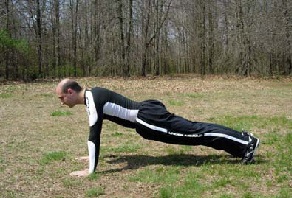
Push-ups.  Do them on your fists to strengthen the structural alignment for striking.  We will be incorporating the Dynamic Effort Method here, which is basically lifting a non-maximal load (your bodyweight) as fast as possible.  Begin in the top portion of the push-up.  Descend in a slow, controlled manner.  At the bottom portion of the exercise, explode upwards as fast as possible.  Try for 5 repetitions.  Rest 60 seconds, then move on to exercise two.

Exercise Two

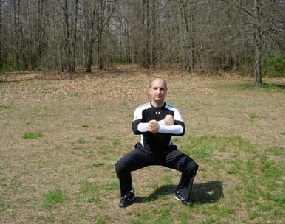
Bodyweight Squats.  Do them in Jumonji no Kamae, as shown below.  Utilize the same protocol as above.  Descend in a slow, controlled manner.  At the bottom of the squat, explode back to standing.  Try for 5 to 10 repetitions.  Rest for one minute, then move on to exercise three.  

Exercise Three

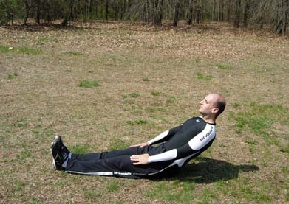
Straight Leg Sit-up.  Lie flat on your back.  Exhale, contract the core, and begin to sit up slowly keeping your spine straight.  Inhale at the top of the movement.  Exhale again and slowly lie back down.  Perform 5 repetitions of the straight leg sit-up.  Rest for 60 seconds and return to exercise one.  Continue until you have completed 5 sets of all 3 exercises.

How Often?

This workout can be performed 2-3 times a week, depending on your schedule and your fitness needs.  If you are including conditioning work as well, for an example see Warrior Fitness Workout of the Week #1, then this strength based GPP workout should only be done twice a week.  Here is an example of what a weekly schedule may look like:


Monday
  • Joint mobility warm-up
  • Class training
Tuesday
  • Joint mobility warm-up
  • GPP Strength Workout
Wednesday
  • Joint mobility warm-up
  • Class training
Thursday
  • Joint mobility warm-up
  • Warrior Fitness Conditioning Workout
Friday
  • Joint mobility warm-up
  • Yoga for compensatory movement


This is just one option of how fitness and marital arts can be combined in a weekly schedule.  If you have the luxury of being able to do a conditioning workout after your martial arts class instead of on a separate day, you can save more time.  Or, try getting up earlier and doing the workouts in the morning so your evenings are free for family time or more budo.

Future articles in the series will look at Specific Physical Preparedness, as well as Activity (martial art) Specific Exercises for Bujinkan training.  Additionally, I will expand on GPP, showing new exercises, and how to increase the difficulty levels of the exercises discussed today.

To receive a free PDF on joint mobility, sign up for the Warrior Fitness Mailing List on the top right side of this page.

To learn more about the Warrior Fitness training method, exercises, and programming options, check out Warrior Fitness: Conditioning for Martial Arts.


Warrior Fitness Recommended Equipment

A question I often receive through email (which, by the way is great, please keep them coming!) is whether or not Warrior Fitness is strictly a bodyweight training system.  In short, no it’s not, but let me expand on that.  Bodyweight training is an outstanding way to exercise.  It requires absolutely no equipment, no gym membership, a small amount of space, and can be done virtually anywhere.  It works equally well for the business traveler, the stay at home parent, or the vacationer.  In my opinion bodyweight training should be the foundation of your fitness program, especially if you are just starting out.  My rationale behind this is a simple one: if you cannot master your own bodyweight first, you really have no business adding weight.  Now, obviously there are exceptions to this rule.  For example, if you are being treated by a Physical Therapist and they recommend a weighted exercise to help your condition, then you must follow their advice.  Additionally, I said it should be the foundation of your program, but that doesn’t mean equipment cannot be added for variety, to increase the combined exercises effectiveness, or to shore up a particular strength or mobility deficit. 

With that out of the way, here is a short list of the equipment I do use for myself and with my clients and highly recommend.

The Equipment List


1.  Sandbags - Cheap and easy to make yourself.  Great for taking strength and conditioning outside the box.  Want to make one?  Get an army duffle bag, two 50 lb bags of sand from your local Home Dept, a box of gallon freezer bags, and some duct tape.  Fill the freezer bags with sand.  Double bag them, then duct tape them to make sure they are secure.  Place the duct-taped, sand filled freezer bags inside the duffel bag (make heavier or lighter depending on your preference), zip up the bag, secure it, and you’re good to go!

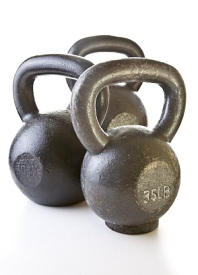
2.  Kettlebells - I got my first kettlebell from Dragondoor back in 2002 when they were the only supplier outside of Russia.  Nowadays kettlebells have gone mainstream and can be found at your local Walmart (along with pretty much anything and everything else!).

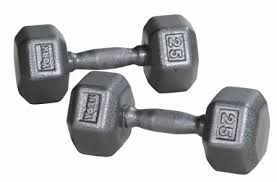
3.  Dumbbells - The cheaper kettlebell alternative, just not as cool looking.

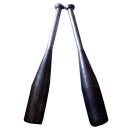
4. Clubbells - These are excellent for targeting angular and rotational strength, as well as sport or activity-specific performance enhancement.  They are currently only available through RMAX.

5.  Resistance Bands – Can be obtained from Elite Fitness Systems here

6.  Pull-up Bar – I made my own in the basement from a couple pieces of wood, some rope, and a metal bar, but there are also portable pull-up bars you can buy for under $40.  Here’s an example: EZ Chin Up Bar – Portable, Powerful, Personal and Effective Exercise Machine.  The other option is to train outside and use a sturdy tree branch.  This is an excellent alternative when the weather turns warmer!
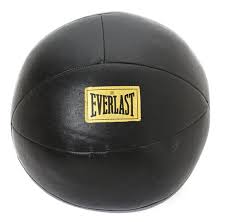
7. Medicine Balls – Can be found at Sports Authority,  or most other sporting good stores, for about $30.

8.  Sledge Hammer and Tire-  Hitting a tire with a sledge hammer is not only an incredible conditioning exercise, it’s also really fun and great stress relief!  Make sure you do this outside though!  Pick up a sledge hammer from your local Home Depot or Lowes.  I got mine for about $25.  Tires are usually free.  Stop by any Tire and Auto shop and ask them for a used tire.  Since they are disposing of them anyway, they are more than happy to allow you to take one.   

As you can see, each piece of equipment is portable, able to cover a wide array of exercises and levels of ability, and, with the exception of clubbells and kettlebells, are all inexpensive to make or buy.  Which one is best?  All of them and none of them, depending on the specific goals you set for your health and fitness.  They are all tools in the Warrior’s arsenal to be used as needed.  Stay tuned for more information as to how the Warrior Fitness Training System utilizes all of the above fitness equipment!

8 Ways to Fit in Your Fitness

It’s often been said that if you want something done you should give it to a busy person.  While this may be true of some busy people, namely the ones who are highly motivated, highly productive, and highly efficient, what about all the other busy people?  What about those who are busy through poor time management skills, or maybe those who are simply overwhelmed?  How about them?  Does the task they are given merely get thrown on top of a growing pile of “To-Do’s”, or even worse, shuffled to the bottom?  What if the task they are given, or give themselves, is directly related to increasing their quality of life and most likely longevity as well?  What if that task will help them be more productive at all their other tasks by reducing stress levels, increasing energy, and their overall sense of well being?  What if that task would help them to reduce, remove, or otherwise prevent a host of daily aches, pains, and illnesses that are stoically (or sometimes not so) suffered as things that “just happen” as we grow older? 

Here’s a list of 8 ways for these busy people to fit in their fitness and reclaim a healthy lifestyle.

1.  Plan it out.  Scheduling is the key to successful time management.  Look at your weekly calendar and plan to exercise just as you would plan an important client meeting, a lunch with an old friend, or coaching your kid’s Little League team.

2.  Exercise wherever you are.  Joint mobility sessions can be done at your desk – see here.

3.  Work in an office building?  Take the stairs instead of the elevator.  See how fast you can make it to your floor – beat those lazy suckers in the elevator to your floor!

4.  Have a lunch break?  Go outside and go for a walk.  10 minutes in the fresh air will do wonders for you.  Eat at your desk while you work and then go for a walk.  Want to make your walk more productive?  Try inhaling for 5 steps, holding you breath on the inhale for 5 steps, exhaling for 5 steps, then holding the breath after the exhale for 5 steps.  When you can comfortably do that for the entire duration of your walk, increase to 6, 8, 10 steps!

5.  Get up earlier and workout **warning – this one requires effort and commitment!!**

6.  Spend quality time with your kids.  Exercise together – see Warrior Fitness for Kids.

7.  Brief workouts.  Got a spare 15 minutes?  Bring the intensity and lose the long, boring workouts.  See the Warrior Fitness WOWs for some ideas.

8.  Isometrics.  These require very little time to be effective, need no equipment, and can be done literally anywhere.

Obviously, this list is neither exhaustive nor all inclusive,  but I do hope it has helped you and sparked some ideas to help you fit in your fitness no matter how busy you are.  What ideas do you have?

Jack Hoban on Fitness

The interviews conducted here at Warrior Fitness will highlight people who have significantly influenced my thinking and training on fitness, who are leaders in their particular fields of expertise, and whom I admire.  Jack Hoban happens to fit all three.  Through his unwavering commitment to martial arts and fitness, Jack has inspired me to keep going over the past 20 years down the dual path of martial arts and fitness.

 Jack Hoban is a former active duty U.S. Marine Corps Captain and long time practitioner of martial arts.  He is Shidoshi Senior Instructor in the Bujinkan Budo Taijutsu and Togakure Ryu Ninjutsu systems under Grand Master Masaaki Hatsumi in Japan and has authored three books on warriorship.  Mr. Hoban also holds an MBA and is an executive in the healthcare industry.    Jack’s full biography, and further information, can be found on his website here


1.  Can you please describe your current philosophy on physical fitness?

I have been serious about physical fitness for most of my life, first as an athlete in grammar school, high school and college, and then as a Marine, and martial artist.  That hasn’t changed, just become more refined and age-appropriate as the years have gone by.  Humans are physical beings and have been so for millions of years; I think we should acknowledge and honor that fact by maintaining a high level of physicality in our lives.  That’s my philosophy.  Until fairly recently, being physically fit, for most of us, was just a part of being human—and staying alive through hunting and gathering, farming, work, or other physical endeavors.  That has changed, and there is a greater risk of falling into a sedentary lifestyle today.  But our basic nature as physical animals has not changed.  We have to be careful not to stray too far from our nature, or certainly unhappiness and ill health may result.

2.  How has your outlook changed over the years?

It really hasn’t changed.  It has just become more refined.  I have tried some of the new fitness technologies—for example I run barefoot now using the new Vibram footwear.  I also think I use cross-training more effectively than in the past.  But I pretty much do the kinds of things I have always done.  I do have to worry more about “overdoing it,” because injuries take longer to heal.

3.  Do you have a daily fitness regimen that you follow?

Yes and no.  I have a range of things that I do, but it changes according to my schedule, the season, the weather and how I am feeling.

4.  Can you briefly tell us what it consists of?

Again, it is not a daily thing in that I don’t do the same thing every day.   But over the course of a week I typically fit in a few runs (45 minutes to an hour), I lift weights, I do a lot of core training, and I do various calisthenics.  In the winter I use the gym for the rowing machine, treadmill and elliptical.  In the summer I swim in the ocean almost every day.  I practice martial arts daily by myself, and have a class between 2 and 5 times a week.

5.  How do you think fitness and budo (martial arts) are related?

Inseparably, although martial artists might take care to explore a regimen that is complimentary to martial arts—one that increases strength and endurance, but also promotes flexibility and relaxation.

6.  How has your being in excellent physical condition enhanced your martial arts training?

Simple, it helps me to “keep going” longer and more consistently without being tired or sick.  And by the way, real fights are very physical—tiring and punishing. 

7.  How does your being in excellent physical condition help your work with the Marine Corps Martial Arts Program (MCMAP)?

When I first meet a new class of students, the unspoken question is “Is he one of us?  Can he do what we do?  If he can’t, why should we do what he does?”  That’s just the nature of young, competitive men.  Because I can pretty much keep up with them “for an old guy,” I gain a certain measure of respect.  That way, they are open to the other physical and ethical lessons I am there to share.

8.  Has the Marines Combat Conditioning program influenced your personal exercise program, and if so, how?

Yes, in at least two ways.  It has made me more aware of the value of cross training, and two, it has made me more creative in using training aides of opportunity.  By that I mean, you can design your own training regimens and make your own training apparatuses just by using your brain and common items and structures.  You don’t need fancy equipment; an old tire works just fine as an exercise apparatus.

9.  The last, but most important question, how do you keep going?

I enjoy it!  Find a method of physical exercise that you enjoy and pursue that.  Find other people who like it as well, and do it together.  That will help too.

Thanks Jack!

Warrior Fitness Book FAQs

1. Are the Warrior Fitness workouts applicable to beginners?

Absolutely! The workouts in the Warrior Fitness program are completely scalable based on your level of fitness.  Each exercise is explained step-by-step.

2. Is nutrition covered in the book?

Nutrition is an important aspect of a complete, healthy lifestyle, but is not discussed in the Warrior Fitness book. My own personal ideas about nutrition can be summed up fairly simply though. Eat lean proteins, lots of fruit and vegetables, and some complex carbohydrates. Eliminate or reduce white sugar, white rice, and white flour from your diet. Drink plenty of clean water and green tea.

3. Does the Warrior Fitness program teach Amatsu medicine , a traditional system of Japanese Natural Medicine taught by Hatsumi Soke?

No. I have not been taught any Amatsu medicine within the context of my Bujinkan training.

4. Is this program just Junan Taiso (basic stretching exercises used as warm-ups for martial arts practice)?

No. The Warrior Fitness book provides a comprehensive program consisting of joint mobility, flexibility, strength, conditioning, breath work, and recovery. Much more than simply junan taiso exercises.

5. Do I have to workout every day?

You do not need to do a full workout, but I highly recommend doing some movement everyday! Joint mobility work, combined with breathing exercises can take as little as 15 to 20 minutes in the morning. It’s a great way to start your day!

6. How much time do the Warrior Fitness strength and conditioning workouts require?

The workouts contained in the Warrior Fitness book are designed to be fast and effective. You can achieve a quality workout in 15 minutes, if you are short on time. Longer workouts can also be programmed, depending on how much time is available.

7. Do I need a gym membership for this program to work?

Definitely not! Warrior Fitness workouts are designed to be done anywhere with little to no equipment necessary.

8. How do I fit in working out and the skill training for my martial art?

Excellent question. This is where scheduling and time management skills come in handy. Time will not simply appear out of thin air. You must make time. However, the most important advice I can give on this topic is that if you do not have time for both skill work (martial art training) and conditioning, skill work must take the priority! You are training to be a martial artist after all.

9. Is this book applicable only for those training in the martial arts?

No. This book is certainly not just for people in the martial arts. The exercises and ideas contained within are applicable to anyone of any range of fitness and ability. Pick up a copy today and see for yourself!

Please feel free to email me here with any additional thoughts or questions concerning the book.