Ninja Walking

The following article is an excerpt from Warrior Fitness: Conditioning for Martial Arts…  Enjoy!
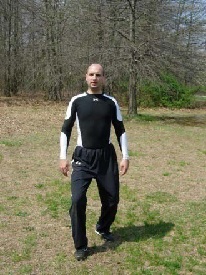
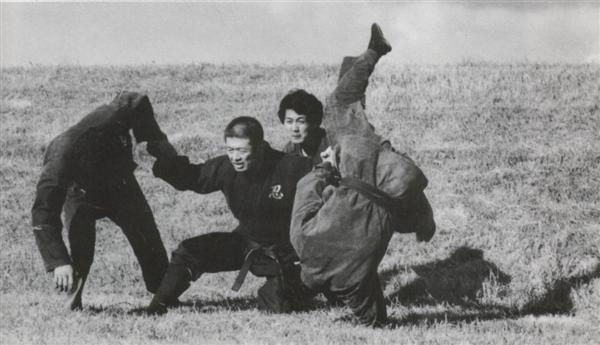
Proper walking is footwork training for budo. How we walk in day-to-day life is how we will walk (move) in combat. Efficiency in more complex movement begins with efficiency in simple movements. How can we expect to move with ease in the chaos of a combative environment when most of us have trouble walking with natural gait? Walking is a ubiquitous activity that many people simply take for granted. They move through the day without any awareness of the strain they place on their knees, hips, and lower backs by their poor movement patterns. Just a little awareness will do wonders for your balance, posture, and lightness of step. When Hatsumi Sensei first came to the U.S., of the things he noticed immediately was how heavy and inefficiently people walked. His comment was that most people walked “like Frankenstein”!

 Walking Exercises:

1. Stand in shizen no kamae (natural posture) and balance on one leg. Lift the other foot a few inches off the ground and then lower again in a slow, controlled manner using the flexing of the grounded leg to regulate the descent. Gently bounce a few times getting the feeling of how the grounded leg’s flexion and extension controls the lowering of the other foot. The balance on your leg should be such that you are able to lower the opposite foot to the ground in any direction and easily maintain kamae (balance). Switch legs and now balance on the other leg while lowering the foot.

2. Stand in shizen no kamae (natural posture). Use your right hip to lift the right foot off the ground. It will feel strange at first since this is not a very commonly used muscle action, but once you get used to it, it will become an efficient way of lifting the leg. With the right leg lifted, pull back with the right shoulder.  Notice how this has the effect of creating a slight torque in the spine and moves the right foot forward at the same time. Release the tension in the spine by placing the right foot down in a forward step. Feel how the release of tension propels the body forward and allow it to create the same lift from the hip and pulling back of the shoulder on the left side.

3. Combine the previous two exercises together and begin to walk.

 4.  Another idea to try when walking is to alternate periods of normal, regular breathing with holding your breath for duration when “full”, after an inhale, and when “empty”, after an exhale. Try inhaling for a count of 5 (steps or seconds), hold your breath for a count of 5, exhale for a count of 5, and finally, hold your breath empty for a count of 5 while walking. Repeat as long as you can continue the pace. Note that 5 is just an arbitrary number and can be raised or lowered to suit your own needs. This practice will help you to understand how your body can function during situations when you must suddenly hold your breath yet still continue to work. Another benefit of this exercise is that it also helps the body to process oxygen to brain, heart, and other working muscles more efficiently.

Don’t forget “light feet and soft knees” when walking!
Unlocking Flow in Your Taijutsu Practice

Here’s another one for all my Bujinkan Budo Taijutsu friends out there.

The following set of exercises is specifically designed to increase flow (nagare) in your taijutsu. However, before we get into the exercises themselves we should address the question, what is flow?

Flow is efficiency and continuity in movement. Flow is smoothness of movement that is unencumbered by mechanical, jerky actions. Moving at a faster pace and working harder, does not necessarily mean that the movement is flowing. In fact, if you are working harder, I can almost guarantee the movement is not flowing.


Get Out the Way – Move!

Flow is not something you do; it is something you get out of the way of!

What types of internal distractions, tensions, hitches in movement are preventing you from getting out of your own way?

The following flow exercises are culled from basic exercises of Bujinkan Budo Taijutsu, but can be utilized by anyone to expand your movement potential and increase flow.

When training these exercises, the idea is, of course, continuous movement. Begin with a slow and smooth protocol, working on keeping a good technique level and efficient transition between the movements. One discovers the key to developing flow by examining the in between stages of movement. Often, we see the kamae (structure) and then we see the roll, but what we miss is the essence of flow – the small, transitory movements between them.

Do not attempt to “accomplish” the exercise; that is not the point. Use it as a vehicle to unlock the flow in your movement. Try to keep moving. Don’t pause to think in the middle. Increase the speed as you begin to feel comfortable, but if the technique begins to get sloppy or the movements begin to look mechanical, drop down the intensity level until you are once again performing the flows with good technique. Remember, there is zero training value in simply trying to do the exercises for a “cardio” workout. Go buy a treadmill!

Chi No Kata

1. Step back from a natural posture into left leg forward Ichimonji No Kamae. Do Chi No Kata. From the end point of the kata, continue lowering your center of gravity and extend the right arm to effectively blend the transition from Chi No Kata into a front roll. Allow the momentum of the front roll to carry you to your feet, lifting up from the crown of your head and using your spine, into right Ichimonji No Kamae and, without stopping in the kamae, leap forward landing again in right Ichimonji No Kamae. Continue the movement by reaching forward with the left hand with a feeling of the body being pulled by the hand into left Ichimonji No Kamae. Repeat on the other side.

Sui No Kata

2. Step back from a natural posture into left Ichimonji No Kamae. Do Sui No Kata. From the omote shutou strike at the end of the kata, continue lowering the body with the weight on the front leg, simultaneously stepping through with the back leg to transition from the strike into a back roll. Allow the momentum of the back roll to carry you to your feet, lifting up from the crown of your head and using your spine, into right Ichimonji No Kamae and, without stopping in the kamae, leap backward landing again in right Ichimonji No Kamae. Repeat on the other side.

Ka No Kata

3. Step back from a natural posture into left Ichimonji No Kamae. Do Ka No Kata. From the ura shutou strike at the end of the kata, bring your left foot forward next to the right foot a little more than shoulder width apart to transition into Hira No Kamae. Without stopping in the kamae, lower your center of gravity and flow into a side roll to the right. Roll right back into Hira No Kamae and leap sideways to the right, landing again in Hira No Kamae. Repeat on the other side.

Fu No Kata

4. Step back from a natural posture into left Ichimonji No Kamae. Do Fu No Kata. Immediately transition to Hoko No Kamae and flow into a cartwheel. Land back in Hoko No Kamae and leap down into a kneeling Ichimonji No Kamae. Repeat on the other side.

Ku No Kata

5. Step back from a natural posture into left Ichimonji No Kamae. Do Ku No Kata. Immediately transition to a forward break-fall followed by a forward roll into Jumonji No Kamae. Leap directly upwards. Repeat on the other side.

Enjoy!

Flow drills from the book, Warrior Fitness: Conditioning for Martial Arts

WFBookcover3d

Ukemi Flow Conditioning Workout

This one is for all the martial artists out there –  I created the following ukemi conditioning workout for myself a few years ago to specifically target the transitions between my rolls and begin to unlock flow.  Additionally, it has the effect of really getting your heart pumping and makes a great workout!  Start out slowly and smoothly by practicing for the first few rounds.  Groove the movement and then begin to increase the speed.  Remember, you do yourself and your training a disservice if you rush through the movements simply to say you accomplished the workout.  Flow is not something you do, it’s something you allow – you have to be able to get out of your own way!  That being said, give this a try and let me know how it works for you.

Ukemi Flow

  1. Begin in Shizen No Kamae (natural stance), squat down to ball of foot squat
  2. Zenpo Kaiten (front roll) over the right shoulder
  3. Ushiro Kaiten (back roll)
  4. Stand up into Shizen No Kamae (natural stance), squat down to ball of foot squat
  5. Zenpo Kaiten (front roll) over the left shoulder
  6. Ushiro Kaiten (back roll)
  7. Stand up into Shizen No Kamae (natural stance)
  8. Yoko Nagare (side roll) with the leg crossing in front to the right
  9. Yoko Nagare (side roll) with the leg crossing in front to the left
  10. Stand up into Shizen No Kamae (natural stance)
  11. Zempo Ukemi (forward break fall)
  12. Stand up into Shizen No Kamae (natural stance)
  13. Yoko Nagare (side roll) with the leg crossing behind to the right
  14. Yoko Nagare (side roll) with the leg crossing behind to the left
  15. Stand up into Shizen No Kamae (natural stance) – repeat!

Start out with 4 rounds of 3 minutes each with a 1 minute break between rounds.  Use the minute break to get your breathing back under control and shake out the tension.  When this becomes easier, decrease the rest period to 30 seconds between rounds. Finally, try to perform the Ukemi Flow continuously for 12 minutes.  You can also adjust the difficulty level of the flow by adding directional leaps at the end of each roll.  Or, it can be made easier by performing it from kneeling in Seiza no Kamae instead of standing.

Notes: Make sure you warm-up with brief joint mobility session prior to the workout.

Got your own version of an ukemi-specific workout?  Please share with us in the comments section below!

A Day in the Life…

At the suggestion of my good friend, and West Coast Buyu, Dave Furukawa, I am presenting a look at one of my daily workouts.  Please see Dave’s comments on my previous post here for reference.

This is a record of my activity from yesterday, Memorial Day 2010:

Morning

Life begins early here, even on long holiday weekends, since our 19 month old, Juliana, doesn’t distinguish weekends from weekdays yet!  So at 6 am I was up making coffee and searching through her Elmo DVDs to find the particular episode she wanted that morning.  As the coffee was brewing I began working through my joint mobility routine in the kitchen.  Each joint from neck down to ankles and toes is rotated through its entire range of motion to flush the joints with synovial fluid and increase blood flow to the surrounding muscles.  This has the effect of lubricating the joints and removing the “rust”, as well as awakening the entire body.

As interest in her Elmo episode waned and Juliana wandered off to “read” her books and play with toys, I began working through San Shin no Kata, the Bujinkan basic movement exercises.  Each movement was practiced stationary, then walking forward and backward with emphasis on using the spine to generate power for the movements.

Mid-Afternoon

In the afternoon I took the kids to the playground.  My older daughter, Caitlin, rode her bike while I pushed the baby along in her little buggy.  As I walked each step was coordinated with breathing to work on breath capacity.  For example, inhale for 5-steps, hold on the inhale for 5-steps, exhale for 5-steps, then hold on the exhale for 5-steps.  This can be done continuously with the same pattern or you can alter the number of steps for each breath cycle up or down to make it easier or more challenging.  See my post entitled Breathing 101 for more breathing related exercises.  At the playground, in between pushing the kids on the swings and taking the little one down the slide, I used the monkey bars for random amounts of pull-ups and chin-ups.

Evening

Finally got the kids to bed around 8:30 and went down to the basement gym for my workout proper.  My current program is geared towards developing unarmed striking power and basic weapons work. 

  • Brief joint mobility warm-up
  • Suburi with Yari (spear) – 3 rounds of 10 thrusts from Seigan no Kamae, 10 thrusts from Jodan no Kamae, each side
  • Suburi with heavy bokken – 3 rounds of 10 cuts from Jodan no Kamae, advancing and retreating
  • Swipes with 15 lb clubbell – 3 sets of 10
  • Mills with 15 lb clubbell (think omote shuto type movement) – 3 sets of 10
  • Reverse Mills with 15 lb clubbell (think ura shuto type movement) – 3 sets of 10
  • Clean to Order with 25 lb clubbell – 3 sets of 5 each arm
  • Clean to Order with 45 lb clubbell – 1 set of 5 each arm
  • 5 minutes of various yoga asana to cool-down

This is just a quick glimpse into a much larger program that I am testing on myself for eventual release.  For more information on my previous programs, please check out my ebook, Warrior Fitness: Conditioning for Martial Arts.

A Case for Mini Workouts

These days everyone is short on time.  Most are content to allow the daily grind and family time to fill their days while lamenting about the fact that they have no time for working out.  The complaints are common and heard often.  But somehow these same people are able to find time to watch an hour or more of TV every night before going to bed.

Now, I’m not going to ask you to forego your Sunday night Walking Dead episode (I certainly won’t!) in favor of hitting the gym for an hour, so don’t worry – just using the ability to watch TV as an example of “finding time”.

While it may be a stretch for many people to find 45 minutes to an hour each day for exercise or martial arts training, how about just finding 5 minutes?  Surely everyone can find a spare 5 minutes even a few times a day, right???

Recently, as my own daily grind has become busier and busier, I have been finding just how effective mini workouts can be to fill in the gaps in one’s training.  These types of workouts are often overlooked because of their brevity.

After all, how can one possibly get a complete workout in 5 minutes?!  Well, you can’t.  But that’s not the point.  The effects of mini workouts are cumulative.  In other words, they add up over time (that’s what cumulative means… :).

They are not meant to completely replace your regular training, but are meant to enhance it and compliment it.

They are an effective way to keep yourself on track and focused when short on time, or if you have already completed a full workout and still want to get in some extra training – nothing wrong with that either!  Remember, the goal of the mini workout is not to be too complicated or over-involved.  Make them short, sweet, and to the point!

Examples of Mini Workouts

Here are just a few ideas I’ve found that make ideal mini workouts:

  • 10 push-ups + 10 v-ups + 10 squats (repeat 3-5 x’s)
  • Finger tip push-ups (see how many you can do)
  • Tabata exercises (pick one and go)
  • 5 Kettlebell Snatches (each side) + 5 Kettlebell Swings (each side) + 10 Hindu Push-ups (Perform AMRAP for 5 or 10 minutes)
  • Isometrics
  • Breathing exercises combined with bodyweight training
  • Joint mobility work
  • Pull-ups (5-4-3-2-1 rep scheme)
  • Burpees or Sprawls for 50 to 100 reps

Mini Workouts for Martial Arts

The mini workout should be an essential aspect of any martial artist’s training.  It is said that great martial artists are training all the time.  Well known and respected masters from Musashi to Tesshu to Ueshiba to Hatsumi Soke have constantly extolled the importance of solo-training and dedicated practice.

While mini workouts do not form a complete picture of solo- training, they do play an important role.  In the future, I’ll be sharing a more extensive look at solo-training for martial arts, particularly for Bujinkan practitioners.  But for now, here’s a short list to get you started:

  • Ukemi practice – mix up rolls, change directions freely, roll over obstacles
  • San Shin no Kata
  • Solo flow drill – move continuously for 5 minutes. Flow from strikes to kicks to leaps to rolls, from kamae to kamae – be creative!
  • Kamae work in a mirror
  • Striking practice
  • Junan taiso (see above!)

Make sure to make time for mini workouts!

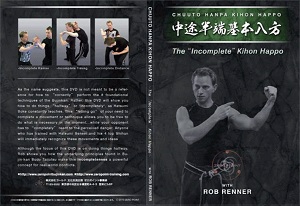
The “Incomplete” Kihon Happo DVD Review

Chuuto Hanpa Kihon Happo or, The “Incomplete” Kihon Happo, is a new DVD by Bujinkan instructor, Rob Renner.  Rob has been training in the Bujinkan since 1986 and living in Japan since 2005.  He trains with Hatsumi Soke and the Shihan, senior instructors, typically 5 to 6 days a week.

This DVD is, as Rob points out, not the “official” version of the foundational techniques of the Bujinkan, but rather a synthesis of each Japanese Shihans’ take on the techniques as studied and interpreted by Rob.

The DVD begins with Rob’s expanation of Hanmi, or “half-body” kamae.  This incomplete Ichimoni no Kamae has the hips at a 45 degree angle forward to facilitate structure, stability, and mobility instead of the traditionally taught kamae with the hips completely sideways while the head looks forward.  Not only is Rob teaching 1/2 kamae, but as each technique is analyzed, he shows how to utilize 1/2 the distance, and 1/2 the time as well to create more efficient, and effective, technique.

Each technique of the Kihon Happo is then presented, first as they are usually performed in Bujinkan Dojos worldwide, followed by a discussion of common problems and mistakes when done as shown.  Make sure to pay attention here as you may recognize some of your own mistakes.  This discussion alone is worth the price of the DVD! 

Rob then moves on to demonstrating and explaining how to use the principles of Bujinkan Taijutsu to effectively do the techniques.  Each section begins with a quick bulleted list of principles that will be taught for each technique.  This is an effective way to prepare the audience for the material to be reviewed in the section and also serves as an effective reminder as the same principles are presented, and added to, each time.  Throughout the principle-based discussions, Rob constantly stresses the importance of correct kamae by using hips, knees, feet, and shoulders in alignment to be able to control distance and move in any direction. 

In the Torite Goho section of Kihon Happo, Rob makes a very important distinction between translating kuzushi as “breaking balance” versus “breaking structure”.  When you break an opponent’s structure, he is still very much on balance, but simply can’t generate force in any meaningful way.  And, since his balance is not compromised, he still believes in his mind that he is okay.  Hmm… sounds like kyojitsu to me.  However, when breaking an opponent’s balance, his body will automatically endeavor to correct it and suddenly you’re in a fight.

Kihon Happo Techniques Taught on the DVD

Koshi Sanpo:

  • Ichimonji no Kata
  • Jumonji no Kata
  • Hicho no Kata

Torite Goho:

  • Omote Gyaku
  • Mushadori
  • Onikudaki
  • Ura Gyaku
  • Ganseki Nage / Musodori

In the final section of the DVD, Rob uses the Torite Goho to show examples of Hatsumi Sensei’s movement as it is today.  This is done by following all the principles espoused in the earlier parts of the DVD and through manipulation of the kukan and kyojitsu.  It’s a great way to wrap up, pull everything together, and show a progression of the material all at the same time.  This is a very well done DVD with tons of detailed instruction.  Highly recommended!

For more information, and to purchase the DVD, please see Rob Renner’s website, Bujinkan Zeropoint Dojo.

Basics Ain’t So Basic After All

As a teacher and student of Bujinkan Budo Taijutsu, I often hear the same question over and over again – how can I improve my skill?  What should I practice to get better?  Since I remember myself asking that question several times (probably several hundred times if you ask some people!) to my teacher and seniors in the art, I always take time to give a thoughtful and honest answer.  And, my answer to these sincere seekers is always the same  – practice the basics. 

Basic Does NOT Equal Simple 

I think maybe the term “basic” itself is a little misleading.  When someone says, basic, most of us immediately translate it in our minds to “simple”.  Nothing could be further from the truth for the basics of our martial art.  What I’d like us to do today for the purposes of our discussion is to suspend the judgement that basic = simple.  Instead, replace the word basic with foundational.  How do you continue to build upon a skill set indefinitely?  Well, the foundation must be strong.  It must be broad.  And, to keep going higher still, it must be deep.

Each January, every year, for the past 20 years I have been training in the Bujinakn, my teacher, Jack Hoban, spends the entire month with us reviewing nothing but the basics of our art.  This sets the tone for the year and helps to increase the capacity of the entire class to absorb the higher level lessons for that year.  Guess what?  Invariably, I learn something new each time Jack teaches.  Every year, just by practicing the basics… eh… excuse me… the foundational training of our system new ideas, new concepts are born as we go deeper into the details and application of the techniques.

Shu Ha Ri

In traditional Japanese arts, there’s a concept called Shu-Ha-Ri.  This is a method of progression, or more accurately, a cycle of progression, for learning any art.

Shu – “Protect” the form. 

Ha – “Break” the form

Ri – “Leave behind” the form

This process is a continuous cycle in our Bujinakn training.  In order to progress higher in the art, our base must be solid, so we protect the form.  In order to understand the art, we must begin to break the form.  In order to master the art, we must leave the form behind.  Yet, this is not a linear progression at all!  Working on the foundation is never a step backwards.  Think of it more as a ratcheting back to spring forward.  Want to surpass your current level?  Strengthen the foundation.

Think you know the basics?  Think again.

I will be sharing my interpretation and experience of the foundational skills of Bujinkan Budo Taijutsu here.  Please come and check it out!

How to Train for the Endurance of a Ninja

As promised, here is an example strength endurance workout to start you on the way to building ninja-like endurance.

We will work the upper body, core, and lower body for a complete, whole body workout.

The goal of this type of training is to improve the body’s general endurance capacity so as to increase our overall resistance to fatigue.  This will enable you to train longer, harder, and more frequently, as well as improving your ability to recover between training sessions and between exercises.

Instructions

Move from one exercise to the next with no rest between exercises.  Determine rest periods at the end of each set on your own.  If no rest is required then move back to the first exercise and begin again.  Strive to perform as many sets as possible in 20 minutes.

Upper Body:

  • Pull-ups – SM (submax)
  • Shuto Push-ups – 20
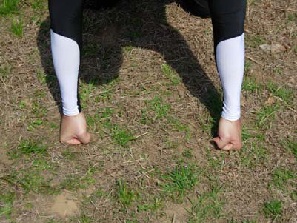
  • Fist Push-ups – 20
  • Hindu Push-ups – 20

Shuto Push-up


Core: 

  • V-ups – 20
  • Knee Hugs – 20

For reference, these exercises are illustrated and described here.

Legs:

  • Ichimonji Squats – 25 each side
  • Walking Lunges– 20 per leg
  • Mountain Climbers – 50 per leg

Finisher:  

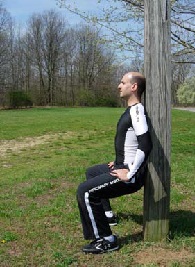
  • Wall Sit for time

This last exercise we will perform only once when the main work above is complete.  The idea here is to provide a final challenge to both the body and the mind.  You will already be exhausted from all the prior work, so consider this an exercise in willpower and mental toughness.  This will require the mental fortitude to push yourself just a little bit farther!

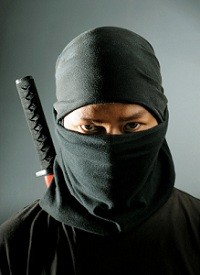
Remember, it requires more than a black costume and funny split-toe shoes to be a ninja – train hard!


Martial Power Cover1

Fitness Requirements for Bujinkan Martial Arts Training – part 2

In part one of this series, here, we discussed why it makes sense for Bujinkan practitioners, and indeed all martial artists, to include a fitness regimen as part of their training.

We also reviewed the basics of General Physical Preparedness (GPP), and why it is necessary.

Today, I’d like to talk about some specific examples of GPP type exercises and how to incorporate them into an overall training plan for both martial arts and fitness.

If you are attending classes and training on your own outside of dojo (highly recommended by the way), then you probably already have a pretty full schedule.  Add in a full-time job, spouse and kids to the mix and any extra time you may have dwindles down fairly quickly.  What is required is a way to obtain the benefits of this supplementary training without consuming more time you just don’t have. 

Therefore, let’s make it easy and eliminate a few of the top time-consuming excuses right off the bat:

Time Saving Strategies


1.  No gym will be required.  Right here you save the time it takes to commute to and from the gym, waiting for equipment, and the general socializing chit-chat around the water cooler.

2.  Virtually no space required.  We can do these exercises anywhere from a park and backyard to a small apartment living room or hotel room.

3.  No (or minimal) equipment required.  We can begin training right now with only our bodyweight as resistance and obtain amazing results.  Adding in portable equipment like clubs, sandbags, kettlebells and dumbbells will also add to the results!

So, we have pretty much eliminated time constraints, space constraints, and financial constraints from the equation.  No more excuses!  Let’s get down to work!

Oh, did I forget to mention that this workout will be brief, but intense,  and help to build whole-body functional strength?  Another time management function brought to you by Warrior Fitness.  The only caveat I have is this – remember that GPP exercises are not sexy.  Yes, they will help you to look sexy, but the exercises themselves don’t get seriously cool until we move up to Specific Physical Preparedness and beyond.

Exercise One

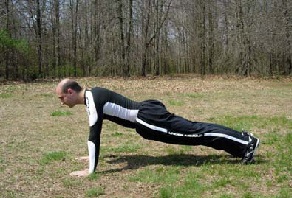
Push-ups.  Do them on your fists to strengthen the structural alignment for striking.  We will be incorporating the Dynamic Effort Method here, which is basically lifting a non-maximal load (your bodyweight) as fast as possible.  Begin in the top portion of the push-up.  Descend in a slow, controlled manner.  At the bottom portion of the exercise, explode upwards as fast as possible.  Do 10-25 repetitions.  Rest 60 seconds, then move on to exercise two.

Exercise Two

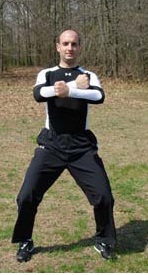
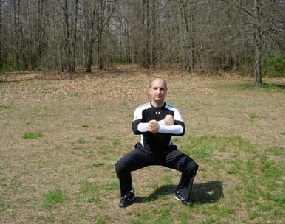
Bodyweight Squats.  Do them in Jumonji no Kamae, as shown below.  Utilize the same protocol as above.  Descend in a slow, controlled manner.  At the bottom of the squat, explode back to standing.  Do 25 repetitions.  Rest for one minute, then move on to exercise three.

Exercise Three

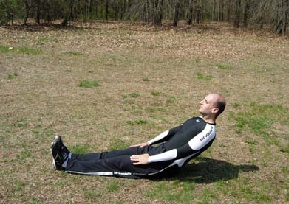
Straight Leg Sit-up.  Lie flat on your back.  Exhale, contract the core, and begin to sit up slowly keeping your spine straight.  Inhale at the top of the movement.  Exhale again and slowly lie back down.  Perform 5 repetitions of the straight leg sit-up.  Rest for 60 seconds and return to exercise one.  Continue until you have completed 5 sets of all 3 exercises.

How Often?

This workout can be performed 3 times a week, depending on your schedule and your fitness needs.  If you are including conditioning work as well, for an example see the WarFit Combat Conditioning System then this strength based GPP workout should only be done twice a week.  Here is an example of what a weekly schedule may look like:


Monday
  • Joint mobility warm-up
  • GPP Workout
  • Class training
Tuesday
  • Joint mobility warm-up
  • Solo Training
Wednesday
Thursday
  • Joint mobility warm-up
  • Solo Training
Friday
  • Joint mobility warm-up
  • WarFit Conditioning Workout
  • Yoga for compensatory movement


This is just one option of how fitness and marital arts can be combined in a weekly schedule.  If you have the luxury of being able to do a conditioning workout after your martial arts class instead of on a separate day, you can save more time.  Or, try getting up earlier and doing the workouts in the morning so your evenings are free for family time or more budo.

Future articles in the series will look at Specific Physical Preparedness, as well as Activity (martial art) Specific Exercises for Bujinkan training.  Additionally, I will expand on GPP, showing new exercises, and how to increase the difficulty levels of the exercises discussed today.

To learn more about the Warrior Fitness training method, exercises, and programming options, check out Warrior Fitness: Conditioning for Martial Arts.