Can Isometrics Really Burn Fat?

The Surprising Truth About One of the Most Underrated Fat-Loss Methods Ever Created

When most people think about burning fat, they imagine one thing: Cardio.

Running.
Cycling.
Rowing.
Jumping rope.

Or maybe they think of brutal HIIT workouts that leave them gasping for air and lying on the floor questioning their life choices.

But what if there was another way?

What if one of the oldest strength-training methods in existence could help you burn fat, build muscle, protect your joints, and improve your martial arts performance at the same time?

That’s where isometric training comes in.

And despite what many people believe, isometrics can be a surprisingly powerful fat-loss tool.

The key is understanding how they work.
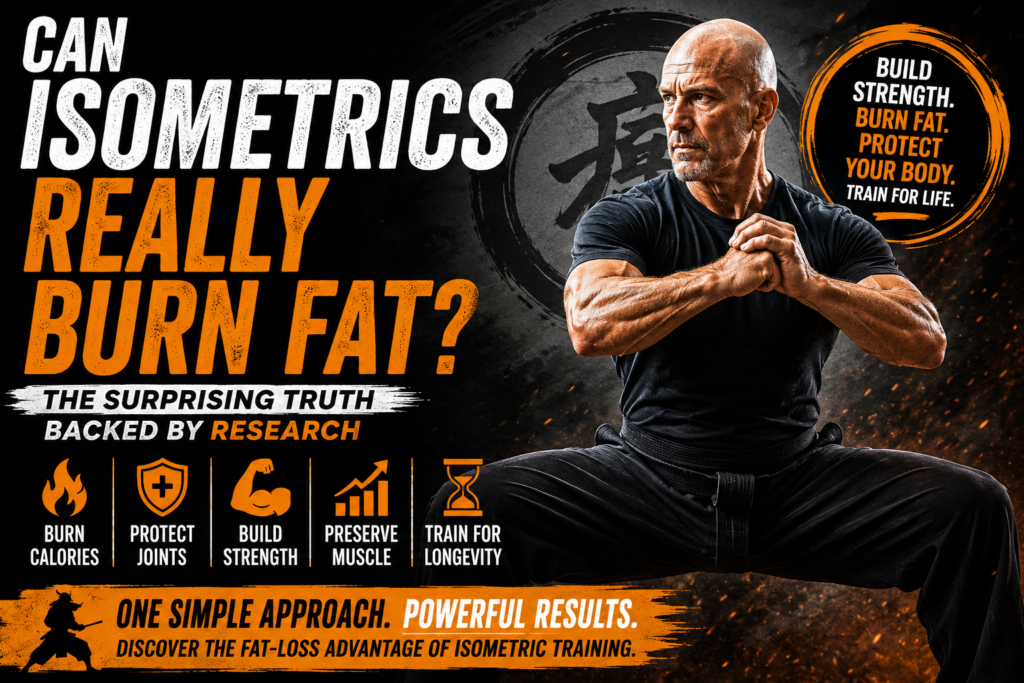

The Biggest Myth About Fat Loss

Many people assume that fat loss only happens during exercise.

That’s not true.

Fat loss occurs when your body uses more energy than it consumes over time.

Exercise contributes to that process, but what matters even more is what happens after the workout.

This is where isometrics become incredibly interesting.

Because unlike traditional cardio, isometrics can create a unique combination of:

  • High muscular tension
  • Increased metabolic demand
  • Greater muscle preservation
  • Elevated post-workout calorie burn
  • Improved insulin sensitivity

All of which support fat loss.


Why Isometrics Demand More Energy Than You Think

At first glance, an isometric exercise doesn’t seem very intense. After all, you’re not moving. But internally, your body is working incredibly hard.

When you hold a deep horse stance…

When you maintain a wall sit…

When you drive against an immovable object…

Thousands of muscle fibers are firing simultaneously. Your nervous system recruits additional motor units to maintain force production.

Blood flow becomes partially restricted.

Metabolic byproducts begin accumulating.

The body is forced to work harder and harder simply to maintain the position.

This creates a surprisingly large energy demand.

Research has consistently shown that isometric contractions increase heart rate, oxygen consumption, and metabolic activity.

In other words:

Just because you’re not moving doesn’t mean you’re not working.


Research: Isometrics Increase Metabolic Demand

Studies examining sustained isometric contractions have demonstrated significant increases in:

  • Heart rate
  • Oxygen consumption
  • Blood lactate levels
  • Energy expenditure

Researchers have found that high-intensity isometric contractions can produce cardiovascular responses similar to traditional exercise.

This is one reason why activities like:

  • Wall sits
  • Horse stance training
  • Plank variations
  • Isometric squat holds
  • Overcoming isometrics

Often leave practitioners sweating heavily despite never taking a single step.

The body perceives these exercises as hard work because they are hard work.

The tension is real.

And tension requires energy.


Muscle Is the Engine of Fat Loss

One of the biggest problems with traditional fat-loss programs is that they often sacrifice muscle.

People lose weight.

But they also lose strength.

They lose athleticism.

They lose power.

And eventually their metabolism slows down.

Isometric training helps solve this problem.

Numerous studies have demonstrated that isometric contractions can build strength and preserve muscle mass effectively.

Why does this matter?

Because muscle tissue is metabolically active.

The more muscle you maintain while dieting, the easier it becomes to burn fat and keep it off.

This is especially important for martial artists and men over 40.

As we age, muscle loss accelerates.

Every year that passes makes preserving strength more important.

Isometrics help you hold onto the very tissue that keeps your metabolism running strong.


The Afterburn Effect

One of the hidden benefits of hard isometric training is Excess Post-Exercise Oxygen Consumption (EPOC).

Often called the “afterburn effect.”

Following intense exercise, the body continues consuming oxygen and expending energy as it recovers.

This process can continue for hours.

The harder the muscular effort, the greater the recovery demand.

High-tension isometric training creates:

  • Nervous system fatigue
  • Muscular fatigue
  • Tissue adaptation demands

All of which require energy to recover from.

That means your body continues burning calories after the workout is over.


Why Isometrics Are Perfect for Older Warriors

Traditional fat-loss programs often create a frustrating cycle.

You want to lose weight.

So you do more cardio.

Your joints start hurting.

Your recovery suffers.

Your motivation drops.

Then you stop.

Isometrics offer a different path.

Because there is little or no impact.

No pounding.

No repetitive joint stress.

No endless miles of running.

Instead, you can create intense muscular effort while protecting the knees, hips, ankles, and spine.

For practitioners over 40, this can be a game changer.

You can continue training hard without accumulating the wear and tear that often comes with traditional conditioning methods.

Why Most Fat-Loss Programs Fail Martial Artists Over 40

At 25, you can get away with almost anything.

Miss sleep.

Train hard every day.

Run miles on concrete.

Push through nagging injuries.

Your body absorbs the punishment and somehow keeps moving forward.

But after 40, the rules change. Unfortunately, most fat-loss programs don’t. They still tell you to:

  • Run more.
  • Do more cardio.
  • Train harder.
  • Burn more calories.
  • Push through fatigue.

And for many martial artists, that’s exactly where things start falling apart. The knees begin aching. The hips get tight. The lower back stiffens. Recovery slows down. Training becomes inconsistent.

Then something even worse happens: You start losing the very qualities that made you a martial artist in the first place.

  • Strength.
  • Power.
  • Stability.
  • Balance.
  • Structure.

Instead of becoming leaner and stronger, you become lighter—but weaker. This is one of the biggest mistakes aging martial artists make. They chase weight loss while sacrificing performance.

But the goal isn’t simply to weigh less.

The goal is to build a body that can still move, fight, train, and perform.

A body that remains capable.

A body that remains resilient.

A body that remains powerful.

This is where isometric training shines.

Rather than breaking the body down through endless impact and repetitive motion, isometrics strengthen the very structures that tend to deteriorate with age:

  • Tendons
  • Ligaments
  • Stabilizer muscles
  • Postural chains
  • Connective tissue networks

At the same time, they help preserve muscle mass, maintain strength, improve joint integrity, and increase metabolic demand. In other words: You aren’t just burning calories. You’re rebuilding the foundation.

That’s why many practitioners discover something surprising after several months of consistent isometric training:

They not only look better…

They move better.

Their stances feel stronger.

Their balance improves.

Their joints hurt less.

Their techniques become more efficient.

And perhaps most importantly—

They begin feeling like martial artists again.

Not because they’re younger.

But because they’re finally training in a way that supports longevity instead of fighting against it.


The Martial Arts Advantage

This is where things get really interesting. Most forms of exercise burn calories. But not all forms of exercise improve martial performance. Isometric training does both.

The same tension that helps build strength and increase metabolic demand also develops:

  • Structural integrity
  • Rooting
  • Stability
  • Power transfer
  • Tendon strength
  • Body control

The exact qualities martial artists need.

A deep horse stance isn’t just burning calories.

It’s strengthening the legs.

Building posture.

Developing mental toughness.

Training alignment.

Improving fighting structure.

This means every minute of training serves multiple purposes.

You become leaner.

You become stronger.

You become harder to move.

And you become more dangerous.


The Secret Weapon: Overcoming Isometrics

If your goal is maximum fat loss and strength development, overcoming isometrics deserve special attention. These involve pushing or pulling against an immovable object with maximal effort.

Examples include:

  • Pulling against a fixed strap
  • Pushing against safety pins
  • Driving into a wall
  • Pressing against an immovable bar

The muscular recruitment during these efforts is enormous. Nearly every available motor unit is called into action. The result is a tremendous neurological and metabolic stimulus.

Few training methods provide more return on investment.

A 10-second maximal overcoming isometric can leave even experienced athletes breathing hard.


A Simple Fat-Burning Isometric Circuit

Try this:

  1. Horse Stance – 90 sec
  2. Low Push-Up Hold – 45 sec
  3. Lunge Hold – 45 sec/side
  4. Plank – 60 sec
  5. Rotational Isometric – 30 sec/side
  6. Overcoming Row – 20 sec
  7. Overcoming Press – 20 sec
  8. Dantien Breathing – 60 sec

Protocol: Rest 60 seconds. Repeat 3-5 rounds.

The entire workout takes less than 20 minutes. Yet most people will finish drenched in sweat.

More importantly – Your muscles, connective tissue, cardiovascular system, and nervous system will all have been challenged simultaneously.


The Real Secret: Consistency

Can isometrics burn fat?

Absolutely.

But the real magic happens when you practice them consistently.

Not once a week.

Not when you feel motivated.

Daily.

Even 10 minutes per day can produce remarkable results when performed consistently over months and years.

This is how warriors were built long before treadmills existed.

Through tension.

Discipline.

Structure.

And daily practice.


Final Thoughts

If you’re looking for a fat-loss method that also builds strength, protects your joints, enhances martial performance, and helps you stay powerful as you age, isometric training deserves a place in your routine.

The beauty of isometrics is that they don’t force you to choose between conditioning and strength.

You get both.

You don’t have to sacrifice your joints to burn fat.

You don’t have to spend hours doing cardio.

You simply learn how to generate tension correctly and apply it consistently.

That’s where real transformation begins.

Ready to Experience the Power of Isometric Training?

The truth is that most people only scratch the surface of what isometric training can do.

Inside The Isometric Warrior Training Guide, you’ll discover the complete system for using isometrics to build real-world strength, develop tendon power, improve martial performance, increase resilience, and create a body that grows stronger—not weaker—with age.

You’ll learn:

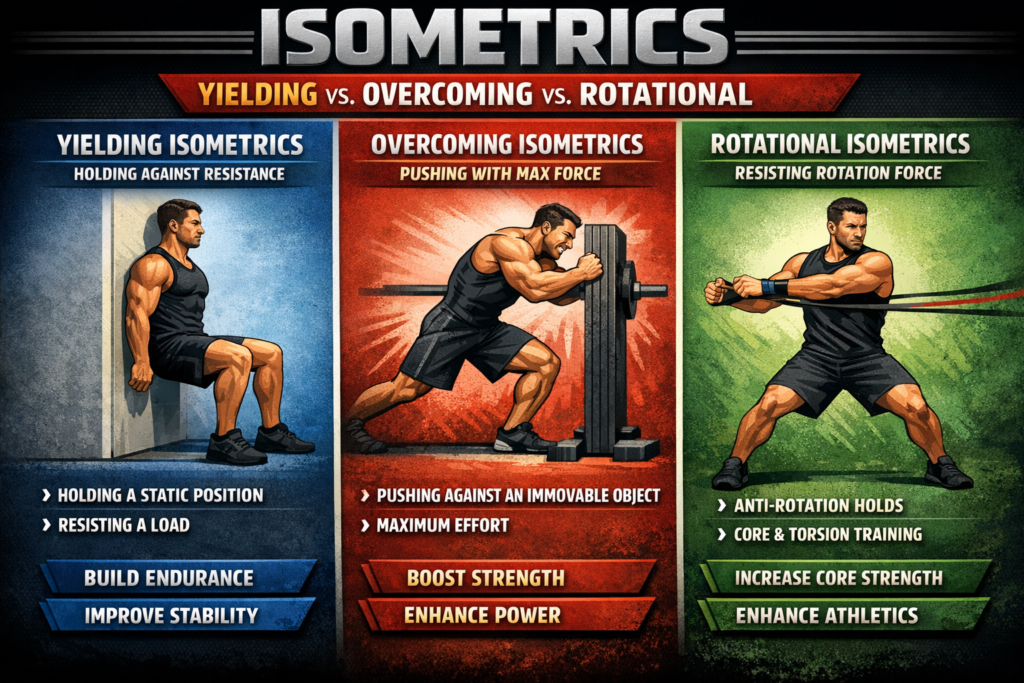
  • Yielding Isometrics
  • Overcoming Isometrics
  • Rotational Isometrics
  • Ancient martial applications
  • Fat-burning training protocols
  • Strength-building blueprints
  • Joint-friendly workouts for practitioners over 40

If you’re ready to unlock one of the most powerful—and misunderstood—training methods ever developed, The Isometric Warrior Training Guide is your next step.

Because the goal isn’t just to lose fat.

It’s to build a body that remains strong, capable, and dangerous for life.
The Complete Path to Lifelong Martial Strength

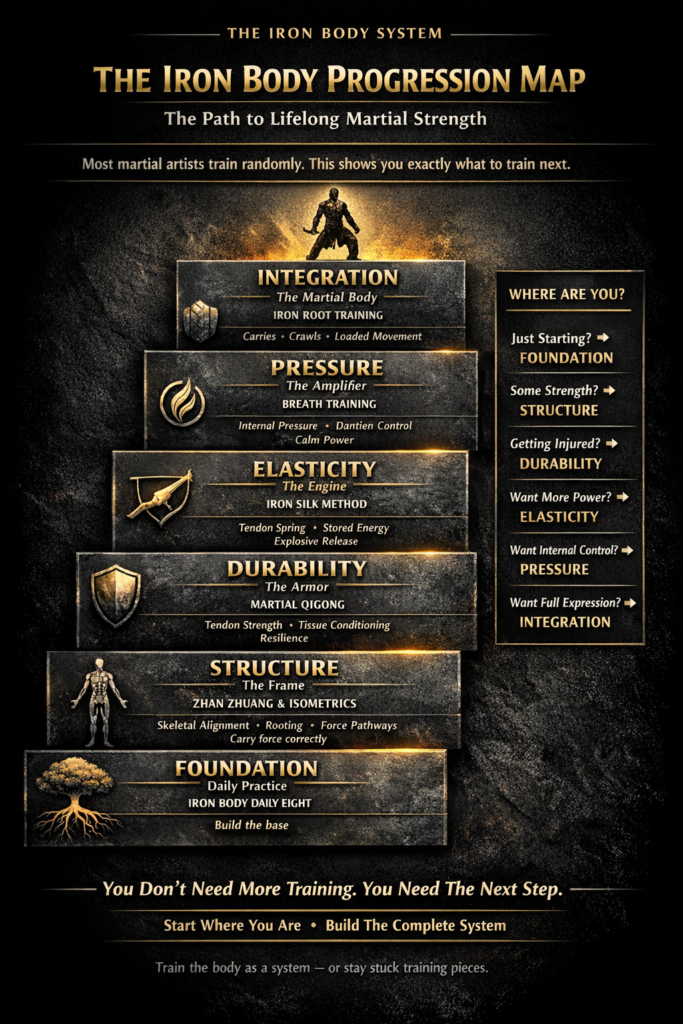
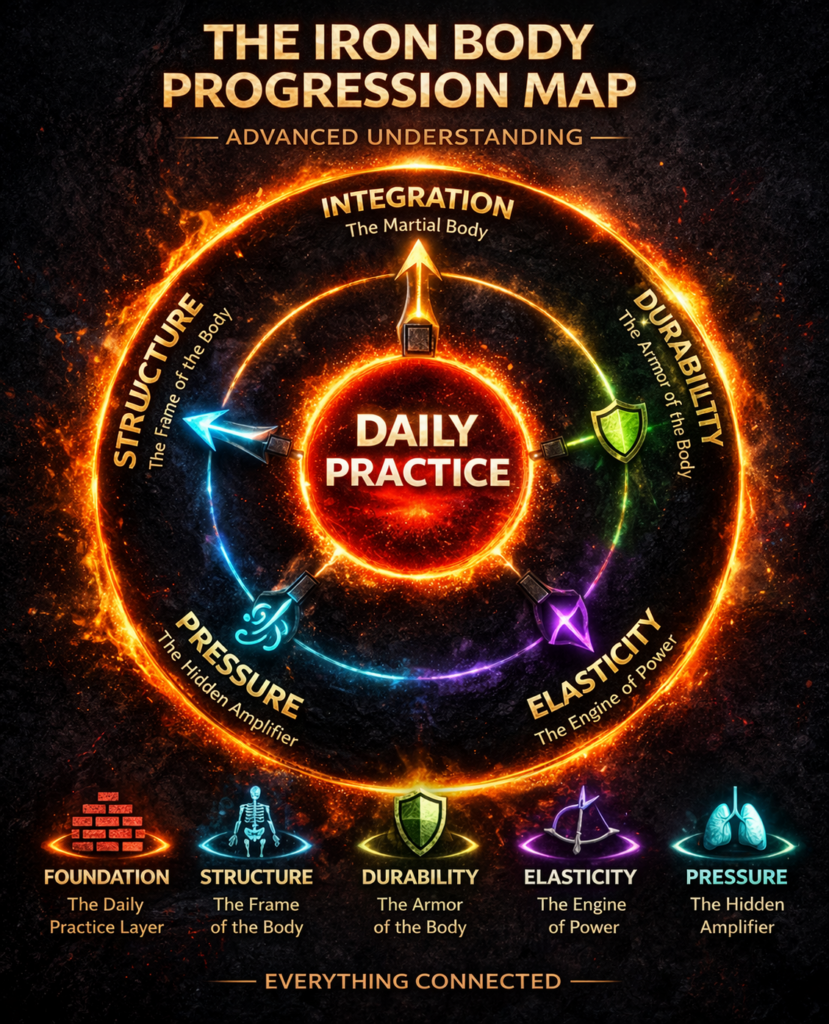
THE IRON BODY PROGRESSION MAP

The Complete Path to Lifelong Martial Strength


The Iron Body Is Not Built All At Once

It Is Built In Layers

There comes a moment in every serious martial artist’s life where something doesn’t quite add up anymore.

It doesn’t happen during training. In fact, during training, everything can feel fine. You’re moving, you’re sweating, you’re working. But afterward… when you sit down, when your body settles, that’s when you start to notice it.

Your understanding is deeper than it’s ever been. Your timing is better. Your awareness is sharper. You see things now that you never saw before.

And yet your body doesn’t respond the way it used to.

Your strikes require more effort. Your structure doesn’t feel as stable under pressure. Recovery takes longer than it should. And the most frustrating part is this—you’re still training. Maybe harder than ever.

So what’s the problem?

The truth is, you’re not losing skill.

You’re losing your ability to express it.

Your mind still understands exactly what to do, but your body no longer has the capacity to carry it out the way it once did. And this has nothing to do with age, effort, or discipline.

It has everything to do with how you’ve been training.


The Real Problem Is Fragmentation

Most martial artists train in pieces.

They build a little strength here, add some conditioning there, work their techniques, maybe sprinkle in mobility or flexibility work. On the surface, it looks complete. It feels like they’re covering all the bases.

But they’re not.

They’re training parts of the body… instead of training the body as a system.

Over time, this creates a kind of internal disconnect. Strength develops without structure. Durability improves without elasticity. Breath is trained, but never fully integrated into movement. And slowly, almost invisibly, the body starts to lose its cohesion.

Power begins to leak. Movement becomes stiff. Effort increases where it used to be effortless.

Because the body doesn’t function in isolated pieces. It functions as an interconnected whole.

This is what the old masters understood—deeply, physically, not just intellectually. They weren’t chasing strength or conditioning as separate qualities. They were developing the body itself. They were building a system.

That’s the idea behind the Iron Body.

And it’s the reason the Iron Body Progression Map exists.


A Map That Shows You What To Do Next

Most people don’t need more information.

They need direction.

They need to know where they are, what they’re missing, and what comes next.

The Iron Body Progression Map gives you that.

It’s not just a concept. It’s a structure you can follow. A way to rebuild your body layer by layer, so that everything begins to work together again instead of fighting against itself.

You can think of it as a ladder. Each step supports the one above it. Skip a step, and everything becomes unstable. Follow it in order, and something powerful begins to happen—the body starts to reconnect.


Foundation: Where Everything Begins

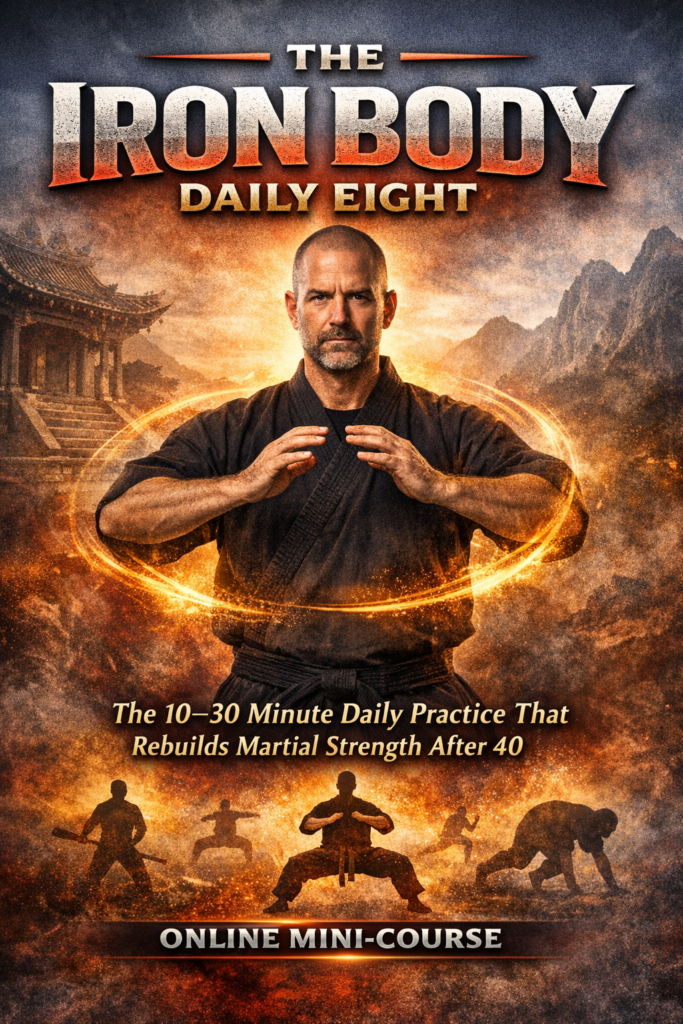
At the base of the system is daily practice. This is the Iron Body Daily Eight.

This is where most people go wrong, because it doesn’t look impressive. It’s not intense. It doesn’t leave you exhausted. But that’s exactly why it works.

This layer teaches you how to hold your body correctly. It develops alignment, awareness, and a kind of quiet control over your nervous system. Your posture improves. Your breathing begins to settle. You start to feel your body as a connected whole rather than a collection of parts.

Without this layer, everything else you do sits on unstable ground. No matter how strong or skilled you become, something always feels off. But once this foundation is in place, everything above it has something solid to build on.

👉 If you don’t already have a structured daily practice, this is exactly what the Iron Body Daily Eight Mini-Course was designed to give you—a simple, guided starting point you can implement immediately.


Structure: Building the Frame

Once the foundation is established, the next step is structure.

This is where practices like Zhan Zhuang and isometric training come in. Now you’re no longer just aware of your body—you’re organizing it. You’re learning how to stack the skeleton, how to root into the ground, and how to create clear pathways for force to travel through your body.

This changes everything.

Instead of feeling loose or disconnected, you begin to feel supported. Stable. Grounded. Your body starts to behave like a unified structure rather than a series of moving parts.

Most people try to generate power before they build structure. That’s why their power never holds up under pressure. Because without structure, force has nowhere to go. It collapses.

Structure is what allows power to exist in the first place.

👉 This is why foundational isometric work and standing training are emphasized so heavily inside the system—they’re not “extra work”… they are the work.


Durability: Strengthening the Tissue

With structure in place, the next layer is durability.

Now you begin strengthening the actual material of the body—the tendons, fascia, connective tissue, and even the bones. This is where Martial Qigong comes in.

At this stage, the body starts to feel different. Joints that used to ache begin to settle down. The constant sense of wear and tear starts to fade. You don’t just feel strong—you feel resilient.

There’s a density to your body now. A kind of quiet toughness that doesn’t rely on tension.

This is what allows you to train consistently over time without breaking down. It’s what separates someone who trains hard for a few years from someone who can train for decades.

👉 This is the layer most modern training completely ignores—which is exactly why systems like Martial Qigong become so important as you progress.


Elasticity: The True Source of Power

Once the body is structured and durable, something new becomes possible.

Now you can develop elasticity.

This is where real martial power begins to emerge.

Through methods like Yi Jin Jing and the Iron Silk Method, you train the tendons to behave like springs. Instead of forcing movement with muscular effort, you begin to store and release energy naturally.

This is where things start to feel almost surprising.

Strikes become heavier, but require less effort. Movement becomes lighter, but more effective. The body begins to generate power without you having to consciously push for it.

This is the difference between forcing power and having power.

👉 This is where the Iron Silk Method fits into the system—developing the kind of spring-like power most martial artists never access.


Pressure: The Hidden Amplifier

At this point, everything is in place—but it still needs to be connected internally.

That’s where breath comes in.

Breath is what ties the entire system together. It creates internal pressure. It stabilizes the body from the inside out. It allows force to move through the body in a way that is controlled, efficient, and calm.

Without breath, everything remains mechanical.

With breath, everything becomes alive.

You’re no longer just moving your body—you’re driving it from within.


Integration: The Martial Body

The final layer is integration.

This is where everything you’ve built is tested and expressed through real movement—carries, crawls, loaded patterns, and martial application.

This is where strength becomes usable. Where structure becomes dynamic. Where power becomes something you can apply under pressure without thinking about it.

This is what it means to have a martial body.

Not just strength. Not just technique.

But a body that can express both—effortlessly.


Why This Changes Everything

Once you understand this map, your entire approach to training shifts.

You stop asking random questions like, “What workout should I do today?”

And you start asking a much more important question:

“What layer am I missing?”

That question gives you direction. It removes confusion. It allows you to train with purpose instead of guessing.

And more importantly, it prevents you from wasting years developing one quality while neglecting the others.


Where Are You Right Now?

If you’re honest with yourself, you already know where you are.

Maybe you’re just starting and need to build a foundation. Maybe you’re strong, but unstable. Maybe your body feels worn down and needs durability. Or maybe you’re chasing power, but haven’t yet developed the elasticity that makes it effortless.

Where you are determines what you should train next.


The Final Truth

You don’t need more intensity.

You don’t need more random training.

You don’t need to push harder.

You need to train the right layer, at the right time, in the right order.

That is how the Iron Body is built.


Start Here

If you want to begin the process the right way, start with the foundation.

The Iron Body Daily Eight is where everything begins. It’s simple, but it’s not easy. It requires attention, consistency, and patience. But if you commit to it, it will change the way your body feels, moves, and performs.

From there, you build upward—structure, durability, elasticity, pressure, and finally integration.

And over time, something shifts.

You don’t just feel stronger.

You feel connected. Stable. Powerful.

Like your body is finally working the way it was meant to.

👉 The Iron Body Daily Eight is the entry point into this entire system.

– -Jon Haas, The Warrior Coach

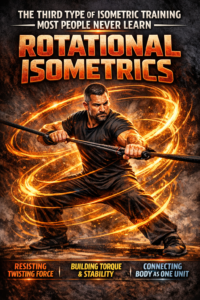
The Third Type of Isometric Training Most People Never Learn

The Third Type of Isometric Training Most People Never Learn (Rotational Isometrics)

Most people think isometric training means one thing:

Holding still.

Planks.
Wall sits.
Horse stance.

And if they go a little deeper, they might discover overcoming isometrics—pushing or pulling against an immovable object.

But there is a third type of isometric training that almost nobody talks about.

And it’s the one that most closely resembles real martial power.

It’s called:

Rotational Isometrics


Why Most Strength Training Falls Short

Most strength training is linear.

Up and down.
Push and pull.

Even most isometric training is linear:

You hold a position.
Or you push in one direction.

But martial arts are not linear.

Punches rotate.
Throws spiral.
Grappling involves torque, pressure, and redirection.

Power doesn’t move in straight lines.

It moves in curves, spirals, and angles.

And if your training doesn’t reflect that…

Your strength won’t transfer.


What Are Rotational Isometrics?

A rotational isometric is when you create tension by resisting rotation or producing force in opposing directions.

Instead of holding still…

You are actively creating twisting force inside the body.

Examples include:

• resisting a band pulling you into rotation
• twisting into a stance without moving
• creating opposing forces between upper and lower body
• diagonal push/pull tension patterns
• rotational squat holds
• Dragon Coil Holds

The key idea:

You are not just holding position.
You are organizing force through the body.


What Rotational Isometrics Train

This is where things get interesting.


1. Fascial Chains (Not Just Muscles)

Rotational tension travels through the body in diagonal patterns.

This activates:

• anterior/posterior sling systems
• cross-body fascial lines
• spiral tension chains

These are the exact pathways used in:

• punching
• throwing
• takedowns
• weapon work


2. Internal Connection

Rotational isometrics teach the body how to:

• connect upper and lower body
• transmit force across the torso
• maintain structure during movement

This is what many internal arts call:

“whole-body power”


3. Torque and Pressure

Linear strength pushes.

Rotational strength twists and compresses.

This is what creates:

• heavy hands
• crushing grappling pressure
• destabilization of opponents


4. Anti-Rotation Stability

Ironically, training rotation improves your ability to resist rotation.

This is critical for:

• defending takedowns
• maintaining base
• staying balanced under pressure


Why This Is the Missing Link

Here’s the problem:

Most people train:

✔ Yielding (structure)
✔ Overcoming (force)

But they skip:

❌ Direction of force

So their strength exists…

…but it doesn’t transfer cleanly into movement.

Rotational isometrics fix that.

They teach the body how to:

organize force through angles


The Martial Connection

If you look at traditional systems:

• Tai Chi → silk reeling
• Bagua → circular walking
• Xing Yi → directional force
• Jujutsu → kuzushi (off-balancing)

They are all based on:

rotation and redirection of force

Rotational isometrics are the modern bridge into that training.

They make those principles:

• measurable
• repeatable
• physically trainable


How I Use Rotational Isometrics

Inside my system, rotational work comes after structure is built.

Because without structure, rotation becomes collapse.

Here’s how it fits:

Step 1 — Yielding Isometrics

Build structure and endurance

Step 2 — Overcoming Isometrics

Build force and power

Step 3 — Rotational Isometrics

Organize and apply that power


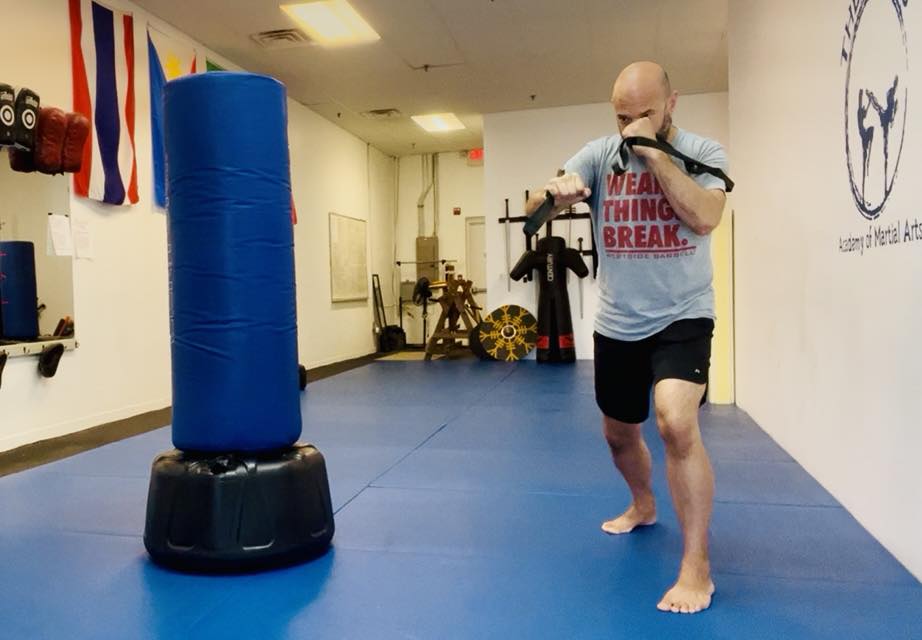
Example Drill — Diagonal Push/Pull

Set up:

• Attach a band or strap
• One hand pushes forward
• One hand pulls back
• Hips remain stable
• Spine tall

Hold for 30–45 seconds.

Focus on:

• creating tension through the torso
• breathing calmly
• feeling force travel from foot to hand

This is not a “hold.”

This is a force pattern.


Example Drill — Dragon Coil Hold

From a squat:

• rotate the torso
• maintain lower body alignment
• create opposing tension

This develops:

• spiral strength
• hip integration
• rotational power


Where Most People Go Wrong

They try to muscle the movement.

But rotational strength is not about squeezing harder.

It’s about:

• direction
• alignment
• connection

Too much tension kills the effect.

Correct tension distributes it.


How This Fits Into My Programs

If you’ve been following my work, you’ve already seen these layers.

The Isometric Warrior Training Guide

Builds structural foundation through yielding isometrics

👉 Learn more here


The 21-Day Isometric Forge

Introduces overcoming + diagonal tension

👉 (Free bonus program inside the private Isometric Warrior Brotherhood)


The Iron Silk Method

Fully integrates:

• tendon elasticity (Yi Jin Jing)
• rotational force
• breath-driven power

👉 Learn more here


Final Thought

Most people train strength.

Very few train how strength moves through the body.

That’s the difference between:

Looking strong…

and feeling powerful.

Rotational isometrics are the bridge.

Train them seriously, and your strength will begin to show up where it actually matters.


Jon Haas
The Warrior Coach

The Five Pillars of the Iron Body

How Martial Artists Build Lifelong Strength, Power, and Durability

There is a quiet truth that most martial artists eventually discover.

Technique alone is not enough.

You can know hundreds of techniques, understand strategy, and have decades of experience… but if the body itself is not developed correctly, that knowledge cannot be fully expressed.

The greatest martial artists throughout history understood something very important:

They didn’t just train techniques.

They trained the body itself.

They forged a body that was:

• elastic
• structurally aligned
• internally powerful
• externally durable
• and capable of integrating all these qualities into real movement

This type of body is what I like to call The Iron Body.

And over the decades, after studying internal martial arts, strength training, Qigong, and traditional conditioning methods, I’ve come to understand that the martial body develops through five essential pillars.


The Five Pillars of the Iron Body

Every powerful martial artist develops five core qualities:

  1. Elasticity

  2. Structure

  3. Pressure

  4. Durability

  5. Integration

When these pillars are trained together, the body becomes both powerful and resilient.

Let’s look at each one.


Pillar One: Elasticity

The Spring of the Body

Muscular strength is useful, but true martial power comes from something deeper.

The body must behave like a bow.

When tendons and connective tissue become elastic, they store energy during movement and release it explosively.

This is why skilled martial artists often appear relaxed yet generate tremendous force.

They are not relying on muscular tension.

They are using elastic power.

Training methods that develop elasticity include:

• Yi Jin Jing tendon training
• structural isometrics
• slow movement exercises
• controlled connective tissue loading

This is exactly the focus of my Iron Silk Method program.

Iron Silk is designed to restore the elastic connective tissue qualities that allow martial power to feel effortless.

When elasticity develops, many practitioners notice:

• strikes feel heavier
• movements become smoother
• the body feels springy instead of stiff

Elasticity is the engine of martial power.


Pillar Two: Structure

The Frame That Carries Force

Power does not come only from the muscles or tendons.

It must travel through the body.

Structure is what allows force to move efficiently through the skeleton into the ground.

When structure is correct:

• the body becomes stable
• pressure flows through the frame
• muscles remain relaxed

When structure collapses, power disappears.

This is why many internal martial arts emphasize standing practice.

Standing training teaches the body to align:

• feet
• hips
• spine
• shoulders
• head

When these elements are stacked correctly, the body becomes capable of carrying tremendous force without strain.

This is the focus of Zhan Zhuang training.

Zhan Zhuang develops:

• posture
• root
• internal connection
• relaxed strength

Over time, standing practice creates a body that feels heavy and stable under pressure.


Pillar Three: Pressure

Breath-Driven Internal Power

Breathing is far more than a relaxation tool.

In traditional martial arts, breath is used to create internal pressure.

This pressure stabilizes the body and fuels movement.

Practices that develop internal pressure include:

• dantien breathing
• whole-body breathing
• compression and expansion drills

When breath and structure work together, something powerful happens.

The body begins to move as one connected unit.

This type of breathing is a key component of both Iron Silk and Martial Qigong training.


Pillar Four: Durability

The Armor of the Body

Elasticity creates power.

Structure directs power.

Breath fuels power.

But the body must also be able to handle power.

That’s where durability comes in.

Durability refers to the strengthening of:

• bones
• tendons
• muscles
• skin
• connective tissue

Historically this was developed through hard Qigong training.

Practices included:

• static posture strength training
• tendon conditioning
• iron body methods
• breath-powered tension

This is exactly what is taught inside my Martial Qigong course.

Martial Qigong develops the external strength and durability that allows martial artists to remain strong and resilient as they age.

Without durability, elasticity becomes fragile.

With durability, the body becomes capable of absorbing and delivering force safely.


Pillar Five: Integration

Turning Training Into Martial Power

The final pillar is integration.

Integration is where everything comes together.

Elasticity, structure, breath, and durability must eventually become one coordinated system.

This is what allows martial artists to move naturally and generate power without thinking.

Integration is developed through:

• slow martial movement
• striking mechanics
• grappling pressure drills
• standing meditation

At this stage, the body begins to express power effortlessly.

Many practitioners describe this as:

• heavy hands
• relaxed strength
• effortless issuing

This is the stage where training becomes true martial skill.


The Foundation of Everything: Daily Practice

All five pillars rest on one essential foundation.

Daily practice.

The martial body is not built through occasional effort.

It is built through consistent, intelligent training over time.

Even short daily practice sessions can create profound changes in the body.

A simple daily structure might include:

Standing practice 
Iron Silk tendon training
Breathing exercises
Martial Qigong conditioning

Over weeks and months, these practices gradually transform the body.

This is how martial artists develop strength that lasts decades instead of years.


Bringing It All Together

When the five pillars are trained together, the body begins to change in remarkable ways.

Elastic connective tissue creates explosive power.

Structure carries force efficiently.

Breath generates internal pressure.

Durability protects the body.

Integration turns all of this into martial ability.

This is the essence of The Iron Body Protocol.

And it is exactly what my training programs are designed to develop.

Iron Silk Method builds elasticity and tendon power
Martial Qigong develops durability and external strength
Zhan Zhuang standing practice creates structure and internal connection

Together, they form a complete system for building a powerful, resilient martial body.


Train for the Long Path

Martial arts are not just about fighting.

They are about developing the body and mind over a lifetime.

When you train the five pillars consistently, the goal is simple:

To become stronger, healthier, and more capable every year.

Not weaker.

Not slower.

But better.

That is the path of the Iron Body.

Train with intent.

— Jon Haas
The Warrior Coach

The Paleolithic Origins of Standing Postures

The origins of standing practices are lost in the mists of time, but one can easily imagine that they began with ancient hunters as a way of attuning to their surroundings and gathering deep reserves of energy and strength while becoming invisible to the prey they hunted.


As they were used by hunters, warriors, and healers they began to be further refined, developed, and codified into the powerful practices we have today under the broad heading of zhan zhuang or standing meditation. 

The Paleolithic Posture


“In the Paleolithic Posture, the knees are slightly bent, the spine is straight and long, the breath is deep and quiet, the eyes are open and alert. The body feels like a tree standing with deep roots for balance and tall branches for grace… The Paleolithic Posture is an attitude of mind and body that was a matter of instinct and survival among ancient hunters, warriors, mothers, and healers.” 

– Honoring the Medicine by Kenneth “Bear Hawk” Cohen, M.A., M.S.Th.


I researched, studied, and practiced these postures for well over a decade plumbing their mysteries and making them accessible for anyone who wants to understand and experience the tremendous benefits for themselves.


You can apply all that I teach to your own health, strength, and energy here or here.


“In ancient times great masters stood on earth, supporting heaven, controlling yin and yang, breathing with essence of qi, standing alone, guarding spirit, with body being as one.”


The health preserving and sustaining effects of zhan zhuang have been documented in hospitals and medical clinics across China. The reason this practice has such a profound impact on health and recovery from exercise is that standing meditation acts like a system-wide reboot for the whole body. It stimulates the nervous system, increases circulation, and raises energy levels, while providing deep relaxation for both mind and body.


The Effective to Efficient Continuum of Training

What’s the difference between being effective in your training and becoming efficient?

When you first started to drive a car, you sucked at it, right? You couldn’t turn on the radio and the turn signal at the same time, and I’ll bet when you tried to wave at someone outside on the sidewalk, you turned the wheel in the same direction too. 

In short, you were a disaster.

Gradually, with practice, you got better and better at driving until you became effective. Meaning you could get yourself from point A to point B without crashing or otherwise screwing up.

Now, after years of driving you can effortlessly change lanes, check your mirrors, adjust the air conditioning, change the radio station, and carry on a conversation without even thinking about it. You slowly but surely moved from merely an effective driver (accomplishing the act of driving) to an efficient driver (accomplishing the act of driving with minimum effort AND maximum effectiveness).

Your martial arts training and your strength training are the same.

You cannot hope to progress beyond a basic level if you are just effective at your techniques or exercises. You must move across the continuum from effective to efficient. From mundane to master.

 How can we define efficiency?

Here’s the easiest definition – Efficiency = Useful Work / Total Work

 Look at any martial arts master at the top of his game. He is supremely effective (otherwise he wouldn’t be a master) BUT he’s also extremely efficient in his movement and energy expenditure. The master moves with grace under pressure, with strength and power refined and focused, and an effortlessness that defies belief. His mind and body perfectly integrated, he can do this all day. 

How do you progressively move from effective to efficient? 

Yes, it’s a matter of time and practice of course. But what else?

Throughout the ages, master martial artists have developed specific regimens of solo (and paired) training exercises to hack into the nervous systems software and update the code to bypass years of trial and error. This way they have laid out a clear path of progression for the savvy practitioner to follow step-by-step from effectiveness to efficiency to mastery.


Specific Training + Frequent Practice = Massive Results


What are the specific practices required?

That, my friends, is the subject of the next article… 🙂


“He Opened My Eyes to Budo…”

Way back in 2009 I started studying this weird, rarely talked about, even more rarely taught aspect of traditional martial arts called internal power.

To say it opened up my worldview when it came to martial arts training would be a huge understatement!
Now, to put it in perspective, I’d been training in martial arts since I was 10, and I’d trained with high level masters all over the world. But I was blown away by this stuff!!!

I’m reminded of what Ueshiba (the founder of Aikido) said of his Daito Ryu teacher, Sokaku Takeda who taught him these internal power exercises – “He opened my eyes to budo”

To me, this training is really the underlying essence of budo. It creates a powerful body for any martial artist, no matter the art. And it gives those who are in the know a tremendous advantage!!

What is Internal Power?

I think it’s best to start with the basics.  What is internal power and how can it useful to the practitioner of any and all martial arts or combat sports?  Let me state this at the outset to hopefully clear up a rather unfortunate misinterpretation of IP.

Internal Power is physical.

It’s not some mystical mumbo jumbo or a throwing chi balls type of nonsense.

It is actually a way of conditioning the body through specific solo training exercises and paired partner training. The training method spans thousands of years and has been handed down through the ages within the warrior traditions of India, China, and Japan.  It is a body technology with a set method and detailed process of instruction that simply cannot be learned by osmosis.  It must be explicitly taught.


The basis for the method is what is known as the union of opposites or In Yo Ho, in Japanese.

By creating opposing forces within the body (up/down, left/right, front/back) through the use of intent – your own mental direction using imagery, feeling, and visualization – we begin to increase the mind-body connection to a remarkable degree.

Through the solo training exercises we condition and strengthen the entire fascia network, as well as tendons and ligaments, throughout the body.  This process serves to create a connected body through the center so that when ‘one thing move, everything moves’.

How Can YOU Learn This?

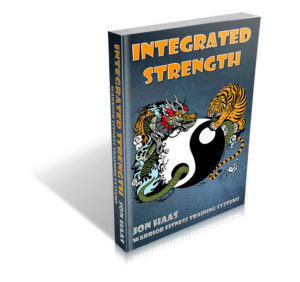
So when I had the opportunity, I put all my knowledge into a program called Integrated Strength back in 2015. This program lays the foundation of combining internal power with the warrior’s system of functional strength.

Thus in the Integrated Strength Program I have combined the two methods to create a fully integrated system of developing human strength potential.

This complete system of Internal Power Development AND Unusual Strength is presented to you for the FIRST TIME EVER inside the Integrated Strength Training Program.

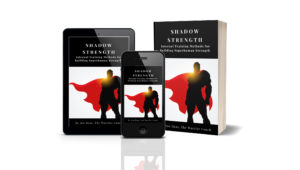
I refined and added to that body of knowledge in the next installment of internal power training called Shadow Strength in 2019.

Shadow Strength contains a unique set of exercises drawn from traditional martial arts designed to utilize breath, posture, and mobility to build superhuman levels of strength and resistance to injury.


And this year I released the newest program in my internal strength series called The Power Protocol which takes all of the training so far to the next level.

The goal of The Power Protocol program is singular in nature – to cut through the morass of myth and misinformation and give you a practical, proven, results-driven method for building real martial power no matter who you are, what martial art you study, or how you’ve been let down by unknowing or unscrupulous teachers in the past.

This program is your one-stop-shop for developing knock-down, drag out power for any martial art from the inside out and the outside in. After following this program, you will be stronger, tougher, more durable, flexible, and resistant to injury.

Not to mention the ability to hit like a truck out of nowhere and be almost impossible to take down, throw, or joint lock without your express compliance

These 3 programs contain the most powerful training I’ve released publicly to date.

Now you can save 50% on all 3 powerful programs here <<==

If you train in martial arts, you owe it to yourself to grab this package and get started – your training will NEVER be the same!

Train the Body, Everything will Follow

How do you get great at so many different facets of martial art at one time?
 
What one thing can you do to bring up your game across the board, no matter what are you practice?
 

Train the body.

 
Want to get better at grappling? Train the body
Want to get better at striking? Train the body
Want to get better at weapons work? Train the body
Want to become more powerful? Train the body
Want to become harder to throw? Train the body
 

Why does this work?

 
Your body is the delivery platform for every skill in martial arts. Thus, if you properly condition the body, you improve your ability to acquire higher and higher levels of skill across the board. Build a stronger foundation and the tower can go much higher.
 
Once you build a highly conditioned body for martial arts, all your other skills instantly become much easier to train.
 
Instead of focusing on all the many different skills, weapons, tactics, techniques, etc. in the martial arts, look at the one commonality between them all – YOU. To be more specific, your body.
 
If you put in the work at the level of conditioning the body, ALL your skills improve. You are focusing your energy on creating a body specific for budo. This type of training precedes all of your techniques. It builds a stronger, broader foundation so that any skill you choose to work on is automatically improved!
 
Over the past 30 years of training in martial arts, I have been privileged to cross-train in many different arts from Jujutsu to Karate to Russian Systema to BJJ and MMA to Krav Maga and Combatives to Internal Arts and weapons training. In each of these I was able to, not only hold my own, but develop a remarkable degree of skill in a very short amount of time – why?
 
 
Do you want to keep struggling to reach your full potential or do you want a specific, proven, step-by-step system to get you there?
 

Why Body Skills are Critical to Martial Arts

Body skills are the foundation of ALL martial and athletic movement.

In fact, in my mind, they are the foundation of all good, powerful, pain-free human movement!

What are body skills?

They are the qualities that connect, support, mobilize, and strengthen the body from the inside out. They create a highly resilient, dynamically stable body that underpins all other skill acquisition. In short, you want to get better at the specific skill sets within your martial art, quickly – train the body!

Learn how to develop high level body skills for martial art 

The Trinity of Training for Health and Strength

The ancients who created yoga, qigong, and various systems of martial arts knew a thing or 2 about training the body as a whole, integrated unit and not a series of disparate parts.

In fact the word yoga means “to yolk” or to unite together.

Each separate system that came down to us from the ancient world had one thing in common no matter where they originated…

They all utilized breath, posture, and movement to create a balanced healthy body, energetic, and free from pain.

When you combine exercises using all 3 modalities you get a powerful synergistic effect on health and strength that modern methods lack.

Learn exactly how to unite all 3 here =>

Shadow Strength utilizes a proprietary set of exercises drawn from traditional martial arts and trained in a unique combination to skyrocket your internal strength, power, and resistance to injury.

Using breath, posture, and martial mobility, Shadow Strength breaks down the barriers to superhuman strength and an unbreakable body.

Learn more here =>> http://warriorfitness.org/shadow/

21 Day Wuji Standing Meditation Challenge

21 Day Wuji Standing Meditation Challenge

Why Wuji?

The health preserving and sustaining effects of Wuji Standing have been documented in hospitals and medical clinics across China. 
The reason this practice has such a profound impact on health and recovery from exercise is that the standing meditation acts like a system-wide reboot for the whole body.

It stimulates the nervous system, increases circulation, and raises energy levels, while providing deep relaxation for both mind and body.

Aches, pains, old injuries, muscular tensions, and imbalances are highlighted and brought to the forefront by this method and then slowly dissolved over time and completely released.

The practice provides a way of completely relaxing and letting go of the muscular tensions in the body, while the correct alignment of the bones delivers support, creating a profound neutral and relaxed, almost buoyant state.

As the whole body and mind are exercised, both relax and stimulate the nervous system, increasing circulation, opening the joints, and raising energy levels for a feeling of overall well-being.

This exercise looks easy from the outside. After all, you’re just standing there and not moving. However, there is a lot going on inside: the breath and qi (energy) are moving.

This exercise is a challenging, sometimes frustrating, yet highly beneficial and rewarding practice. The only way to truly appreciate it is to experience it for yourself.

Wuji Standing Challenge Instructions

Learn More…

Shadow Strength utilizes a proprietary set of exercises drawn from traditional martial arts and trained in a unique combination to skyrocket your internal strength, power, and resistance to injury.

Using breath, posture, and martial mobility, Shadow Strength breaks down the barriers to superhuman strength and an unbreakable body.