Ukemi Flow Conditioning Workout

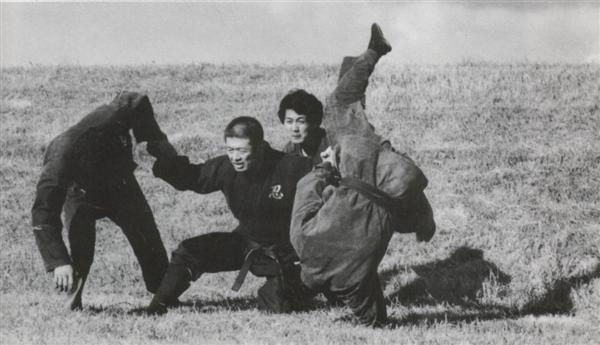
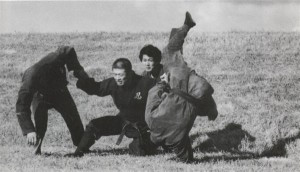
This one is for all the martial artists out there –  I created the following ukemi conditioning workout for myself a few years ago to specifically target the transitions between my rolls and begin to unlock flow.  Additionally, it has the effect of really getting your heart pumping and makes a great workout!  Start out slowly and smoothly by practicing for the first few rounds.  Groove the movement and then begin to increase the speed.  Remember, you do yourself and your training a disservice if you rush through the movements simply to say you accomplished the workout.  Flow is not something you do, it’s something you allow – you have to be able to get out of your own way!  That being said, give this a try and let me know how it works for you.

Ukemi Flow

  1. Begin in Shizen No Kamae (natural stance), squat down to ball of foot squat
  2. Zenpo Kaiten (front roll) over the right shoulder
  3. Ushiro Kaiten (back roll)
  4. Stand up into Shizen No Kamae (natural stance), squat down to ball of foot squat
  5. Zenpo Kaiten (front roll) over the left shoulder
  6. Ushiro Kaiten (back roll)
  7. Stand up into Shizen No Kamae (natural stance)
  8. Yoko Nagare (side roll) with the leg crossing in front to the right
  9. Yoko Nagare (side roll) with the leg crossing in front to the left
  10. Stand up into Shizen No Kamae (natural stance)
  11. Zempo Ukemi (forward break fall)
  12. Stand up into Shizen No Kamae (natural stance)
  13. Yoko Nagare (side roll) with the leg crossing behind to the right
  14. Yoko Nagare (side roll) with the leg crossing behind to the left
  15. Stand up into Shizen No Kamae (natural stance) – repeat!

Start out with 4 rounds of 3 minutes each with a 1 minute break between rounds.  Use the minute break to get your breathing back under control and shake out the tension.  When this becomes easier, decrease the rest period to 30 seconds between rounds. Finally, try to perform the Ukemi Flow continuously for 12 minutes.  You can also adjust the difficulty level of the flow by adding directional leaps at the end of each roll.  Or, it can be made easier by performing it from kneeling in Seiza no Kamae instead of standing.

Notes: Make sure you warm-up with brief joint mobility session prior to the workout.

Got your own version of an ukemi-specific workout?  Please share with us in the comments section below!

A Case for Mini Workouts

These days everyone is short on time.  Most are content to allow the daily grind and family time to fill their days while lamenting about the fact that they have no time for working out.  The complaints are common and heard often.  But somehow these same people are able to find time to watch an hour or more of TV every night before going to bed.

Now, I’m not going to ask you to forego your Sunday night Walking Dead episode (I certainly won’t!) in favor of hitting the gym for an hour, so don’t worry – just using the ability to watch TV as an example of “finding time”.

While it may be a stretch for many people to find 45 minutes to an hour each day for exercise or martial arts training, how about just finding 5 minutes?  Surely everyone can find a spare 5 minutes even a few times a day, right???

Recently, as my own daily grind has become busier and busier, I have been finding just how effective mini workouts can be to fill in the gaps in one’s training.  These types of workouts are often overlooked because of their brevity.

After all, how can one possibly get a complete workout in 5 minutes?!  Well, you can’t.  But that’s not the point.  The effects of mini workouts are cumulative.  In other words, they add up over time (that’s what cumulative means… :).

They are not meant to completely replace your regular training, but are meant to enhance it and compliment it.

They are an effective way to keep yourself on track and focused when short on time, or if you have already completed a full workout and still want to get in some extra training – nothing wrong with that either!  Remember, the goal of the mini workout is not to be too complicated or over-involved.  Make them short, sweet, and to the point!

Examples of Mini Workouts

Here are just a few ideas I’ve found that make ideal mini workouts:

  • 10 push-ups + 10 v-ups + 10 squats (repeat 3-5 x’s)
  • Finger tip push-ups (see how many you can do)
  • Tabata exercises (pick one and go)
  • 5 Kettlebell Snatches (each side) + 5 Kettlebell Swings (each side) + 10 Hindu Push-ups (Perform AMRAP for 5 or 10 minutes)
  • Isometrics
  • Breathing exercises combined with bodyweight training
  • Joint mobility work
  • Pull-ups (5-4-3-2-1 rep scheme)
  • Burpees or Sprawls for 50 to 100 reps

Mini Workouts for Martial Arts

The mini workout should be an essential aspect of any martial artist’s training.  It is said that great martial artists are training all the time.  Well known and respected masters from Musashi to Tesshu to Ueshiba to Hatsumi Soke have constantly extolled the importance of solo-training and dedicated practice.

While mini workouts do not form a complete picture of solo- training, they do play an important role.  In the future, I’ll be sharing a more extensive look at solo-training for martial arts, particularly for Bujinkan practitioners.  But for now, here’s a short list to get you started:

  • Ukemi practice – mix up rolls, change directions freely, roll over obstacles
  • San Shin no Kata
  • Solo flow drill – move continuously for 5 minutes. Flow from strikes to kicks to leaps to rolls, from kamae to kamae – be creative!
  • Kamae work in a mirror
  • Striking practice
  • Junan taiso (see above!)

Make sure to make time for mini workouts!

How to Train for the Endurance of a Ninja

As promised, here is an example strength endurance workout to start you on the way to building ninja-like endurance.

We will work the upper body, core, and lower body for a complete, whole body workout.

The goal of this type of training is to improve the body’s general endurance capacity so as to increase our overall resistance to fatigue.  This will enable you to train longer, harder, and more frequently, as well as improving your ability to recover between training sessions and between exercises.

Instructions

Move from one exercise to the next with no rest between exercises.  Determine rest periods at the end of each set on your own.  If no rest is required then move back to the first exercise and begin again.  Strive to perform as many sets as possible in 20 minutes.

Upper Body:

  • Pull-ups – SM (submax)
  • Shuto Push-ups – 20
  • Fist Push-ups – 20
  • Hindu Push-ups – 20

Shuto Push-up


Core: 

  • V-ups – 20
  • Knee Hugs – 20

For reference, these exercises are illustrated and described here.

Legs:

  • Ichimonji Squats – 25 each side
  • Walking Lunges– 20 per leg
  • Mountain Climbers – 50 per leg

Finisher:  

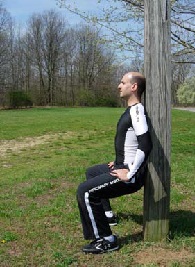
  • Wall Sit for time

This last exercise we will perform only once when the main work above is complete.  The idea here is to provide a final challenge to both the body and the mind.  You will already be exhausted from all the prior work, so consider this an exercise in willpower and mental toughness.  This will require the mental fortitude to push yourself just a little bit farther!

Remember, it requires more than a black costume and funny split-toe shoes to be a ninja – train hard!


Martial Power Cover1

What’s Tabata You?

If you have been keeping up with the latest trends in conditioning research then you probably already know that interval training is the most efficient way to train.  Interval training alternates periods of high intensity exercise with periods of rest to produce gains in both aerobic and anaerobic systems.  Forget about those long slow distance runs to improve aerobic fitness!

The Body’s 3 Energy Systems

To briefly summarize, the body has three energy systems, 2 anaerobic, or non-oxidative, and 1 aerobic, that serve to create ATP (adenosine triphosphate).  ATP is utilized by every cell in your body; it fuels muscular contractions, cognitive processes, and internal regulatory functions.   Both anaerobic systems fuel maximally intensive activity, while the aerobic system fuels sustained low to moderate level activity.

The ATP-PC system provides immediately available energy for high intensity efforts from ATP stored within the muscles.  This system is the most powerful, but least enduring of the three, lasting only about 10 to 30 seconds max.

The Glycolytic system, the second most powerful, is only slightly more enduring than the ATP-PC system.  It derives energy from glycogen stored in the muscles and liver converting it to ATP in a process called glycolysis.  Its capacity is approximately 90 to 120 seconds.  Rest intervals allow the body to recuperate and restore ATP.

Lastly, the Aerobic system uses proteins, fats, and carbohydrates to produce ATP.  As the intensity of the effort increases, the aerobic system relies more on glycogen for energy.  If the intensity continues to increase, the anaerobic systems must kick-in to provide energy.  The important idea to realize here is that all 3 energy systems are always supplying the body with the energy it needs for any activity, at any level of intensity.  It’s just that one may be more dominant than the other 2 at a specific time.

If Anaerobic is ‘Without Oxygen’, Why am I Sucking Wind?

If you have been following any of the Warrior Fitness Training Programs, you are already familiar with examples of anaerobic exercises and how they affect the body.  Have you noticed how after even a brief, but intense anaerobic session you are breathing heavily?

If anaerobic really means ‘without oxygen’, how come you are so out of breath?

What happens is that your aerobic system is trying like heck to help restore your anaerobic systems.  All that extra oxygen is being used to metabolize the lactate that’s accumulated in the muscles during the bout of intense activity.  In order to continue to supply energy for all-out, intense efforts, the anaerobic system must be replenished.  Excess Post-exercise Oxygen Consumption (EPOC) is the term used to identify this process of extra oxygen being taken in to restore all systems.  So, basically, as the intensity of your exercise increases, so does your EPOC.  And, that’s why you’re sucking wind!

Tabata Protocol

No discussion of interval training would be complete without touching on Tabata.  Dr. Izumi Tabata at the National Institute of Fitness and Sports in Tokyo, Japan performed perhaps the most well known study on interval training.   A group exercising with moderate intensity endurance training was compared to another group using high intensity intermittent training.  Each group exercised 5 days a week.  The moderate intensity group exercised for 60 minutes, at 70% VO2 max.  The high intensity group did 8 intervals of 20 seconds, followed by 10 seconds of recovery.  They operated at 170% VO2 max.

After 6 weeks, both groups experienced improvements in maximal oxygen uptake.  The biggest difference between them was that only the high intensity group gained improvement in anaerobic capacity.  The high intensity group actually realized a 28% increase in anaerobic capacity AND a 14% increase in VO2max.  So, the study concluded that high intensity intermittent training can improve both the anaerobic and aerobic systems simultaneously.  Very impressive results!

How Can I Use Tabata?

I knew that after reading the amazing results achieved by Dr. Tabata you’d be ready to try using his protocol, I sure was!  The protocol itself is pretty simple, in theory.  Choose an exercise – say sprints, for example.  Perform the exercise for 20 seconds as fast as possible while still keeping good form.  Rest 10 seconds.  Complete 8 rounds.  Sprints are an easy example, but really the Tabata Protocol can be applied to almost any exercise.  Try some of these:

  • Bodyweight squats
  • Burpees
  • Kettlebell swings or snatches
  • Sledgehammer swings
  • Push-ups
  • Sprawls
  • Renegade Rows
  • Sandbag Shouldering
  • Mountain climbers
  • Jumping

These are just a few examples of exercises that can be used with Tabata. Just make sure you don’t overly complicate it because you do have to be able to perform several reps within the 20 seconds!!

Additionally, try grouping together 4 to 6 different exercises to increase the effectiveness of the workout and create a synergistic effect where the total combined effect is greater than the sum of the individual exercises.  This, I think, is where the real fun begins!

To seriously amp up your conditioning, learning how to use various breathing techniques to restore yourself quicker, lower your heart rate, and increase the effectiveness of your conditioning sessions is a MUST!

warfit3d3

Fitness Requirements for Bujinkan Martial Arts Training – part 2

In part one of this series, here, we discussed why it makes sense for Bujinkan practitioners, and indeed all martial artists, to include a fitness regimen as part of their training.

We also reviewed the basics of General Physical Preparedness (GPP), and why it is necessary.

Today, I’d like to talk about some specific examples of GPP type exercises and how to incorporate them into an overall training plan for both martial arts and fitness.

If you are attending classes and training on your own outside of dojo (highly recommended by the way), then you probably already have a pretty full schedule.  Add in a full-time job, spouse and kids to the mix and any extra time you may have dwindles down fairly quickly.  What is required is a way to obtain the benefits of this supplementary training without consuming more time you just don’t have. 

Therefore, let’s make it easy and eliminate a few of the top time-consuming excuses right off the bat:

Time Saving Strategies


1.  No gym will be required.  Right here you save the time it takes to commute to and from the gym, waiting for equipment, and the general socializing chit-chat around the water cooler.

2.  Virtually no space required.  We can do these exercises anywhere from a park and backyard to a small apartment living room or hotel room.

3.  No (or minimal) equipment required.  We can begin training right now with only our bodyweight as resistance and obtain amazing results.  Adding in portable equipment like clubs, sandbags, kettlebells and dumbbells will also add to the results!

So, we have pretty much eliminated time constraints, space constraints, and financial constraints from the equation.  No more excuses!  Let’s get down to work!

Oh, did I forget to mention that this workout will be brief, but intense,  and help to build whole-body functional strength?  Another time management function brought to you by Warrior Fitness.  The only caveat I have is this – remember that GPP exercises are not sexy.  Yes, they will help you to look sexy, but the exercises themselves don’t get seriously cool until we move up to Specific Physical Preparedness and beyond.

Exercise One

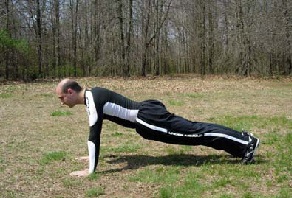
Push-ups.  Do them on your fists to strengthen the structural alignment for striking.  We will be incorporating the Dynamic Effort Method here, which is basically lifting a non-maximal load (your bodyweight) as fast as possible.  Begin in the top portion of the push-up.  Descend in a slow, controlled manner.  At the bottom portion of the exercise, explode upwards as fast as possible.  Do 10-25 repetitions.  Rest 60 seconds, then move on to exercise two.
Exercise Two

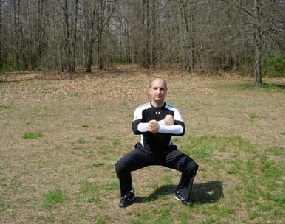
Bodyweight Squats.  Do them in Jumonji no Kamae, as shown below.  Utilize the same protocol as above.  Descend in a slow, controlled manner.  At the bottom of the squat, explode back to standing.  Do 25 repetitions.  Rest for one minute, then move on to exercise three.
Exercise Three

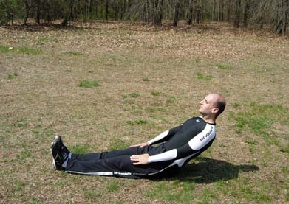
Straight Leg Sit-up.  Lie flat on your back.  Exhale, contract the core, and begin to sit up slowly keeping your spine straight.  Inhale at the top of the movement.  Exhale again and slowly lie back down.  Perform 5 repetitions of the straight leg sit-up.  Rest for 60 seconds and return to exercise one.  Continue until you have completed 5 sets of all 3 exercises.
How Often?

This workout can be performed 3 times a week, depending on your schedule and your fitness needs.  If you are including conditioning work as well, for an example see the WarFit Combat Conditioning System then this strength based GPP workout should only be done twice a week.  Here is an example of what a weekly schedule may look like:


Monday
  • Joint mobility warm-up
  • GPP Workout
  • Class training
Tuesday
  • Joint mobility warm-up
  • Solo Training
Wednesday
Thursday
  • Joint mobility warm-up
  • Solo Training
Friday
  • Joint mobility warm-up
  • WarFit Conditioning Workout
  • Yoga for compensatory movement


This is just one option of how fitness and marital arts can be combined in a weekly schedule.  If you have the luxury of being able to do a conditioning workout after your martial arts class instead of on a separate day, you can save more time.  Or, try getting up earlier and doing the workouts in the morning so your evenings are free for family time or more budo.

Future articles in the series will look at Specific Physical Preparedness, as well as Activity (martial art) Specific Exercises for Bujinkan training.  Additionally, I will expand on GPP, showing new exercises, and how to increase the difficulty levels of the exercises discussed today.

To learn more about the Warrior Fitness training method, exercises, and programming options, check out Warrior Fitness: Conditioning for Martial Arts.


Warrior Fitness Workout of the Week #2

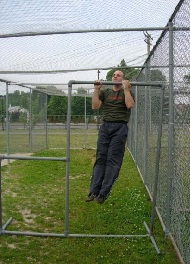
Commando Pull-Ups

This week’s conditioning workout will push your anaerobic threshold to the max.  Endurance is defined as the ability to resist fatigue – how resistant are you?

  • 10 Commando Pull-ups (switch grip every 5)
  • 10 Burpees
  • 10 Lateral Jumps (jump over medicine ball or other small obstacle)
  • 10 Fudo-ken (fist) Push-ups
 Complete 5 rounds as fast as possible with good form. Rest 1 minute between rounds.

 How Do I Do a Burpee?


Burpees are a great, whole-body conditioning exercise that will really challenge your cardiovascular fitness.

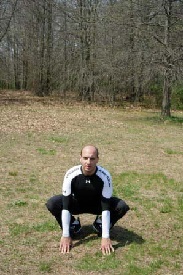
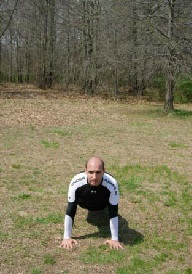
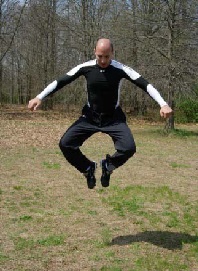
Begin in a standing position.     Drop down to a squat on the balls of your feet.  Place your hands down in front of you and jump your legs back to the lowered portion of a push-up.  Jump your legs back to the ball of foot squat, then leap into the air as high as possible.  Repeat rapidly!

Burpees -Squat down from standing

Burpees - Jump back to push-up

Burpees - Leap as high as possible!

Modifying Your Workout


Conditioning workouts are supposed to suck.  No doubt about it!  They push your body to its limits and increase mental toughness.  However, they should be approached incrementally, especially if you are not used to them.  In this particular workout, I’d recommend that beginners cut the volume of repetitions in half.  If you still find you are struggling, increase the rest period between rounds up to 2-3 minutes rather than the prescribed 60 seconds.  Additionally, you may perform 3 rounds to start instead of 5.  As you gain confidence and begin getting stronger, you can increase the number of repetitions and rounds, and decrease the rest periods.  Change one variable at a time so you are not forcing your body to adjust too rapidly.  Remember, injury is not the goal!

For more information on the Warrior Fitness Workouts of the Week, please see our User Guide here.

Want to know more?  Check out Warrior Fitness: Conditioning for Martial Arts!

Warrior Fitness Workout of the Week #1

For 15 minutes, perform the following:

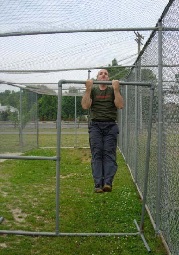
Chin Up


  • Chin-ups
  • Hindu Push-ups
  • Jumping Jacks
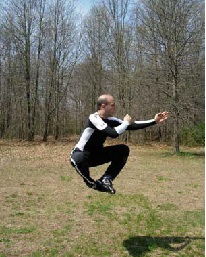
  •  Ichimonji Jump Squats (can be replaced with non-jumping squats as fatigue levels rise)


Hindu Push-up


Ichimonji Jump Squat

Do them in any order for any number of reps at a time as long as you continuously move for the full 15 minutes.    

Modifying Your Workout

Not quite ready to jump into the full 15 minutes yet?  This workout can be modified depending on your current level of conditioning.

For example, you may break up the 15 minutes into 5 rounds of 3 minutes each and include a rest period of 1 to 2 minutes between rounds.  As your conditioning levels increase, begin increasing the length of the rounds and decreasing the rest period.  Remember, the goal is to exercise for 15 minutes straight.    

Additionally, if you do not have a chin-up bar, you can try  towel pulls instead.  Wrap a towel around a pole in your basement, or around both door knobs of an open door, sit all the way back until your arms are straight and pull yourself forward.  You can make this exercise more difficult by grasping the towel with one hand which also provides a great grip workout to boot!

Enjoy!    

Notes: Make sure you warm-up with brief joint mobility session prior to the workout.  Remember that when you sign up for our mailing list you receive a free sample chapter on Joint Mobility from my Warrior Fitness book!

For further information on the Workouts of the Week, please see our User Guide here.

Are You FIT to be a Warrior?

It goes without saying that the role of a warrior in society is to protect self and others. Yet, how many of us aspiring warriors don’t realize that health, fitness, and overall well-being are the primary qualities on the forefront of “self” defense? Most of us may train our entire lives without ever being involved in a dangerous altercation, but the same cannot be said about avoiding the dangers of lack of physical exercise such as osteoarthritis, ill health, heart disease, cancer, type II diabetes, and obesity to name a few.

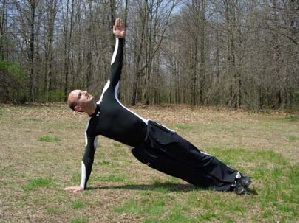
Side Plank

Physical fitness (and proper nutrition!) plays a leading role in the prevention of these diseases and conditions, as well as in the protection of our overall health and psychological well being.


Many of us spend 40 + hours a week sitting in an office staring at a computer where the most exercise we get during an 8-hour stint is to walk to the bathroom several times a day followed by wandering into the cafeteria to see what pre-packaged garbage is waiting for us in the vending machines.

Then, often we come home from work exhausted (from what?) and flop on the couch to watch TV in order to “unwind” (again, from what?) before finally dragging ourselves upstairs and into bed for the night.

We have conditioned ourselves into laziness and inaction. Yes, I do mean “conditioned”. Conditioning does not only apply to being fit; it is possible to condition your body for anything, including being over weight, tired all the time, and to completely lack motivation for any type of physical activity. No wonder Americans are among the fattest people on the planet! (By the way, I am only picking on Americans because I am one; however the rampant increase in obesity is a worldwide problem and getting worse. Just look at recent news articles from the UK on the same subject.)

Challenges of Discussing Fitness

One of the challenges that arise when we attempt to discuss fitness in a meaningful way is that the term itself is extraordinarily vague. Some people think of a triathlon athlete as “fit” while others believe a power lifter is “fit.” Unfortunately, neither of these examples conforms to the actual definition of fitness; they are just two extreme ends of the spectrum.

Fitness Attributes

Fitness is essentially made up of nine different attributes:

  • Strength
  • Power
  • Agility
  • Balance
  • Flexibility
  • Local muscular endurance
  • Cardiovascular endurance
  • Strength endurance
  • Coordination

All of these components must be present to constitute a suitable definition of fitness.

Warrior Fitness Methodology

The Warrior Fitness training methodology blends all 9 of the above qualities together to construct a comprehensive fitness program applicable to all walks of life. This blended approach allows for a wide variety of options, based on each individual’s fitness needs, when crafting a complete program. The variety enables each program to be tailored specifically to the individual while still remaining true to the overall Warrior Fitness philosophy of health, fitness, and growth, balanced with recovery.

Warrior Fitness: Conditioning for Martial Arts

WFBookcover3d

Warrior Fitness Book