The Five Pillars of the Iron Body

How Martial Artists Build Lifelong Strength, Power, and Durability

There is a quiet truth that most martial artists eventually discover.

Technique alone is not enough.

You can know hundreds of techniques, understand strategy, and have decades of experience… but if the body itself is not developed correctly, that knowledge cannot be fully expressed.

The greatest martial artists throughout history understood something very important:

They didn’t just train techniques.

They trained the body itself.

They forged a body that was:

• elastic
• structurally aligned
• internally powerful
• externally durable
• and capable of integrating all these qualities into real movement

This type of body is what I like to call The Iron Body.

And over the decades, after studying internal martial arts, strength training, Qigong, and traditional conditioning methods, I’ve come to understand that the martial body develops through five essential pillars.


The Five Pillars of the Iron Body

Every powerful martial artist develops five core qualities:

  1. Elasticity

  2. Structure

  3. Pressure

  4. Durability

  5. Integration

When these pillars are trained together, the body becomes both powerful and resilient.

Let’s look at each one.


Pillar One: Elasticity

The Spring of the Body

Muscular strength is useful, but true martial power comes from something deeper.

The body must behave like a bow.

When tendons and connective tissue become elastic, they store energy during movement and release it explosively.

This is why skilled martial artists often appear relaxed yet generate tremendous force.

They are not relying on muscular tension.

They are using elastic power.

Training methods that develop elasticity include:

• Yi Jin Jing tendon training
• structural isometrics
• slow movement exercises
• controlled connective tissue loading

This is exactly the focus of my Iron Silk Method program.

Iron Silk is designed to restore the elastic connective tissue qualities that allow martial power to feel effortless.

When elasticity develops, many practitioners notice:

• strikes feel heavier
• movements become smoother
• the body feels springy instead of stiff

Elasticity is the engine of martial power.


Pillar Two: Structure

The Frame That Carries Force

Power does not come only from the muscles or tendons.

It must travel through the body.

Structure is what allows force to move efficiently through the skeleton into the ground.

When structure is correct:

• the body becomes stable
• pressure flows through the frame
• muscles remain relaxed

When structure collapses, power disappears.

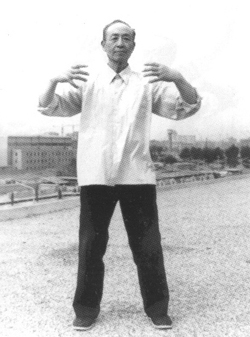
This is why many internal martial arts emphasize standing practice.

Standing training teaches the body to align:

• feet
• hips
• spine
• shoulders
• head

When these elements are stacked correctly, the body becomes capable of carrying tremendous force without strain.

This is the focus of Zhan Zhuang training.

Zhan Zhuang develops:

• posture
• root
• internal connection
• relaxed strength

Over time, standing practice creates a body that feels heavy and stable under pressure.


Pillar Three: Pressure

Breath-Driven Internal Power

Breathing is far more than a relaxation tool.

In traditional martial arts, breath is used to create internal pressure.

This pressure stabilizes the body and fuels movement.

Practices that develop internal pressure include:

• dantien breathing
• whole-body breathing
• compression and expansion drills

When breath and structure work together, something powerful happens.

The body begins to move as one connected unit.

This type of breathing is a key component of both Iron Silk and Martial Qigong training.


Pillar Four: Durability

The Armor of the Body

Elasticity creates power.

Structure directs power.

Breath fuels power.

But the body must also be able to handle power.

That’s where durability comes in.

Durability refers to the strengthening of:

• bones
• tendons
• muscles
• skin
• connective tissue

Historically this was developed through hard Qigong training.

Practices included:

• static posture strength training
• tendon conditioning
• iron body methods
• breath-powered tension

This is exactly what is taught inside my Martial Qigong course.

Martial Qigong develops the external strength and durability that allows martial artists to remain strong and resilient as they age.

Without durability, elasticity becomes fragile.

With durability, the body becomes capable of absorbing and delivering force safely.


Pillar Five: Integration

Turning Training Into Martial Power

The final pillar is integration.

Integration is where everything comes together.

Elasticity, structure, breath, and durability must eventually become one coordinated system.

This is what allows martial artists to move naturally and generate power without thinking.

Integration is developed through:

• slow martial movement
• striking mechanics
• grappling pressure drills
• standing meditation

At this stage, the body begins to express power effortlessly.

Many practitioners describe this as:

• heavy hands
• relaxed strength
• effortless issuing

This is the stage where training becomes true martial skill.


The Foundation of Everything: Daily Practice

All five pillars rest on one essential foundation.

Daily practice.

The martial body is not built through occasional effort.

It is built through consistent, intelligent training over time.

Even short daily practice sessions can create profound changes in the body.

A simple daily structure might include:

Standing practice 
Iron Silk tendon training
Breathing exercises
Martial Qigong conditioning

Over weeks and months, these practices gradually transform the body.

This is how martial artists develop strength that lasts decades instead of years.


Bringing It All Together

When the five pillars are trained together, the body begins to change in remarkable ways.

Elastic connective tissue creates explosive power.

Structure carries force efficiently.

Breath generates internal pressure.

Durability protects the body.

Integration turns all of this into martial ability.

This is the essence of The Iron Body Protocol.

And it is exactly what my training programs are designed to develop.

Iron Silk Method builds elasticity and tendon power
Martial Qigong develops durability and external strength
Zhan Zhuang standing practice creates structure and internal connection

Together, they form a complete system for building a powerful, resilient martial body.


Train for the Long Path

Martial arts are not just about fighting.

They are about developing the body and mind over a lifetime.

When you train the five pillars consistently, the goal is simple:

To become stronger, healthier, and more capable every year.

Not weaker.

Not slower.

But better.

That is the path of the Iron Body.

Train with intent.

— Jon Haas
The Warrior Coach
Why Body Skills are Critical to Martial Arts

Body skills are the foundation of ALL martial and athletic movement.

In fact, in my mind, they are the foundation of all good, powerful, pain-free human movement!

What are body skills?

They are the qualities that connect, support, mobilize, and strengthen the body from the inside out. They create a highly resilient, dynamically stable body that underpins all other skill acquisition. In short, you want to get better at the specific skill sets within your martial art, quickly – train the body!
Learn how to develop high level body skills for martial art 

The Trinity of Training for Health and Strength

The ancients who created yoga, qigong, and various systems of martial arts knew a thing or 2 about training the body as a whole, integrated unit and not a series of disparate parts.

In fact the word yoga means “to yolk” or to unite together.

Each separate system that came down to us from the ancient world had one thing in common no matter where they originated…

They all utilized breath, posture, and movement to create a balanced healthy body, energetic, and free from pain.

When you combine exercises using all 3 modalities you get a powerful synergistic effect on health and strength that modern methods lack.

Learn exactly how to unite all 3 here =>

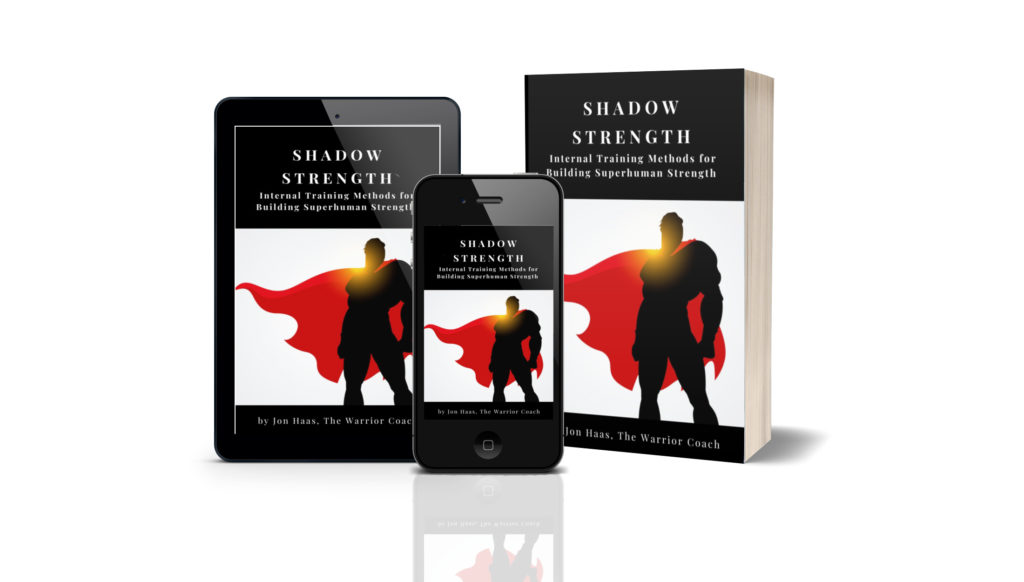
Shadow Strength utilizes a proprietary set of exercises drawn from traditional martial arts and trained in a unique combination to skyrocket your internal strength, power, and resistance to injury.

Using breath, posture, and martial mobility, Shadow Strength breaks down the barriers to superhuman strength and an unbreakable body.

Learn more here =>> http://warriorfitness.org/shadow/

Musashi on Posture in Strategy

In his classic work on the art of strategy, Go Rin No Sho, Musashi gives the following instructions on Posture in his art.

“Keep your neck straight, putting some force in the hollow of the nape; lower your shoulders, with the sensation that the torso from the shoulders down forms a unity; keep the back straight, do not stick out your buttocks, push your force downward from your knees to the tips of your toes, Advance the belly slightly forward so that the pelvis does not lose its stability…

It is necessary for you to have as your posture in strategy just the ordinary one, and it is essential that the posture of strategy be the ordinary one for you. This must be examined well.”


Notice how adamant he is that your stance for combat and your everyday stance be the same…

Isn’t it interesting that Musashi’s instructions for how to stand in his system of strategy sound remarkably similar to zhan zhuang (standing meditation) and shizen no kamae (natural posture).

Coincidence? I think not…

For comparison here is a video I made on how to stand in Shizen no Kamae (natural posture).


Now let’s take a deeper look into the standing practice as the world’s oldest and most effective form of Qigong.


Tachi Geiko (Standing Training) or Ritsu Zen (Standing Zen)

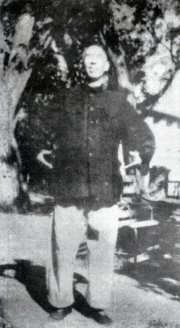
Zhan zhuang, or standing meditation exercise, has been used as a method of relaxation and health cultivation for thousands of years. The earliest known reference to standing appears inThe Yellow Emperor’s Classic of Chinese Medicine. Martial arts master Wang Xiangzhai wrote the following in his book on zhan zhuang:

“It is said that already 2000 years ago there existed the book Internal Canon, the gem of Chinese medicine, which even today is a guide for medical practice. The chapter Simple questions concentrates on cultivating health. For example we can read there: “In ancient times great masters stood on earth, supporting heaven, controlling yin and yang, breathing with essence of qi, standing alone, guarding spirit, with body being as one.”… Before the eastern Han dynasty many scholars and warriors knew the methods of “tranquil cultivating.” The exercises could be done walking, standing, sitting, lying. It was popular form of cultivating health. Later, during reign of Liang dynasty’s emperor Wu, Damo came to China to teach. He transmitted methods of “washing marrow” and “changing tendons.”


The health preserving and sustaining effects of zhan zhuang have been documented in hospitals and medical clinics across China. The reason this practice has such a profound impact on health and recovery from exercise is that the standing meditation acts like a system-wide reboot for the whole body. It stimulates the nervous system, increases circulation, and raises energy levels, while providing deep relaxation for both mind and body.

Aches, pains, old injuries, muscular tensions, and imbalances are highlighted and brought to the forefront by this method and then slowly dissolved over time and completely released. The practice provides a way of completely relaxing and letting go of the muscular tensions in the body, while the correct alignment of the bones delivers support, creating a profound neutral and relaxed, almost buoyant state. As the whole body and mind are exercised, both relax and stimulate the nervous system, increase circulation, open the joints, and raise energy level for a feeling of overall well-being.

This exercise looks easy from the outside. After all, you’re just standing there and not moving. However, inside, there is a lot going on – the breath and the qi (energy) are moving. This exercise is a challenging, sometimes frustrating, yet highly beneficial and rewarding practice. The only way to truly appreciate it is to experience it for yourself.


How Do We Stand?

In practical terms, how should we stand?  Let’s start with the head and work our way down.

  • Begin by standing in a natural stance. Feet shoulder width apart, knees slightly bent.
  • Lift upward slightly with the crown of the head, as if being pulled up by a string, allowing the chin to lower. This straightens the vertebrae at the back of the neck.
  • Shoulders are back and down sitting on the spine.
  • The back should be flat. Do not tuck the pelvis. The spine should be suspended from above like a skeleton hanging in a science classroom.
  • Hold the arms in front of the body, level with the solar plexus, as if hugging a tree. There should be a golf-ball sized space under the armpits.
  • The bottom of the spine pulls straight down from the tailbone, as if there is a weight attached to the sacrum. You should feel like you are sitting on a high stool yet trying to stand up at the same time.
  • Allow the knees to bend slightly. Feet should be shoulder width apart and pointed straight forward as if on railroad tracks.
  • Legs should feel like they are squeezing a beach ball. Remember, though, the ball puts outward pressure on the legs as they squeeze in, so there is pressure both directions, not just one.
  • The weight is carried in the hollow behind the balls of the feet. In Chinese medicine, this is known as the yongquan or bubbling well point.


All of the above points must be maintained to have a truly “natural” standing posture.


Maintaining a relaxed posture is key to beginning your standing meditation.


Supercharge Your Standing Practice

Now that you have the external mechanics down, let’s talk about how to supercharge your relaxation process.

  1. Mentally scan the body for areas of tension. The usual suspects will be the neck, shoulders, low back, and quads.


  1. Begin to actively release each area of tension one by one with your mind. For example, think of the tightness in your shoulders and relax it by telling yourself, “The tightness in my shoulders is letting go and relaxing.” Then proceed to the next area until you have systematically gone through them all.


  1. If one particular area is giving you trouble, then work on breathing into it. Inhale into the area, hold for a few seconds, and then exhale from the area to release it. Use this process over and over again until all the tension has let go.


  1. Once you have removed all the residual tension in the body, continue to stand holding that relaxed feeling. Think of your body as a drop of ink dissolving in the ocean, spreading out in all directions.


  1. Start with ten minutes of zhan zhuang standing. Work up to thirty minutes. In Chinese medicine, it is said that it takes approximately 28 minutes for the blood to complete one full cycle though the body, thus the recommendation to stand for thirty minutes. This can be increased to sixty minutes over time to allow for two full cycles of blood to be completed.


A New Way to Recover

In teaching this method to both my fitness clients and martial arts students I find that in addition to our usual compliment of recovery drills (consisting of mobility exercises, yoga asana, and compensatory movement), the addition of this simple practice of standing meditation has consistently accelerated our recovery process, allowed us to reach new levels of relaxation, and strengthened the mind-body connection beyond any other work we have done. Additionally, it has managed to increase energy levels while fortifying our bodies against the daily rigors of life, work, and family stresses.

While this method is elegantly simple to practice, requires little space and no special equipment, and can be done at virtually any time of day, it also is startlingly deep.

Go Deeper – Take the 100 Day Challenge!

Traditionally it is said that a minimum period of 100 days is necessary for the body to acclimatize and adapt to a practice. As our goal is to completely rewire the nervous system in order to change the body, 100 days seems like the perfect length of time.

How to Do It

  1. Work your way up to standing for 30 minutes a day for 100 days – think you can do it?
  2. Take the Integrated Strength Program challenge for 100 days and seriously upgrade your strength, health, and martial power!

5.5 Principles for More Effective Striking in ANY Martial Art

Part 1 of this series, Conditioning the Fists for Striking can be found HERE.

Being able to strike with power and precision involves a lot more than merely knowing the technique. Practice must include these principles of effective striking techniques for all martial arts…

1. Whole Body Power 

All movement in real life happens in three dimensions, so why train exercises that only incorporate one or two? Training muscles in isolation, unless it is used to rehab a specific injury, range of motion, or strengthen a particular muscle to add to the whole, does not work in martial art.

Our strike conditioning exercises must train movements in three dimensions utilizing diagonal, rotary, and angular strength, as well as prime moving muscles.

2. Stored Elastic Energy (SEE) 

Stored Elastic Energy is basically the potential energy stored in tendons and connective tissue as a way to power movement.

An easy exercise to begin to feel stored elastic energy is to stand in a natural stance with feet shoulder width apart.  Bend your right arm and raise it up to shoulder height as if you were about to throw the most telegraphed punch in history (don’t worry, it’s just an exercise).  Now, lead from the elbow and pull your fist back.  Allow your torso to rotate, but keep the feet planted and the hips facing forward.  When you reach the end of your range of motion, hang out there for a second and feel the tension (torque) on the spine.  Now simply relax and release that torque to throw the punch.  Don’t add any driving forces with muscle.  You can’t propel it any faster; you’ll just slow it down.

Feel it?

Try it again.

Do it with the other arm.  Remember the feeling.  This is stored elastic energy (SEE).

The point here about creating torque or stored elastic energy (SEE) in the spine is essential in being able to move powerfully without winding up or telegraphing the movement.

If you are having trouble feeling it, try to exaggerate the movement.

Make it much larger than necessary to study the feeling. It should feel like a tension in the lower back near the bottom of the spine. When this tension (torque) is relaxed (released), the movement happens.

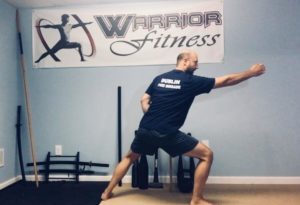
3. Structure / Kamae 

Many people tend to use the terms alignment and structure almost interchangeably but in actuality, alignment is a component of structure.

For example, looking at a natural standing posture, good alignment would be:
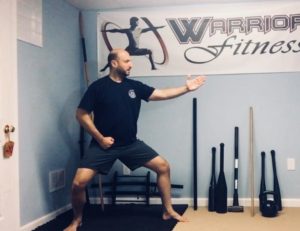
  • Crown up
  • Chin down
  • Shoulders packed down
  • Spine lifting up (through crown)
  • Spine pulling down (through the sacrum)
  • Hips under shoulders
  • Knees under hips
  • Mid-foot balance
  • Chest is relaxed
  • Butt not sticking out nor is pelvis tucked under
  • Knees are over the toes
  • Weight evenly distributed (50/50)
  • No leaning forward or backwardThis puts the whole body into proper alignment.


Structure also includes (in my lexicon) the balance of tensions within the body’s soft tissues. The bones act as compressive struts pushing outward from the center while the soft tissues (fascia) act as the stays pulling inward towards the center keeping the tensional balance in the body.

4. Breathing 

How often do you think about breathing as it relates to striking?

Yet it is absolutely essential to maintain proper breathing when in combat or simply hitting a heavy bag, mitt, or an opponent. Lack of breath control affects the rest of your body and hinders your overall performance.

5. The S.A.I.D Principle 

Why are all the above ideas important to understand in relation to striking and martial movement?

The SAID Principle – Specific Adaptation to Implied Demand says every activity that we repeat consistently causes an adaptation in the body.

The critical thing to note here is that it does not matter at all how we value this adaptation.  It can be something that we want like how healthy exercise increases lean muscle mass and burns excess fat, or it can be something we do not want like how eating junk food to an extreme causes our body to adapt by putting on weight.

Both of these are examples of activities that cause adaptations in the body.   Our goal is to train adaptations we value highly like the enhanced neural connections in our nervous system that increase our skill level. Keep this in mind when training.  We do not want to train bad habits!

5.5 Elements of Efficiency 

Efficiency is defined as the amount of useful work divided by the amount of total work.  In other words, how much effect are you producing for the amount of effort you are expending?

  • Ever see a batter “swing for the fences” only to completely miss the pitch?
  • Ever see someone try to pick something up that is really light, but they believe is heavy?
  • How about watching someone using the general whole-body tension we discussed above trying to hit a heavy bag?

How much effect, i.e. force from the strike embedded into the target, is gained from the huge effort expended?

You must train to have your strikes be both effective (devestatingly powerful) and efficient (uses the least amount of force or energy to accomplish the movement). Only then can you be said to have mastered the art of striking!


Learn exactly how to upgrade your striking skills in ANY martial art with these resources from Warrior Fitness Training Systems…

The Top 3.5 Reasons Training is Hard

The other day a student said to me during training: “This is hard.”

My reply was, “Well of course it’s hard. You don’t come to me to learn how to do things you’re already good at, do you?” 

But why is this difficult?

In my experience,training is hard for approximately 3.5 main reasons…

1. You are learning new skills. It’s hard to be good at movements, exercises, and concepts that are new to you. Your nervous system must adapt to the new and different stimulus and create, or sharpen pathways to build competence and skill.

2. You must work on your weak points. Working on things you are already good at is fun, but the only way to truly become all-around strong is to eliminate your weak points.

3. Your ego. No one wants to look inept or silly. But the only way to become better means that we must put ego aside in order to learn.

3.5. Superficial Expert Status. The amount of information available today gives people immediate access to any body of knowledge out there, no matter how obscure, in a matter of seconds.  We have all become SMEs – “Superficial Matter Experts”.  We think that just because we know “about” something we actually understand it. No one wants to spend the time and effort required to learn something deeply.

But these reasons are exactly why we need to train. And why we need to train with people who have greater, or more specialized knowledge, higher levels of experience, and greater levels of skill than we do.

This is why I still train with my martial arts teachers. This is why I still have a strength coach. This is why I participate in masterminds and have business coaches.

Because I know that I need to be pushed and challenged in order to grow, just like I must push and challenge my students and clients in order for them to grow.

Ready to be pushed and challenged?

It begins here <<===

Form Begets Function

A new guest blog post by my friend, Jarell Lindsey owner of  Lean Functional Muscle.

Form Begets Function

I was scanning the posts of a fitness forum the other day, and I came across something that confused me a bit.

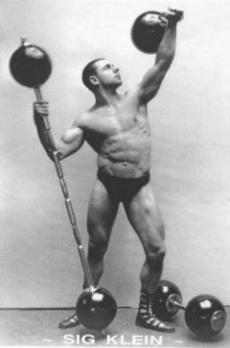
The post was regarding the physique of one Sig Klein, you may have heard of him, and how a modern bodyweight trainer could achieve a physique comparable to such a strength legend.

sig-klein

What could have been a great platform to discuss the merits of old school training methods became a complete misunderstanding of their use. For instance, the poster spoke on how lever work and static training lacked appropriate intensity for muscular growth, despite the incredible physiques that gymnasts possess above most other disciplines of fitness.

He furthermore went to say how he had trained with gymnasts before, and noted that they rarely trained to exhaustion, and more for technique than for musculature; therefore, he wanted a method that would help him develop the musculature, regardless of technique.

Funny that.

For, you see, one of my first lessons in biology was that, even on a molecular level, function begets form. The function of an organelle determines the way that it is structured.

Why wouldn’t it be the same on a macroscopic level? Gymnasts, traceurs, rock climbers, and martial artists all train for function over form, and they offer some of the best physiques the training world has to offer.

If you truly want a physique like Sig Klein with the strength to boot, training for function is key.

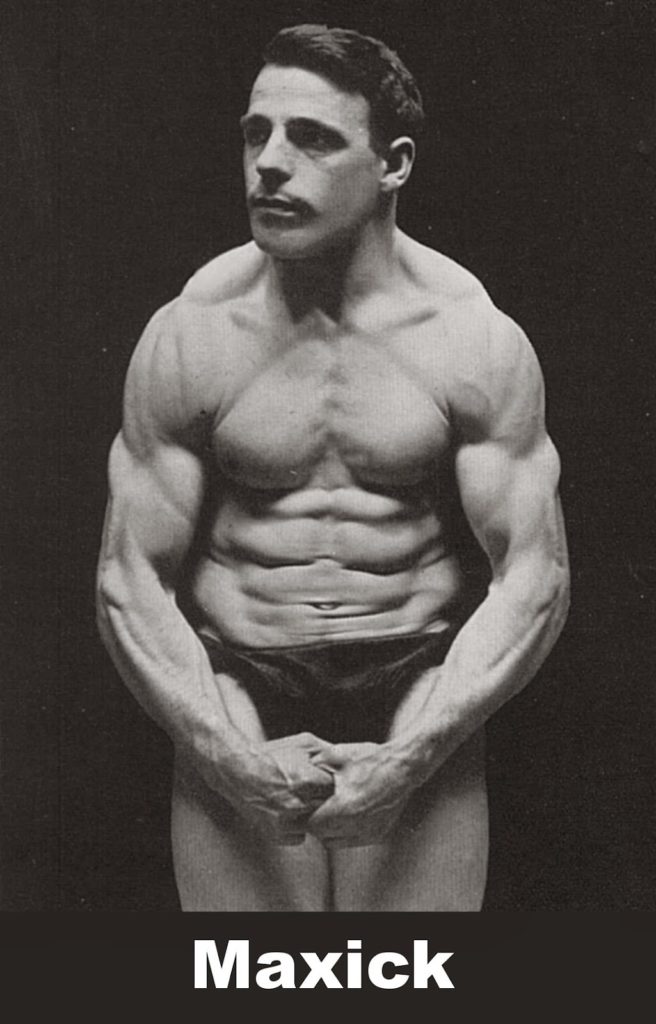
Furthermaxick2more, the poster said that the gymnasts never trained to exhaustion. From the training journals of Maxick, one of the strongest oldtime strongmen there ever were, you train daily so as not to train to exhaustion.
 

Your body doesn’t get stronger from training; it gets stronger from nourishment from your breath, your food, your blood and organs, etc. Many oldtime strongmen, including Sig Klein, rarely ever trained to failure. Nevertheless, they’d train their whole bodies everyday in a way that nourished their strength without fatiguing it.

Function begets form, my dear Watson.

Observe how well you function, not as a crane, tiger, or bear style, but as the functional patterns of a human, and watch your strength and physique truly begin to soar.

Like Paul Freakin’ Bunyan!

I was recently asked how one should train their psyche for martial arts.  It seems like a weird question… Train your psyche??  Upon further reflection though, it’s actually a very astute question.

Psyche is defined as the totality of the human mind, conscious and unconscious.  So training it must be essential.  How then do we do it?

The basic meaning of the Greek word ψυχή (psūkhē) was “life” in the sense of “breath”, formed from the verb ψύχω (psukhō, “to blow”). Derived meanings included “spirit”, “soul”, “ghost”, and ultimately “self” in the sense of “conscious personality” or “psyche”.

http://en.wikipedia.org/wiki/Psyche_(psychology)

Generally when martial artists talk about training the psyche, they speak in terms of mental toughness.  How your threshold of pain equals your threshold of performance and things like that.  Here’s another way to train the psyche that is a little bit different…

Train Your Psyche

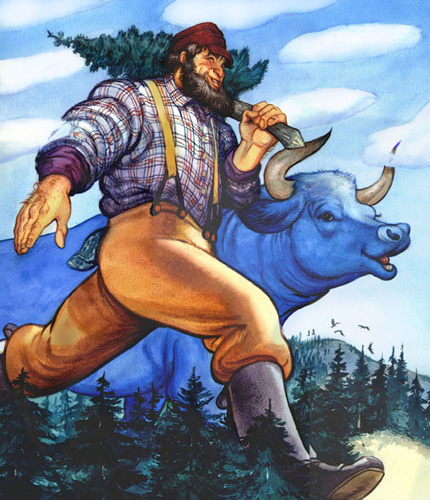
When you practice your martial art, whether in solo training or with your training partners, picture yourself as a giant, like Paul Freakin’ Bunyan, standing taller than the tallest trees.  Have a feeling that your enormous stature confers a comparable sense of self confidence, super human strength, titan like power, and a strength of will that you can accomplish anything.  Balance it out with a supreme sense of benevolence like a warrior-protector.

paulbunyanbabe

Stand tall.  Breathe deeply.  Relax, yet remain full of energy and intent.  Assume a completely nonchalant facial expression like nothing in the world can perturb you.  In Japanese, this is Fudoshin – immovable heart.

fudoshin

Embody the characteristics you want to possess.  This changing of your physiology, focus, and belief  is the quickest way to change your state.  Then the question becomes, how long can you maintain it?  Practice well.

Martial Software or Martial Hardware?

Remember in The Matrix when Morpheus downloaded those dozens of different martial arts programs (software) into Neo’s brain and he instantly could perform all the techniques from those arts?

That is a perfect example of a software upgrade.  Techniques instantly available at your fingertips – literally! Continue reading

Internal Power and Bujinkan Training

When I first began talking about internal power in the context of Bujinkan training, I realized that many people might be skeptical of this type of training at the very least, or have many preconceived misconceptions that would not allow them to even consider the method as a viable form of training for budo.

Therefore I decided to write this blog post to gauge the interest of my readership and how accepting you might be of internal power training and my interpretation of its role within Bujinkan training. I hope you find it helpful!

What is Internal Power?

I think it’s best to start with the basics.  What is internal power and how can it useful to the practitioner of Bujinkan Budo Taijutsu?  Let me state this at the outset to hopefully clear up a rather unfortunate misinterpretation of IP.

Internal Power is physical.

It’s not some mystical mumbo jumbo or a throwing chi balls type of nonsense.

It is actually a way of conditioning the body through specific solo training exercises and paired partner training. The training method spans thousands of years and has been handed down through the ages within the warrior traditions of India, China, and Japan.  It is a body technology with a set method and detailed process of instruction that simply cannot be learned by osmosis.  It must be explicitly taught.

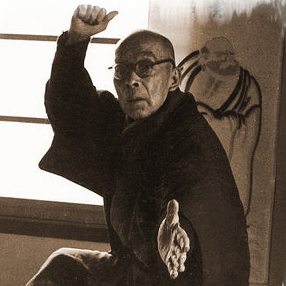
takamatsuSensei

The basis for the method is what is known as the union of opposites or In Yo Ho, in Japanese.

By creating opposing forces within the body (up/down, left/right, front/back) through the use of intent – your own mental direction using imagery, feeling, and visualization – we begin to increase the mind-body connection to a remarkable degree.

Through the solo training exercises we condition and strengthen the entire fascia network, as well as tendons and ligaments, throughout the body.  This process serves to create a connected body through the center so that when ‘one thing move, everything moves’.

The Ultimate Ukemi

Internal Power training changes the way outside forces act on the body.  The structure becomes dynamically stable so that applied force can either be distributed throughout the chain and dissipated or, at a higher level, simply reflected right back onto the opponent.  When force is reflected back this is what is known in Japanese as Yamabiko, or Mountain Echo.

At first blush it may sound like a party trick, but the budo applications are quite staggering.  Think about it.

How does every martial art technique work?

What is the first thing you are taught to do prior to applying a technique?

Break the opponent’s balance, right?  Get kuzushi.

What if no one can compromise your structure?

What does that do to every throw, lock, and take down applied to you?  Yeh.  You’re getting it now, aren’t’ you?

And that’s just the beginning.

Every time you move, you are completely and dynamically stable, balanced.  You gain the ability to hit like a truck using the full mass of a connected body without dedicating your weight.  (Remember – when one thing moves, everything moves.)

This becomes very profound, especially when you start to incorporate weapons.

And, since you are connected through the middle of your body due to the specific solo training exercises, you will finally and probably for the first time, actually be moving from center, hara, or dantien.

Sound interesting?

You can learn my full method of integrating and training the mind-body system HERE.


I am also more than happy to share what I know about internal power training, especially in the context of how it can be fully integrated into our Bujinkan Budo Taijutsu practice.  I teach it in my weekly classes and seminars upon request. Contact me HERE.

Time to Reorganize Priorities

I spent all morning today running around with my 4 year old doing a bunch of errands.  We went to Story Time at Barnes & Noble (she loves that!), then to the bank, to the post office (where I shipped out one of the last paperback copies of Warrior Fitness: Conditioning for Martial Arts!), then off to go food shopping.  Finally we made it back home where I got lunch ready, chicken nuggets for her and a protein shake for me (recipe here!).

Now, aside from telling you about my morning, you may be wondering what my point is here.  At each one of the stops we made I did some people watching and listening.  At B&N, while listening to the story teller read Good Night Moon, I overheard 2 moms having a conversation about Weight Watchers and how they both needed to lose weight.  There was some talk about eating healthier, but the main focus seemed to be on how they could cheat – and they hadn’t even started yet!!  All this while both were sucking down some serious calories from their Starbucks mocha-whatevers with chocolate syrup and whipped cream.  Since I was curious, I engaged them in conversation and asked if they were going to add exercise in to help them with their goals.  They both agreed that it would be a great idea, if only they had time.  They seemed very convinced that they were way too busy with everything going on in their lives and would just have to “do the best they could”.  I wanted to pursue the conversation more, but the story was over and Juliana was ready to go play with the legos and trains, so we walked away.

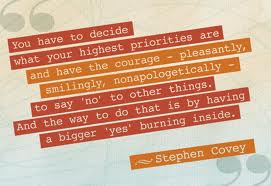
Stephen Covey Quote

This got me thinking – why do people TALK about being healthy so MUCH, yet put so little actual value on their health and fitness that they can’t make it a priority in their lives?  We all KNOW so much about how to be healthy, but knowing is not enough.  We all want so much to be healthy, fit and strong, but willing it is not enough.  There is simply ONLY ONE WAY to become fit, healthy, and stong, and that is DOING IT!


“People often say that motivation doesn’t last. Well, neither does bathing – that’s why we recommend it daily.”  – Zig Ziglar

Make your fitness a priority in your life.  Sooner or later if you don’t make time for being healthy you will be forced to make time for being sick.  Take charge of your own fitness today.  Make it part of your weekly schedule.  Get it done.

Remember – what gets scheduled gets done.  What does NOT get scheduled falls by the wayside.  Don’t just talk about it.  Become it!