THE IRON BODY PROGRESSION MAP
The Complete Path to Lifelong Martial Strength
The Iron Body Is Not Built All At Once
It Is Built In Layers
There comes a moment in every serious martial artist’s life where something doesn’t quite add up anymore.
It doesn’t happen during training. In fact, during training, everything can feel fine. You’re moving, you’re sweating, you’re working. But afterward… when you sit down, when your body settles, that’s when you start to notice it.
Your understanding is deeper than it’s ever been. Your timing is better. Your awareness is sharper. You see things now that you never saw before.
And yet your body doesn’t respond the way it used to.
Your strikes require more effort. Your structure doesn’t feel as stable under pressure. Recovery takes longer than it should. And the most frustrating part is this—you’re still training. Maybe harder than ever.
So what’s the problem?
The truth is, you’re not losing skill.
You’re losing your ability to express it.
Your mind still understands exactly what to do, but your body no longer has the capacity to carry it out the way it once did. And this has nothing to do with age, effort, or discipline.
It has everything to do with how you’ve been training.
The Real Problem Is Fragmentation
Most martial artists train in pieces.
They build a little strength here, add some conditioning there, work their techniques, maybe sprinkle in mobility or flexibility work. On the surface, it looks complete. It feels like they’re covering all the bases.
But they’re not.
They’re training parts of the body… instead of training the body as a system.
Over time, this creates a kind of internal disconnect. Strength develops without structure. Durability improves without elasticity. Breath is trained, but never fully integrated into movement. And slowly, almost invisibly, the body starts to lose its cohesion.
Power begins to leak. Movement becomes stiff. Effort increases where it used to be effortless.
Because the body doesn’t function in isolated pieces. It functions as an interconnected whole.
This is what the old masters understood—deeply, physically, not just intellectually. They weren’t chasing strength or conditioning as separate qualities. They were developing the body itself. They were building a system.
That’s the idea behind the Iron Body.
And it’s the reason the Iron Body Progression Map exists.
A Map That Shows You What To Do Next
Most people don’t need more information.
They need direction.
They need to know where they are, what they’re missing, and what comes next.
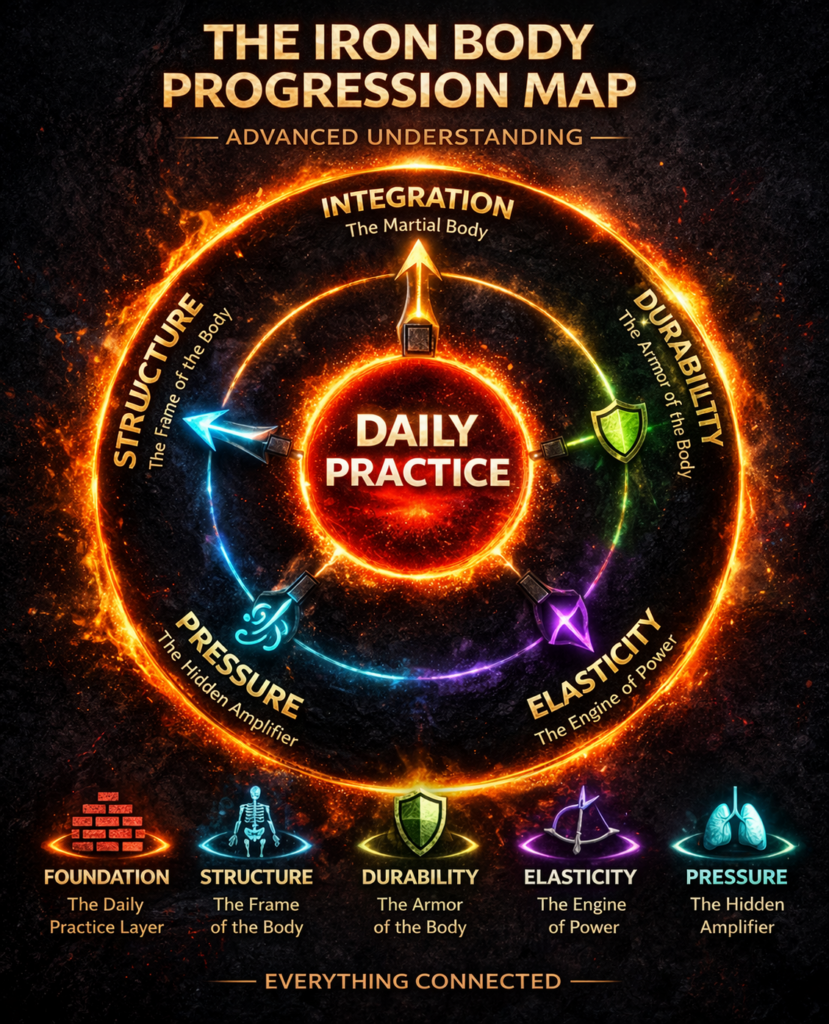
The Iron Body Progression Map gives you that.
It’s not just a concept. It’s a structure you can follow. A way to rebuild your body layer by layer, so that everything begins to work together again instead of fighting against itself.
You can think of it as a ladder. Each step supports the one above it. Skip a step, and everything becomes unstable. Follow it in order, and something powerful begins to happen—the body starts to reconnect.
Foundation: Where Everything Begins
At the base of the system is daily practice. This is the Iron Body Daily Eight.
This is where most people go wrong, because it doesn’t look impressive. It’s not intense. It doesn’t leave you exhausted. But that’s exactly why it works.
This layer teaches you how to hold your body correctly. It develops alignment, awareness, and a kind of quiet control over your nervous system. Your posture improves. Your breathing begins to settle. You start to feel your body as a connected whole rather than a collection of parts.
Without this layer, everything else you do sits on unstable ground. No matter how strong or skilled you become, something always feels off. But once this foundation is in place, everything above it has something solid to build on.
👉 If you don’t already have a structured daily practice, this is exactly what the Iron Body Daily Eight Mini-Course was designed to give you—a simple, guided starting point you can implement immediately.
Structure: Building the Frame
Once the foundation is established, the next step is structure.
This is where practices like Zhan Zhuang and isometric training come in. Now you’re no longer just aware of your body—you’re organizing it. You’re learning how to stack the skeleton, how to root into the ground, and how to create clear pathways for force to travel through your body.
This changes everything.
Instead of feeling loose or disconnected, you begin to feel supported. Stable. Grounded. Your body starts to behave like a unified structure rather than a series of moving parts.
Most people try to generate power before they build structure. That’s why their power never holds up under pressure. Because without structure, force has nowhere to go. It collapses.
Structure is what allows power to exist in the first place.
👉 This is why foundational isometric work and standing training are emphasized so heavily inside the system—they’re not “extra work”… they are the work.
Durability: Strengthening the Tissue
With structure in place, the next layer is durability.
Now you begin strengthening the actual material of the body—the tendons, fascia, connective tissue, and even the bones. This is where Martial Qigong comes in.
At this stage, the body starts to feel different. Joints that used to ache begin to settle down. The constant sense of wear and tear starts to fade. You don’t just feel strong—you feel resilient.
There’s a density to your body now. A kind of quiet toughness that doesn’t rely on tension.
This is what allows you to train consistently over time without breaking down. It’s what separates someone who trains hard for a few years from someone who can train for decades.
👉 This is the layer most modern training completely ignores—which is exactly why systems like Martial Qigong become so important as you progress.
Elasticity: The True Source of Power
Once the body is structured and durable, something new becomes possible.
Now you can develop elasticity.
This is where real martial power begins to emerge.
Through methods like Yi Jin Jing and the Iron Silk Method, you train the tendons to behave like springs. Instead of forcing movement with muscular effort, you begin to store and release energy naturally.
This is where things start to feel almost surprising.
Strikes become heavier, but require less effort. Movement becomes lighter, but more effective. The body begins to generate power without you having to consciously push for it.
This is the difference between forcing power and having power.
👉 This is where the Iron Silk Method fits into the system—developing the kind of spring-like power most martial artists never access.
Pressure: The Hidden Amplifier
At this point, everything is in place—but it still needs to be connected internally.
That’s where breath comes in.
Breath is what ties the entire system together. It creates internal pressure. It stabilizes the body from the inside out. It allows force to move through the body in a way that is controlled, efficient, and calm.
Without breath, everything remains mechanical.
With breath, everything becomes alive.
You’re no longer just moving your body—you’re driving it from within.
Integration: The Martial Body
The final layer is integration.
This is where everything you’ve built is tested and expressed through real movement—carries, crawls, loaded patterns, and martial application.
This is where strength becomes usable. Where structure becomes dynamic. Where power becomes something you can apply under pressure without thinking about it.
This is what it means to have a martial body.
Not just strength. Not just technique.
But a body that can express both—effortlessly.
Why This Changes Everything
Once you understand this map, your entire approach to training shifts.
You stop asking random questions like, “What workout should I do today?”
And you start asking a much more important question:
“What layer am I missing?”
That question gives you direction. It removes confusion. It allows you to train with purpose instead of guessing.
And more importantly, it prevents you from wasting years developing one quality while neglecting the others.
Where Are You Right Now?
If you’re honest with yourself, you already know where you are.
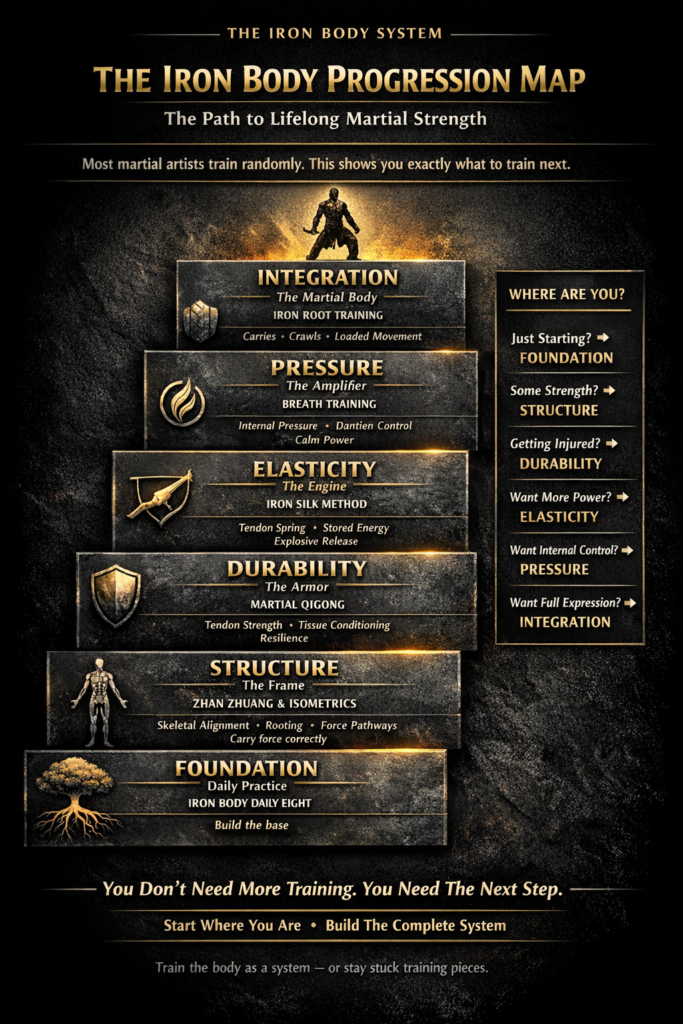
Maybe you’re just starting and need to build a foundation. Maybe you’re strong, but unstable. Maybe your body feels worn down and needs durability. Or maybe you’re chasing power, but haven’t yet developed the elasticity that makes it effortless.
Where you are determines what you should train next.
The Final Truth
You don’t need more intensity.
You don’t need more random training.
You don’t need to push harder.
You need to train the right layer, at the right time, in the right order.
That is how the Iron Body is built.
Start Here
If you want to begin the process the right way, start with the foundation.
The Iron Body Daily Eight is where everything begins. It’s simple, but it’s not easy. It requires attention, consistency, and patience. But if you commit to it, it will change the way your body feels, moves, and performs.
From there, you build upward—structure, durability, elasticity, pressure, and finally integration.
And over time, something shifts.
You don’t just feel stronger.
You feel connected. Stable. Powerful.
Like your body is finally working the way it was meant to.
👉 The Iron Body Daily Eight is the entry point into this entire system.
– -Jon Haas, The Warrior Coach
 The Five Pillars of the Iron Body
 Bringing It All Together