The Complete Path to Lifelong Martial Strength

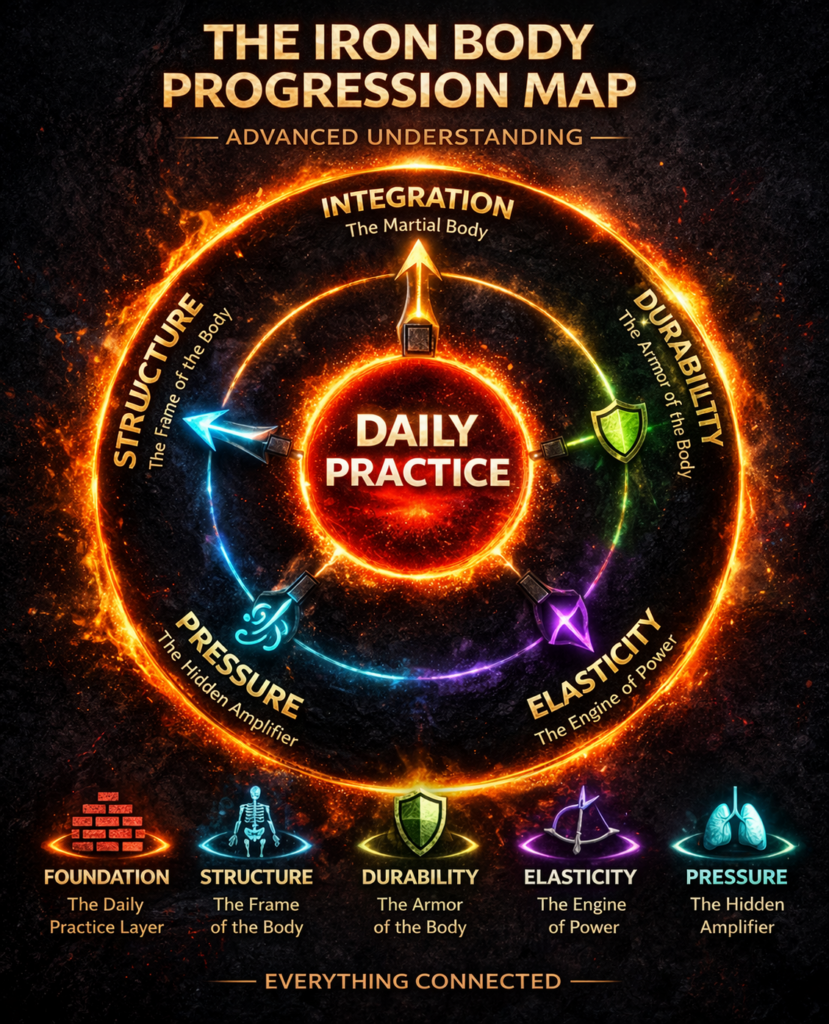
THE IRON BODY PROGRESSION MAP

The Complete Path to Lifelong Martial Strength


The Iron Body Is Not Built All At Once

It Is Built In Layers

There comes a moment in every serious martial artist’s life where something doesn’t quite add up anymore.

It doesn’t happen during training. In fact, during training, everything can feel fine. You’re moving, you’re sweating, you’re working. But afterward… when you sit down, when your body settles, that’s when you start to notice it.

Your understanding is deeper than it’s ever been. Your timing is better. Your awareness is sharper. You see things now that you never saw before.

And yet your body doesn’t respond the way it used to.

Your strikes require more effort. Your structure doesn’t feel as stable under pressure. Recovery takes longer than it should. And the most frustrating part is this—you’re still training. Maybe harder than ever.

So what’s the problem?

The truth is, you’re not losing skill.

You’re losing your ability to express it.

Your mind still understands exactly what to do, but your body no longer has the capacity to carry it out the way it once did. And this has nothing to do with age, effort, or discipline.

It has everything to do with how you’ve been training.


The Real Problem Is Fragmentation

Most martial artists train in pieces.

They build a little strength here, add some conditioning there, work their techniques, maybe sprinkle in mobility or flexibility work. On the surface, it looks complete. It feels like they’re covering all the bases.

But they’re not.

They’re training parts of the body… instead of training the body as a system.

Over time, this creates a kind of internal disconnect. Strength develops without structure. Durability improves without elasticity. Breath is trained, but never fully integrated into movement. And slowly, almost invisibly, the body starts to lose its cohesion.

Power begins to leak. Movement becomes stiff. Effort increases where it used to be effortless.

Because the body doesn’t function in isolated pieces. It functions as an interconnected whole.

This is what the old masters understood—deeply, physically, not just intellectually. They weren’t chasing strength or conditioning as separate qualities. They were developing the body itself. They were building a system.

That’s the idea behind the Iron Body.

And it’s the reason the Iron Body Progression Map exists.


A Map That Shows You What To Do Next

Most people don’t need more information.

They need direction.

They need to know where they are, what they’re missing, and what comes next.

The Iron Body Progression Map gives you that.

It’s not just a concept. It’s a structure you can follow. A way to rebuild your body layer by layer, so that everything begins to work together again instead of fighting against itself.

You can think of it as a ladder. Each step supports the one above it. Skip a step, and everything becomes unstable. Follow it in order, and something powerful begins to happen—the body starts to reconnect.

Foundation: Where Everything Begins

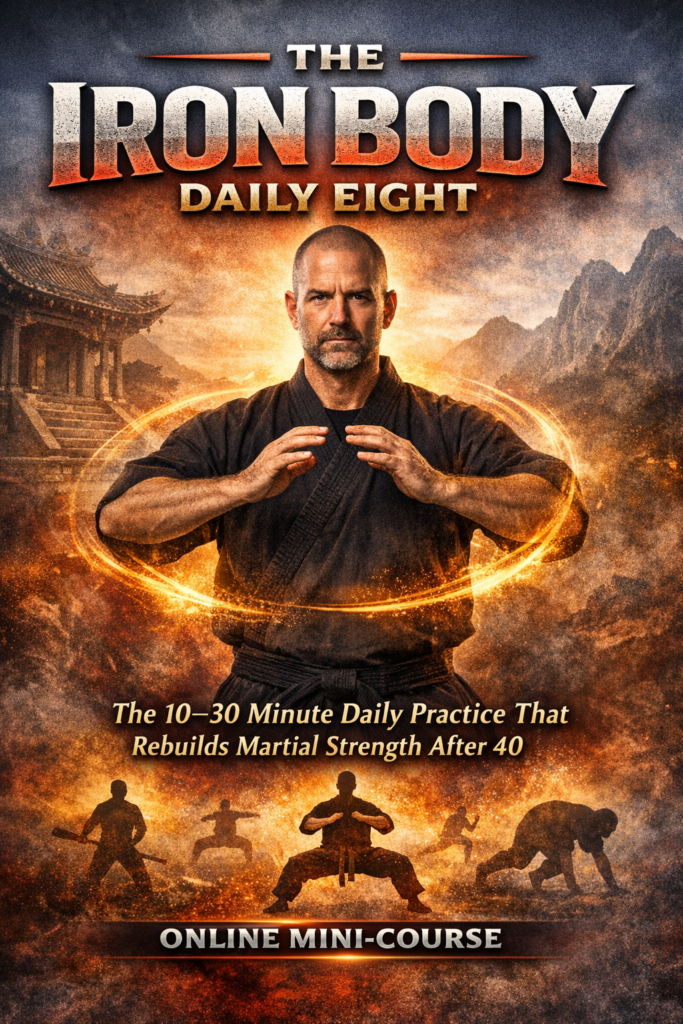
At the base of the system is daily practice. This is the Iron Body Daily Eight.

This is where most people go wrong, because it doesn’t look impressive. It’s not intense. It doesn’t leave you exhausted. But that’s exactly why it works.

This layer teaches you how to hold your body correctly. It develops alignment, awareness, and a kind of quiet control over your nervous system. Your posture improves. Your breathing begins to settle. You start to feel your body as a connected whole rather than a collection of parts.

Without this layer, everything else you do sits on unstable ground. No matter how strong or skilled you become, something always feels off. But once this foundation is in place, everything above it has something solid to build on.

👉 If you don’t already have a structured daily practice, this is exactly what the Iron Body Daily Eight Mini-Course was designed to give you—a simple, guided starting point you can implement immediately.


Structure: Building the Frame

Once the foundation is established, the next step is structure.

This is where practices like Zhan Zhuang and isometric training come in. Now you’re no longer just aware of your body—you’re organizing it. You’re learning how to stack the skeleton, how to root into the ground, and how to create clear pathways for force to travel through your body.

This changes everything.

Instead of feeling loose or disconnected, you begin to feel supported. Stable. Grounded. Your body starts to behave like a unified structure rather than a series of moving parts.

Most people try to generate power before they build structure. That’s why their power never holds up under pressure. Because without structure, force has nowhere to go. It collapses.

Structure is what allows power to exist in the first place.

👉 This is why foundational isometric work and standing training are emphasized so heavily inside the system—they’re not “extra work”… they are the work.


Durability: Strengthening the Tissue

With structure in place, the next layer is durability.

Now you begin strengthening the actual material of the body—the tendons, fascia, connective tissue, and even the bones. This is where Martial Qigong comes in.

At this stage, the body starts to feel different. Joints that used to ache begin to settle down. The constant sense of wear and tear starts to fade. You don’t just feel strong—you feel resilient.

There’s a density to your body now. A kind of quiet toughness that doesn’t rely on tension.

This is what allows you to train consistently over time without breaking down. It’s what separates someone who trains hard for a few years from someone who can train for decades.

👉 This is the layer most modern training completely ignores—which is exactly why systems like Martial Qigong become so important as you progress.


Elasticity: The True Source of Power

Once the body is structured and durable, something new becomes possible.

Now you can develop elasticity.

This is where real martial power begins to emerge.

Through methods like Yi Jin Jing and the Iron Silk Method, you train the tendons to behave like springs. Instead of forcing movement with muscular effort, you begin to store and release energy naturally.

This is where things start to feel almost surprising.

Strikes become heavier, but require less effort. Movement becomes lighter, but more effective. The body begins to generate power without you having to consciously push for it.

This is the difference between forcing power and having power.

👉 This is where the Iron Silk Method fits into the system—developing the kind of spring-like power most martial artists never access.


Pressure: The Hidden Amplifier

At this point, everything is in place—but it still needs to be connected internally.

That’s where breath comes in.

Breath is what ties the entire system together. It creates internal pressure. It stabilizes the body from the inside out. It allows force to move through the body in a way that is controlled, efficient, and calm.

Without breath, everything remains mechanical.

With breath, everything becomes alive.

You’re no longer just moving your body—you’re driving it from within.


Integration: The Martial Body

The final layer is integration.

This is where everything you’ve built is tested and expressed through real movement—carries, crawls, loaded patterns, and martial application.

This is where strength becomes usable. Where structure becomes dynamic. Where power becomes something you can apply under pressure without thinking about it.

This is what it means to have a martial body.

Not just strength. Not just technique.

But a body that can express both—effortlessly.


Why This Changes Everything

Once you understand this map, your entire approach to training shifts.

You stop asking random questions like, “What workout should I do today?”

And you start asking a much more important question:

“What layer am I missing?”

That question gives you direction. It removes confusion. It allows you to train with purpose instead of guessing.

And more importantly, it prevents you from wasting years developing one quality while neglecting the others.


Where Are You Right Now?

If you’re honest with yourself, you already know where you are.
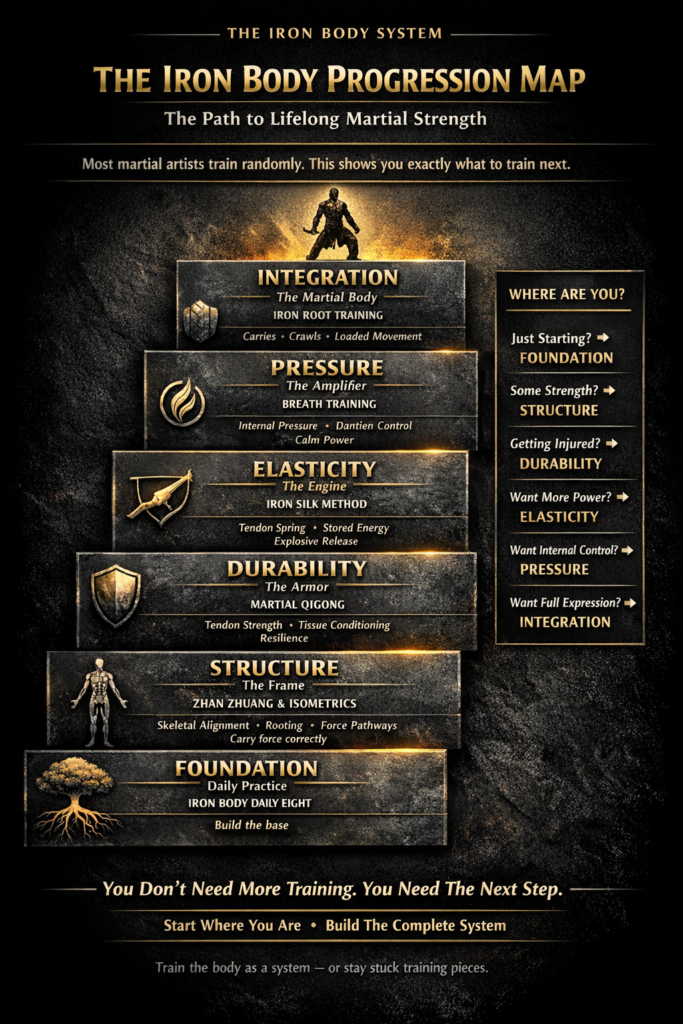
Maybe you’re just starting and need to build a foundation. Maybe you’re strong, but unstable. Maybe your body feels worn down and needs durability. Or maybe you’re chasing power, but haven’t yet developed the elasticity that makes it effortless.

Where you are determines what you should train next.


The Final Truth

You don’t need more intensity.

You don’t need more random training.

You don’t need to push harder.

You need to train the right layer, at the right time, in the right order.

That is how the Iron Body is built.


Start Here

If you want to begin the process the right way, start with the foundation.

The Iron Body Daily Eight is where everything begins. It’s simple, but it’s not easy. It requires attention, consistency, and patience. But if you commit to it, it will change the way your body feels, moves, and performs.

From there, you build upward—structure, durability, elasticity, pressure, and finally integration.

And over time, something shifts.

You don’t just feel stronger.

You feel connected. Stable. Powerful.

Like your body is finally working the way it was meant to.

👉 The Iron Body Daily Eight is the entry point into this entire system.

– -Jon Haas, The Warrior Coach
The Third Type of Isometric Training Most People Never Learn

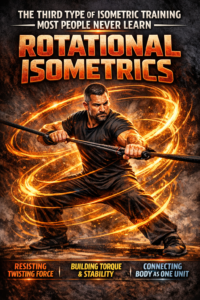
The Third Type of Isometric Training Most People Never Learn (Rotational Isometrics)

Most people think isometric training means one thing:

Holding still.

Planks.
Wall sits.
Horse stance.

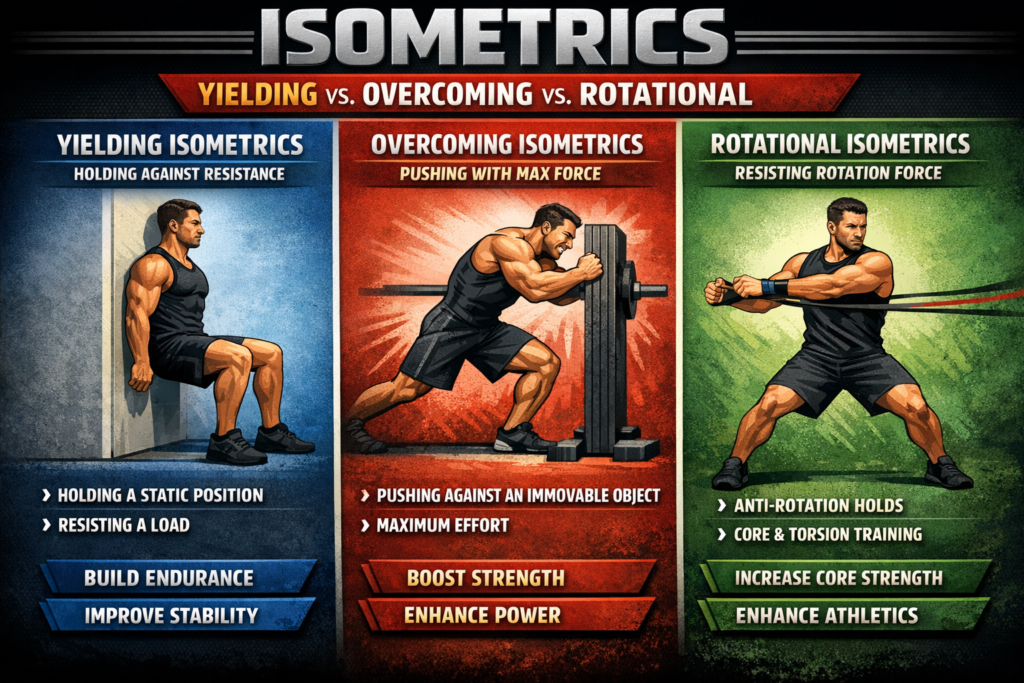
And if they go a little deeper, they might discover overcoming isometrics—pushing or pulling against an immovable object.

But there is a third type of isometric training that almost nobody talks about.

And it’s the one that most closely resembles real martial power.

It’s called:

Rotational Isometrics


Why Most Strength Training Falls Short

Most strength training is linear.

Up and down.
Push and pull.

Even most isometric training is linear:

You hold a position.
Or you push in one direction.

But martial arts are not linear.

Punches rotate.
Throws spiral.
Grappling involves torque, pressure, and redirection.

Power doesn’t move in straight lines.

It moves in curves, spirals, and angles.

And if your training doesn’t reflect that…

Your strength won’t transfer.


What Are Rotational Isometrics?

A rotational isometric is when you create tension by resisting rotation or producing force in opposing directions.

Instead of holding still…

You are actively creating twisting force inside the body.

Examples include:

• resisting a band pulling you into rotation
• twisting into a stance without moving
• creating opposing forces between upper and lower body
• diagonal push/pull tension patterns
• rotational squat holds
• Dragon Coil Holds

The key idea:

You are not just holding position.
You are organizing force through the body.


What Rotational Isometrics Train

This is where things get interesting.


1. Fascial Chains (Not Just Muscles)

Rotational tension travels through the body in diagonal patterns.

This activates:

• anterior/posterior sling systems
• cross-body fascial lines
• spiral tension chains

These are the exact pathways used in:

• punching
• throwing
• takedowns
• weapon work


2. Internal Connection

Rotational isometrics teach the body how to:

• connect upper and lower body
• transmit force across the torso
• maintain structure during movement

This is what many internal arts call:

“whole-body power”


3. Torque and Pressure

Linear strength pushes.

Rotational strength twists and compresses.

This is what creates:

• heavy hands
• crushing grappling pressure
• destabilization of opponents


4. Anti-Rotation Stability

Ironically, training rotation improves your ability to resist rotation.

This is critical for:

• defending takedowns
• maintaining base
• staying balanced under pressure


Why This Is the Missing Link

Here’s the problem:

Most people train:

✔ Yielding (structure)
✔ Overcoming (force)

But they skip:

❌ Direction of force

So their strength exists…

…but it doesn’t transfer cleanly into movement.

Rotational isometrics fix that.

They teach the body how to:

organize force through angles


The Martial Connection

If you look at traditional systems:

• Tai Chi → silk reeling
• Bagua → circular walking
• Xing Yi → directional force
• Jujutsu → kuzushi (off-balancing)

They are all based on:

rotation and redirection of force

Rotational isometrics are the modern bridge into that training.

They make those principles:

• measurable
• repeatable
• physically trainable


How I Use Rotational Isometrics

Inside my system, rotational work comes after structure is built.

Because without structure, rotation becomes collapse.

Here’s how it fits:

Step 1 — Yielding Isometrics

Build structure and endurance

Step 2 — Overcoming Isometrics

Build force and power

Step 3 — Rotational Isometrics

Organize and apply that power


Example Drill — Diagonal Push/Pull

Set up:

• Attach a band or strap
• One hand pushes forward
• One hand pulls back
• Hips remain stable
• Spine tall

Hold for 30–45 seconds.

Focus on:

• creating tension through the torso
• breathing calmly
• feeling force travel from foot to hand

This is not a “hold.”

This is a force pattern.


Example Drill — Dragon Coil Hold

From a squat:

• rotate the torso
• maintain lower body alignment
• create opposing tension

This develops:

• spiral strength
• hip integration
• rotational power


Where Most People Go Wrong

They try to muscle the movement.

But rotational strength is not about squeezing harder.

It’s about:

• direction
• alignment
• connection

Too much tension kills the effect.

Correct tension distributes it.


How This Fits Into My Programs

If you’ve been following my work, you’ve already seen these layers.

The Isometric Warrior Training Guide

Builds structural foundation through yielding isometrics

👉 Learn more here


The 21-Day Isometric Forge

Introduces overcoming + diagonal tension

👉 (Free bonus program inside the private Isometric Warrior Brotherhood)


The Iron Silk Method

Fully integrates:

• tendon elasticity (Yi Jin Jing)
• rotational force
• breath-driven power

👉 Learn more here


Final Thought

Most people train strength.

Very few train how strength moves through the body.

That’s the difference between:

Looking strong…

and feeling powerful.

Rotational isometrics are the bridge.

Train them seriously, and your strength will begin to show up where it actually matters.


Jon Haas
The Warrior Coach

The Five Pillars of the Iron Body

How Martial Artists Build Lifelong Strength, Power, and Durability

There is a quiet truth that most martial artists eventually discover.

Technique alone is not enough.

You can know hundreds of techniques, understand strategy, and have decades of experience… but if the body itself is not developed correctly, that knowledge cannot be fully expressed.

The greatest martial artists throughout history understood something very important:

They didn’t just train techniques.

They trained the body itself.

They forged a body that was:

• elastic
• structurally aligned
• internally powerful
• externally durable
• and capable of integrating all these qualities into real movement

This type of body is what I like to call The Iron Body.

And over the decades, after studying internal martial arts, strength training, Qigong, and traditional conditioning methods, I’ve come to understand that the martial body develops through five essential pillars.


The Five Pillars of the Iron Body

Every powerful martial artist develops five core qualities:

  1. Elasticity

  2. Structure

  3. Pressure

  4. Durability

  5. Integration

When these pillars are trained together, the body becomes both powerful and resilient.

Let’s look at each one.


Pillar One: Elasticity

The Spring of the Body

Muscular strength is useful, but true martial power comes from something deeper.

The body must behave like a bow.

When tendons and connective tissue become elastic, they store energy during movement and release it explosively.

This is why skilled martial artists often appear relaxed yet generate tremendous force.

They are not relying on muscular tension.

They are using elastic power.

Training methods that develop elasticity include:

• Yi Jin Jing tendon training
• structural isometrics
• slow movement exercises
• controlled connective tissue loading

This is exactly the focus of my Iron Silk Method program.

Iron Silk is designed to restore the elastic connective tissue qualities that allow martial power to feel effortless.

When elasticity develops, many practitioners notice:

• strikes feel heavier
• movements become smoother
• the body feels springy instead of stiff

Elasticity is the engine of martial power.


Pillar Two: Structure

The Frame That Carries Force

Power does not come only from the muscles or tendons.

It must travel through the body.

Structure is what allows force to move efficiently through the skeleton into the ground.

When structure is correct:

• the body becomes stable
• pressure flows through the frame
• muscles remain relaxed

When structure collapses, power disappears.

This is why many internal martial arts emphasize standing practice.

Standing training teaches the body to align:

• feet
• hips
• spine
• shoulders
• head

When these elements are stacked correctly, the body becomes capable of carrying tremendous force without strain.

This is the focus of Zhan Zhuang training.

Zhan Zhuang develops:

• posture
• root
• internal connection
• relaxed strength

Over time, standing practice creates a body that feels heavy and stable under pressure.


Pillar Three: Pressure

Breath-Driven Internal Power

Breathing is far more than a relaxation tool.

In traditional martial arts, breath is used to create internal pressure.

This pressure stabilizes the body and fuels movement.

Practices that develop internal pressure include:

• dantien breathing
• whole-body breathing
• compression and expansion drills

When breath and structure work together, something powerful happens.

The body begins to move as one connected unit.

This type of breathing is a key component of both Iron Silk and Martial Qigong training.


Pillar Four: Durability

The Armor of the Body

Elasticity creates power.

Structure directs power.

Breath fuels power.

But the body must also be able to handle power.

That’s where durability comes in.

Durability refers to the strengthening of:

• bones
• tendons
• muscles
• skin
• connective tissue

Historically this was developed through hard Qigong training.

Practices included:

• static posture strength training
• tendon conditioning
• iron body methods
• breath-powered tension

This is exactly what is taught inside my Martial Qigong course.

Martial Qigong develops the external strength and durability that allows martial artists to remain strong and resilient as they age.

Without durability, elasticity becomes fragile.

With durability, the body becomes capable of absorbing and delivering force safely.


Pillar Five: Integration

Turning Training Into Martial Power

The final pillar is integration.

Integration is where everything comes together.

Elasticity, structure, breath, and durability must eventually become one coordinated system.

This is what allows martial artists to move naturally and generate power without thinking.

Integration is developed through:

• slow martial movement
• striking mechanics
• grappling pressure drills
• standing meditation

At this stage, the body begins to express power effortlessly.

Many practitioners describe this as:

• heavy hands
• relaxed strength
• effortless issuing

This is the stage where training becomes true martial skill.


The Foundation of Everything: Daily Practice

All five pillars rest on one essential foundation.

Daily practice.

The martial body is not built through occasional effort.

It is built through consistent, intelligent training over time.

Even short daily practice sessions can create profound changes in the body.

A simple daily structure might include:

Standing practice 
Iron Silk tendon training
Breathing exercises
Martial Qigong conditioning

Over weeks and months, these practices gradually transform the body.

This is how martial artists develop strength that lasts decades instead of years.


Bringing It All Together

When the five pillars are trained together, the body begins to change in remarkable ways.

Elastic connective tissue creates explosive power.

Structure carries force efficiently.

Breath generates internal pressure.

Durability protects the body.

Integration turns all of this into martial ability.

This is the essence of The Iron Body Protocol.

And it is exactly what my training programs are designed to develop.

Iron Silk Method builds elasticity and tendon power
Martial Qigong develops durability and external strength
Zhan Zhuang standing practice creates structure and internal connection

Together, they form a complete system for building a powerful, resilient martial body.


Train for the Long Path

Martial arts are not just about fighting.

They are about developing the body and mind over a lifetime.

When you train the five pillars consistently, the goal is simple:

To become stronger, healthier, and more capable every year.

Not weaker.

Not slower.

But better.

That is the path of the Iron Body.

Train with intent.

— Jon Haas
The Warrior Coach

Which Warrior Fitness Program is Right for You?

I get asked this question all the time – Jon, which one of your programs should I start with?

And the answer is, it depends on your goals. 

So in this article I’m going to give you a set of general guidelines to help you decide which program is right for you.

Quick disclaimer before we get started: ALL of my programs are designed to increase functional strength, improve mobility/flexibility, and build your health and energy reserves. 

Even though my training is forged in the crucible of martial arts, you do NOT need to be a martial artist to reap all the benefits from any of my programs.

 So here goes…

 If you are a martial artist looking to unlock the methods of internal power which make ANY art powerful and useful then I recommend starting with Integrated Strength, Shadow Strength, or The Power Protocol

Each one of these looks at the secrets of internal power and strength from a slightly different perspective to guide you into becoming an all around power house in your respective art.

 If you are a weekend warrior looking for the edge in your strength and conditioning training, I suggest the WarFit Program or Sledgehammer Domination which are designed to build superior levels of functional strength, burn fat, and increase all around endurance.

If you are looking to build up your energy reserves and recover faster from all your training and life stress, I suggest Evolve Your Breathing or Vital Force. Both these programs will balance out your workouts and help build health, energy, and give you the edge in your recovery.

And lastly, if you are a man in the over 40 crowd, I highly recommend Strong(er) Over 40 and Dad Strength. These programs will guide you to growing stronger as you get older, along with building and keeping your levels of testosterone high!

At any age and in any life circumstance, keep training, keep pushing, keep growing, and always keep challenging your perceived limits!

If you want all the best that Warrior Fitness has to offer, then I highly recommend all 12 issues of the Warrior’s Inner Circle. Here is where you get my most up to date training information taken directly from what I’m working on in my own training right now!


Hope that helps guide you in your decision making process! If you have any questions let me know!


Grab my entire training library of 29 programs plus a free 30 minute coaching call with me and save over $500 here <<==


3 Things I Do Every Day for Recovery

I’m looking at the calendar and this year is winding down quickly. I swear, once we hit September the whole thing just seems to fly by!
And, since this year has been crazy (to say the least) for most of the world, I won’t be sorry to see it go!

But before the year ends, I’ll be turning 49. And, I have to tell you – my training has gotten more intense this year, not less. I feel better and stronger at 49 than I did at 29!

I train hard, but it’s my recovery strategies that I perform every day without fail that allow me to train as hard as I do, and to keep getting stronger (and stay injury free) as I get older!!

I’ve heard it said that if exercise is king, then recovery is queen. However, you want to say it, the key is that your recovery must be equal to, or even greater than, your exercise.

Unless recovery is a priority you will NOT be able to sustain intense training as you get older.

 Here are the 3 things I do every day to keep my body performing optimally…


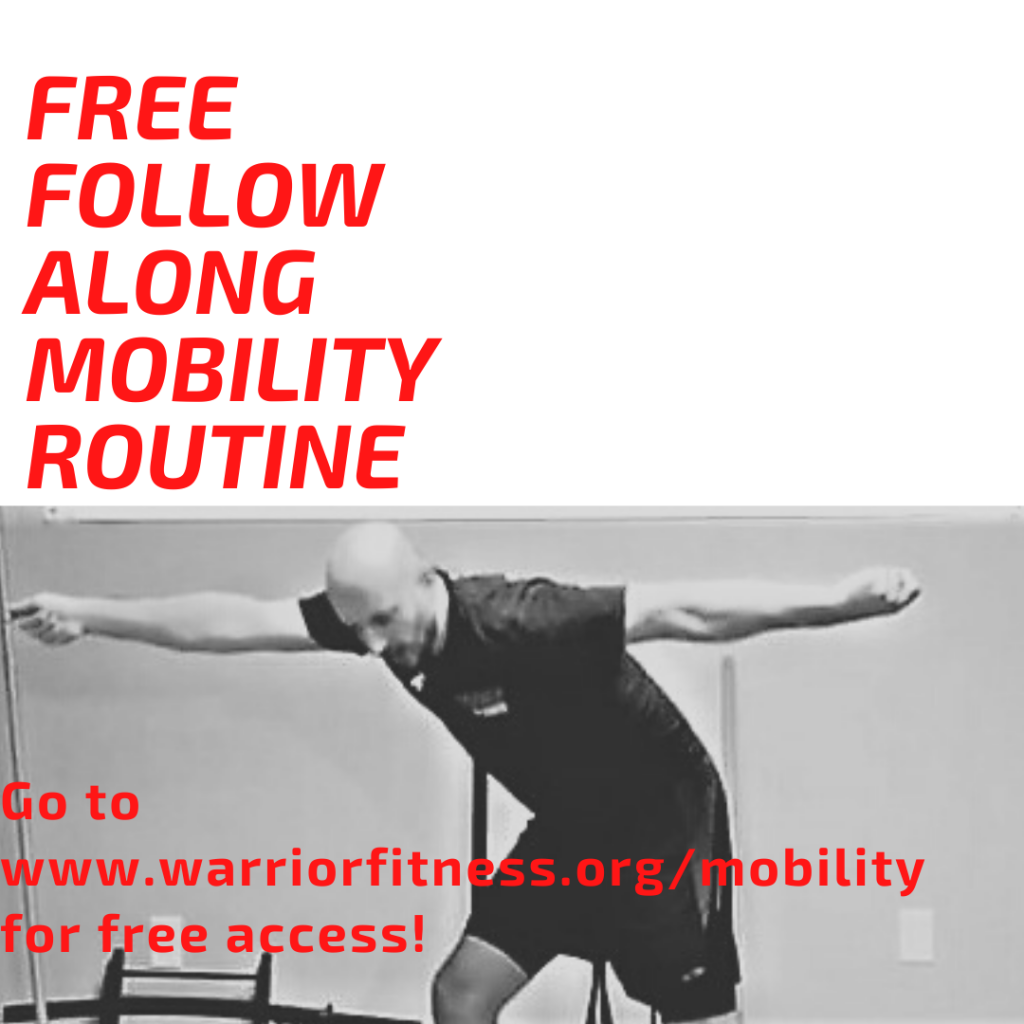
  1. Daily Mobility Training – If you saw my social media posts over the weekend, you know that I highly recommend daily mobility training to keep your body healthy, strong, and injury free. We not only want to have increased range of motion on all our joints as we age, we want to be able to move pain-free as well!

Here is my complete daily mobility routine <<==


  1. Daily Breath Work – I’ve been studying breathing exercises for well over 20 years now and it’s something that I do every day to make sure I’m energized and healthy. The one greatest indicator of overall health and longevity is lung function – the greater lung capacity you have, the healthier and stronger you are! Breath is life.

My Evolve Your Breathing Program contains all you need to build lung capacity, increase energy, and create vital health. (also, you can get EYB for free when you pick up a copy of Shadow Strength) My qigong program, Vital Force is also an excellent reference for breath training and energy development.


  1. Pine Pollen – I have been adding this to my morning glass of water and it has made a huge difference in aiding my recovery from intense training. While not absolutely necessary, I do find that it helps give me an edge in my training! Get Pine Pollen<<==

Which Program is Best for YOU?

I get asked this question all the time – Jon, which one of your programs should I start with?

And the answer is, it depends on your goals. So in this article I’m going to give you a set of general guidelines to help you decide which program is right for you.

Quick disclaimer before we get started: ALL of my programs are designed to increase functional strength, improve mobility/flexibility, and build your health and energy reserves. Even though my training is forged in the crucible of martial arts, you do NOT need to be a martial artist to reap all the benefits from any of my programs.

 So here goes…

 If you are a martial artist looking to unlock the methods of internal power which make ANY art powerful and useful than I recommend starting with Integrated Strength, Shadow Strength, or The Power Protocol. Each one of these looks at the secrets of internal power and strength from a slightly different perspective to guide you into becoming an all around power house in your respective art.

 If you are a weekend warrior looking for the edge in your strength and conditioning training, I suggest the WarFit Program or Sledgehammer Domination which are designed to build superior levels of functional strength, burn fat, and increase all around endurance.

If you are looking to build up your energy reserves and recover faster from all your training and life stress, I suggest Evolve Your Breathing or Vital Force. Both these programs will balance out your workouts and help build health, energy, and give you the edge in your recovery.

And lastly, if you are a man in the over 40 crowd, I highly recommend Strong(er) Over 40 and Dad Strength. These programs will guide you to growing stronger as you get older, along with building and keeping your levels of testosterone high!

At any age and in any life circumstance, keep training, keep pushing, keep growing, and always keep challenging your perceived limits!

If you want all the best that Warrior Fitness has to offer brought to you each and every month, then I highly recommend signing up for the Warrior’s Inner Circle. Here is where you get my most up to date training information plus 4 free stand alone programs!!

Top 30 Testosterone Boosting Foods

It’s no secret that our manhood is in jeopardy.

Lack of proper nutrition and exercise, processed foods, and environmental toxins are all conspiring to plummet men’s testosterone levels to an all-time low.

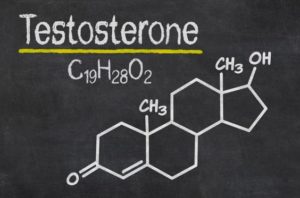
Optimal levels of testosterone are absolutely necessary to help us burn fat, build muscle, reduce depression, be successful, and, all other factors aside, it is the very thing that makes us men.

Here are 5 simple, yet powerful steps you can take right now to begin combating this epidemic and bringing back manliness!

1) Limit your exposure to plastics. Plastics contain phytoestrogens that increase the amount of estrogen in the body – not something we want!

2) Strength Training – the proper strength training protocol can boost both testosterone and growth hormone. Testosterone is responsible for both building muscle AND burning fat!

3) Cold Showers – Take a cold shower twice a day. It’s also great for mental toughness!

4) Eat your nuts. – Have a handful of Almonds and 3 Brazil Nuts first thing in the morning and again before bed to increase healthy fats.

5) Vitamins – Take Vitamin D, Fish Oil, and Zinc. All are necessary for testosterone production!


The Top 30 Testosterone Boosting Foods


These foods both directly boost testosterone and help to limit estrogen exposure.

One important thing to note is that low fat, low cholesterol diets have been the worst thing to happen to men in the past 40 years.

Remember – Cholesterol is the building block of all sex hormones, testosterone included – so eat your cholesterol!


  • Grass fed beef
  • Bacon
  • Eggs (free range)
  • Bison
  • Brazil Nuts
  • Macadamia Nuts
  • Almonds
  • Butter
  • Blue Cheese
  • Oysters & other shell fish
  • Broccoli
  • Cauliflower
  • Cabbage
  • Brussel Sprouts
  • Kale
  • Pomegranate
  • Avocado
  • Blackberries
  • Blueberries
  • Acai Berries
  • Olive Oil
  • Coconut Oil
  • MCT Oil
  • Coffee
  • Onions
  • Ginger
  • Parsley
  • Garlic
  • Raw Milk
  • Liver
  • Bonus Testosterone Boosting Super Food – Pine Pollen


FREE BOOK REVEALS… How To Go From Dad to Super Dad!
Download Your Free Copy of ** Dad Strength: The Definitive Guide to Sustainable Fitness for Men in Their 40’s, 50’s, 60’s , and Beyond! **

A 3-Phased Approach to Recover, Build, and Sustain Strength Quickly and Easily as You Get Older!

Download your copy here <<===


Need more personalized help?

Want me to work with you one-on-one to create a specifically designed program for you to burn fat, build muscle, increase energy, and optimize your testosterone levels?

Go HERE now to apply for a spot in my distance coaching program!

Be Dangerous to be Kind

Inside the heart of every man lives a warrior waiting to be unleashed. Unfortunately, this fierceness, for the majority of men, lies dormant and untested. But, I assure you, it is there.

As boys we pretended to be superheroes, Jedi knights, or ninja warriors.  I know I did all 3 with matching costumes, capes, and weapons to boot. In fact, I distinctly remember when I was 6 or 7 leaping off the back deck of my parent’s house in New Hampshire fully garbed in Superman Underoos (on the outside of my clothes, of course!) and cape fully expecting to fly.

We ran wild, climbed trees, built forts, engaged in mock sword battles, and real fist fights as boys – not to test our mettle, but really just as an open and honest expression of our warrior nature.

As we grew up though, things changed. We grew tame (lame?). The wildness was repressed and replaced under the well meaning familial and societal pressure of becoming a responsible adult. We went to school, got a job working for the man, and become domesticated.

We shed our capes in favor of business suits.

We took off our Lone Ranger masks and put on listless, polite faces.

We put down our pretend weapons and picked up pocket protectors.

We suppressed the wildness and ferocity of the warrior in our hearts and tried to follow the expected path – college, corporate job, marriage, family, retirement, death.  One more masculine casualty – a would be warrior turned tame and toothless, a tiger no more, really just an aging house cat.

But is that really all there is?

Doesn’t the wildness remain?

Yes. I assure you it most certainly does. For as I stated earlier, inside the heart of a man – every man, no matter who you are – lies a warrior.

Being a warrior is not confined to myths and legends or historical anachronisms. Nor is it merely the province of those in uniform who stand on the front lines and protect us with their own (though they truly embody the warrior spirit).

No, warriorship, at its essence is the birthright of every man. For all of us are made with a warrior’s heart, strong and dangerous.

Yes, dangerous.  The most dangerous men I have ever met have also been among the kindest and friendliest. Is this a contradiction? No, not at all. Only the truly powerful can choose to be truly gentle. Those who lack strength and courage have no choice.

A warrior must have the strength, skill, and ability to wield violence. Notice that I did not say, “be a violent man”. There is a vast difference. The warrior’s capacity for violence is tempered by discipline, a sense of justice, and a strong moral code.

Moreover, the warrior’s role in society is that of a protector and defender of life. His strength must never be used to intimidate, but only to motivate, to inspire, and to protect.

Méthode Naturelle creator Georges Hébert wrote at the beginning of the 20th century, “Être fort pour être utile” – Be strong to be useful

Those of us who walk this path of strength have a duty to use our strength to help others and to defend and protect those who are not as strong.

As Spiderman once said – “With great power come great responsibility.” 🙂

Strength must have a higher purpose.

The Warrior’s Creed

This might be my own personal bias, but I believe a warrior has a greater responsibility, one of both self and others.  My perception has been colored, for the better, I think, by my teacher, Jack Hoban, author of The Ethical Warrior: Values, Morals and Ethics – For Life, Work and Service, and his mentor, Dr. Robert L. Humphrey.

These 2 men are both true warriors whom I admire greatly.  Jack served as a U.S. Marine Corps officer and is a master level instructor in the Bujinkan martial arts.  Dr. Humphrey was a boxer and Marine Corps officer who survived the battle of Iwo Jima in World War II.

There is much, much more to both of their stories, but for now, we can sum up the essence of what it means to be a warrior like so:


“The Warrior Creed”

Wherever I go,
Everyone is a little bit safer because I am there.
Wherever I am,
Anyone in need has a friend.
When I return home,
Everyone is happy I am there.
It’s a better life! 

-Dr. Robert L. Humphrey


Everyone who calls themselves a warrior believes that they should possess greater strength, greater power, and greater skill; should they not also possess greater compassion for others and a greater sense of responsibility for helping others as well?


For those who have the strength and the skill, but no accountability, they cannot be called warriors – they are merely thugs.


Ready to Upgrade Your Power? Click HERE now.