Warrior Fitness Workout of the Week #5

8 is Enough!

This week’s Warrior Fitness Workout of the Week:

  • 8 Pull-ups
  • 8 Burpees
  • 8 Mt. Climbers (left + right = 1 rep)
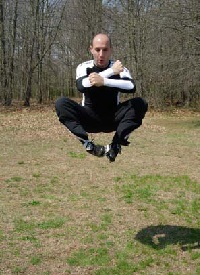
  • 8 Jumonji Squat Jumps
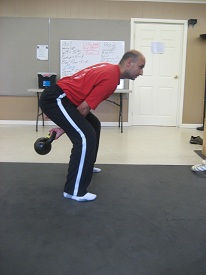
  • 8 Dumbbell Swings (4 each arm)

Complete 8 rounds as fast as possible.  Rest as needed.

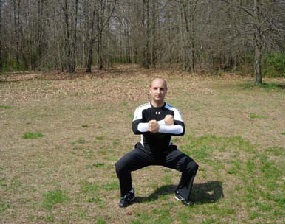
Jumonji Squat


Jump!


Modifying Your Workout

Conditioning workouts are supposed to suck.  No doubt about it!  They push your body to its limits and increase mental toughness.  However, they should be approached incrementally, especially if you are not used to them.  In this particular workout, I’d recommend that beginners cut the volume of repetitions in half.  If you still find you are struggling, increase the rest period between rounds; try not to rest in between exercises, if you can help it.   Additionally, you may perform 4 rounds to start and work your way up to 8.  As you gain confidence and begin getting stronger, you can increase the number of repetitions and rounds, and decrease the rest periods.  Change one variable at a time so you are not forcing your body to adjust too rapidly.  Remember, injury is not the goal!

Notes: Make sure you warm-up with brief joint mobility session prior to the workout.  Remember that when you sign up for our mailing list you receive a free sample chapter on Joint Mobility from my Warrior Fitness book!

For further information on the Workouts of the Week, please see our User Guide here.


Sometimes It’s OK to Not Follow the Program

Every have one of those days when no matter how fun, exciting, and productive your workout program happens to be, you just don’t feel like doing it?  I don’t mean out of lack of enthusiasm or laziness here though; motivation is not the problem.  You’re energetic and ready to train, but really just want to break out of the mold for a minute instead of sticking to the program.  This happened to me last night.  I went downstairs to my basement gym after putting the kids to bed ready, willing, and able to train.  I went through my standard head to toe joint mobility warm-up (sign up for the Warrior Fitness Mailing List to recieve a free chapter on Joint Mobility from my book, Warrior Fitness), followed by some breathing exercises to flush my bloodstream with oxygen and give me a little extra “go”, and then it hit me.  I had no desire to do my planned workout for the day.  Boom.  Just like that.  No warning, no indication, no nothing.  I stood there stunned for a minute just sort of staring into space, looking around the gym with a “what the heck do I do now” expression on my face.  Now don’t get me wrong here, I love the workout program I created for myself that I’ve been following for the past 3 weeks.  My results have been spectacular, my energy levels high, and I have, until last night, genuinely been looking forward to the workouts.  The exercises I was scheduled to perform were a combination of dumbbell lifts and bodyweight exercises designed to push my anaerobic threshold and build lean muscle while burning fat.  Great stuff!  So, what was the problem? 

What Did I Do?

I took a look around my little corner basement gym and my eyes settled on a pair of 15 lb clubbells against the wall, next to the dumbbell rack and thought to myself, Hmmm… haven’t picked those up in a while…. why not?  So I scrapped my preplanned workout for the day and picked up a clubbell.  I started out with some basic cleans to order, then moved into working shield casts, followed by mills, reverse mills.  No sets.  No rep scheme.  No timed rest intervals.  No plan.  Just playing with the movements and enjoying the freedom.  By the time I was done, 30 minutes had gone by and I was drenched in sweat and smiling ear to ear.

Sometimes it’s ok to not follow the program.  But, tomorrow it’s back to the dumbbells!

You Have No Idea What Being Fat is Costing You

Special thanks to guest author, Alan Livelsberger for this insightful post!

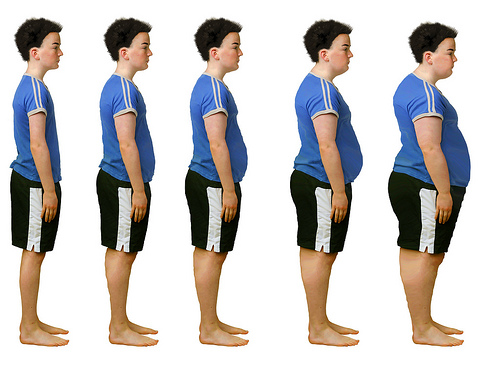
I have a secret to share with you; I used to carry a few extra pounds with me.  Almost fifty, actually.  But that’s not the secret.  Anyone looking at me could have told you that.  You’ll have to keep reading to learn my secret. 

Several months ago, I decided to do something about the extra weight.  It wasn’t easy and I am certainly not perfect with regard to adherence to my weight loss plan, but I’m halfway to my goal weight.  One of the reasons I am so far along is the Warrior Fitness blog and my access to Jon.  The blog keeps me motivated and Jon is great for keeping me honest about working out.  He’s part of my support system that is so crucial to success and I urge you to make him part of yours.

This brings me to my secret, “Looking thin is cool, but being thin is awesome.” It is a hard feeling to describe, almost like waking up from a drug induced stupor.  The best way that I’ve found to describe it is that it’s like when you’re not getting enough sleep.  Any parent knows what that is like with a new born in the house.  Months of getting up one, two, or three times a night.  You’re grumpy, you can’t focus and then . . . you get two great nights of sleep in a row.  All of a sudden you notice how you are supposed to function and what you have been missing. 

Well that is what losing 20 pounds of fat is like.  You have more energy.  I used to struggle to finish my Muay Thai class.  Now, not only can I finish the class, I can jump rope or lift weights afterward.  You can think more clearly.  I feel I am retaining more of what I read and also making those connections among seemingly unconnected data pieces.  I’ve also noticed that I have more confidence and less aches and pains. 

One of the most surprising benefits is that you feel like a winner.  You are literally piling up victories.  Every time you forgo an unapproved food or get a workout in, you are instilling a culture of winning within yourself.  Not a bad thing to have in life, for sure.

Those are some great benefits to dropping a few pounds, and I urge you to examine how you feel each and every day.  If you think there is something more to life, there is – go find it.

About the Author

Ever since being inspired by Kung Fu Theatre, Alan has been a martial arts enthusiast.  Over the course of 20 years, he has dabbled in Judo, BJJ, and Russian Martial Art.  He is currently an Instructor Candidate in ROSS and a Muay Thai practitioner.

Tabata for Kids!

Usually my favorite place for the kids to exercise is outside.  There’s nothing like running around, climbing on the jungle gym at the local playground, or just enjoying a walk on a beautiful day in the  fresh air and sunshine to fulfill your children’s daily recommended allowance of exercise.  But how about those dull, rainy days when the kids are cooped up indoors?  For some reason, indoor activities always seem to lend themselves to sedentary type things, like: video games, watching tv, surfing the Internet, playing cards or boardgames, and reading (although my kids and I all love to read, and it is fundamental, of course), for example. 

Break Up a Boring Day with Exercise!

One way I’ve found to insert a daily dose of exercise that’s fun for the kids and short enough to hold thier attention span is working on Tabata Intervals with them.  Click here for a more in-depth discussion on Tabata.  These don’t require a lot of space so they are a perfect indoor, rainy day workout to get the kids moving.  Check it out –

The Exercises:

  • Jumping Jacks
  • Lunges
  • Base Switches(Start from all fours on hands and balls of feet. Lift right hand and left foot together.  Switch to crab walk position.  Pick up left hand and right foot. Switch back to base position. Continue.)
  • Mountain Climbers

Per the Tabata Protocol, each exercise is performed for 20 seconds on, 10 seconds rest for 8 rounds.  Rest for one minute and then move onto the next exercise.  Try not to push them too much or provide too much instruction.  Just enough for them to get the form down.  Let them move at their own speed through the exercises and they will gradually pick up the pace on their own  This workout provides 16 minutes of high intensity exercise for any kid.  Get them off the couch and away from the TV to get their daily dose of exercise!

Breathing 101

I was planning to title this post, “Breathing for Dummies” after the famous how-to guides, but I realized most dummies aren’t interested in bettering their health, fitness, and extending longevity in their sports, martial arts, or activities.  Plus, I dislike the subtle insult of refering to my readers as “dummies”.  Nor would I want dummies for readers anyway.  So instead today we will go over Breathing 101.  These are what I consider to be the most effective ways to integrate breathing exercises into your daily training, and use them to increase lung capacity and efficiency of how your body processes oxygen.  We will look at several different exercises that will enable you to lower your heart rate, blood pressure, and stress levels, as well as to increase energy.

Breathing as a Bridge

You may not be aware that breathing is a bridge between our voluntary and autonomic nervous systems.  Meaning breath is plugged into both.  The autonomic system will keep you breathing continuously without your conscious control, or sometimes, without even your awareness of it going on.  But, you also have the power to override that control and decide at any moment to take a deep breath or hold your breath.  What does this mean to you though, right?  Well, here’s what it means, you have the power, at any time, to consciously choose to influence things like your heart rate and blood pressure which are not under your conscious control.  Now that’s fascinating to me!  Because breath is tied into both systems it can be used like a bridge to gain access to aspects of your body that you cannot directly control.  How do we do this?

Try This Experiment

Take your pulse.  Count beats for 10 seconds then multiply by 6.  If you’re sitting and relaxed, that number should be your resting heart rate.  Now, inhale as deeply as possible and hold your breath and tense your whole body for a few seconds.  Are you red in the face?  Take your pulse again.  What happened?  Your hear rate jumped up and your blood pressure spiked right along with it, right?  Now try exhaling for a count of 6, but don’t inhale yet.  Extend the pause before the inhale a little bit.  Feel more relaxed?  Check your pulse.  It should have dropped.  Pretty cool, eh?  And this is just the beginning.

The Exercises


Relaxing Breath (Square Breathing)

This is very similar to the experiment we did above.  The basic premise of our ability to influence the autonomic nervous system is that inhalation increases heart rate, which subsequently increase blood pressure, to a slight degree, while exhalation lowers heart rate and blood pressure to a slight degree.  During our normal cycle of breathing, these changes are too minute to register, or even notice.  But, by gradually lengthening our breath and extending the pause before inhaling and exhaling, we compound the effect.

  1. Begin by exhaling through the mouth for 5 seconds.
  2. Do not inhale.  Try to extend the breath pause for 5 seconds.
  3. Before tension begins to creep in, inhale for 5 seconds.
  4. Hold the breath on the inhale for 5 seconds.
  5. Repeat the cycle 10 times.
  6. As this becomes easier, and your capacity expands, try increasing the duration to 6, 7, 8 seconds.


Energizing Breath

In this breathing exercise we will utilize a protocol founded by yoga and improved upon by Russian sport science and martial art.  Here we will divide the breath into 3 levels: clavicular (upper level), intercostal (mid level), Diaphragmatic (lower level).  This exercise will focus only on the clavicular, or upper level.  I first learned this exercise, and several others including the next one below, about 10 years ago from my good friends Dave Rusin and Oleg Yakimovich who are ROSS Russian Martial Art instructors.  More information about ROSS can be found at their website here.  Check it out!

  1. Exhale through the mouth in a short, quick burst by compressing the upper chest.
  2. Do not actively inhale.  Allow the inhale to happen by relaxing the muscles in the chest.
  3. Repeat rapidly 20 to 40 times.
  4. Build up to where you can perform continuously for 60 seconds.
  5. If you become dizzy, stop and sit down!

Restoring Breath

Here again we will depend on Russian sport science and martial art for our technique.  This one is literally a life saver when doing high intensity anaerobic workouts!  It can be used in between exercises as well as in between sets, during the rest period, and at the end of the workout to normalize breathing and dramatically lower heart rate.

  1. Forcefully exhale as deeply as possible by rolling your shoulders forward, tilting the pelvis up, and contracting the core strongly.
  2. Pause before the inhale for a few seconds.
  3. As stated above, do not actively inhale.  Allow the breath to be sucked back in through the nose as your body returns to a natural standing posture.
  4. Repeat for about 60 seconds, or as long as needed.

Try these out and let me know how they work for you.  Any questions, please feel free to contact me here.

Basics Ain’t So Basic After All

As a teacher and student of Bujinkan Budo Taijutsu, I often hear the same question over and over again – how can I improve my skill?  What should I practice to get better?  Since I remember myself asking that question several times (probably several hundred times if you ask some people!) to my teacher and seniors in the art, I always take time to give a thoughtful and honest answer.  And, my answer to these sincere seekers is always the same  – practice the basics. 

Basic Does NOT Equal Simple 

I think maybe the term “basic” itself is a little misleading.  When someone says, basic, most of us immediately translate it in our minds to “simple”.  Nothing could be further from the truth for the basics of our martial art.  What I’d like us to do today for the purposes of our discussion is to suspend the judgement that basic = simple.  Instead, replace the word basic with foundational.  How do you continue to build upon a skill set indefinitely?  Well, the foundation must be strong.  It must be broad.  And, to keep going higher still, it must be deep.

Each January, every year, for the past 20 years I have been training in the Bujinakn, my teacher, Jack Hoban, spends the entire month with us reviewing nothing but the basics of our art.  This sets the tone for the year and helps to increase the capacity of the entire class to absorb the higher level lessons for that year.  Guess what?  Invariably, I learn something new each time Jack teaches.  Every year, just by practicing the basics… eh… excuse me… the foundational training of our system new ideas, new concepts are born as we go deeper into the details and application of the techniques.

Shu Ha Ri

In traditional Japanese arts, there’s a concept called Shu-Ha-Ri.  This is a method of progression, or more accurately, a cycle of progression, for learning any art.

Shu – “Protect” the form. 

Ha – “Break” the form

Ri – “Leave behind” the form

This process is a continuous cycle in our Bujinakn training.  In order to progress higher in the art, our base must be solid, so we protect the form.  In order to understand the art, we must begin to break the form.  In order to master the art, we must leave the form behind.  Yet, this is not a linear progression at all!  Working on the foundation is never a step backwards.  Think of it more as a ratcheting back to spring forward.  Want to surpass your current level?  Strengthen the foundation.

Think you know the basics?  Think again.

I will be sharing my interpretation and experience of the foundational skills of Bujinkan Budo Taijutsu here.  Please come and check it out!

How to Train for the Endurance of a Ninja

As promised, here is an example strength endurance workout to start you on the way to building ninja-like endurance.

We will work the upper body, core, and lower body for a complete, whole body workout.

The goal of this type of training is to improve the body’s general endurance capacity so as to increase our overall resistance to fatigue.  This will enable you to train longer, harder, and more frequently, as well as improving your ability to recover between training sessions and between exercises.

Instructions

Move from one exercise to the next with no rest between exercises.  Determine rest periods at the end of each set on your own.  If no rest is required then move back to the first exercise and begin again.  Strive to perform as many sets as possible in 20 minutes.

Upper Body:

  • Pull-ups – SM (submax)
  • Shuto Push-ups – 20
  • Fist Push-ups – 20
  • Hindu Push-ups – 20

Shuto Push-up


Core: 

  • V-ups – 20
  • Knee Hugs – 20

For reference, these exercises are illustrated and described here.

Legs:

  • Ichimonji Squats – 25 each side
  • Walking Lunges– 20 per leg
  • Mountain Climbers – 50 per leg

Finisher:  

  • Wall Sit for time

This last exercise we will perform only once when the main work above is complete.  The idea here is to provide a final challenge to both the body and the mind.  You will already be exhausted from all the prior work, so consider this an exercise in willpower and mental toughness.  This will require the mental fortitude to push yourself just a little bit farther!

Remember, it requires more than a black costume and funny split-toe shoes to be a ninja – train hard!


Martial Power Cover1

Blueberry Almond Joy Protein Shake

Looking for a quick and easy meal that’s healthy too?  Try this delicious recipe for a shake full of protein, healthy fats, and antioxidants!

What You’ll Need:

  • 1 Scoop natural whey protein powder
  • 1 Scoop Greens Plus powder
  • 1  Tablespoon almond butter
  • 1 Tablespoon shredded coconut (no sugar added)
  • 1 Cup frozen blueberries
  • 1 Teaspoon cinnamon
  • 1/2 Cup plain Greek yogurt
  • 1 Cup coconut milk or organic whole milk (depending on preference)

Put all the ingredients in a blender.  Mix it up and enjoy!


So Ya Wanna Be a Ninja?

Masaaki Hatsumi, Grandmaster of the Bujinkan Dojo, once stated, “endurance is of primary importance for the ninja.”  One definition of endurance is the ability to resist fatigue.  Looking at the kanji (Chinese character) for Nin, there is the ideogram for “sword” over the ideogram for “heart” giving Nin a meaning of, “even though you hold a sword over my heart, I will endure.” 

How many of us training in the Bujinkan, or any other martial art, can truthfully claim that ability?  How long can you train?  How far can you push yourself?  In martial art, endurance, or the ability to “keep going” is defined in years, not minutes, hours, or days.  How can we create an effective training program that will instill in us the ability to continue, to endure?

Physical Endurance

Let’s begin by examining the concept of physical endurance.  There are 3 basic types of physical endurance:

  1. Aerobic endurance
  2. Anaerobic endurance
  3. Strength endurance

We discussed the body’s 3 energy systems and how using the Tabata Protocol can effectively improve both the aerobic and anaerobic systems here.  Strength endurance is defined as the ability to effectively maintain muscular functioning under work conditions of long duration.  There are two basic ways to increase the ability of your body to do more physical work.  One is the continuous adding of weights, sets, reps, and time to push the body to create an adaptation to allow it to perform more work for a longer duration.  As we discussed previously in the article on GPP, the body’s capacity is expanded.  Progress is incremental and continuous for as long as one is able to keep increasing driving forces in the body.  The next one, however, is often overlooked in our “just add more volume” culture.  More is always better, right?  If one vitamin is good for you, take 4, that’s even better (please don’t!).  But, there is another way to allow the body to continue training in addition (no pun intended) to adding more work.  By removing restrictions in your body, like unnecessary tension or extra body weight or lack of flexibility/mobility in a particular area, you then free up resources in your body that were spent holding that tension that you weren’t even aware of on a conscious level.  These restrictions, once removed, allow even greater leaps in performance than simply adding more work.  When the 2 are combined, it’s a powerful combination!

How Do We Program It?

By programming our workouts so that we effectively build in both the removal of restrictive forces, while also increasing driving forces, we can maximize our progress.  This idea is present in traditional methods of Hatha Yoga in the form of balancing strength and surrender.  Contrary to popular opinion, yogi’s do not simply work to become more flexible.  They actively work to increase both strength and flexibility as complimentary opposites in order to achieve a state of balance.  Now, I’m not asking you to become a yogi here, merely pointing out that this is not a new concept at all, but has been used by traditional arts for thousands of years.  Our program for developing ninja-like endurance will utilize both joint mobility exercises and yoga asana (poses), as well as breathing exercises, to aid in the removal of restrictive forces binding your training and slowing your progress.  Next week I will be putting out an article on breathing exercises that can be used for relaxation, stress management, removing residual tension, and also for increasing energy – keep your eyes out!

For an example of some easy yoga postures that can start helping you right now, head over to my good friend Josh Sager’s excellent blog, Fretterverse, and check out my article on Yoga for Guitarists.   A free sample joint mobility training program can be obtained simply by signing up for the Warrior Fitness Mailing List at the top right of the page.  Sign up now and begin working on removing restrictive forces today!

And, don’t forget to check out Warrior Fitness: Conditioning for Martial Artists for more exercises, options, explanations, and program design!

Stay tuned for a sampleStrength Endurance Workout coming soon!