How to Train for the Endurance of a Ninja

As promised, here is an example strength endurance workout to start you on the way to building ninja-like endurance.

We will work the upper body, core, and lower body for a complete, whole body workout.

The goal of this type of training is to improve the body’s general endurance capacity so as to increase our overall resistance to fatigue.  This will enable you to train longer, harder, and more frequently, as well as improving your ability to recover between training sessions and between exercises.

Instructions

Move from one exercise to the next with no rest between exercises.  Determine rest periods at the end of each set on your own.  If no rest is required then move back to the first exercise and begin again.  Strive to perform as many sets as possible in 20 minutes.

Upper Body:

  • Pull-ups – SM (submax)
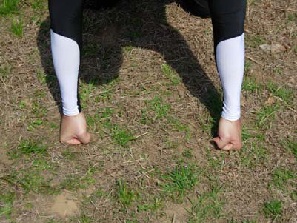
  • Shuto Push-ups – 20
  • Fist Push-ups – 20
  • Hindu Push-ups – 20

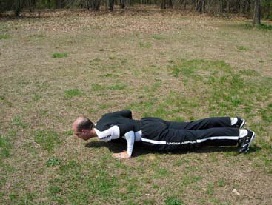
Shuto Push-up


Core: 

  • V-ups – 20
  • Knee Hugs – 20

For reference, these exercises are illustrated and described here.

Legs:

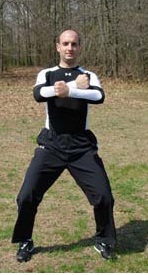
  • Ichimonji Squats – 25 each side
  • Walking Lunges– 20 per leg
  • Mountain Climbers – 50 per leg

Finisher:  

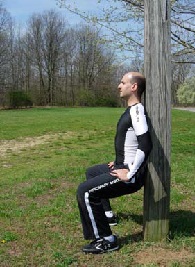
  • Wall Sit for time

This last exercise we will perform only once when the main work above is complete.  The idea here is to provide a final challenge to both the body and the mind.  You will already be exhausted from all the prior work, so consider this an exercise in willpower and mental toughness.  This will require the mental fortitude to push yourself just a little bit farther!

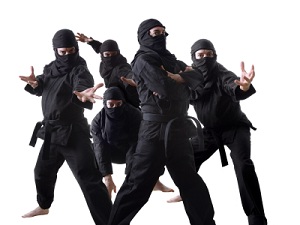
Remember, it requires more than a black costume and funny split-toe shoes to be a ninja – train hard!


Martial Power Cover1

Blueberry Almond Joy Protein Shake

Looking for a quick and easy meal that’s healthy too?  Try this delicious recipe for a shake full of protein, healthy fats, and antioxidants!

What You’ll Need:

  • 1 Scoop natural whey protein powder
  • 1 Scoop Greens Plus powder
  • 1  Tablespoon almond butter
  • 1 Tablespoon shredded coconut (no sugar added)
  • 1 Cup frozen blueberries
  • 1 Teaspoon cinnamon
  • 1/2 Cup plain Greek yogurt
  • 1 Cup coconut milk or organic whole milk (depending on preference)

Put all the ingredients in a blender.  Mix it up and enjoy!


So Ya Wanna Be a Ninja?

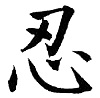
Masaaki Hatsumi, Grandmaster of the Bujinkan Dojo, once stated, “endurance is of primary importance for the ninja.”  One definition of endurance is the ability to resist fatigue.  Looking at the kanji (Chinese character) for Nin, there is the ideogram for “sword” over the ideogram for “heart” giving Nin a meaning of, “even though you hold a sword over my heart, I will endure.” 

How many of us training in the Bujinkan, or any other martial art, can truthfully claim that ability?  How long can you train?  How far can you push yourself?  In martial art, endurance, or the ability to “keep going” is defined in years, not minutes, hours, or days.  How can we create an effective training program that will instill in us the ability to continue, to endure?

Physical Endurance

Let’s begin by examining the concept of physical endurance.  There are 3 basic types of physical endurance:

  1. Aerobic endurance
  2. Anaerobic endurance
  3. Strength endurance

We discussed the body’s 3 energy systems and how using the Tabata Protocol can effectively improve both the aerobic and anaerobic systems here.  Strength endurance is defined as the ability to effectively maintain muscular functioning under work conditions of long duration.  There are two basic ways to increase the ability of your body to do more physical work.  One is the continuous adding of weights, sets, reps, and time to push the body to create an adaptation to allow it to perform more work for a longer duration.  As we discussed previously in the article on GPP, the body’s capacity is expanded.  Progress is incremental and continuous for as long as one is able to keep increasing driving forces in the body.  The next one, however, is often overlooked in our “just add more volume” culture.  More is always better, right?  If one vitamin is good for you, take 4, that’s even better (please don’t!).  But, there is another way to allow the body to continue training in addition (no pun intended) to adding more work.  By removing restrictions in your body, like unnecessary tension or extra body weight or lack of flexibility/mobility in a particular area, you then free up resources in your body that were spent holding that tension that you weren’t even aware of on a conscious level.  These restrictions, once removed, allow even greater leaps in performance than simply adding more work.  When the 2 are combined, it’s a powerful combination!

How Do We Program It?

By programming our workouts so that we effectively build in both the removal of restrictive forces, while also increasing driving forces, we can maximize our progress.  This idea is present in traditional methods of Hatha Yoga in the form of balancing strength and surrender.  Contrary to popular opinion, yogi’s do not simply work to become more flexible.  They actively work to increase both strength and flexibility as complimentary opposites in order to achieve a state of balance.  Now, I’m not asking you to become a yogi here, merely pointing out that this is not a new concept at all, but has been used by traditional arts for thousands of years.  Our program for developing ninja-like endurance will utilize both joint mobility exercises and yoga asana (poses), as well as breathing exercises, to aid in the removal of restrictive forces binding your training and slowing your progress.  Next week I will be putting out an article on breathing exercises that can be used for relaxation, stress management, removing residual tension, and also for increasing energy – keep your eyes out!

For an example of some easy yoga postures that can start helping you right now, head over to my good friend Josh Sager’s excellent blog, Fretterverse, and check out my article on Yoga for Guitarists.   A free sample joint mobility training program can be obtained simply by signing up for the Warrior Fitness Mailing List at the top right of the page.  Sign up now and begin working on removing restrictive forces today!

And, don’t forget to check out Warrior Fitness: Conditioning for Martial Artists for more exercises, options, explanations, and program design!

Stay tuned for a sampleStrength Endurance Workout coming soon!

What’s Tabata You?

If you have been keeping up with the latest trends in conditioning research then you probably already know that interval training is the most efficient way to train.  Interval training alternates periods of high intensity exercise with periods of rest to produce gains in both aerobic and anaerobic systems.  Forget about those long slow distance runs to improve aerobic fitness!

The Body’s 3 Energy Systems

To briefly summarize, the body has three energy systems, 2 anaerobic, or non-oxidative, and 1 aerobic, that serve to create ATP (adenosine triphosphate).  ATP is utilized by every cell in your body; it fuels muscular contractions, cognitive processes, and internal regulatory functions.   Both anaerobic systems fuel maximally intensive activity, while the aerobic system fuels sustained low to moderate level activity.

The ATP-PC system provides immediately available energy for high intensity efforts from ATP stored within the muscles.  This system is the most powerful, but least enduring of the three, lasting only about 10 to 30 seconds max.

The Glycolytic system, the second most powerful, is only slightly more enduring than the ATP-PC system.  It derives energy from glycogen stored in the muscles and liver converting it to ATP in a process called glycolysis.  Its capacity is approximately 90 to 120 seconds.  Rest intervals allow the body to recuperate and restore ATP.

Lastly, the Aerobic system uses proteins, fats, and carbohydrates to produce ATP.  As the intensity of the effort increases, the aerobic system relies more on glycogen for energy.  If the intensity continues to increase, the anaerobic systems must kick-in to provide energy.  The important idea to realize here is that all 3 energy systems are always supplying the body with the energy it needs for any activity, at any level of intensity.  It’s just that one may be more dominant than the other 2 at a specific time.

If Anaerobic is ‘Without Oxygen’, Why am I Sucking Wind?

If you have been following any of the Warrior Fitness Training Programs, you are already familiar with examples of anaerobic exercises and how they affect the body.  Have you noticed how after even a brief, but intense anaerobic session you are breathing heavily?

If anaerobic really means ‘without oxygen’, how come you are so out of breath?

What happens is that your aerobic system is trying like heck to help restore your anaerobic systems.  All that extra oxygen is being used to metabolize the lactate that’s accumulated in the muscles during the bout of intense activity.  In order to continue to supply energy for all-out, intense efforts, the anaerobic system must be replenished.  Excess Post-exercise Oxygen Consumption (EPOC) is the term used to identify this process of extra oxygen being taken in to restore all systems.  So, basically, as the intensity of your exercise increases, so does your EPOC.  And, that’s why you’re sucking wind!

Tabata Protocol

No discussion of interval training would be complete without touching on Tabata.  Dr. Izumi Tabata at the National Institute of Fitness and Sports in Tokyo, Japan performed perhaps the most well known study on interval training.   A group exercising with moderate intensity endurance training was compared to another group using high intensity intermittent training.  Each group exercised 5 days a week.  The moderate intensity group exercised for 60 minutes, at 70% VO2 max.  The high intensity group did 8 intervals of 20 seconds, followed by 10 seconds of recovery.  They operated at 170% VO2 max.

After 6 weeks, both groups experienced improvements in maximal oxygen uptake.  The biggest difference between them was that only the high intensity group gained improvement in anaerobic capacity.  The high intensity group actually realized a 28% increase in anaerobic capacity AND a 14% increase in VO2max.  So, the study concluded that high intensity intermittent training can improve both the anaerobic and aerobic systems simultaneously.  Very impressive results!

How Can I Use Tabata?

I knew that after reading the amazing results achieved by Dr. Tabata you’d be ready to try using his protocol, I sure was!  The protocol itself is pretty simple, in theory.  Choose an exercise – say sprints, for example.  Perform the exercise for 20 seconds as fast as possible while still keeping good form.  Rest 10 seconds.  Complete 8 rounds.  Sprints are an easy example, but really the Tabata Protocol can be applied to almost any exercise.  Try some of these:

  • Bodyweight squats
  • Burpees
  • Kettlebell swings or snatches
  • Sledgehammer swings
  • Push-ups
  • Sprawls
  • Renegade Rows
  • Sandbag Shouldering
  • Mountain climbers
  • Jumping

These are just a few examples of exercises that can be used with Tabata. Just make sure you don’t overly complicate it because you do have to be able to perform several reps within the 20 seconds!!

Additionally, try grouping together 4 to 6 different exercises to increase the effectiveness of the workout and create a synergistic effect where the total combined effect is greater than the sum of the individual exercises.  This, I think, is where the real fun begins!

To seriously amp up your conditioning, learning how to use various breathing techniques to restore yourself quicker, lower your heart rate, and increase the effectiveness of your conditioning sessions is a MUST!

warfit3d3

Fitness Requirements for Bujinkan Martial Arts Training – part 2

In part one of this series, here, we discussed why it makes sense for Bujinkan practitioners, and indeed all martial artists, to include a fitness regimen as part of their training.

We also reviewed the basics of General Physical Preparedness (GPP), and why it is necessary.

Today, I’d like to talk about some specific examples of GPP type exercises and how to incorporate them into an overall training plan for both martial arts and fitness.

If you are attending classes and training on your own outside of dojo (highly recommended by the way), then you probably already have a pretty full schedule.  Add in a full-time job, spouse and kids to the mix and any extra time you may have dwindles down fairly quickly.  What is required is a way to obtain the benefits of this supplementary training without consuming more time you just don’t have. 

Therefore, let’s make it easy and eliminate a few of the top time-consuming excuses right off the bat:

Time Saving Strategies


1.  No gym will be required.  Right here you save the time it takes to commute to and from the gym, waiting for equipment, and the general socializing chit-chat around the water cooler.

2.  Virtually no space required.  We can do these exercises anywhere from a park and backyard to a small apartment living room or hotel room.

3.  No (or minimal) equipment required.  We can begin training right now with only our bodyweight as resistance and obtain amazing results.  Adding in portable equipment like clubs, sandbags, kettlebells and dumbbells will also add to the results!

So, we have pretty much eliminated time constraints, space constraints, and financial constraints from the equation.  No more excuses!  Let’s get down to work!

Oh, did I forget to mention that this workout will be brief, but intense,  and help to build whole-body functional strength?  Another time management function brought to you by Warrior Fitness.  The only caveat I have is this – remember that GPP exercises are not sexy.  Yes, they will help you to look sexy, but the exercises themselves don’t get seriously cool until we move up to Specific Physical Preparedness and beyond.

Exercise One

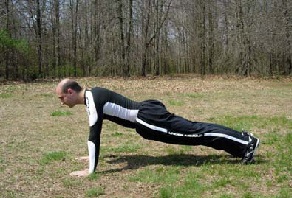
Push-ups.  Do them on your fists to strengthen the structural alignment for striking.  We will be incorporating the Dynamic Effort Method here, which is basically lifting a non-maximal load (your bodyweight) as fast as possible.  Begin in the top portion of the push-up.  Descend in a slow, controlled manner.  At the bottom portion of the exercise, explode upwards as fast as possible.  Do 10-25 repetitions.  Rest 60 seconds, then move on to exercise two.

Exercise Two

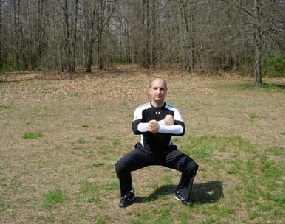
Bodyweight Squats.  Do them in Jumonji no Kamae, as shown below.  Utilize the same protocol as above.  Descend in a slow, controlled manner.  At the bottom of the squat, explode back to standing.  Do 25 repetitions.  Rest for one minute, then move on to exercise three.

Exercise Three

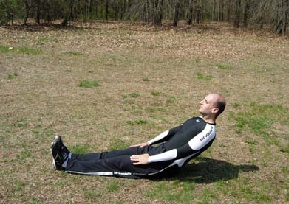
Straight Leg Sit-up.  Lie flat on your back.  Exhale, contract the core, and begin to sit up slowly keeping your spine straight.  Inhale at the top of the movement.  Exhale again and slowly lie back down.  Perform 5 repetitions of the straight leg sit-up.  Rest for 60 seconds and return to exercise one.  Continue until you have completed 5 sets of all 3 exercises.

How Often?

This workout can be performed 3 times a week, depending on your schedule and your fitness needs.  If you are including conditioning work as well, for an example see the WarFit Combat Conditioning System then this strength based GPP workout should only be done twice a week.  Here is an example of what a weekly schedule may look like:


Monday
  • Joint mobility warm-up
  • GPP Workout
  • Class training
Tuesday
  • Joint mobility warm-up
  • Solo Training
Wednesday
Thursday
  • Joint mobility warm-up
  • Solo Training
Friday
  • Joint mobility warm-up
  • WarFit Conditioning Workout
  • Yoga for compensatory movement


This is just one option of how fitness and marital arts can be combined in a weekly schedule.  If you have the luxury of being able to do a conditioning workout after your martial arts class instead of on a separate day, you can save more time.  Or, try getting up earlier and doing the workouts in the morning so your evenings are free for family time or more budo.

Future articles in the series will look at Specific Physical Preparedness, as well as Activity (martial art) Specific Exercises for Bujinkan training.  Additionally, I will expand on GPP, showing new exercises, and how to increase the difficulty levels of the exercises discussed today.

To learn more about the Warrior Fitness training method, exercises, and programming options, check out Warrior Fitness: Conditioning for Martial Arts.


Fitness Requirements for Bujinkan Martial Arts Training

As a 25 year veteran of Bujinkan martial arts training, as well as being the creator of Warrior Fitness Training Systems, one of the things I pride myself on is my ability to access the fitness needs of my fellow martial artists, particularly those who train in the Bujinkan.

A common misconception that you’ll hear bandied about from dojo to dojo all across the world is that strength, and by association overall, general fitness, is not required.

I think this has to do with a fundamental misunderstanding of how we train.  In class, when practicing techniques, it is imperative to be as efficient in one’s movement as possible, and thus avoid using excess, unnecessary power (read – strength).

In order to isolate the study of distance, timing, angling, and space management, one must put strength on the back burner in the dojo to avoid powering through the movements and missing all the wonderful subtleties that taijutsu has to offer.

However, in an actual conflict, you can and in fact, you must, use all your power, including strength, to survive.  As Jack Hoban said in his interview here, “real fights are very physical – tiring and punishing”.  Anyone who thinks physical fitness isn’t required in the traditional martial arts is really just kidding themselves.

Bujinkan Practitioners and Fitness

Why do Bujinkan practitioners need fitness training?

Optimal physical conditioning provides the platform from which the skills can be used.”  

– Fred Hatfield, aka Dr. Squat

Meaning that the specific physical skills of taijutsu MUST be built upon a solid foundation of basics, like sanshin no kata and kihon happo, and even more fundamental, a strong budo-body.  Without this platform in place your martial art skills are like a house built on sand.

From my book, Warrior Fitness: Conditioning for Martial Arts:

 “Since combat occurs in a volatile and unpredictable atmosphere, training must prepare the warrior to adapt. Remember that the goal of all the exercises in this manual is to develop the ability to control the degree of tension in our body and be able to utilize just the right amount of force at the appropriate moment. This way we may be able to sustain activity for longer and longer periods of time without exhausting ourselves.”
 

The first step in ensuring you are building skill on top of a solid foundation is General Physical Preparedness (GPP).  The goal of GPP is enhanced work capacity.  This is the ability to run faster, jump higher, and hit harder.

When work capacity increases, it allows the budding warrior to adapt more easily to increases in both mental and physical demands.  In other words, it increases your capacity and level of readiness to absorb higher levels of specificity.  In a martial art as seemingly limitless as Budo Taijutsu, one must possess the endurance to “keep going!”

In Part 2 of this series on fitness for Bujinkan practioners, we’ll look at some examples of GPP type exercises and how to incorporate them into an overall training program.

  • Looking to increase your level of readiness for martial arts training and fitness?


Want to train more, at a higher level, for a longer period of time?


Want to get more out of your training time both at home and in the dojo?


Want to build new skills and enhance your technical arsenal?

My brand new program, The Power Protocol, will show you how!

How Dense are You?

In today’s hectic world it seems we are all continually struggling to fit more and more into less and less time.  Whether it’s squeezing more work into a 9 to 5 day, cramming more activities into a 2-day weekend, or condensing a week’s worth of email posts into a digestible digest version, it seems we are all trying to become more dense.  In that spirit, I’d like to offer the option of Density Training.  This is by no means the only way to train, nor is it recommended to use it as your sole form of conditioning, but when you are short on time and are looking for ways to do more with less, Density Training is definitely a viable option.

Density Training Concept

The concept of Density Training is pretty simple.  Do more work in the same amount of time or do the same amount of work in less time.  So, for example if you were using  push-ups as the exercise and the last time you used this protocol you managed to do 100 push-ups in 10 minutes, then this session you would either try to increase the number of push-ups you can do in 10 minutes or strive to do 100 push-ups in under 10 minutes.  Not rocket science, right?  What if this is your first time attempting this type of training?  Pick your exercise, let’s stick with push-ups for continuity’s sake, and pick an amount of time, say 10 minutes.  Then try to do as many push-ups as you possibly can in that 10 minutes.  Crank them out.  Push yourself (pun intended).  Remember the time limit used and amount of reps achieved, or preferably write it down, and the next time do more.  Simple as that.

More Options

Density Training can be used with almost any exercise.  Here are some additional examples:

  • Sprints – pick a relatively short distance, maybe 30 to 50 yards, and see how many sprints you can complete in 10 minutes
  • Rope Skipping – not my thing really, but hey, who’s discriminating?
  • Heavy Bag punching, kicking, elbowing, kneeing, or any combination – how many strikes can you throw in 10 minutes (Yes I know I keep using 10 minutes, but you don’t have to.  Find something that works for you.)
  • Any Bodyweight exercise – Burpees are great for this!
  • Make it martial arts specific and see how many sword cuts you can do in 10 minutes.  Just remember to keep the technique level high or you’re wasting your time!!

Remember, this is not the only option out there for those short on time, but it is a good one.  Give it a try and let me know how it works out for you.  Try it with different exercises.  Experiment.  Have fun!

8 Ways to Fit in Your Fitness

It’s often been said that if you want something done you should give it to a busy person.  While this may be true of some busy people, namely the ones who are highly motivated, highly productive, and highly efficient, what about all the other busy people?

What about those who are busy through poor time management skills, or maybe those who are simply overwhelmed?  How about them?  Does the task they are given merely get thrown on top of a growing pile of “To-Do’s”, or even worse, shuffled to the bottom?  What if the task they are given, or give themselves, is directly related to increasing their quality of life and most likely longevity as well?  What if that task will help them be more productive at all their other tasks by reducing stress levels, increasing energy, and their overall sense of well being?  What if that task would help them to reduce, remove, or otherwise prevent a host of daily aches, pains, and illnesses that are stoically (or sometimes not so) suffered as things that “just happen” as we grow older?


Here’s a list of 8 ways for these busy people to fit in their fitness and reclaim a healthy lifestyle:

1.  Plan it out.

Scheduling is the key to successful time management.  Look at your weekly calendar and plan to exercise just as you would plan an important client meeting, a lunch with an old friend, or coaching your kid’s Little League team.

2.  Exercise wherever you are.

Joint mobility sessions can be done at your desk – see here.

3.  Take the Stairs.

Work in an office building?  Take the stairs instead of the elevator.  See how fast you can make it to your floor – beat those lazy suckers in the elevator to your floor!

4. Get outside.

Have a lunch break?  Go outside and go for a walk.  10 minutes in the fresh air will do wonders for you.  Eat at your desk while you work and then go for a walk.  Want to make your walk more productive?  Try inhaling for 5 steps, holding you breath on the inhale for 5 steps, exhaling for 5 steps, then holding the breath after the exhale for 5 steps.  When you can comfortably do that for the entire duration of your walk, increase to 6, 8, 10 steps!

5. Get up earlier.

Get up earlier and workout **warning – this one requires effort and commitment!!**

6.  Exercise together.

Spend quality time with your kids.  Exercise together – see Warrior Fitness for Kids.

7.  Brief workouts.

Got a spare 15 minutes?  Bring the intensity and lose the long, boring workouts.  See the Warrior Fitness WOWs for some ideas.

8.  Isometrics.

These require very little time to be effective, need no equipment, and can be done literally anywhere.

Obviously, this list is neither exhaustive nor all inclusive,  but I do hope it has helped you and sparked some ideas to help you fit in your fitness no matter how busy you are.  What ideas do you have?