Warrior Fitness Workout of the Week #3

Let’s change it up a little bit this week and spend some time focusing on our core.  Since all movement originates from the core of the body, it makes good sense to target it specifically and ensure our cores are strong, mobile, and integrated with the rest of our body.  Instead of wasting time doing endless crunches, or spending crazy amounts of money on relatively useless tummy flattening gimmicks (as sold on late night TV), try this functional core workout instead! 

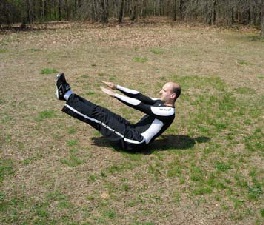
V-up

  • 10 V-ups 

Lie flat on your back with arms stretched out over your head.  Exhale, contract the core and lift arms and legs together.  Inhale as you lay back.  Repeat. 

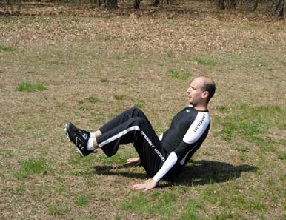
  • 10 Knees to Chest 

Sit with legs extended straight.  Lean back slightly and lift legs, bringing knees to chest.  Exhale as you contract, inhale as you straighten. 

Knees to Chest

  • 10 Crunches with 3 second isometric hold

Yes, sometimes even crunches can be useful.  Just depends on how you do them!  In this case, perform a normal crunch, but as you lift off the ground exhale, contract the core tightly and hold for 3 seconds before descending.

  • 10 Pendulum Leg Lifts (side-to-side) 

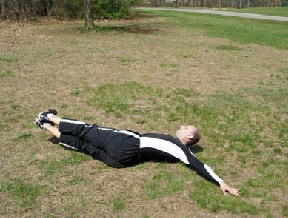
Pendulums

 Lie flat on your back with your legs straight up in the air, knees locked.  Exhale and slowly drop your feet to the left side, back to center, then the right side.  This is one rep.  

Instructions

Complete 5 rounds. Rest 90 seconds between each round; no rest between exercises.  

Need a Finisher?

Finishers are used to squeeze just a little bit extra out of the workout.  They are awesome for increasing mental toughness as well!

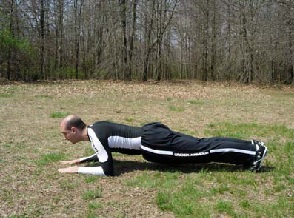
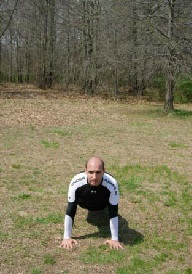
  • Finisher Exercise: Plank hold for time – get in position and hold as long as you can.  See if you can last 5 minutes!

Plank Hold


For more information on the Warrior Fitness Workouts of the Week, please see our User Guide.  And, as always, please let me know if you have any questions or comments.  Reach me here or leave a comment below. 

Want to know more?  Check out Warrior Fitness: Conditioning for Martial Arts!


Top 10 Things to Look for in a Kid’s Martial Arts Class

One of the first things fellow parents tend to ask me after they find out I’ve been involved in the martial arts for over 25 years is, how do I find a good martial arts class for my kids?  Well, after years of answering this question, I realized my answers tend to follow a certain pattern.  They may be expressed in slightly different terms and the order of the points may change each time I’m asked, but the answers remain the same.  So, for all those parents out there who are looking to involve their child(ren) in the martial arts (a highly recommended pursuit, by the way),  I’ve formulated my own “top 10” list:

1.  Is the school a franchise? 

 These typically have cookie-cutter, one size fits all programs and tend to be belt factories.  Steer clear!  There may be franchises out there that do not fall into this category, but I haven’t run into them.

2.  Do the kids in class fear the teacher or respect him? 

This is very telling.  As a kid, I was afraid of my first karate teacher and even though I loved the art and practiced like crazy at home, I’d try to get out of going to class almost every week. 

3.  Are the parents sitting in the waiting room comfortable with the teacher and happy with the class? 

When you visit a school, talk to the parents who have been there awhile.  Do they constantly complain about the teacher, the atmosphere, or even the cost?  Do their kids love the program or simply tolerate it?  Also, what is the vibe you pick up when walking into the school – listen to your gut!

4.  Variety! 

Kids get bored very easily.  And, when they are bored, they don’t learn very well.  Classes should have a wide variety of drills to show children principles and techniques from many different perspectives.  Remember, martial arts are not academic subjects!

5.  Tons of physical exercise. 

Kids have a lot of energy.  Exercises that teach physical skills, as well as give them an outlet for their energy are the best.  Also, in case no one has told you, we have a growing childhood obesity problem in this country.  Exercise, along with a focus on a healthy diet, is key to resolving this issue and giving our kids the tools to ensure a lifetime of health.

6.  Do they teach self-defense applications of kata, or just the forms?

This is essential, not only for the correct transmission of the art, but also for the students to understand how to actually apply the techniques.  Obviously, this must be tempered to make some aspects of practice age appropriate, but it must be taught.

7.  Do they teach rolling and falling techniques?

 Not only are these fun for the kids to practice, but they can, and do, prevent injuries.  Very important both in the dojo and out in real life.  Additionally, they help to develop coordination, agility, and kinesthetic awareness!

8.  Is situational awareness stressed?

This is, without a doubt, the most important aspect of self-defense and must be continuously stressed and communicated.  Bad things do not “just happen” to kids.  There are always pre-incident cues that are present, if one is paying attention.

9.  Do the kids in class appear to be motivated or just going through the motions?

Watch carefully when you visit the class.  Are they lackadaisical in their practice?  Do they look like they don’t want to be there?  Or, are the kids energized and focused throughout the class? 

10.  Leadership. 

A school does not need to have a specific, defined class program on “Leadership” (these are usually a colossal waste of money for parents… hint, hint!).  It should, however, endow the students with leader qualities through the example of the teacher and by getting the kids involved in the class room (dojo) instruction.  This can be done by rotating who leads various drills and allowing children to teach their peers by explaining and demonstrating certain kata, techniques, or exercises.  This is not only good for the child’s self confidence, but also for their overall and long term development.

Applying Six Sigma Principles to Your Fitness Plan

Six Sigma is a process improvement methodology that has its origins in the manufacturing business.  It has been adapted and expanded to cover a wide variety of business products, services, and help foster solutions in terms of reducing costs, removing defects, and continuously increasing efficiency.

Today, we are moving from the boardroom to the gym and looking at ways to apply a scaled-down version of Six Sigma methodology to improving your health and fitness.  Right now, you are the product and we are looking for ways to foster continuous improvement in you!

What is DMAIC?

Let’s look at one of the basic methodologies for Six Sigma projects called DMAIC and see how it can be applied to improve your fitness program.

DEFINE the problem and project goals specifically.

  • What are your fitness goals, right now, today?  Whether it’s to lose a certain number of pounds in an allotted time-frame, or be able to do a one-arm push-up at 40, it doesn’t matter.  Here is where we define our objective.

MEASURE key aspects and collect data.

  • What is your current weight or dress size or waist size?
  • How many push-ups can you do in one session?
  • How many calories, carbohydrates, and grams of protein do you eat daily?
  • How many servings of fruits and vegetables do you eat daily?
  • What is your resting heart rate?  Blood pressure?  Cholesterol numbers?
  • How fast can you run a mile?
  • Or, any other measurements that pertain specifically to the goal you outlined in the Define section above.

ANALYZE the data to investigate and verify cause and effect relationships.  Determine the root cause of the problem.

  • Do you have 3 sausage, egg and cheese breakfast sandwiches from Dunkin Donuts daily and notice that your cholesterol has sky-rocketed, your blood pressure is too high, and your waist line has expanded?
  • Do you run out of breath climbing a flight of stairs?
  • Or, not have enough energy to play with you kids in the park?
  • Do you aspire to run a marathon this year, but can’t get motivated?
  • Look closely at the data you gathered above and figure out what is holding you back from achieving your goal.

IMPROVE or optimize the process based on the analysis.

Here is where all the real work gets done, but also where you may encounter a stumbling block.  You’ve defined your goal, measured key aspects as they relate to your goal, analyzed all the data and determined the root cause of the problem, but what do you do now?

This is where having a knowledgeable and highly experienced Coach comes into play

(Book a Strategy Session Call with me HERE).

You need someone who can review the findings above and determine the best possible solution for you.  This includes:

  1. Knowledge and understanding of exercise methodologies and how to apply them on a case-by-case basis.
  2. Ability to design an individualized fitness plan for you.
  3. Ability to effectively and efficiently get you the maximum results in the minimum amount of time.
  4. Ability to communicate, break things down, and respond accordingly to questions and concerns.
  5. Ability to motivate and keep you on the path.

CONTROL future state process to ensure any deviations from the target are corrected before they result in defects.

  • Here is where your progress is charted and tracked to make sure slippage does not occur.  If slippage does occur, it can be noticed and corrected for immediately to assure the project – a fit and healthy you – remains on track!

Many companies and organizations have applied these principles to better their businesses, increase production, reduce costs, and improve their overall business processes.  Why shouldn’t you be able to take the same ideas and apply them to your health and fitness?

Warrior Fitness Executive Coaching Program

Book a Free Strategy Session call with me HERE to see if you are a good fit.

Warrior Fitness for Kids!

This will be the first in a continuing series of posts chronicling my thoughts and discoveries on Warrior Fitness for Kids.  As the father of 2 young girls, ages 9 and 1, I have a very vested interest in assuring my daughters are among the healthiest, fittest, and most well-informed kids out there.  Follow along and yours will be too!

It doesn’t take a genius to see that America has become a nation of over weight, physically lazy, comfort-seekers.  The saddest part is the effect this perverse attitude has had on our children.  How can we call ourselves responsible parents when our kids consume more McDonald’s than broccoli, and watch more TV than play outside?  What happened to running, jumping, playing tag, climbing trees and fences, or riding bikes as fast as you can just for the sheer thrill of it?  Has watching Sponge Bob and playing video games replaced playing outside from the time school lets out until dinner is ready?  I remember my mother having to shout for my brothers and me almost on a daily basis to call us home for supper.  And, in the summertime, we were playing outside until well after dark!

What Can We Do to Reverse This Trend?

To me, the answer is simple: Lead from the front!  What impetus do your children have to eat healthy and exercise if you do not?  You, as a parent, must set the example for your kids.  My daughters constantly see me exercising, whether it’s stretching, working on the technical details of an exercise, practicing martial arts, or a full-blown conditioning routine, I’m setting an example for them on a daily basis.  Coming home from work and sitting on our butts in front of the television while we “relax” and “unwind” is more than just detrimental to your health.  It sets up a poor pattern of conditioning that you’re children will follow for a lifetime.

Train With Your Kids

Want to spend some quality time with your kids and help them become fitter in the process?  Workout with them.  Make it fun, not drudgery.  That means stay out of the commercial gym and away from the damn treadmills!  You’re people, not hamsters.  One of the ways my oldest daughter and I spend time together during the warmer weather is to go on walks after dinner, while the sun is still up.  But just walking around the block is boring, so we found a couple ways to spice it up:

  • Pick a landmark – mailbox, telephone pole, tree – and race to it.  Recover by walking a little bit, then race again.
  • Leap like a frog until you get tired – see who gets tired first!
  • Crawl on hands and feet (be careful of the terrain), then get up and run.
  • Let your child ride their bike and you try to keep up, or you ride a bike and let them keep up!

These are just a few examples of how you can change a simple walk around the block to a fun workout for you and the kids.  Shhh… don’t tell them they’re doing High Intensity Interval Training (HIIT)!

As this series continues, I’ll be sharing more ideas about how to workout with you kids in ways that are fun and effective for both of you.  Additionally, I have workouts that I’ve designed for my 9 year old daughter that I’ll be sharing here as well – stay tuned!

How about you?  Do you workout with your kids?  What are some of the things you do to help keep them inspired and keep going?

Warrior Fitness Workout of the Week #2

Commando Pull-Ups

This week’s conditioning workout will push your anaerobic threshold to the max.  Endurance is defined as the ability to resist fatigue – how resistant are you?

  • 10 Commando Pull-ups (switch grip every 5)
  • 10 Burpees
  • 10 Lateral Jumps (jump over medicine ball or other small obstacle)
  • 10 Fudo-ken (fist) Push-ups
 Complete 5 rounds as fast as possible with good form. Rest 1 minute between rounds.

 How Do I Do a Burpee?


Burpees are a great, whole-body conditioning exercise that will really challenge your cardiovascular fitness.

Begin in a standing position.     Drop down to a squat on the balls of your feet.  Place your hands down in front of you and jump your legs back to the lowered portion of a push-up.  Jump your legs back to the ball of foot squat, then leap into the air as high as possible.  Repeat rapidly!

Burpees -Squat down from standing

Burpees - Jump back to push-up

Burpees - Leap as high as possible!

Modifying Your Workout


Conditioning workouts are supposed to suck.  No doubt about it!  They push your body to its limits and increase mental toughness.  However, they should be approached incrementally, especially if you are not used to them.  In this particular workout, I’d recommend that beginners cut the volume of repetitions in half.  If you still find you are struggling, increase the rest period between rounds up to 2-3 minutes rather than the prescribed 60 seconds.  Additionally, you may perform 3 rounds to start instead of 5.  As you gain confidence and begin getting stronger, you can increase the number of repetitions and rounds, and decrease the rest periods.  Change one variable at a time so you are not forcing your body to adjust too rapidly.  Remember, injury is not the goal!

For more information on the Warrior Fitness Workouts of the Week, please see our User Guide here.

Want to know more?  Check out Warrior Fitness: Conditioning for Martial Arts!

Fitness at Work?

This proves to be quite difficult for many cube-dwelling corporate warriors. This article will provide the reader with concrete examples of ways to increase health, energy, mobility, and core strength all while seated (or standing) at your own desk. Fitness at Work will only require about 10 minutes a day which can even be broken up into shorter increments and done throughout the work day.  And, for those concerned with being stared at, most of these can be accomplished surreptitiously!

Before we get started, let’s take a look at some of the specific impediments to our health, vitality, and fitness that may be exacerbated by sitting at a desk, working on a computer 8+ hours a day, 5 days a week:

  • General fatigue
  • Short-range stiffness
  • Stiff neck, neck pain (pain in the neck?)
  • Low back trouble, ruptured/herniated/bulging discs, etc.
  • Carpal tunnel syndrome
  • Expanding waist line
  • Lack of good overall muscle tone

Try to perform the following exercises a few times a day to reduce tension from the daily grind!

Neck Mobility

  • Up/Down (Lift up from crown of head, slide down along plane of jaw)
  • Left/Right (Turn head as far left as possible without pain, turn as far right as possible)
  • Side/Side (Tilt head down to left, move from corner of jaw, repeat to right)
  • Full circle

Shoulder Mobility

  • Roll both shoulders backwards (Lift shoulders up towards ears, roll backward fully articulating the range of motion, drop them down as far as comfortable)
  • Roll both forward
  • Alternate shoulder rolls (Roll left shoulder back as described above while pushing right shoulder forward then switch)


Wrist Mobility 

  • Hold both hands in loose fists, make circles clockwise and counter clockwise with wrists
  • Begin with left wrist, hold in fist as above, lift wrist up, to the outside, down, to the inside, reverse direction and repeat with right wrist

Finger Mobility

  • Begin circling fingers with thumb (5 times) then continue with each additional finger
  • Circle fingers from pinky in the opposite direction

Core Strength

  • Tilt the pelvis up slightly while rolling the shoulders down, creating a “scooped out” concave with your torso. As you do this exhale and tighten all the core muscles and muscles around the core
  • Hold the tension for 5 – 8 seconds, then release allowing the breath to rush in as your abdomen naturally expands out again
  • Repeat 5 to 10 reps

Remember, just a short 10 minute break a few times a day will do wonders to increase your concentration, productivity, and mental health!

 Let me know how these exercises work for you.  Also, how do you relieve stress at work?

Want to know more?  Check out Warrior Fitness: Conditioning for Martial Arts!

User Guide to the Workouts of the Week

I received several emails this morning after yesterday’s post on Warrior Fitness Workout of the Week #1 from people who wanted more information on how to implement and program the workouts of the week.  So here it is!

The Workout of the Week section is designed to give you insight into the Warrior Fitness training method.  We will cover topics such as joint mobility, high intensity interval training (HIIT) and the Tabata Protocol for conditioning, strength endurance, explosive strength, core work, yoga, and martial arts. 

1.  How often should I do the Workout of the Week (WOW)? 

This depends on the intensity level of the prescribed workout.  For example, if the WOW is an illustration of a yoga compensatory routine, you can do it daily, but if it’s a high intensity conditioning workout, you may only be able to perform it 2-3 times a week, depending on your recovery levels.   These workouts are short; usually, under 30 minutes.   You should have plenty of time to squeeze them into a busy schedule!

2.  Should I change my workout every week to correspond to the WOW? 

Not necessarily, no.  The workouts change weekly in order to showcase various aspects of our training methodology, but that doesn’t mean you need to change it up on a weekly basis.  Workout programs should be designed with specific goals in mind and crafted to meet individual needs.  Your body needs time to adapt to your exercise selection for it to elicit the planned response, usually about 4 to 6 weeks.  If you find a something that you like, stick with it.  If you have a more detailed question about how to program a specific workout, or even a series of workouts, let me know.  I can help you.  That’s why I’m here.

3.  What if I already have a workout program?  How can incorporate the WOWs? 

 If you currently have a training regimen that you are happy with, but want to give one of our workouts a try, you can definitely do that.  Simply replace one of your conditioning days with one of our conditioning workouts.  Or, add in our joint mobility exercises as a warm-up.  Remember, you receive a sample chapter on joint mobility  from the book, Warrior Fitness, when you sign up for our mailing list.

4.  I am just starting to exercise, can I still use the WOWs? 

Absolutely!  Start slowly.  Begin by doing our joint mobility exercises on a daily basis to prime your body and help you regain lost range of motion.  Each of our workouts contains instructions on modifying the workout to scale it for any level of conditioning.  Also, if you have further questions about modifying workouts, or programming workouts, contact me.  I’ll be glad to help you.

5.  Will I lose weight with these workouts? 

 Yes!  Our conditioning workouts are designed to turn on your body’s metabolic furnace and torch unwanted fat, while building lean muscle. 

6.  How can I find out more?

My ebook, Warrior Fitness: Conditioning for Martial Arts, is available for direct download.  It contains the background, philosophy, and methodology behind Warrior Fitness, as well as an ample exercise selection and a chapter on program design.

Want to know more?  Just ask!

 I hope this has been a helpful introduction to the Warrior Fitness Workouts of the Week.  What other questions do you have?

Warrior Fitness Workout of the Week #1

For 15 minutes, perform the following:

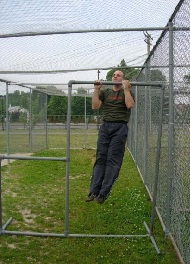
Chin Up


  • Chin-ups
  • Hindu Push-ups
  • Jumping Jacks
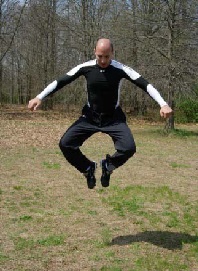
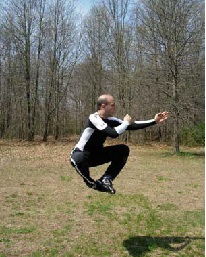
  •  Ichimonji Jump Squats (can be replaced with non-jumping squats as fatigue levels rise)


Hindu Push-up


Ichimonji Jump Squat

Do them in any order for any number of reps at a time as long as you continuously move for the full 15 minutes.    

Modifying Your Workout

Not quite ready to jump into the full 15 minutes yet?  This workout can be modified depending on your current level of conditioning.

For example, you may break up the 15 minutes into 5 rounds of 3 minutes each and include a rest period of 1 to 2 minutes between rounds.  As your conditioning levels increase, begin increasing the length of the rounds and decreasing the rest period.  Remember, the goal is to exercise for 15 minutes straight.    

Additionally, if you do not have a chin-up bar, you can try  towel pulls instead.  Wrap a towel around a pole in your basement, or around both door knobs of an open door, sit all the way back until your arms are straight and pull yourself forward.  You can make this exercise more difficult by grasping the towel with one hand which also provides a great grip workout to boot!

Enjoy!    

Notes: Make sure you warm-up with brief joint mobility session prior to the workout.  Remember that when you sign up for our mailing list you receive a free sample chapter on Joint Mobility from my Warrior Fitness book!

For further information on the Workouts of the Week, please see our User Guide here.

Conditioning for Striking

Looking for a great way to spice up your conditioning work and make it more martial arts specific at the same time? Give this workout a try! What you will need – wave bag, double-end bag, heavy bag lying on the ground (you can make substitutions as needed). 

There is no real set/rep scheme for this workout. Just perform three 5-minute rounds, or five 3-minute rounds, depending on your level of conditioning, with 60 seconds of active recovery in between.

You are free to move from one piece of equipment to the next and back, as you like. Spend as much or as little time with each. The goal is continuous movement. Use any strike or kick you like on any and all of the stations. The heavy bag lying on the ground provides not only a way to practice choking, striking and kicking on the ground, but an obstacle to leap over, roll over, and maneuver around while working the other bags. If you get stuck and don’t know what to do next, do body-weight squats or jumping jacks until you figure it out. Don’t try to think so much! If you get stuck again, do push-ups. Be creative. Have fun!

Notes: Make sure you warm-up with brief joint mobility session prior to the workout.

5 Ways to Help Decrease the Stress

Today’s corporate warriors are often besieged with too many tasks, meetings, email, cell phone calls, pagers going off, Blackberrys buzzing, etc. Individually, these things are not significant, but when combined together in a constant barrage, all day long, they produce a cacophony of stimulation which, if not addressed through specific countermeasures, can cause a significant stress response in the brain. This stress response emanates from our primal, survival oriented center of the brain which, in times of crisis, can overload and over run the higher brain functions – i.e., those that allow us to plan, prioritize, manage time and people, and be creative.

Article in Harvard Business Review

 According to an article in Harvard Business Review, when busy executives begin to experience symptoms of this stress response in the brain, they often forget important details, lose the ability to prioritize tasks, and generally feel overwhelmed. Overall tension in the body increases, as well as other important markers such as heart rate and blood pressure.

The ability to reduce and manage stress is a key issue in the overcoming of these symptoms in busy workers. Stress can be reduced in various ways such as relaxation, meditation, vacation, diet, and exercise. It is the last two, diet and exercise, that I am focusing on in my recommendations today.

5 Ways to Help Decrease the Stress

  1. Begin to increase complex carbohydrates at every meal. (Complex carbohydrates are whole wheat, multi-grain, etc.)
  2. As you increase complex carbohydrates, begin to eliminate simple carbohydrates. (Simple carbohydrates are white flour, white sugar, and white rice)
  3. Eat protein and vegetables (or fruit) with every meal.
  4. Exercise at least 3 days a week for a 1/2 hour or more.
  5. Daily short exercise breaks – this can be done at your desk or standing up in the office. It is a quick “10 Minute Recharge” for stress reduction and to increase energy throughout the day. This consists of moving all the joints in the body in circles or waves to increase mobility, increase blood flow in muscles and prevent stagnation. These joint mobility exercises coupled with active exhalation breathing aid in the reduction of stress and help to lower blood pressure.

These exercises can be taught quickly and easily, but the benefits are enormous.

For all the aspiring Corporate Warriors out there, how do you deal with stress?