
A Day in the Life…

At the suggestion of my good friend, and West Coast Buyu, Dave Furukawa, I am presenting a look at one of my daily workouts.  Please see Dave’s comments on my previous post here for reference.

This is a record of my activity from yesterday, Memorial Day 2010:

Morning

Life begins early here, even on long holiday weekends, since our 19 month old, Juliana, doesn’t distinguish weekends from weekdays yet!  So at 6 am I was up making coffee and searching through her Elmo DVDs to find the particular episode she wanted that morning.  As the coffee was brewing I began working through my joint mobility routine in the kitchen.  Each joint from neck down to ankles and toes is rotated through its entire range of motion to flush the joints with synovial fluid and increase blood flow to the surrounding muscles.  This has the effect of lubricating the joints and removing the “rust”, as well as awakening the entire body.

As interest in her Elmo episode waned and Juliana wandered off to “read” her books and play with toys, I began working through San Shin no Kata, the Bujinkan basic movement exercises.  Each movement was practiced stationary, then walking forward and backward with emphasis on using the spine to generate power for the movements.

Mid-Afternoon

In the afternoon I took the kids to the playground.  My older daughter, Caitlin, rode her bike while I pushed the baby along in her little buggy.  As I walked each step was coordinated with breathing to work on breath capacity.  For example, inhale for 5-steps, hold on the inhale for 5-steps, exhale for 5-steps, then hold on the exhale for 5-steps.  This can be done continuously with the same pattern or you can alter the number of steps for each breath cycle up or down to make it easier or more challenging.  See my post entitled Breathing 101 for more breathing related exercises.  At the playground, in between pushing the kids on the swings and taking the little one down the slide, I used the monkey bars for random amounts of pull-ups and chin-ups.

Evening

Finally got the kids to bed around 8:30 and went down to the basement gym for my workout proper.  My current program is geared towards developing unarmed striking power and basic weapons work. 

  • Brief joint mobility warm-up
  • Suburi with Yari (spear) – 3 rounds of 10 thrusts from Seigan no Kamae, 10 thrusts from Jodan no Kamae, each side
  • Suburi with heavy bokken – 3 rounds of 10 cuts from Jodan no Kamae, advancing and retreating
  • Swipes with 15 lb clubbell – 3 sets of 10
  • Mills with 15 lb clubbell (think omote shuto type movement) – 3 sets of 10
  • Reverse Mills with 15 lb clubbell (think ura shuto type movement) – 3 sets of 10
  • Clean to Order with 25 lb clubbell – 3 sets of 5 each arm
  • Clean to Order with 45 lb clubbell – 1 set of 5 each arm
  • 5 minutes of various yoga asana to cool-down

This is just a quick glimpse into a much larger program that I am testing on myself for eventual release.  For more information on my previous programs, please check out my ebook, Warrior Fitness: Conditioning for Martial Arts.


A Case for Mini Workouts

These days everyone is short on time.  Most are content to allow the daily grind and family time to fill their days while lamenting about the fact that they have no time for working out.  The complaints are common and heard often.  But somehow these same people are able to find time to watch an hour or more of TV every night before going to bed.

Now, I’m not going to ask you to forego your Sunday night Walking Dead episode (I certainly won’t!) in favor of hitting the gym for an hour, so don’t worry – just using the ability to watch TV as an example of “finding time”.

While it may be a stretch for many people to find 45 minutes to an hour each day for exercise or martial arts training, how about just finding 5 minutes?  Surely everyone can find a spare 5 minutes even a few times a day, right???

Recently, as my own daily grind has become busier and busier, I have been finding just how effective mini workouts can be to fill in the gaps in one’s training.  These types of workouts are often overlooked because of their brevity.

After all, how can one possibly get a complete workout in 5 minutes?!  Well, you can’t.  But that’s not the point.  The effects of mini workouts are cumulative.  In other words, they add up over time (that’s what cumulative means… :).

They are not meant to completely replace your regular training, but are meant to enhance it and compliment it.

They are an effective way to keep yourself on track and focused when short on time, or if you have already completed a full workout and still want to get in some extra training – nothing wrong with that either!  Remember, the goal of the mini workout is not to be too complicated or over-involved.  Make them short, sweet, and to the point!

Examples of Mini Workouts

Here are just a few ideas I’ve found that make ideal mini workouts:

  • 10 push-ups + 10 v-ups + 10 squats (repeat 3-5 x’s)
  • Finger tip push-ups (see how many you can do)
  • Tabata exercises (pick one and go)
  • 5 Kettlebell Snatches (each side) + 5 Kettlebell Swings (each side) + 10 Hindu Push-ups (Perform AMRAP for 5 or 10 minutes)
  • Isometrics
  • Breathing exercises combined with bodyweight training
  • Joint mobility work
  • Pull-ups (5-4-3-2-1 rep scheme)
  • Burpees or Sprawls for 50 to 100 reps

Mini Workouts for Martial Arts

The mini workout should be an essential aspect of any martial artist’s training.  It is said that great martial artists are training all the time.  Well known and respected masters from Musashi to Tesshu to Ueshiba to Hatsumi Soke have constantly extolled the importance of solo-training and dedicated practice.

While mini workouts do not form a complete picture of solo- training, they do play an important role.  In the future, I’ll be sharing a more extensive look at solo-training for martial arts, particularly for Bujinkan practitioners.  But for now, here’s a short list to get you started:

  • Ukemi practice – mix up rolls, change directions freely, roll over obstacles
  • San Shin no Kata
  • Solo flow drill – move continuously for 5 minutes. Flow from strikes to kicks to leaps to rolls, from kamae to kamae – be creative!
  • Kamae work in a mirror
  • Striking practice
  • Junan taiso (see above!)

Make sure to make time for mini workouts!

Top 10 Things to Look for in a Kid’s Martial Arts Class

One of the first things fellow parents tend to ask me after they find out I’ve been involved in the martial arts for over 25 years is, how do I find a good martial arts class for my kids?  Well, after years of answering this question, I realized my answers tend to follow a certain pattern.  They may be expressed in slightly different terms and the order of the points may change each time I’m asked, but the answers remain the same.  So, for all those parents out there who are looking to involve their child(ren) in the martial arts (a highly recommended pursuit, by the way),  I’ve formulated my own “top 10” list:

1.  Is the school a franchise? 

 These typically have cookie-cutter, one size fits all programs and tend to be belt factories.  Steer clear!  There may be franchises out there that do not fall into this category, but I haven’t run into them.

2.  Do the kids in class fear the teacher or respect him? 

This is very telling.  As a kid, I was afraid of my first karate teacher and even though I loved the art and practiced like crazy at home, I’d try to get out of going to class almost every week. 

3.  Are the parents sitting in the waiting room comfortable with the teacher and happy with the class? 

When you visit a school, talk to the parents who have been there awhile.  Do they constantly complain about the teacher, the atmosphere, or even the cost?  Do their kids love the program or simply tolerate it?  Also, what is the vibe you pick up when walking into the school – listen to your gut!

4.  Variety! 

Kids get bored very easily.  And, when they are bored, they don’t learn very well.  Classes should have a wide variety of drills to show children principles and techniques from many different perspectives.  Remember, martial arts are not academic subjects!

5.  Tons of physical exercise. 

Kids have a lot of energy.  Exercises that teach physical skills, as well as give them an outlet for their energy are the best.  Also, in case no one has told you, we have a growing childhood obesity problem in this country.  Exercise, along with a focus on a healthy diet, is key to resolving this issue and giving our kids the tools to ensure a lifetime of health.

6.  Do they teach self-defense applications of kata, or just the forms?

This is essential, not only for the correct transmission of the art, but also for the students to understand how to actually apply the techniques.  Obviously, this must be tempered to make some aspects of practice age appropriate, but it must be taught.

7.  Do they teach rolling and falling techniques?

 Not only are these fun for the kids to practice, but they can, and do, prevent injuries.  Very important both in the dojo and out in real life.  Additionally, they help to develop coordination, agility, and kinesthetic awareness!

8.  Is situational awareness stressed?

This is, without a doubt, the most important aspect of self-defense and must be continuously stressed and communicated.  Bad things do not “just happen” to kids.  There are always pre-incident cues that are present, if one is paying attention.

9.  Do the kids in class appear to be motivated or just going through the motions?

Watch carefully when you visit the class.  Are they lackadaisical in their practice?  Do they look like they don’t want to be there?  Or, are the kids energized and focused throughout the class? 

10.  Leadership. 

A school does not need to have a specific, defined class program on “Leadership” (these are usually a colossal waste of money for parents… hint, hint!).  It should, however, endow the students with leader qualities through the example of the teacher and by getting the kids involved in the class room (dojo) instruction.  This can be done by rotating who leads various drills and allowing children to teach their peers by explaining and demonstrating certain kata, techniques, or exercises.  This is not only good for the child’s self confidence, but also for their overall and long term development.

User Guide to the Workouts of the Week

I received several emails this morning after yesterday’s post on Warrior Fitness Workout of the Week #1 from people who wanted more information on how to implement and program the workouts of the week.  So here it is!

The Workout of the Week section is designed to give you insight into the Warrior Fitness training method.  We will cover topics such as joint mobility, high intensity interval training (HIIT) and the Tabata Protocol for conditioning, strength endurance, explosive strength, core work, yoga, and martial arts. 

1.  How often should I do the Workout of the Week (WOW)? 

This depends on the intensity level of the prescribed workout.  For example, if the WOW is an illustration of a yoga compensatory routine, you can do it daily, but if it’s a high intensity conditioning workout, you may only be able to perform it 2-3 times a week, depending on your recovery levels.   These workouts are short; usually, under 30 minutes.   You should have plenty of time to squeeze them into a busy schedule!

2.  Should I change my workout every week to correspond to the WOW? 

Not necessarily, no.  The workouts change weekly in order to showcase various aspects of our training methodology, but that doesn’t mean you need to change it up on a weekly basis.  Workout programs should be designed with specific goals in mind and crafted to meet individual needs.  Your body needs time to adapt to your exercise selection for it to elicit the planned response, usually about 4 to 6 weeks.  If you find a something that you like, stick with it.  If you have a more detailed question about how to program a specific workout, or even a series of workouts, let me know.  I can help you.  That’s why I’m here.

3.  What if I already have a workout program?  How can incorporate the WOWs? 

 If you currently have a training regimen that you are happy with, but want to give one of our workouts a try, you can definitely do that.  Simply replace one of your conditioning days with one of our conditioning workouts.  Or, add in our joint mobility exercises as a warm-up.  Remember, you receive a sample chapter on joint mobility  from the book, Warrior Fitness, when you sign up for our mailing list.

4.  I am just starting to exercise, can I still use the WOWs? 

Absolutely!  Start slowly.  Begin by doing our joint mobility exercises on a daily basis to prime your body and help you regain lost range of motion.  Each of our workouts contains instructions on modifying the workout to scale it for any level of conditioning.  Also, if you have further questions about modifying workouts, or programming workouts, contact me.  I’ll be glad to help you.

5.  Will I lose weight with these workouts? 

 Yes!  Our conditioning workouts are designed to turn on your body’s metabolic furnace and torch unwanted fat, while building lean muscle. 

6.  How can I find out more?

My ebook, Warrior Fitness: Conditioning for Martial Arts, is available for direct download.  It contains the background, philosophy, and methodology behind Warrior Fitness, as well as an ample exercise selection and a chapter on program design.

Want to know more?  Just ask!

 I hope this has been a helpful introduction to the Warrior Fitness Workouts of the Week.  What other questions do you have?

Conditioning for Striking

Looking for a great way to spice up your conditioning work and make it more martial arts specific at the same time? Give this workout a try! What you will need – wave bag, double-end bag, heavy bag lying on the ground (you can make substitutions as needed). 

There is no real set/rep scheme for this workout. Just perform three 5-minute rounds, or five 3-minute rounds, depending on your level of conditioning, with 60 seconds of active recovery in between.

You are free to move from one piece of equipment to the next and back, as you like. Spend as much or as little time with each. The goal is continuous movement. Use any strike or kick you like on any and all of the stations. The heavy bag lying on the ground provides not only a way to practice choking, striking and kicking on the ground, but an obstacle to leap over, roll over, and maneuver around while working the other bags. If you get stuck and don’t know what to do next, do body-weight squats or jumping jacks until you figure it out. Don’t try to think so much! If you get stuck again, do push-ups. Be creative. Have fun!

Notes: Make sure you warm-up with brief joint mobility session prior to the workout.

Warrior Fitness Book FAQs

1. Are the Warrior Fitness workouts applicable to beginners?

Absolutely! The workouts in the Warrior Fitness program are completely scalable based on your level of fitness.  Each exercise is explained step-by-step.

2. Is nutrition covered in the book?

Nutrition is an important aspect of a complete, healthy lifestyle, but is not discussed in the Warrior Fitness book. My own personal ideas about nutrition can be summed up fairly simply though. Eat lean proteins, lots of fruit and vegetables, and some complex carbohydrates. Eliminate or reduce white sugar, white rice, and white flour from your diet. Drink plenty of clean water and green tea.

3. Does the Warrior Fitness program teach Amatsu medicine , a traditional system of Japanese Natural Medicine taught by Hatsumi Soke?

No. I have not been taught any Amatsu medicine within the context of my Bujinkan training.

4. Is this program just Junan Taiso (basic stretching exercises used as warm-ups for martial arts practice)?

No. The Warrior Fitness book provides a comprehensive program consisting of joint mobility, flexibility, strength, conditioning, breath work, and recovery. Much more than simply junan taiso exercises.

5. Do I have to workout every day?

You do not need to do a full workout, but I highly recommend doing some movement everyday! Joint mobility work, combined with breathing exercises can take as little as 15 to 20 minutes in the morning. It’s a great way to start your day!

6. How much time do the Warrior Fitness strength and conditioning workouts require?

The workouts contained in the Warrior Fitness book are designed to be fast and effective. You can achieve a quality workout in 15 minutes, if you are short on time. Longer workouts can also be programmed, depending on how much time is available.

7. Do I need a gym membership for this program to work?

Definitely not! Warrior Fitness workouts are designed to be done anywhere with little to no equipment necessary.

8. How do I fit in working out and the skill training for my martial art?

Excellent question. This is where scheduling and time management skills come in handy. Time will not simply appear out of thin air. You must make time. However, the most important advice I can give on this topic is that if you do not have time for both skill work (martial art training) and conditioning, skill work must take the priority! You are training to be a martial artist after all.

9. Is this book applicable only for those training in the martial arts?

No. This book is certainly not just for people in the martial arts. The exercises and ideas contained within are applicable to anyone of any range of fitness and ability. Pick up a copy today and see for yourself!

Please feel free to email me here with any additional thoughts or questions concerning the book.

Not a Warrior? Not a Problem.

Although Warrior Fitness has it’s origins in the martial arts, you do not need to be a martial artist to benefit from my program. Since it’s inception, I have continued to test and refine the Warrior Fitness methodology to work with and help almost any level of fitness from couch potato to high ranking martial artist, and everyone in between.

The only real requirement is the certainty that you have a greater capacity, greater capability, and greater purpose to your life than you are living right now.  You must desire to improve yourself for the better and be willing to fight for it.  I only work with those who are willing to take massive action!

Awaken Your Inner Warrior!

Here are a few examples of how Warrior Fitness can help you to awaken your inner warrior….

  • For the father who wants to be in the best shape of his life in order to play with his kids and set an example of a healthy lifestyle that they will carry with them for the rest of their lives,
  • for the mother who, after a long day at work wants to de-stress with a brief, but intense workout that won’t leave her exhausted,
  • for the businessman who finds his waistline expanding, his health lacking, muscle sagging, and wants to do something about it,
  • for the performer who needs to control her breathing and nervousness before getting on stage,
  • for the amateur athlete or weekend warrior who realizes that the daily aches and pains are getting worse as they get older and want to be stronger, healthier, and more capable as he gets older,
  • for the regular people who have lives and families and other hobbies and don’t want to spend all day in the gym yet are ready for something more in their lives,
  • for the unconventional fitness enthusiast who doesn’t desire the globo commercial gym scene, and is looking for a low-tech/high yield approach to fitness,
  • for the fitness nut who’s tired of the same old treadmill and is looking for something extradinary,
  • And, of course for the martial artist who wants to get back into fighting fit shape while enhancing their martial art’s effectiveness by increasing how efficiently they move…

My objective in sharing Warrior Fitness is to help you meet your goals.  To transform your life and share my passion for training with you.  I honestly enjoy teaching people and helping them to realize their health and fitness goals; I simply love to see people “get it”.  Allow me to help you reclaim your fitness and awaken your inner warrior!

Jon Bottoms upPS – Sick of being average?  Ready for extraordinary?  Let me know how I can help you… 
If you are ready for a Warrior Life, click HERE <<===

Goals for 2010

Happy New Year!

Welcome to Warrior Fitness in 2010. This year, like every year, is full of potential. It’s a new beginning, another opportunity to change, to reinvent yourself for the better. To make improvements by forging your body physically, challenging yourself mentally, and growing spiritually. There is a sense of excitement at all the possibilities that lay before us.

How will you change yourself this year? What goals have you set? What do you want to accomplish in your training and in your life? Whether the goal is to improve your fitness levels for martial arts training, to enhance your performance in those martial arts, to lose weight, to gain muscle, to improve mobility and increase flexibility, or just to be a healthier, more fit you, Warrior Fitness can help you achieve all these goals and more.

January is the busiest time of the year for gyms and health clubs, but guess what? In February, those places are ghost towns. How do all those well meaning goals become unsustainable for so many, so quickly? How can you assure yourself that your motivation won’t quit, that your will won’t weaken? One way to do this is to have someone else hold you accountable for your goal setting, progress, and accomplishment. Motivation is a funny thing. When we think no one is watching, it becomes much easier to slack off or make an excuse to ourselves as to why we can’t workout today, or why those cookies are better for us than that salad. When you must hold yourself accountable to a third party, it’s much harder to stray from the goals you have set.

Warrior Fitness offers personal training services, both in person and online, to help you hold yourself accountable. Together, we will set goals, create a step-by-step plan to meet them, and work toward achieving them. If you would like more information, or want to get started now, please email me here. and reinvent yourself this year!

Are You FIT to be a Warrior?

It goes without saying that the role of a warrior in society is to protect self and others. Yet, how many of us aspiring warriors don’t realize that health, fitness, and overall well-being are the primary qualities on the forefront of “self” defense? Most of us may train our entire lives without ever being involved in a dangerous altercation, but the same cannot be said about avoiding the dangers of lack of physical exercise such as osteoarthritis, ill health, heart disease, cancer, type II diabetes, and obesity to name a few.

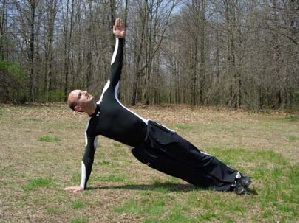
Side Plank

Physical fitness (and proper nutrition!) plays a leading role in the prevention of these diseases and conditions, as well as in the protection of our overall health and psychological well being.


Many of us spend 40 + hours a week sitting in an office staring at a computer where the most exercise we get during an 8-hour stint is to walk to the bathroom several times a day followed by wandering into the cafeteria to see what pre-packaged garbage is waiting for us in the vending machines.

Then, often we come home from work exhausted (from what?) and flop on the couch to watch TV in order to “unwind” (again, from what?) before finally dragging ourselves upstairs and into bed for the night.

We have conditioned ourselves into laziness and inaction. Yes, I do mean “conditioned”. Conditioning does not only apply to being fit; it is possible to condition your body for anything, including being over weight, tired all the time, and to completely lack motivation for any type of physical activity. No wonder Americans are among the fattest people on the planet! (By the way, I am only picking on Americans because I am one; however the rampant increase in obesity is a worldwide problem and getting worse. Just look at recent news articles from the UK on the same subject.)

Challenges of Discussing Fitness

One of the challenges that arise when we attempt to discuss fitness in a meaningful way is that the term itself is extraordinarily vague. Some people think of a triathlon athlete as “fit” while others believe a power lifter is “fit.” Unfortunately, neither of these examples conforms to the actual definition of fitness; they are just two extreme ends of the spectrum.

Fitness Attributes

Fitness is essentially made up of nine different attributes:

  • Strength
  • Power
  • Agility
  • Balance
  • Flexibility
  • Local muscular endurance
  • Cardiovascular endurance
  • Strength endurance
  • Coordination

All of these components must be present to constitute a suitable definition of fitness.

Warrior Fitness Methodology

The Warrior Fitness training methodology blends all 9 of the above qualities together to construct a comprehensive fitness program applicable to all walks of life. This blended approach allows for a wide variety of options, based on each individual’s fitness needs, when crafting a complete program. The variety enables each program to be tailored specifically to the individual while still remaining true to the overall Warrior Fitness philosophy of health, fitness, and growth, balanced with recovery.

Warrior Fitness: Conditioning for Martial Arts

WFBookcover3d

Warrior Fitness Book