The Complete Path to Lifelong Martial Strength

THE IRON BODY PROGRESSION MAP

The Complete Path to Lifelong Martial Strength


The Iron Body Is Not Built All At Once

It Is Built In Layers

There comes a moment in every serious martial artist’s life where something doesn’t quite add up anymore.

It doesn’t happen during training. In fact, during training, everything can feel fine. You’re moving, you’re sweating, you’re working. But afterward… when you sit down, when your body settles, that’s when you start to notice it.

Your understanding is deeper than it’s ever been. Your timing is better. Your awareness is sharper. You see things now that you never saw before.

And yet your body doesn’t respond the way it used to.

Your strikes require more effort. Your structure doesn’t feel as stable under pressure. Recovery takes longer than it should. And the most frustrating part is this—you’re still training. Maybe harder than ever.

So what’s the problem?

The truth is, you’re not losing skill.

You’re losing your ability to express it.

Your mind still understands exactly what to do, but your body no longer has the capacity to carry it out the way it once did. And this has nothing to do with age, effort, or discipline.

It has everything to do with how you’ve been training.


The Real Problem Is Fragmentation

Most martial artists train in pieces.

They build a little strength here, add some conditioning there, work their techniques, maybe sprinkle in mobility or flexibility work. On the surface, it looks complete. It feels like they’re covering all the bases.

But they’re not.

They’re training parts of the body… instead of training the body as a system.

Over time, this creates a kind of internal disconnect. Strength develops without structure. Durability improves without elasticity. Breath is trained, but never fully integrated into movement. And slowly, almost invisibly, the body starts to lose its cohesion.

Power begins to leak. Movement becomes stiff. Effort increases where it used to be effortless.

Because the body doesn’t function in isolated pieces. It functions as an interconnected whole.

This is what the old masters understood—deeply, physically, not just intellectually. They weren’t chasing strength or conditioning as separate qualities. They were developing the body itself. They were building a system.

That’s the idea behind the Iron Body.

And it’s the reason the Iron Body Progression Map exists.


A Map That Shows You What To Do Next

Most people don’t need more information.

They need direction.

They need to know where they are, what they’re missing, and what comes next.

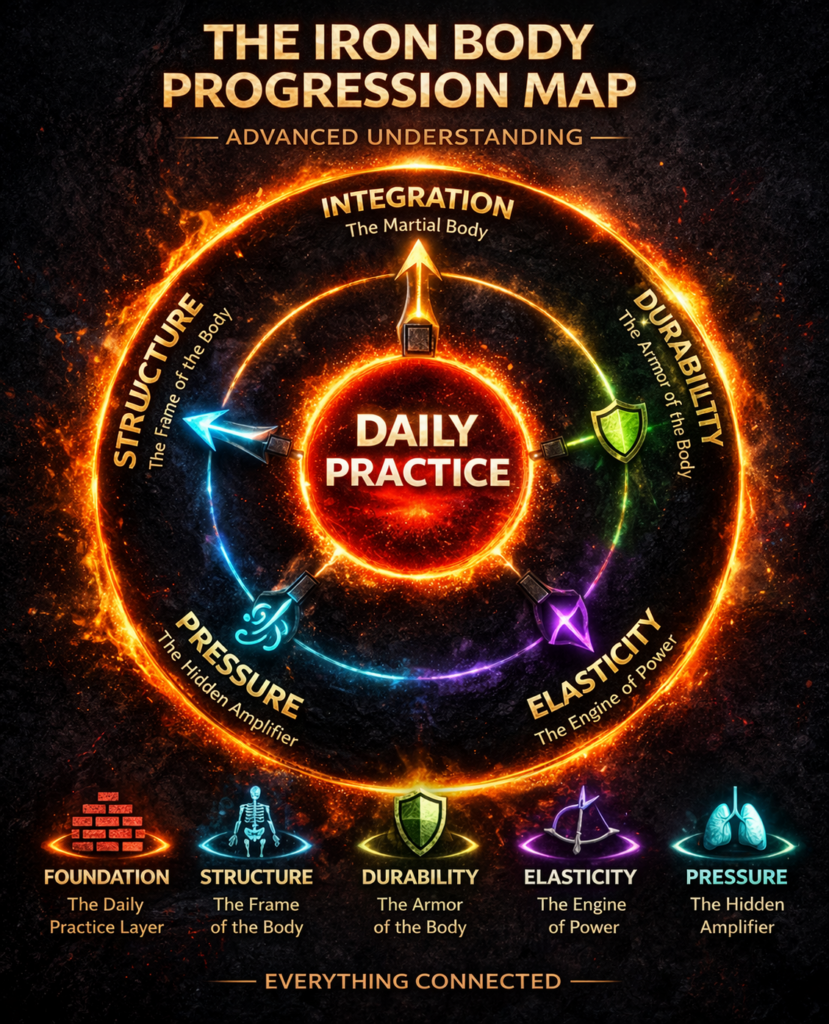
The Iron Body Progression Map gives you that.

It’s not just a concept. It’s a structure you can follow. A way to rebuild your body layer by layer, so that everything begins to work together again instead of fighting against itself.

You can think of it as a ladder. Each step supports the one above it. Skip a step, and everything becomes unstable. Follow it in order, and something powerful begins to happen—the body starts to reconnect.

Foundation: Where Everything Begins

At the base of the system is daily practice. This is the Iron Body Daily Eight.

This is where most people go wrong, because it doesn’t look impressive. It’s not intense. It doesn’t leave you exhausted. But that’s exactly why it works.

This layer teaches you how to hold your body correctly. It develops alignment, awareness, and a kind of quiet control over your nervous system. Your posture improves. Your breathing begins to settle. You start to feel your body as a connected whole rather than a collection of parts.

Without this layer, everything else you do sits on unstable ground. No matter how strong or skilled you become, something always feels off. But once this foundation is in place, everything above it has something solid to build on.

👉 If you don’t already have a structured daily practice, this is exactly what the Iron Body Daily Eight Mini-Course was designed to give you—a simple, guided starting point you can implement immediately.


Structure: Building the Frame

Once the foundation is established, the next step is structure.

This is where practices like Zhan Zhuang and isometric training come in. Now you’re no longer just aware of your body—you’re organizing it. You’re learning how to stack the skeleton, how to root into the ground, and how to create clear pathways for force to travel through your body.

This changes everything.

Instead of feeling loose or disconnected, you begin to feel supported. Stable. Grounded. Your body starts to behave like a unified structure rather than a series of moving parts.

Most people try to generate power before they build structure. That’s why their power never holds up under pressure. Because without structure, force has nowhere to go. It collapses.

Structure is what allows power to exist in the first place.

👉 This is why foundational isometric work and standing training are emphasized so heavily inside the system—they’re not “extra work”… they are the work.


Durability: Strengthening the Tissue

With structure in place, the next layer is durability.

Now you begin strengthening the actual material of the body—the tendons, fascia, connective tissue, and even the bones. This is where Martial Qigong comes in.

At this stage, the body starts to feel different. Joints that used to ache begin to settle down. The constant sense of wear and tear starts to fade. You don’t just feel strong—you feel resilient.

There’s a density to your body now. A kind of quiet toughness that doesn’t rely on tension.

This is what allows you to train consistently over time without breaking down. It’s what separates someone who trains hard for a few years from someone who can train for decades.

👉 This is the layer most modern training completely ignores—which is exactly why systems like Martial Qigong become so important as you progress.


Elasticity: The True Source of Power

Once the body is structured and durable, something new becomes possible.

Now you can develop elasticity.

This is where real martial power begins to emerge.

Through methods like Yi Jin Jing and the Iron Silk Method, you train the tendons to behave like springs. Instead of forcing movement with muscular effort, you begin to store and release energy naturally.

This is where things start to feel almost surprising.

Strikes become heavier, but require less effort. Movement becomes lighter, but more effective. The body begins to generate power without you having to consciously push for it.

This is the difference between forcing power and having power.

👉 This is where the Iron Silk Method fits into the system—developing the kind of spring-like power most martial artists never access.


Pressure: The Hidden Amplifier

At this point, everything is in place—but it still needs to be connected internally.

That’s where breath comes in.

Breath is what ties the entire system together. It creates internal pressure. It stabilizes the body from the inside out. It allows force to move through the body in a way that is controlled, efficient, and calm.

Without breath, everything remains mechanical.

With breath, everything becomes alive.

You’re no longer just moving your body—you’re driving it from within.


Integration: The Martial Body

The final layer is integration.

This is where everything you’ve built is tested and expressed through real movement—carries, crawls, loaded patterns, and martial application.

This is where strength becomes usable. Where structure becomes dynamic. Where power becomes something you can apply under pressure without thinking about it.

This is what it means to have a martial body.

Not just strength. Not just technique.

But a body that can express both—effortlessly.


Why This Changes Everything

Once you understand this map, your entire approach to training shifts.

You stop asking random questions like, “What workout should I do today?”

And you start asking a much more important question:

“What layer am I missing?”

That question gives you direction. It removes confusion. It allows you to train with purpose instead of guessing.

And more importantly, it prevents you from wasting years developing one quality while neglecting the others.


Where Are You Right Now?

If you’re honest with yourself, you already know where you are.
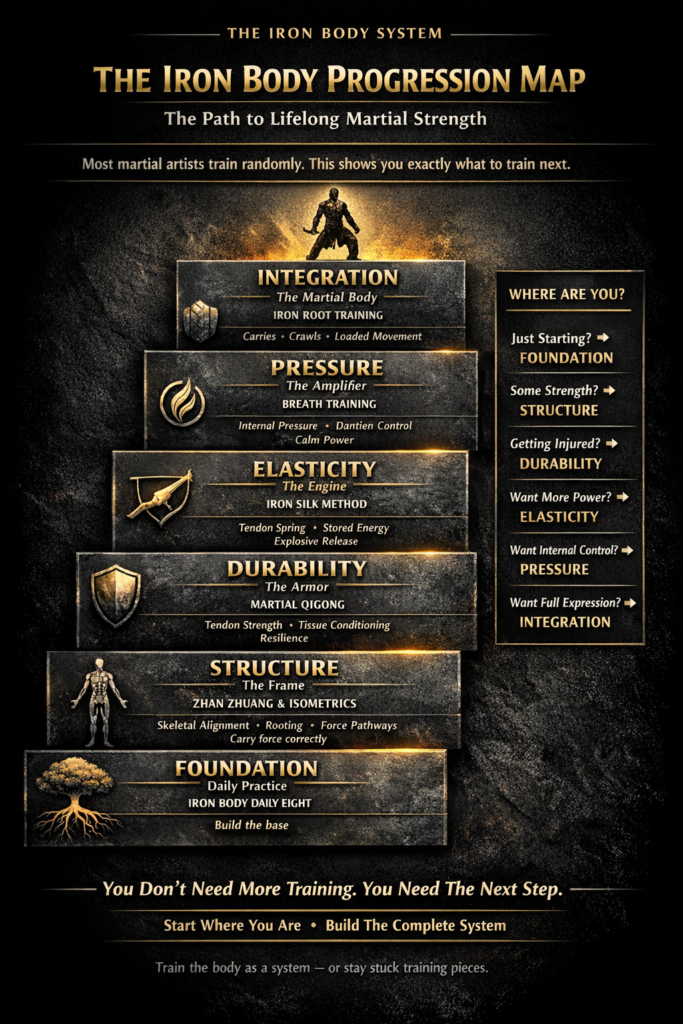
Maybe you’re just starting and need to build a foundation. Maybe you’re strong, but unstable. Maybe your body feels worn down and needs durability. Or maybe you’re chasing power, but haven’t yet developed the elasticity that makes it effortless.

Where you are determines what you should train next.


The Final Truth

You don’t need more intensity.

You don’t need more random training.

You don’t need to push harder.

You need to train the right layer, at the right time, in the right order.

That is how the Iron Body is built.


Start Here

If you want to begin the process the right way, start with the foundation.

The Iron Body Daily Eight is where everything begins. It’s simple, but it’s not easy. It requires attention, consistency, and patience. But if you commit to it, it will change the way your body feels, moves, and performs.

From there, you build upward—structure, durability, elasticity, pressure, and finally integration.

And over time, something shifts.

You don’t just feel stronger.

You feel connected. Stable. Powerful.

Like your body is finally working the way it was meant to.

👉 The Iron Body Daily Eight is the entry point into this entire system.

– -Jon Haas, The Warrior Coach
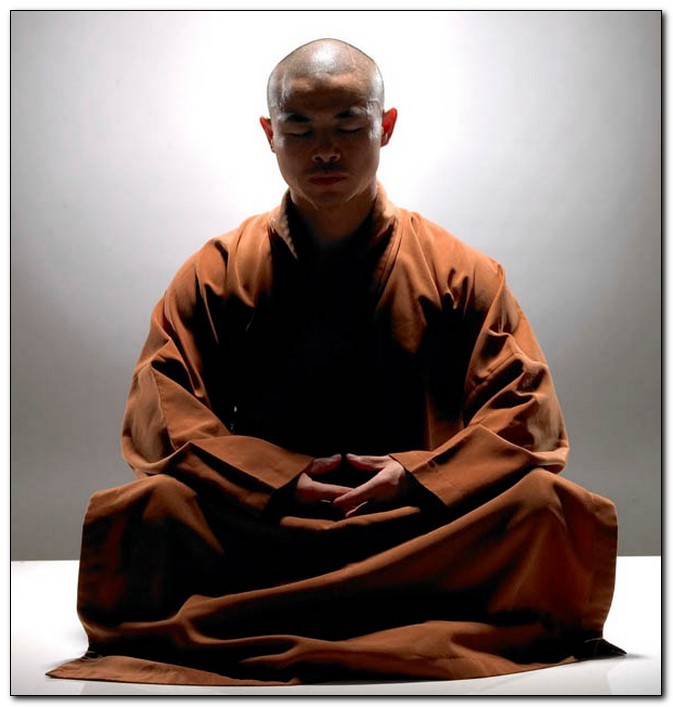
Breathing for Strength, Vitality, and Performance


For millennia breath control exercises have been the secret weapon of advanced yogis, qigong adepts, master healers, and warrior-monks to forge phenomenal strength, super human body control, and extraordinary vitality.

When disciplines such as yoga, Traditional Chinese Medicine, Internal Martial Arts, and Qigong have been successfully used over thousands of years to heal the sick, strengthen the weak, and bring energy to the depleted, you don’t question them – you study them!

While obviously these disciplines have their own unique modalities and practices, working with the breath is the common thread that runs through each of them. And there’s a very specific reason why each have evolved sophisticated breathing exercises that are used with such a high degree of success.

Breathing as a Bridge

Breathing is the only function of the human body that bridges both the autonomic and the voluntary nervous systems. You can breathe on complete autopilot all day long without ever consciously thinking about, and yet you can also choose to take a deep breath, exhale sharply, or even hold the breath at any time.

Herein lies the secret of breathing exercises – because it spans both sides of the nervous system specific breathing techniques are able to influence things such as heart rate, blood pressure, muscular tension, and stress levels.
Over the centuries, adepts of these disciplines (and others) have created literally hundreds of breathing exercises that have been consistently shown through practical experience to…

• Enhance whole body strength
• Increase lung capacity
• Reduce stress
• Improve endurance
• Fire up the body’s bioenergy
• Increase flexibility and range of motion
• Improve pain tolerance/reduce pain
• Build resilience and resistance to disease
• Improve performance under stress
• Not to mention relax, revitalize, and rejuvenate the body through meditation and relaxation exercises!

Relaxing Breath (Square Breathing)

The basic premise of our ability to influence the autonomic nervous system is that inhalation increases heart rate, which subsequently increase blood pressure, to a slight degree, while exhalation lowers heart rate and blood pressure to a slight degree. During our normal cycle of breathing, these changes are too minute to register, or even notice. But, by gradually lengthening our breath and extending the pause before inhaling and exhaling, we compound the effect. Stand in a natural position or sit comfortably on the floor with spine straight to perform this exercise.

1. Begin by exhaling through the mouth for 5 seconds.
2. Do not inhale. Try to extend the breath pause for 5 seconds.
3. Before tension begins to creep in, inhale for 5 seconds.
4. Hold the breath on the inhale for 5 seconds.
5. Repeat the cycle 10 times.
6. As this becomes easier, and your capacity expands, try increasing the duration to 6, 7, 8 seconds.

Breath Walking Meditation Exercise


Energizing Breath

In this breathing exercise we will utilize a protocol founded by yoga and improved upon by Russian sport science and martial art. Here we will divide the breath into 3 levels: clavicular (upper level), intercostal (mid level), Diaphragmatic (lower level). This exercise will focus only on the clavicular, or upper level. Use this powerful breathing exercise to fire up your energy and prepare your body for training!

1. Exhale through the mouth in a short, quick burst by compressing the upper chest.
2. Do not actively inhale. Allow the inhale to happen by relaxing the muscles in the chest.
3. Repeat rapidly 20 to 40 times.
4. Build up to where you can perform continuously for 60 seconds.
5. If you become dizzy, stop and sit down and breathe normally!

60 Second Energizing Breath Video


Here is another fantastic use for breathing….


Restoring Breath

This exercise is literally a life saver when doing high intensity interval training (HIIT) workouts! It can be used in between exercises as well as in between sets, during the rest period, and also at the end of the workout to normalize breathing and dramatically lower heart rate.
1. Forcefully exhale as deeply as possible by rolling your shoulders forward, tilting the pelvis up, and contracting the core strongly.
2. Pause before the inhale for a few seconds.
3. As stated above, do not actively inhale. Allow the breath to be sucked back in through the nose as your body returns to a natural standing posture.
4. Repeat for about 60 seconds, or as long as needed.


To learn more about how you can incorporate powerful breathing exercises into your own training, check out my Evolve Your Breathing Program.

Also, make sure to check out my review of Logan Christopher’s book, Upgrade Your Breath.

To learn more about the Warrior Fitness Training System, check out the free mini-course I have provided below…

Tanren Mini-Course <<===

The Failure of Yogic Breathing

There are many different systems of breath work out there that focus on relaxed breathing and stress reduction that also talk about how to increase breath control and expand the practitioner’s lung capacity.  Unfortunately the majority of these systems fall short due to the fact that they tend to focus the bulk (or all) of their work on static posture breathing and breath retention exercises.  Usually the practitioner is either seated on the floor, on a chair, or lying down in a comfortable, meditative posture while the breath is regulated through a series of counts and breath is retained in gradually expanding holds.

Breathing2

Before any of my Yogi friends get upset with me, let me clearly state that yes, this process works and I am a huge fan of Yoga’s Pranayama along with other systems of breath work.  There is nothing wrong with it!  Doing this type of exercise on a regular basis will increase lung capacity and control, to a degree.

So What is the Problem?

The problem with this type of exercise, as I see it, is that very rarely do we require all that enhanced lung power and capacity while sitting on our butts in a comfortable and relaxed position.  Unless you are only interested in showing off how long you can hold your breath at parties and stuff, this way of exercising has limited usefulness.

A much more practical way of exercising lung capacity and breath control is by working the body through a series of simple calisthenics.  By placing the body under stress via exercise while incrementally increasing the retention of the breath on both the inhale (easier) and the exhale (more advanced), we magnify the results.  In my experience, this has a much broader and far reaching effect on the body’s systems.  It is also vastly more practical in terms of real world usage for martial art, athletics, and overall strength & conditioning training.

So, how do we do it?

I’m glad you asked!  Let’s begin with one of the most natural movements in the world, a basic bodyweight squat.

If you are not familiar with a basic bodyweight squat, here is a super quick tutorial:

  1. Stand in a natural position with feet slightly wider than shoulder width apart
  2. Keep the alignment of your spine as straight as possible from crown to tail bone.
  3. Squat down as low as possible while maintaining the alignment of your straight spine.
  4. Keep the weight mid-foot balance.
  5. Pause for a second at rock bottom.
  6. Lift from the crown of the head to “pull” the body back to standing.

Breathing Squats

We will do our breathing squats in the same fashion but with a couple modifications.  First remember that the purpose of these exercises is to train your breathing and expand your breath control and capacity.  They are not meant to “kill” your legs.  Although, depending on your level of conditioning, they might.

  1. Perform a basic bodyweight squat as detailed above.
  2. Just prior to beginning the squat, inhale deeply into the belly and comfortably hold the breath.  Your goal is to do the squats as relaxed as possible while maintaining the breath hold.
  3. Do 3 squats all while holding the breath on the inhale.
  4. After the 3rd squat, exhale and inhale.  Slowly inhale into the belly and exhale sharply to recover your breath.  When you are recovered, do 3 more.  Repeat.
  5. When you can comfortably do 3 squats while holding your breath (meaning you are not out of breath when you stop), then proceed to 5 squats on the breath hold.

Slowly increase the number of squats you can do on the breath hold.  When you can comfortably do 10 squats with the breath held on the inhale, start over again with 3 squats and hold the breath on the exhale.  You will find that holding the breath on the exhale is much more difficult.  The body is already out of breath and now you are adding stress in the form of exercise.  It is here that you will make the greatest gains in teaching the body how to use a limited supply of oxygen in the most efficient manner.  Make sure you proceed slowly and only add more repetitions when you can comfortably hold the breath on the exhale.

Remember – B.I.F (Breathing Is Fundamental)!

Evolve Your Breathing is a master class in learning how to breathe and respond under stress.  Don’t just breathe to survive – Thrive!!

Learn more here…

EVOLVE_SPOT-1 (2)