5.5 Principles for More Effective Striking in ANY Martial Art

Part 1 of this series, Conditioning the Fists for Striking can be found HERE.

Being able to strike with power and precision involves a lot more than merely knowing the technique. Practice must include these principles of effective striking techniques for all martial arts…

1. Whole Body Power 

All movement in real life happens in three dimensions, so why train exercises that only incorporate one or two? Training muscles in isolation, unless it is used to rehab a specific injury, range of motion, or strengthen a particular muscle to add to the whole, does not work in martial art.

Our strike conditioning exercises must train movements in three dimensions utilizing diagonal, rotary, and angular strength, as well as prime moving muscles.
2. Stored Elastic Energy (SEE) 

Stored Elastic Energy is basically the potential energy stored in tendons and connective tissue as a way to power movement.

An easy exercise to begin to feel stored elastic energy is to stand in a natural stance with feet shoulder width apart.  Bend your right arm and raise it up to shoulder height as if you were about to throw the most telegraphed punch in history (don’t worry, it’s just an exercise).  Now, lead from the elbow and pull your fist back.  Allow your torso to rotate, but keep the feet planted and the hips facing forward.  When you reach the end of your range of motion, hang out there for a second and feel the tension (torque) on the spine.  Now simply relax and release that torque to throw the punch.  Don’t add any driving forces with muscle.  You can’t propel it any faster; you’ll just slow it down.

Feel it?

Try it again.

Do it with the other arm.  Remember the feeling.  This is stored elastic energy (SEE).

The point here about creating torque or stored elastic energy (SEE) in the spine is essential in being able to move powerfully without winding up or telegraphing the movement.

If you are having trouble feeling it, try to exaggerate the movement.

Make it much larger than necessary to study the feeling. It should feel like a tension in the lower back near the bottom of the spine. When this tension (torque) is relaxed (released), the movement happens.

3. Structure / Kamae 

Many people tend to use the terms alignment and structure almost interchangeably but in actuality, alignment is a component of structure.
For example, looking at a natural standing posture, good alignment would be:

  • Crown up
  • Chin down
  • Shoulders packed down
  • Spine lifting up (through crown)
  • Spine pulling down (through the sacrum)
  • Hips under shoulders
  • Knees under hips
  • Mid-foot balance
  • Chest is relaxed
  • Butt not sticking out nor is pelvis tucked under
  • Knees are over the toes
  • Weight evenly distributed (50/50)
  • No leaning forward or backwardThis puts the whole body into proper alignment.
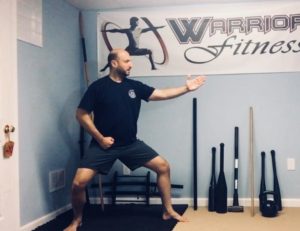


Structure also includes (in my lexicon) the balance of tensions within the body’s soft tissues. The bones act as compressive struts pushing outward from the center while the soft tissues (fascia) act as the stays pulling inward towards the center keeping the tensional balance in the body.

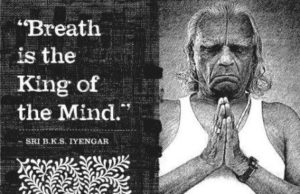
4. Breathing 

How often do you think about breathing as it relates to striking?

Yet it is absolutely essential to maintain proper breathing when in combat or simply hitting a heavy bag, mitt, or an opponent. Lack of breath control affects the rest of your body and hinders your overall performance.
5. The S.A.I.D Principle 

Why are all the above ideas important to understand in relation to striking and martial movement?

The SAID Principle – Specific Adaptation to Implied Demand says every activity that we repeat consistently causes an adaptation in the body.

The critical thing to note here is that it does not matter at all how we value this adaptation.  It can be something that we want like how healthy exercise increases lean muscle mass and burns excess fat, or it can be something we do not want like how eating junk food to an extreme causes our body to adapt by putting on weight.

Both of these are examples of activities that cause adaptations in the body.   Our goal is to train adaptations we value highly like the enhanced neural connections in our nervous system that increase our skill level. Keep this in mind when training.  We do not want to train bad habits!

5.5 Elements of Efficiency 

Efficiency is defined as the amount of useful work divided by the amount of total work.  In other words, how much effect are you producing for the amount of effort you are expending?

  • Ever see a batter “swing for the fences” only to completely miss the pitch?
  • Ever see someone try to pick something up that is really light, but they believe is heavy?
  • How about watching someone using the general whole-body tension we discussed above trying to hit a heavy bag?

How much effect, i.e. force from the strike embedded into the target, is gained from the huge effort expended?

You must train to have your strikes be both effective (devestatingly powerful) and efficient (uses the least amount of force or energy to accomplish the movement). Only then can you be said to have mastered the art of striking!


Learn exactly how to upgrade your striking skills in ANY martial art with these resources from Warrior Fitness Training Systems…
Breathing for Strength, Vitality, and Performance


For millennia breath control exercises have been the secret weapon of advanced yogis, qigong adepts, master healers, and warrior-monks to forge phenomenal strength, super human body control, and extraordinary vitality.

When disciplines such as yoga, Traditional Chinese Medicine, Internal Martial Arts, and Qigong have been successfully used over thousands of years to heal the sick, strengthen the weak, and bring energy to the depleted, you don’t question them – you study them!

While obviously these disciplines have their own unique modalities and practices, working with the breath is the common thread that runs through each of them. And there’s a very specific reason why each have evolved sophisticated breathing exercises that are used with such a high degree of success.

Breathing as a Bridge

Breathing is the only function of the human body that bridges both the autonomic and the voluntary nervous systems. You can breathe on complete autopilot all day long without ever consciously thinking about, and yet you can also choose to take a deep breath, exhale sharply, or even hold the breath at any time.

Herein lies the secret of breathing exercises – because it spans both sides of the nervous system specific breathing techniques are able to influence things such as heart rate, blood pressure, muscular tension, and stress levels.
Over the centuries, adepts of these disciplines (and others) have created literally hundreds of breathing exercises that have been consistently shown through practical experience to…

• Enhance whole body strength
• Increase lung capacity
• Reduce stress
• Improve endurance
• Fire up the body’s bioenergy
• Increase flexibility and range of motion
• Improve pain tolerance/reduce pain
• Build resilience and resistance to disease
• Improve performance under stress
• Not to mention relax, revitalize, and rejuvenate the body through meditation and relaxation exercises!

Relaxing Breath (Square Breathing)

The basic premise of our ability to influence the autonomic nervous system is that inhalation increases heart rate, which subsequently increase blood pressure, to a slight degree, while exhalation lowers heart rate and blood pressure to a slight degree. During our normal cycle of breathing, these changes are too minute to register, or even notice. But, by gradually lengthening our breath and extending the pause before inhaling and exhaling, we compound the effect. Stand in a natural position or sit comfortably on the floor with spine straight to perform this exercise.

1. Begin by exhaling through the mouth for 5 seconds.
2. Do not inhale. Try to extend the breath pause for 5 seconds.
3. Before tension begins to creep in, inhale for 5 seconds.
4. Hold the breath on the inhale for 5 seconds.
5. Repeat the cycle 10 times.
6. As this becomes easier, and your capacity expands, try increasing the duration to 6, 7, 8 seconds.

Breath Walking Meditation Exercise


Energizing Breath

In this breathing exercise we will utilize a protocol founded by yoga and improved upon by Russian sport science and martial art. Here we will divide the breath into 3 levels: clavicular (upper level), intercostal (mid level), Diaphragmatic (lower level). This exercise will focus only on the clavicular, or upper level. Use this powerful breathing exercise to fire up your energy and prepare your body for training!

1. Exhale through the mouth in a short, quick burst by compressing the upper chest.
2. Do not actively inhale. Allow the inhale to happen by relaxing the muscles in the chest.
3. Repeat rapidly 20 to 40 times.
4. Build up to where you can perform continuously for 60 seconds.
5. If you become dizzy, stop and sit down and breathe normally!

60 Second Energizing Breath Video


Here is another fantastic use for breathing….


Restoring Breath

This exercise is literally a life saver when doing high intensity interval training (HIIT) workouts! It can be used in between exercises as well as in between sets, during the rest period, and also at the end of the workout to normalize breathing and dramatically lower heart rate.
1. Forcefully exhale as deeply as possible by rolling your shoulders forward, tilting the pelvis up, and contracting the core strongly.
2. Pause before the inhale for a few seconds.
3. As stated above, do not actively inhale. Allow the breath to be sucked back in through the nose as your body returns to a natural standing posture.
4. Repeat for about 60 seconds, or as long as needed.


To learn more about how you can incorporate powerful breathing exercises into your own training, check out my Evolve Your Breathing Program.

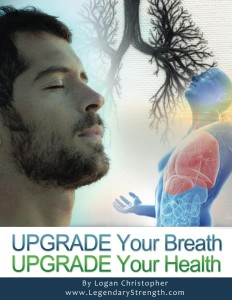
Also, make sure to check out my review of Logan Christopher’s book, Upgrade Your Breath.

To learn more about the Warrior Fitness Training System, check out the free mini-course I have provided below…

Tanren Mini-Course <<===

The Yin and Yang of Strength

The art and science of becoming stronger can be broken down into 2 main methods.

  1. The Addition of Driving Forces (Yang), and
  2. The Subtraction of Restrictive Forces (Yin)

When most people train for strength they focus solely on the Yang of Strength – the addition of driving forces.

But this will only get you so far…

It’s like driving a car around all day with the emergency brake on.  You can still get where you need to go, but that extra, unnecessary drag is killing the car’s performance and guzzling gas (consuming energy).

What is the hidden drag in your performance?

Residual muscle tension, or tonus, is the continuous, passive partial contraction of muscles in the body that aids in posture and support. Any type of strength training exercise, stress, fear, and trauma, will all cause an unwanted and unnecessary increase in the normal residual muscle tension of the body.

Usmuscle-boundually this extra tonus goes unnoticed, or worse is simply deemed an acceptable and natural side effect of living.  The problem with this added tension is that the continuous contraction of muscle throughout the day, ever day, is using up energy.  Energy that can, and should, be available to us is being siphoned off thereby putting the brakes on our performance.
Rather than increasing our energy, freeing our movement, and allowing us to access our full strength potential as human beings, the consistent focus on the Yang of Strength makes us literally muscle bound.

The Yin of Strength

The Yin of Strength is how we strategically and systematically remove those restrictive forces to reveal our true strength potential as an Integrated Human Being.

What specific recovery methods are used?

  • Mobility Training
  • Yoga Postures to act as compensatory movement
  • Vibration Training to literally shake out the tension
  • Breathing Exercises
  • Foam Rolling and Fascial Release
  • Qigong

Check out my latest program, Vital Force: The Yin of Strength

Upgrade Your Breath Book Review

I just finished up my morning practice of breathing exercises so this seems the perfect time to sit down and write about Logan Christopher’s latest book release, Upgrade Your Breath.

I have known Logan for several years now and am proud to say that I own almost every one of his programs. Each one is engaging, thought provoking and well researched, not to mention chock full of incredible information and great exercises. The man clearly knows his stuff AND trains it relentlessly.

His newest program, Upgrade Your Breath is no exception. This book delivers!!

Upgrade Your Breath

As you might know, I am no stranger to breathing exercises. I have been learning, training, and teaching them for over a decade now. They form the basis for my own system of training and I absolutely believe that breathing exercises are the foundation of health and fitness.

Logan’s book is an excellent resource on the subject of breathing. He provides a great number of practical and effective exercises broken down the exercises into 7 different categories. The instructions are clear and easy to follow instructions, and the usage, application and benefits of each one are discussed.

Additionally he also brings out his own unique perspective in the form of anecdotes and tips from Oldtime Strongmen, many of whom used breathing exercises to go from weak to strong and from sickly to healthy. My favorite, and Logan’s too, is the Mighty Atom!

The 7 Categories of Breathing Exercises found in Upgrade Your Breath:

1. Deep Breathing Exercises
2. Breathing for Lung Capacity
3. Breathing for Strength
4. Breathing for Endurance
5. Breathing for Relaxation
6. Breathing for Flexibility
7. Breathing for Energy Circulation

This book is a great resource for anyone interested in bettering their health and improving ALL aspects of fitness! I highly recommend it!

BONUS!

As an added bonus for all those who pick up Logan’s Upgrade Your Breath book, I will throw in my program, Evolve Your Breathing (regularly $37) for just $10!!  All you need to do is email me (WFT.Jon.Haas@gmail.com) your receipt and I’ll send you a link for the discounted program!


How to Train for Chaos without Making Training Chaotic

The current rage in conditioning training, especially when talking about combat conditioning, is to completely change up the workout for each and every session. This has the advantage of keeping the training fresh and throwing the body into chaos each time so it never knows what hit it.

The hardcore advocates of this type of conditioning stress that this environment will create a very broad and general fitness that prepares the trainee for almost every physical contingency, both known and unknowable.

This enables one to prepare for the chaos and uncertainty of combat by training in an uncertain and chaotic environment.

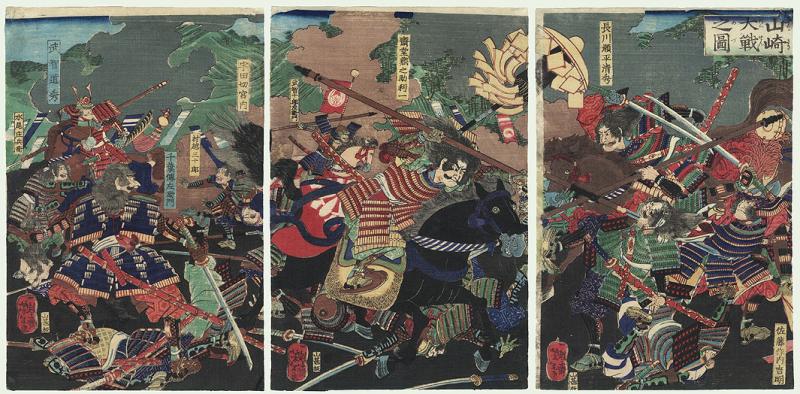
samurai

Seems to make a lot of sense on the surface, right?

However, one of the glaring problems with this type of training is that random training yields random results. It’s difficult to measure progress when the parameters are constantly shifting.

In order for the body to produce an adaptation for improved performance in life, sport, or martial art, we must apply specific stimulus as per the SAID Principle (Specific Adaptation to Imposed Demand). This basically means that the body adapts with a specific type of fitness to any demand which is imposed on it. When the same exercise is performed for too long, the body adapts to the stresses of each set and the adaptations or returns get smaller and smaller. Once it has adapted to the stress, then it’s time to change or increase the stress or else we fall into that trap of diminishing returns.

Usually though it takes the body a period of 4-to-6 weeks to adapt and then it is advisable to begin changing exercises. This does not mean that we need to completely throw away everything we have been doing; far from it. An exercise or drill can be changed by increasing intensity, increasing volume, decreasing rest periods, or increasing complexity or sophistication.

What this suggests is that a properly organized training program with incremental progression of increasing complexity and sophistication may actually prepare the body better than a set of random skills strewn together with a nebulous outcome in mind.

Yet we still crave the chaos, right?

So why not have it both ways?

Let’s program chaos into our training to instill the element of surprise and shock to the body. But, and this is key, we will ONLY do it once a week. This is enough to add the benefits of chaos training without suffering the negative aspects. The rest of the time you must follow a properly programmed training regimen to ensure all the multifaceted fitness qualities required to keep you strong, agile, mobile, and hostile are being met.

How do we program the chaos?

One of my favorite ways to do this is by picking 5-6 different exercises and setting an interval timer for 5 rounds of 3 minutes or 5 rounds of 5 minutes (depending on your fitness level). Instead of setting a rep scheme, move from one exercise to the next in any order you like performing as many or as little reps of each exercise.

If you need active recovery during the round or simply can’t figure out what to do for a few seconds – do Jumping Jacks. The only caveat is that you must not stop for the duration of the round. Take a 1 minute break between rounds to recover your breathing, then go again.

Here’s an example Chaos Training Workout:

1. Kettlebell Swings or Snatches
2. Jab/Cross Combo on Wave Bag
3. Sit Thrus
4. Med Ball Slams
5. Sandbag Burpees

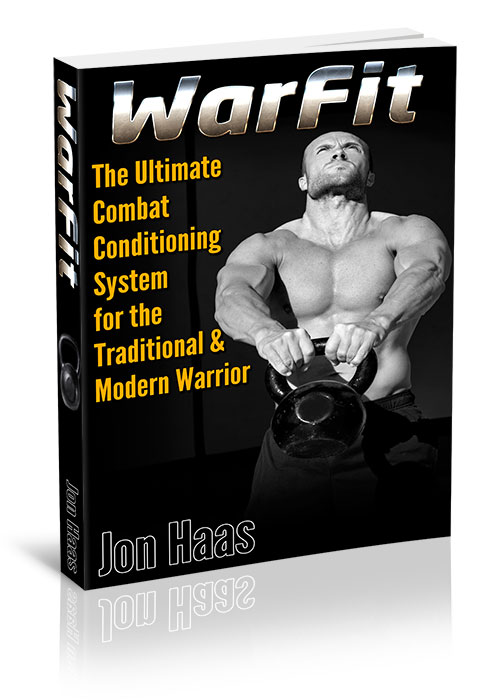
My brand new WarFit Combat Conditioning Program is perfect for the warrior athlete who wants to build superhuman strength, endurance, and conditioning…

warfit3d1


The Failure of Yogic Breathing

There are many different systems of breath work out there that focus on relaxed breathing and stress reduction that also talk about how to increase breath control and expand the practitioner’s lung capacity.  Unfortunately the majority of these systems fall short due to the fact that they tend to focus the bulk (or all) of their work on static posture breathing and breath retention exercises.  Usually the practitioner is either seated on the floor, on a chair, or lying down in a comfortable, meditative posture while the breath is regulated through a series of counts and breath is retained in gradually expanding holds.

Breathing2

Before any of my Yogi friends get upset with me, let me clearly state that yes, this process works and I am a huge fan of Yoga’s Pranayama along with other systems of breath work.  There is nothing wrong with it!  Doing this type of exercise on a regular basis will increase lung capacity and control, to a degree.

So What is the Problem?

The problem with this type of exercise, as I see it, is that very rarely do we require all that enhanced lung power and capacity while sitting on our butts in a comfortable and relaxed position.  Unless you are only interested in showing off how long you can hold your breath at parties and stuff, this way of exercising has limited usefulness.

A much more practical way of exercising lung capacity and breath control is by working the body through a series of simple calisthenics.  By placing the body under stress via exercise while incrementally increasing the retention of the breath on both the inhale (easier) and the exhale (more advanced), we magnify the results.  In my experience, this has a much broader and far reaching effect on the body’s systems.  It is also vastly more practical in terms of real world usage for martial art, athletics, and overall strength & conditioning training.

So, how do we do it?

I’m glad you asked!  Let’s begin with one of the most natural movements in the world, a basic bodyweight squat.

If you are not familiar with a basic bodyweight squat, here is a super quick tutorial:

  1. Stand in a natural position with feet slightly wider than shoulder width apart
  2. Keep the alignment of your spine as straight as possible from crown to tail bone.
  3. Squat down as low as possible while maintaining the alignment of your straight spine.
  4. Keep the weight mid-foot balance.
  5. Pause for a second at rock bottom.
  6. Lift from the crown of the head to “pull” the body back to standing.

Breathing Squats

We will do our breathing squats in the same fashion but with a couple modifications.  First remember that the purpose of these exercises is to train your breathing and expand your breath control and capacity.  They are not meant to “kill” your legs.  Although, depending on your level of conditioning, they might.

  1. Perform a basic bodyweight squat as detailed above.
  2. Just prior to beginning the squat, inhale deeply into the belly and comfortably hold the breath.  Your goal is to do the squats as relaxed as possible while maintaining the breath hold.
  3. Do 3 squats all while holding the breath on the inhale.
  4. After the 3rd squat, exhale and inhale.  Slowly inhale into the belly and exhale sharply to recover your breath.  When you are recovered, do 3 more.  Repeat.
  5. When you can comfortably do 3 squats while holding your breath (meaning you are not out of breath when you stop), then proceed to 5 squats on the breath hold.

Slowly increase the number of squats you can do on the breath hold.  When you can comfortably do 10 squats with the breath held on the inhale, start over again with 3 squats and hold the breath on the exhale.  You will find that holding the breath on the exhale is much more difficult.  The body is already out of breath and now you are adding stress in the form of exercise.  It is here that you will make the greatest gains in teaching the body how to use a limited supply of oxygen in the most efficient manner.  Make sure you proceed slowly and only add more repetitions when you can comfortably hold the breath on the exhale.

Remember – B.I.F (Breathing Is Fundamental)!

Evolve Your Breathing is a master class in learning how to breathe and respond under stress.  Don’t just breathe to survive – Thrive!!

Learn more here…

EVOLVE_SPOT-1 (2)


This Simple Practice RESETS Your Body

Let’s face it.  Some days we just need to hit the RESET button.  Whether due to stress, an accumulation of injuries, fatigue, or illness we need to find a way to RESET the body in order to allow its own natural healing function to take over.

Luckily, there is a very simple process whereby we can RESET ourselves and acquire a deep level of whole body relaxation.  It can be accomplished through the Yiquan training method of Wuji standing, otherwise known as Health Standing.

Wuji translates to “without poles” or “pre-heaven” meaning that yin and yang have not yet been determined.  It is a pure untapped potential and possibility.  It is from this untapped potential that we will begin to form a relaxed, connected body primed for internal power training.

Before we get into the particulars of the exercise, you need to know how to stand. Continue reading

Resolving the Tension Paradox for Martial Artists

In order to truly begin our quest for Integrated Strength, we must first resolve the tension paradox between conventional strength training and internal power…

“Don’t use muscle!”

“No power!”

“Relax!”

“Move naturally!” Continue reading

3 Months to Live

I had a very interesting conversation the other day with an elderly Chinese gentleman.  At 74 years young he still works part-time as a medical doctor and is in excellent health.  He told me that back in 1982 in China he was diagnosed with a very severe lung problem, which was slowly reducing his breathing capacity.  The doctor at the time gave him only 3 months to live!!  I looked at him in amazement and said- “Well, obviously you are still alive and in good health, so what happened?” Continue reading

Breath and Body Coordination

Matching breath to body movement is a key skill in learning how to power movement with the breath.  This matching can be as simple as inhaling on an expanding, opening, or lengthening movements and exhaling on contracting or closing movements.

Under resistance though we begin to look at the idea of exhaling on effort to coordinate breath and body.  Here it can also become a little more sophisticated in using the activation of the core via the breath to send power out to the extremities.

The following is a short clip from my Evolve Your Breathing program showing how the breath can be used to power a push-up.  The concept itself is easy enough to grasp, but the application is a lifetime of study.

EVOLVE_SPOT-1 (2)