A Glimpse Into Internal Power Training – The Push Test

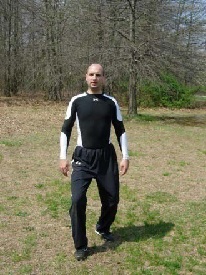
The push test is a very practical way of testing the quality of one’s solo training for internal power.  As explained in Weakest Direction Theory is BS, the body, when properly trained, acts as an omni-directional structure.  This allows the practitioner of internal power to neutralize any incoming force by diffusing it throughout the structure rather than having to surrender to it or resist against it.  Either you can do it or you can’t.  There’s no way to fake it. Continue reading

My Morning Routine

For the past several weeks there has been a running theme interwoven throughout my blog posts.  That theme has been practice, Daily Personal Practice (DPP), to be precise.

I’ve gotten several questions about the details of my own DPP since I refer to it several times in my writing.  So I figured I would pull back the curtains and give you a more detailed glimpse into my Morning Routine of DPP in this post. Continue reading

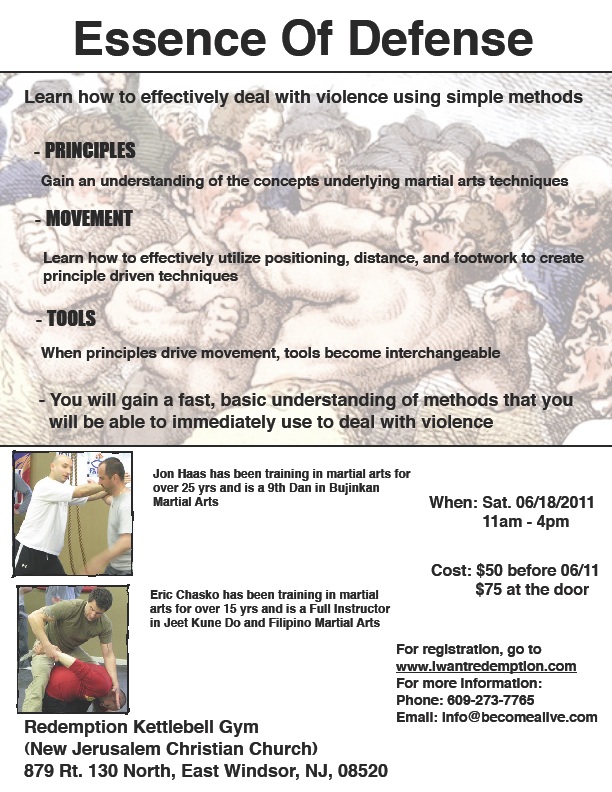
What is the Essence of Defense?

What exactly is the essence of defense?  Suppose you took a martial art(s) and stripped it down to its core principles and functional movements to allow it to be employable with any tool whether it be empty-hand, blunt weapon, edged weapon, long weapon, hidden weapon, or improvised weapon?  What you would have is a fast, effective, no-nonsense approach to communicate years of martial arts training in a short span of time.  This approach would make self defense methods immediately accessible to people who may not want, or have time, to devote decades to becoming effective at defending themselves.  Suppose you want to have the confidence and ability to protect yourself and your family from sudden violence, but don’t want the trappings of tradition and the hours of perfecting forms and kata?  What if the essence of defense could be extracted by 2 highly experienced martial arts practitioners, refined, distilled, and communicated not over years, but in the course of a seminar?

Principles:

  • Get off the line of attack
  • Counter-attack
  • Intercept/destroy the attack
  • Unbalance the opponent
  • Continuous movement
  • Escape
  • Much more….

Movement:

  • Positioning
  • Footwork – angles, distancing
  • Safe space
  • 3 dimensional movement
  • Much more…

Tools:

  • Body weapons
  • Blunt objects
  • Edged weapons
  • Improvised weapons
  • Hidden weapons
  • Much more…


Who should attend The Essence of Defense seminar?

  • Military
  • Law Enforcement Officers
  • Anyone who wants a working knowledge of practical martial arts principles that allows them to create their own techniques in response to a specific threat of violence. 

When:  Saturday, September 8th from 11 AM to 4 PM

Where: Redemption Kettlebell Gym in Robbinsville, NJ

Cost: $65

Who:  Eric Chasko is a fully licensed instructor in Jeet Kune Do/Filipino Martial Arts with over 15 years experience.  

Jon Haas is a 9th dan in Bujinkan Budo Taijutsu with over 30 years experience.

For more information and to sign up, please go to http://www.iwantredemption.com/

See you there!!

Battling Demons

To get good at any discipline, you must practice every day.  To become great, you must practice all the time.  The problem is, with so many pressures, responsibilities, and draws on our time in daily life, how does one manage to train every day?

For me, it’s a daily battle with my demons.  These are the insidious little creatures that lurk in the dark recesses of my mind.  Their sole purpose being to distract me from becoming the person I want to be.  They rationalize and cajole to pull me off the path of self improvement.  The path of training.  For others, the path may be their daily struggle to make good food choices and lose weight, or it may be the daily battle to study at night while working a full-time job in order to earn that MBA.  The path is personal.  The demons are universal.

Currently I train for a few minutes every morning which provides the dual function of waking me up and setting me on the right path for the day.  It primes my muscles, movements, and nervous system for the more involved training I will perform later that night.  Additionally, I will train during the day at odd intervals when I have a few minutes of down time.  These little periods provide the consistency I need to help me keep going.  But, as I stated above, the bulk of my training is done at night after putting the kids to bed.  Usually around 9 pm or so I head down the basement to my home gym.  This is my dedicated training spot.  For me, it helps to focus my efforts since the only thing I do there is train.  It’s minimalist with very few distractions.  Perfect for doing the work.  For the most part, I beat the demons by just getting downstairs and setting foot in the gym.  Getting there is the most difficult part, but once there, the demons are beat and the daily training progresses.

Sometimes, like last night, the battle isn’t won by just getting to the gym.  Last night was different.  I was tired.  I was comfortable sitting on the couch watching TV with my wife.  The kids were asleep.  The house was quiet.  Peaceful.  I thought that the demons hadn’t even shown up to fight because getting down there was so easy.  Once I was in the gym though, they attacked.  It was a sudden, violent onslaught that took me by surprise!  “You’re tired,” they told me. 

“You don’t need to train anymore today…”,

“You did enough over the weekend.  Relax.  Take it easy.”, 

“Why don’t you just go to bed early for a change?  You need your rest!”

On and on it went, not just verbal but real feelings of being sleepy.  Feeling like I should go upstairs and go to sleep.  I almost gave in.  Almost succumbed.  Almost quit.

But mental fortitude kicked in.  Training kicked in.  The battle was on!  I heard myself talking to one of my training buddies saying – “you have to train every day.  You have to want it bad enough.  How do I do it?  Well, it’s like brushing your teeth, Dude.  You just do it every day (usually twice!) no matter what.”  This began the rally.  But it was far from won.  What won the battle once and for all (at least for last night) was the fact that I just started doing my solo conditioning exercises.  I was in the right place.  My mindset was returning.  But the way to win the battle is to simply begin doing the work.  Understand that your training is a necessary part of becoming who you want to be.  Understand that daily training is a necessary part of that process.  And get it done.

Why Sitting All Day is Slowly Killing You

There’s more to leading an active lifestyle than just getting in a workout a few times a week.  Check out this Men’s Health article on Why Sitting All Day is Slowly Killing You.  Think your 45 minute exercise session 3-4 times a week is protecting you from heart disease?  Think again.

For some ideas on how to add beneficial movement to your sedentary office worker life, check out the Corporate Warriors section of Warrior Fitness.

Knowing is Not Enough!

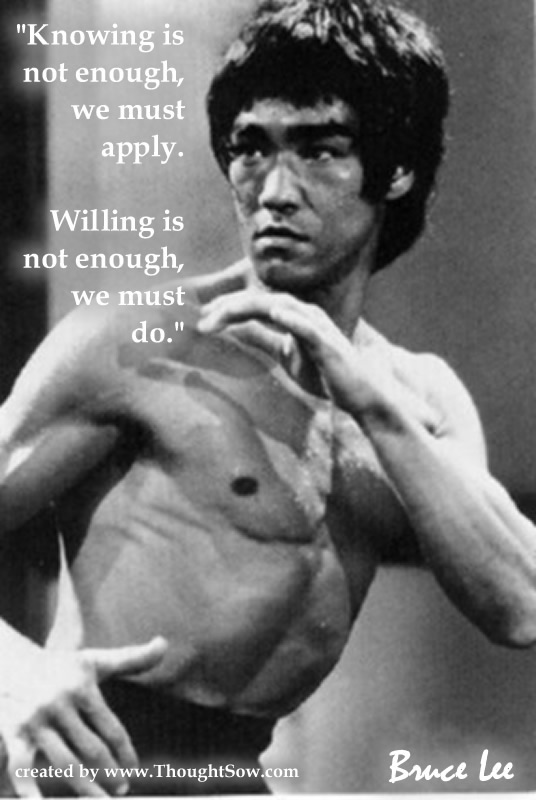
With the proliferation of the Internet and the incredible wealth of resources available in book, DVD, and digital formats, many of us already know more than enough to be martial arts masters!  Yep.  You heard me right – you know more than enough right now to be a master martial artist.  Cool, eh?  Heck, some of us even have more disposable information on budo history, lineage, techniques, kata, and principles at our fingertips than all of the past generations of Bujinkan Soke combined!  Think about that for a second.  Now, at this time in history, the sheer amount of knowledge in the form of information available to us is greater than at any other time, and it’s only going to continue.  Yet, with all of this knowledge, why aren’t we all amazingly skilled?  Why do the legendary feats of past budoka seem so remote and unachievable to us today?  Why are there so few with real skill among the millions of people practicing martial arts worldwide?  Because knowing is not enough, that’s why!  Hatsumi Sensei has emphatically stated on many occasions, that “budo is not an academic subject.”  Why then do we continue to view it as such?  There has only ever been one way to become as highly skilled at a craft as to be called a master.  “Knowing is not enough, we must apply.  Willing is not enough we must do.”    

Is Your Cup Already Full?

Another way we limit ourselves is by equating knowing with being able to do.  For example, when your teacher demonstrates a fundamental principle of movement for the hundredth, or maybe hundred thousandth time, do you smile smugly to yourself and think, “I know that already”?  Maybe you have.  I know I have.  I admit it.  But this type of attitude makes us lazy.  It lowers our skill level because it allows us to hold fast to the superficial without the hard work of plumbing the depths.  It lets us check those basic movement(s) or principles of movement off our mental list and move on to something more advanced; more worthy of our time (we may think)… big mistake.  If we were truly honest with ourselves, we’d be asking a different question.  The better, more appropriate question to be asking ourselves is -”how well can I do that?” or “How well do I truly understand those movement(s) bodily, not intellectually?”   This is hard though because most often the most authentic answer we can give ourselves is, not well enough.   Watch your teacher closely.  Look deeper.  Pay attention because there’s always more.  Be careful.  Practice.  Practice.  Practice!

All Strength is Not the Same for the Warrior!

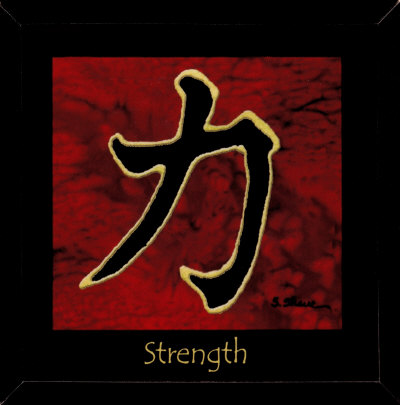
As martial artists most of us tend to cringe and shy away from words like “strength” and “power” in favor of seemingly more budo-friendly fitness words like “agility”, “coordination”, or “balance”. Yet, often we do not understand the actual definitions of the words and simply avoid them because of some misplaced fear that they will be detrimental to our taijutsu and make us “muscle” through our techniques. Nothing could be further from the truth! Let’s examine some of the components that make up strength in more detail to understand just how much they are applicable to creating a strong physical and mental base from which to launch the rest of our Budo Taijutsu skills.

General physical conditioning is essential for the warrior to develop a broad-based platform of strength, endurance, agility, coordination, and flexibility from which to launch and further refine skills. But, what exactly is strength? Strength is defined as “the ability of a given muscle or group of muscles to exert force against resistance.” It is a function of the appropriate muscles contracted by effective nervous stimulation. This alone, however, is insufficient. There are also at least five different sub-categories of strength which we will break down to give you a more complete understanding of the term.

 The first sub-category is Maximal Strength. This is the maximum amount of force that a person can voluntarily produce. Example exercises to cultivate Maximal Strength are: one arm pushups, one arm chin-ups, one legged squats, and heavy weight lifting. But what on earth does Maximal Strength have to do with Budo Taijutsu? Aren’t we training to only use as much force as necessary and appropriate to a specific movement or technique? Why would we need our maximal voluntary strength output when training for taijutsu fitness? These are all good questions. On the surface, it would seem like this sub-category of strength is a big “N/A” for us. What possible benefit could this particular strength quality have for budoka? To begin to appreciate the benefits of training maximal strength, we must first understand the different types of muscle fibers. Generally, when people speak about fast twitch and slow twitch muscle fibers, they tend to separate them out as two distinct types. This can be a little misleading due to the fact that muscle fibers are not either /or, but in actuality they appear to lie somewhere on a continuum between the two. Thus to emphatically state that one type or the other is predominate within certain groups of muscles can cause confusion. Because low intensity exercise, like jogging at a steady-state pace for example, does not activate the fast twitch (FT) muscle fibers, we must increase the intensity of the exercise to stimulate the motor units that contain the FT fibers. If the motor units are not stimulated, then no response occurs and no adaptation occurs. Fast twitch muscle fibers and slow twitch muscle fibers are both recruited in high percentages when performing maximal strength exercises. Maximal strength training creates potent neural adaptations which lead to increased intermuscular and intramuscular coordination. A side bonus for working on maximal strength with body weight exercises is that the majority of them that fall in this category also require balance, coordination, flexibility, and appropriate tension throughout the entire body. Examples include, but are by no means limited to, one arm push-ups, one-legged squats, one arm chin-ups/pull-ups, etc.

Does this mean that we should devote every training session to developing maximal strength? No – far from! As warriors, we must understand the different qualities that make up strength and learn how to apply them to optimize our fitness levels specific to our goals. Since our goals do not revolve around winning any Strongman competitions or Power lifting contests, we can relegate working on maximal strength to only once a week, at the most, or a every couple weeks at the very least, to reap the benefits. The rest of the time, consign maximal strength to its rightful place back in our strength and conditioning toolbox. Too much emphasis on maximal strength can lead to becoming muscle “bound”, as in bound, constrained, unable to move freely and without appropriate tension.

The second sub-category of Strength is Explosive Strength. This is the ability to produce maximal force (see above) in a minimal amount of time. Explosive strength? Jon, you’ve got to be kidding me! We don’t use explosive strength in Bujinkan Budo Taijutsu! Really? Are you sure? Every time you leap, sprint, dive out of the way of an errant sword strike, or (and this is a big one!) use stored elastic energy to create power in your movement, you are using explosive strength. Sure, the terminology sounds like something that will adversely affect our taijutsu and that any serious budoka should avoid like the plague, but rest assured, that the much maligned concept of strength does play an important role in budo taijutsu and utilizing the strength exercises prescribed in this manual will provide a solid physical basis on which to build real skill. Plyometrics is a specific training means for developing explosive strength designed by Russian sports scientist, Yuri Verkhoshansky in the early 1960’s.  Closely linked to Explosive Strength are Speed Strength and Reactive Strength.

The third sub-category of strength is probably one of the most familiar to us. It is Strength-Endurance. OK; much better… now we are in familiar territory. Endurance is a concept that a ninja can relate to! This strength quality involves the production of muscular tension without a noticeable decrease in efficiency over long periods of time. Development of strength-endurance is a fundamental necessity for warriors, whether on the battlefield, in training, or just everyday life. A helpful analogy to keep in mind when applying the different aspects of strength training to budo is that they are like a recipe for success. All of the ingredients in any recipe are not utilized in the same amounts. A little bit of salt may be all that’s required to enhance the flavor, while a lot of flour may be necessary to provide the base. The same idea applies to strength training. Warriors will normally require a lot of strength endurance and cardio-respitory endurance, but maybe only a little bit of maximal strength development is necessary to round out their overall skill. “When effective methodology is used, exercises with resistance promote not only an increase in movement speed but also perfection of coordination, motor reaction, quickness and frequency of movements, the ability to relax muscles, development of local muscular endurance and an increase in maximal anaerobic capacity.” (Verkhoshansky, Special Strength Training – A Practical Manual for Coaches) The key here is in how these various strength qualities are trained. For martial arts, specifically Bujinkan Budo Taijutsu, we want to work exercises which emphasize intermuscular coordination of the whole body. Isolation exercises should be avoided as they are antithetical to what we are trying to accomplish in training. When performing all of the exercises listed here, try to use as little tension and muscular effort as possible; just enough to accomplish the task and no more. Try not to utilize general tension (tightening of the entire body) to carry you through the exercise. Since everything that we do acts as conditioning for our Central Nervous System (CNS), for good or for bad, we want to make sure our exercise philosophy is in harmony with our overall training strategy. Remember that in our day-to-day Bujinkan Budo training we are striving to perform techniques efficiently and effectively with minimal muscular recruitment, therefore our physical fitness training should not use a separate strategy.

Hopefully this short look at the various types of strength has been helpful!
Ninja Walking

The following article is an excerpt from Warrior Fitness: Conditioning for Martial Arts…  Enjoy!

Proper walking is footwork training for budo. How we walk in day-to-day life is how we will walk (move) in combat. Efficiency in more complex movement begins with efficiency in simple movements. How can we expect to move with ease in the chaos of a combative environment when most of us have trouble walking with natural gait? Walking is a ubiquitous activity that many people simply take for granted. They move through the day without any awareness of the strain they place on their knees, hips, and lower backs by their poor movement patterns. Just a little awareness will do wonders for your balance, posture, and lightness of step. When Hatsumi Sensei first came to the U.S., of the things he noticed immediately was how heavy and inefficiently people walked. His comment was that most people walked “like Frankenstein”!

 Walking Exercises:

1. Stand in shizen no kamae (natural posture) and balance on one leg. Lift the other foot a few inches off the ground and then lower again in a slow, controlled manner using the flexing of the grounded leg to regulate the descent. Gently bounce a few times getting the feeling of how the grounded leg’s flexion and extension controls the lowering of the other foot. The balance on your leg should be such that you are able to lower the opposite foot to the ground in any direction and easily maintain kamae (balance). Switch legs and now balance on the other leg while lowering the foot.

2. Stand in shizen no kamae (natural posture). Use your right hip to lift the right foot off the ground. It will feel strange at first since this is not a very commonly used muscle action, but once you get used to it, it will become an efficient way of lifting the leg. With the right leg lifted, pull back with the right shoulder.  Notice how this has the effect of creating a slight torque in the spine and moves the right foot forward at the same time. Release the tension in the spine by placing the right foot down in a forward step. Feel how the release of tension propels the body forward and allow it to create the same lift from the hip and pulling back of the shoulder on the left side.

3. Combine the previous two exercises together and begin to walk.

 4.  Another idea to try when walking is to alternate periods of normal, regular breathing with holding your breath for duration when “full”, after an inhale, and when “empty”, after an exhale. Try inhaling for a count of 5 (steps or seconds), hold your breath for a count of 5, exhale for a count of 5, and finally, hold your breath empty for a count of 5 while walking. Repeat as long as you can continue the pace. Note that 5 is just an arbitrary number and can be raised or lowered to suit your own needs. This practice will help you to understand how your body can function during situations when you must suddenly hold your breath yet still continue to work. Another benefit of this exercise is that it also helps the body to process oxygen to brain, heart, and other working muscles more efficiently.

Don’t forget “light feet and soft knees” when walking!

A Case for Mini Workouts

These days everyone is short on time.  Most are content to allow the daily grind and family time to fill their days while lamenting about the fact that they have no time for working out.  The complaints are common and heard often.  But somehow these same people are able to find time to watch an hour or more of TV every night before going to bed.

Now, I’m not going to ask you to forego your Sunday night Walking Dead episode (I certainly won’t!) in favor of hitting the gym for an hour, so don’t worry – just using the ability to watch TV as an example of “finding time”.

While it may be a stretch for many people to find 45 minutes to an hour each day for exercise or martial arts training, how about just finding 5 minutes?  Surely everyone can find a spare 5 minutes even a few times a day, right???

Recently, as my own daily grind has become busier and busier, I have been finding just how effective mini workouts can be to fill in the gaps in one’s training.  These types of workouts are often overlooked because of their brevity.

After all, how can one possibly get a complete workout in 5 minutes?!  Well, you can’t.  But that’s not the point.  The effects of mini workouts are cumulative.  In other words, they add up over time (that’s what cumulative means… :).

They are not meant to completely replace your regular training, but are meant to enhance it and compliment it.

They are an effective way to keep yourself on track and focused when short on time, or if you have already completed a full workout and still want to get in some extra training – nothing wrong with that either!  Remember, the goal of the mini workout is not to be too complicated or over-involved.  Make them short, sweet, and to the point!

Examples of Mini Workouts

Here are just a few ideas I’ve found that make ideal mini workouts:

  • 10 push-ups + 10 v-ups + 10 squats (repeat 3-5 x’s)
  • Finger tip push-ups (see how many you can do)
  • Tabata exercises (pick one and go)
  • 5 Kettlebell Snatches (each side) + 5 Kettlebell Swings (each side) + 10 Hindu Push-ups (Perform AMRAP for 5 or 10 minutes)
  • Isometrics
  • Breathing exercises combined with bodyweight training
  • Joint mobility work
  • Pull-ups (5-4-3-2-1 rep scheme)
  • Burpees or Sprawls for 50 to 100 reps

Mini Workouts for Martial Arts

The mini workout should be an essential aspect of any martial artist’s training.  It is said that great martial artists are training all the time.  Well known and respected masters from Musashi to Tesshu to Ueshiba to Hatsumi Soke have constantly extolled the importance of solo-training and dedicated practice.

While mini workouts do not form a complete picture of solo- training, they do play an important role.  In the future, I’ll be sharing a more extensive look at solo-training for martial arts, particularly for Bujinkan practitioners.  But for now, here’s a short list to get you started:

  • Ukemi practice – mix up rolls, change directions freely, roll over obstacles
  • San Shin no Kata
  • Solo flow drill – move continuously for 5 minutes. Flow from strikes to kicks to leaps to rolls, from kamae to kamae – be creative!
  • Kamae work in a mirror
  • Striking practice
  • Junan taiso (see above!)

Make sure to make time for mini workouts!

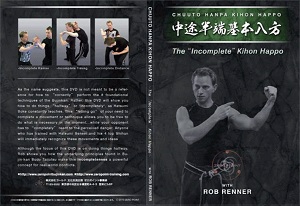
The “Incomplete” Kihon Happo DVD Review

Chuuto Hanpa Kihon Happo or, The “Incomplete” Kihon Happo, is a new DVD by Bujinkan instructor, Rob Renner.  Rob has been training in the Bujinkan since 1986 and living in Japan since 2005.  He trains with Hatsumi Soke and the Shihan, senior instructors, typically 5 to 6 days a week.

This DVD is, as Rob points out, not the “official” version of the foundational techniques of the Bujinkan, but rather a synthesis of each Japanese Shihans’ take on the techniques as studied and interpreted by Rob.

The DVD begins with Rob’s expanation of Hanmi, or “half-body” kamae.  This incomplete Ichimoni no Kamae has the hips at a 45 degree angle forward to facilitate structure, stability, and mobility instead of the traditionally taught kamae with the hips completely sideways while the head looks forward.  Not only is Rob teaching 1/2 kamae, but as each technique is analyzed, he shows how to utilize 1/2 the distance, and 1/2 the time as well to create more efficient, and effective, technique.

Each technique of the Kihon Happo is then presented, first as they are usually performed in Bujinkan Dojos worldwide, followed by a discussion of common problems and mistakes when done as shown.  Make sure to pay attention here as you may recognize some of your own mistakes.  This discussion alone is worth the price of the DVD! 

Rob then moves on to demonstrating and explaining how to use the principles of Bujinkan Taijutsu to effectively do the techniques.  Each section begins with a quick bulleted list of principles that will be taught for each technique.  This is an effective way to prepare the audience for the material to be reviewed in the section and also serves as an effective reminder as the same principles are presented, and added to, each time.  Throughout the principle-based discussions, Rob constantly stresses the importance of correct kamae by using hips, knees, feet, and shoulders in alignment to be able to control distance and move in any direction. 

In the Torite Goho section of Kihon Happo, Rob makes a very important distinction between translating kuzushi as “breaking balance” versus “breaking structure”.  When you break an opponent’s structure, he is still very much on balance, but simply can’t generate force in any meaningful way.  And, since his balance is not compromised, he still believes in his mind that he is okay.  Hmm… sounds like kyojitsu to me.  However, when breaking an opponent’s balance, his body will automatically endeavor to correct it and suddenly you’re in a fight.

Kihon Happo Techniques Taught on the DVD

Koshi Sanpo:

  • Ichimonji no Kata
  • Jumonji no Kata
  • Hicho no Kata

Torite Goho:

  • Omote Gyaku
  • Mushadori
  • Onikudaki
  • Ura Gyaku
  • Ganseki Nage / Musodori

In the final section of the DVD, Rob uses the Torite Goho to show examples of Hatsumi Sensei’s movement as it is today.  This is done by following all the principles espoused in the earlier parts of the DVD and through manipulation of the kukan and kyojitsu.  It’s a great way to wrap up, pull everything together, and show a progression of the material all at the same time.  This is a very well done DVD with tons of detailed instruction.  Highly recommended!

For more information, and to purchase the DVD, please see Rob Renner’s website, Bujinkan Zeropoint Dojo.