Warning: The following post is going to conflict with the most basic, fundamental principle you “know” to be true in martial arts. Chances are you learned this principle on your first day of martial arts class. Since that day you have repeated it almost every class. You have taught it as truth to every new person you’ve ever trained with. It’s so ingrained into your psyche that it’s practically dogma. Most likely you will read this a instantly brand me a Budo Heretic. Yup. It’s that controversial…
Strap in folks, it’s gonna be a bumpy ride for you. Destroying myths and beliefs always is!
Here we go…
I am calling BS on Weakest Direction Theory. You know, the triangle point? Draw a line between uke’s feet, then draw a line perpendicular to that line, and that is their weakest direction because the uke has nothing to brace their structure along the weak line, right? Wrong. It’s a belief system – BS – (what did you think I meant by BS?) based on an old, outdated model of looking at the body.
The Old Model
The old model looks at the structure of the body as a conventional column, like a building. In this model, walking and running are usually described as a ‘controlled fall’. The body vaults from one leg to the other, loading and unloading, inelegantly transferring weight from side to side with each step. 
In this model, the body is balanced precariously on 2 legs. Pushing or pulling toward that triangle point, or 3rd leg, either forwards or backwards easily destabilizes the structure.
This seems to make perfect sense to us since, as I said above, there is nothing overt with which to brace ourselves when pushed or pulled off center into that weakest direction. The only way to regain balance is to step and once again reestablish our equilibrium. 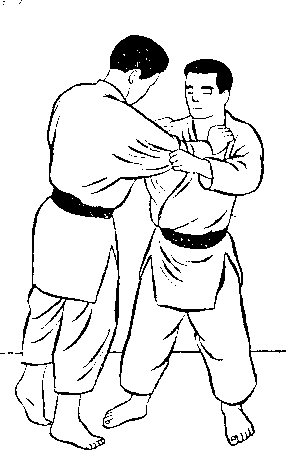
The New Model
The new model is biotensegrity, or the integration of tension within the human body.
“Biotensegrity is a mechanical model of biologic structure and function based on construction concepts introduced by Kenneth Snelson and Buckminster Fuller in the 1960’s. In these models, the compression struts or rods are enmeshed and ‘float’ in a structured network of continuously connected tension ‘tendons’…”
“The structure is omni-directional and functions independent of gravity. Unlike a conventional column, it is structurally stable and functional right side up, upside down or sideways. A tensegrity structure can function equally well on land, at sea, in air or space.”
– The Mechanics of Martial Arts by Stephen Levin, MD http://biotensegrity.com/martial_arts_mechanics.php
In other words, the bones in the human body act as compressive struts pushing outward while the fascia and other connective tissue wrap the body, pulling inward. This creates a dynamic stability and balance within the structure with many far reaching applications. 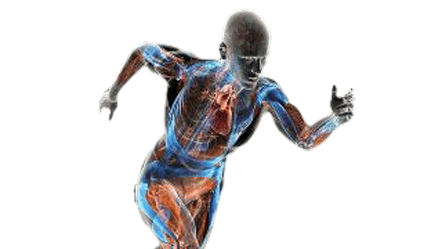 Because the body is truly an omi-directional structure, applied force need not be accepted linearly (as in the old model), but can, with proper training (read – “internal power”) be diffused and distributed throughout the structure to balance incoming forces and remain dynamically stable.
Therefore, an exponent of internal power training may, through both his BS – Belief System – and proper training, not be pushed or pulled off his center even when that force is applied in what was previously thought to be the “weakest direction”. The fact of the matter is, a properly conditioned body does NOT have a weakest direction. Force never need be absorbed directly in a straight line in a local area.
Non-Local Force Distribution
If load (applied force) can be distributed throughout the system, then how can kuzushi be attained? This is hugely important!!
“When absorbing a blow, it reverses the process by soaking up the initial force, distributing it, and then gradually stiffing at the cellular level where the cells, rather than all the resistance landing on a local area. The bone breaking impact, rather than focused where the blow landed, will be he resisted by all your cells in a wave that spreads from the impact cite to a wall of billions of cells throughout the body, acting as perfect hydraulic shock absorbers, take up the blow.”
– The Mechanics of Martial Arts by Stephen Levin, MD http://biotensegrity.com/martial_arts_mechanics.php
To take the entire concept even further, in this brave new world model of Biotensegrity, each individual cell behaves as an omi-directional structure. This insures that ALL connective tissues of the body work together ALL of the time thus proving the old internal martial arts maxim of – When one thing moves, everything moves!
So the question for you now, going forward, is – will you choose to simply keep accepting your old BS – Belief System?
OR, will you begin to learn how to operate from the New Model Belief System that I’ve shown you here today and change your martial arts training for the better, forever???
It’s up to you.
Weakest Direction Theory Part 2 is HERE <<======

This is what is taught in real tai chi chuan and the internal arts. You are correct!
Thanks Mike! What do you train?
Wu Tai chi chuan and kun tao silat.
Pingback: Weakest Direction Theory is BS - Part 2 | Warrior Fitness
This is what is taught in all the internal chinese arts, Taiji, Bagua, Xingyi. Yichuan, Luihebafa.
Internal structure can defy superficial gross motor muscle movement every time. Just got to train it. 🙂
Absolutely, Kelly! The training it is key!
Pingback: A Glimpse Into Internal Power Training - The Push Test | Warrior Fitness
Pingback: La “falsa” teoría de la dirección más débil - Parte 1
Pingback: Research of Martial Arts (Book Review) | Warrior Fitness
Pingback: Resolving the Tension Paradox for Martial Artists | Warrior Fitness