The other day as I was running around teaching classes at the gym, working on various upcoming projects, and writing articles, I suddenly found myself running short on time for my own workout. I had planned to have an hour to myself before going to pick up the kids, but somehow it didn’t quite work out that way. As I looked at the clock, calculated how little time I actually had left before having to run out, it didn’t seem possible to accomplish the workout I had planned for the day. Continue reading
Category Archives: Kettlebells
Combat Conditioning and A Challenge
The video below is a brand new combat conditioning circuit I put together for martial artists. It will be especially good for my Buyu (warrior friends) training in Bujinkan Budo Taijutsu. If you are ready to put your body, mind, and spirit to the test, this circuit is guaranteed to kick your conditioning into high gear. Continue reading
Combat Conditioning Seminar
COMBAT CONDITIONING SEMINAR
Learn Exercise Programming and Secret Conditioning Techniques by 2 of South Jersey’s Top Strength and Conditioning Coaches.
On February 25, 2012 Coach Jon Haas and Coach Christopher Lopez will blow your mind.
***
You Will Learn How To:
(1.) Use Proper Warm Up Techniques to prepare you for Combat based movements
(2.) Incorporate Soft Tissue Movements to Increase Blood Flow and Muscle Recovery
(3.) Maximize Your Strength and Conditioning results from a Combat Perspective
(4.) Use Specific Exercise Programming That can Increase Speed, Explosiveness, and Cardio Capacity…at the Same Time (
5.) Use Secret Breathing Techniques that could be the difference in winning or losing a fight.
PERFECT FOR:
MMA Trainees
Police Officers
Military Personnel
Traditional Martial Artists
Location:
Warrior Fitness Gym
Hainesport Business Complex
4004 Sylon Blvd.
Hainesport, NJ 08036
***
Date and Time:
Saturday February 25, 2012 10:00am – 2:00pm
(bring small snacks to eat during the Seminar)
Price:
$65/Person (Early Registration)
Click HERE to Register.
$75/person (At the Door)
Holiday Belly-Busting Met Con
If you’re like many people perhaps you’ve over indulged a little bit this holiday season. Too many great meals and even greater desserts maybe? Well here’s a quick metabolic conditioning workout to help you out. The great thing about metabolic conditioning workouts is that, unlike traditional aerobics, they stoke the fat burning furnace and keep it burning for hours after your workout is completed. Continue reading
Warrior Workout in the Park
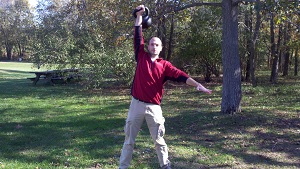
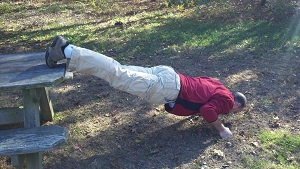
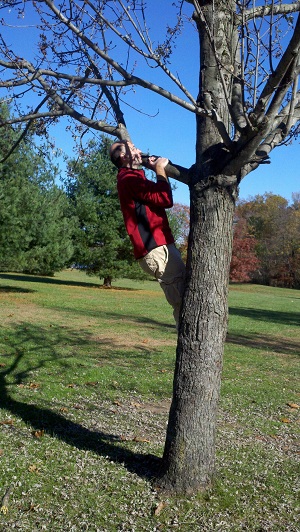
This past Saturday was a beautiful fall day here in Jersey. A perfect day for a Warrior’s Workout in the Park! This workout was directly inspired by Zach Even-Esh’s Ultimate Underground Strength System.
Warrior Workout
15 minute warm-up – mobility, movement, animal crawls, band work, breathing exercises followed by…
1) KB Clean & Press – 5×5
2A) Picnic Table Push-ups on fists – 4 x submax
2B) Thick Tree Branch Pull-ups – 4 x submax

3A) KB Goblet Squats 4×10 (forgot to take pics of these – sorry guys!)
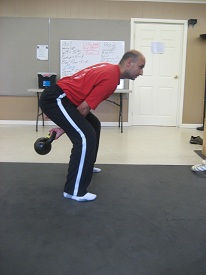
3B) KB Swings 4×10
4) Abs / Grip work 3 sets each
The cool-down consisted of various yoga asana and breathing exercises as both normalizing work and compensatory movement.
Hope you enjoyed this! How did you workout this weekend? Let me know!
A Case for Mini Workouts
These days everyone is short on time. Most are content to allow the daily grind and family time to fill their days while lamenting about the fact that they have no time for working out. The complaints are common and heard often. But somehow these same people are able to find time to watch an hour or more of TV every night before going to bed.
Now, I’m not going to ask you to forego your Sunday night Walking Dead episode (I certainly won’t!) in favor of hitting the gym for an hour, so don’t worry – just using the ability to watch TV as an example of “finding time”.
While it may be a stretch for many people to find 45 minutes to an hour each day for exercise or martial arts training, how about just finding 5 minutes? Surely everyone can find a spare 5 minutes even a few times a day, right???
Recently, as my own daily grind has become busier and busier, I have been finding just how effective mini workouts can be to fill in the gaps in one’s training. These types of workouts are often overlooked because of their brevity.
After all, how can one possibly get a complete workout in 5 minutes?! Well, you can’t. But that’s not the point. The effects of mini workouts are cumulative. In other words, they add up over time (that’s what cumulative means… :).
They are not meant to completely replace your regular training, but are meant to enhance it and compliment it.
They are an effective way to keep yourself on track and focused when short on time, or if you have already completed a full workout and still want to get in some extra training – nothing wrong with that either! Remember, the goal of the mini workout is not to be too complicated or over-involved. Make them short, sweet, and to the point!
Examples of Mini Workouts
Here are just a few ideas I’ve found that make ideal mini workouts:
- 10 push-ups + 10 v-ups + 10 squats (repeat 3-5 x’s)
- Finger tip push-ups (see how many you can do)
- Tabata exercises (pick one and go)
- 5 Kettlebell Snatches (each side) + 5 Kettlebell Swings (each side) + 10 Hindu Push-ups (Perform AMRAP for 5 or 10 minutes)
- Isometrics
- Breathing exercises combined with bodyweight training
- Joint mobility work
- Pull-ups (5-4-3-2-1 rep scheme)
- Burpees or Sprawls for 50 to 100 reps
Mini Workouts for Martial Arts
The mini workout should be an essential aspect of any martial artist’s training. It is said that great martial artists are training all the time. Well known and respected masters from Musashi to Tesshu to Ueshiba to Hatsumi Soke have constantly extolled the importance of solo-training and dedicated practice.
While mini workouts do not form a complete picture of solo- training, they do play an important role. In the future, I’ll be sharing a more extensive look at solo-training for martial arts, particularly for Bujinkan practitioners. But for now, here’s a short list to get you started:
- Ukemi practice – mix up rolls, change directions freely, roll over obstacles
- San Shin no Kata
- Solo flow drill – move continuously for 5 minutes. Flow from strikes to kicks to leaps to rolls, from kamae to kamae – be creative!
- Kamae work in a mirror
- Striking practice
- Junan taiso (see above!)
Make sure to make time for mini workouts!
Everyone Needs a Coach!
The other day, I was working out with my good friend Eric Chasko at his studio, Redemption Kettlebell Gym in East Windsor, NJ. After our training session, we were discussing the mechanics of a basic kettlebell swing and Eric had me demo a few swings. As I began demonstrating the basic kettlebell swing that I had been taught almost 10 years ago, he noticed a hitch in my movement during the back swing. Instead of keeping my back flat, I was raising it slightly as the bell moved into back position. This was something I had never noticed previously. Initially, it would not cause a problem, but over time, and with some serious volume, it would begin to stress my low back and contribute to pain in that area if not addressed.
Eric picked up another kettlebell and showed me the difference between what I was doing on my back swing and how it should be done correctly. We then worked on keeping my back flat while bringing the bell back and then driving with the hips to swing the bell upwards. After a practicing for a couple repetitions, I got it. As Eric is fond of saying, “Kettlebell swings are not bad for your back. The way YOU are doing them is bad for your back!” Unless you ask questions and talk to a knowledgeable professional, you never know what you don’t know!
So, although I have done kettlebell swings for years, I still had something to learn from a coach. Never assume you already know how to do something, even something as basic as a kettlebell swing!
What’s Tabata You?
If you have been keeping up with the latest trends in conditioning research then you probably already know that interval training is the most efficient way to train. Interval training alternates periods of high intensity exercise with periods of rest to produce gains in both aerobic and anaerobic systems. Forget about those long slow distance runs to improve aerobic fitness!
The Body’s 3 Energy Systems
To briefly summarize, the body has three energy systems, 2 anaerobic, or non-oxidative, and 1 aerobic, that serve to create ATP (adenosine triphosphate). ATP is utilized by every cell in your body; it fuels muscular contractions, cognitive processes, and internal regulatory functions. Both anaerobic systems fuel maximally intensive activity, while the aerobic system fuels sustained low to moderate level activity.
The ATP-PC system provides immediately available energy for high intensity efforts from ATP stored within the muscles. This system is the most powerful, but least enduring of the three, lasting only about 10 to 30 seconds max.
The Glycolytic system, the second most powerful, is only slightly more enduring than the ATP-PC system. It derives energy from glycogen stored in the muscles and liver converting it to ATP in a process called glycolysis. Its capacity is approximately 90 to 120 seconds. Rest intervals allow the body to recuperate and restore ATP.
Lastly, the Aerobic system uses proteins, fats, and carbohydrates to produce ATP. As the intensity of the effort increases, the aerobic system relies more on glycogen for energy. If the intensity continues to increase, the anaerobic systems must kick-in to provide energy. The important idea to realize here is that all 3 energy systems are always supplying the body with the energy it needs for any activity, at any level of intensity. It’s just that one may be more dominant than the other 2 at a specific time.
If Anaerobic is ‘Without Oxygen’, Why am I Sucking Wind?
If you have been following any of the Warrior Fitness Training Programs, you are already familiar with examples of anaerobic exercises and how they affect the body. Have you noticed how after even a brief, but intense anaerobic session you are breathing heavily?
If anaerobic really means ‘without oxygen’, how come you are so out of breath?
What happens is that your aerobic system is trying like heck to help restore your anaerobic systems. All that extra oxygen is being used to metabolize the lactate that’s accumulated in the muscles during the bout of intense activity. In order to continue to supply energy for all-out, intense efforts, the anaerobic system must be replenished. Excess Post-exercise Oxygen Consumption (EPOC) is the term used to identify this process of extra oxygen being taken in to restore all systems. So, basically, as the intensity of your exercise increases, so does your EPOC. And, that’s why you’re sucking wind!
Tabata Protocol
No discussion of interval training would be complete without touching on Tabata. Dr. Izumi Tabata at the National Institute of Fitness and Sports in Tokyo, Japan performed perhaps the most well known study on interval training. A group exercising with moderate intensity endurance training was compared to another group using high intensity intermittent training. Each group exercised 5 days a week. The moderate intensity group exercised for 60 minutes, at 70% VO2 max. The high intensity group did 8 intervals of 20 seconds, followed by 10 seconds of recovery. They operated at 170% VO2 max.
After 6 weeks, both groups experienced improvements in maximal oxygen uptake. The biggest difference between them was that only the high intensity group gained improvement in anaerobic capacity. The high intensity group actually realized a 28% increase in anaerobic capacity AND a 14% increase in VO2max. So, the study concluded that high intensity intermittent training can improve both the anaerobic and aerobic systems simultaneously. Very impressive results!
How Can I Use Tabata?
I knew that after reading the amazing results achieved by Dr. Tabata you’d be ready to try using his protocol, I sure was! The protocol itself is pretty simple, in theory. Choose an exercise – say sprints, for example. Perform the exercise for 20 seconds as fast as possible while still keeping good form. Rest 10 seconds. Complete 8 rounds. Sprints are an easy example, but really the Tabata Protocol can be applied to almost any exercise. Try some of these:
- Bodyweight squats
- Burpees
- Kettlebell swings or snatches
- Sledgehammer swings
- Push-ups
- Sprawls
- Renegade Rows
- Sandbag Shouldering
- Mountain climbers
- Jumping
These are just a few examples of exercises that can be used with Tabata. Just make sure you don’t overly complicate it because you do have to be able to perform several reps within the 20 seconds!!
Additionally, try grouping together 4 to 6 different exercises to increase the effectiveness of the workout and create a synergistic effect where the total combined effect is greater than the sum of the individual exercises. This, I think, is where the real fun begins!
To seriously amp up your conditioning, learning how to use various breathing techniques to restore yourself quicker, lower your heart rate, and increase the effectiveness of your conditioning sessions is a MUST!