4 Principles For Punching Power

Principles of Striking Power


1.    Whole Body Power

All movement happens in real life happens in three dimensions, so why train exercises that only incorporate one or two?  Training muscles in isolation, unless it is used to rehab a specific injury, range of motion, or strengthen a particular muscle to add to the whole, does not work in martial art.  With very few special exceptions, the majority of exercises in this manual will train movements in three dimensions utilizing diagonal, rotary, and angular strength, not muscles. As discussed above, this is the goal of SPP – neurological adaptation.


2.  Stored Elastic Energy (SEE)

Stored Elastic Energy is basically the potential energy stored in tendons and connective tissue as a way to power movement.  An easy exercise to begin to feel stored elastic energy is to stand in a natural stance with feet shoulder width apart.  Bend your right arm and raise it up to shoulder height as if you were about to throw the most telegraphed punch in history (don’t worry, it’s just an exercise).  Now, lead from the elbow and pull your fist back.  Allow your torso to rotate, but keep the feet planted and the hips facing forward.  When you reach the end of your range of motion, hang out there for a second and feel the tension (torque) on the spine.  Now simply relax and release that torque to throw the punch.  Don’t add any driving forces with muscle.  You can’t propel it any faster; you’ll just slow it down.  Feel it?  Try it again.  Do it with the other arm.  Remember the feeling.  This is stored elastic energy (SEE). This point here about creating torque or stored elastic energy (SEE) in the spine is essential in being able to move powerfully without winding up or telegraphing the movement. If you are having trouble feeling it, try to exaggerate the movement. Make it much larger than necessary to study the feeling. It should feel like a tension in the lower back near the bottom of the spine. When this tension (torque) is relaxed (released), the movement happens.
WF UG Cover1

3.   Structure / Kamae

 Many people tend to use the terms alignment and structure almost interchangeably but in actuality, alignment is a component of structure. For example, looking at a natural standing posture, good alignment would be:

  • Crown up
  • Chin down
  • Shoulders packed down
  • Spine lifting up (through crown)
  • Spine pulling down (through the sacrum)
  • Hips under shoulders
  • Knees under hips
  • Mid-foot balance
  • Chest is relaxed
  • Butt not sticking out
  • Hips are open
  • Knees are over the toes
  • Weight evenly distributed (50/50)
  • No leaning forward or backward

This puts the whole body into proper alignment. Structure also includes (in my lexicon) the balance of tensions within the body’s soft tissues. Think of spine as the mast of a sail boat while the soft tissues (fascia) act as the stays keeping the tensional balance.


4.           Breathing

 How often do you think about breathing as it relates to striking?  Yet it is absolutely essential to maintain proper breathing when in combat or simply hitting a heavy bag, mitt, or an opponent.  Lack of breath control affects the rest of your body and hinders your overall performance.

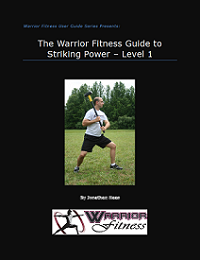
This article is from my e-book manual, Warrior Fitness Guide to Striking Power.

Want to learn even more about how to bring together fitness training with your martial art practice for vast performance improvement?  Join me on a 6-week journey where I take you behind the curtain and show you how to build Martial Power!
MP

How to Develop Wrists of Steel

Martial arts training, especially in arts like Bujinkan Budo Taijutsu, Aikido, and old school Jujutsu, tend to put a lot stress on practitioners’ wrists due to the various types of wrist locks and throws.  Over time this can lead to chronic wrist pain, soreness, and even permanent injury. Continue reading

8 Reasons Why YOU Need Striking Power

Remember, striking power is not just about hitting harder; it’s about hitting smarter.  Here’s a few reasons why this program is something you should incorporate into your martial training:


  1. New, innovative exercises to push through plateaus in your training and stave off boredom.
  2. The right tools for the job – low tech / high yield!
  3. Teach your body how to increase force production through stored elastic energy rather than recruiting more tension.
  4. Efficiency is the key to preserving energy levels.  Efficiency is defined as useful work over total work.
  5. Coordinated whole body power in 3 dimensions.  Life, sport, and martial art happen in 3D – the same old 2 dimensional exercises are NOT up to task!
  6. Specifically develop angular and rotary strength to augment and assist prime movers.
  7. Target postural and stabilizer muscles to strengthen structure behind the strikes.  You can‘t fire a cannon from a canoe!
  8. Solo training is the key to martial greatness – how do you train?

Want to know more about this unique Warrior Fitness product?  Click HERE!


I Need Your Help!

This is going to be a different post for me today.  A little off track from my usual fitness, nutrition, budo, and motivational fare, but definitely a necessary, maybe even vital topic.  First of all, I just want to say thank you to all my Warrior Fitness blog readers and subscribers.  Whether you are one of the many readers who have purchased my Warrior Fitness book or Striking Power e-book or not (yet! :)), you guys make this blog a sustainable enterprise; without you all, I’d just be talking to myself!  I’m grateful that what I write and how I write it resonates with you and also may benefit you in some small way.

I Was Embarassed!

This brings me to the reason for this post.  A few weeks ago at the Underground Strength Coach Certification, see my review HERE, I was talking with Zach Even-Esh about some new product ideas I had for Warrior Fitness.  I had been thinking for a while about tons of new product ideas I’d like to develop for Warrior Fitness and wanted to bounce some of them off him.  Well, what he said to me blew my mind!  Zach said, “Do you know what your readers want?”  I kind of stammered and looked at him a little confused and said, “Um… well, no.  What do you mean?”  He continued on and told me that while I might know what type of products I wanted to create, wouldn’t it make much more sense to know exactly what my Warrior Fitness readers want and need in a fitness or martial arts product and create something great that specifically meets their needs?  I was stunned.  Flabbergasted actually.  It made so much sense and was such a common sensical approach; I’m embarrassed to admit that I’d never even stopped to think about it.  Sorry guys!  So, in an effort to correct my oversight, what I’d like to do is get your opinion on this…

What Would YOU Like to See?

What type of new Warrior Fitness product would you, my readers, like to see?  What areas in your strength, endurance, conditioning, flexibility, mobility, breath control, agility, do you feel need the most attention?  What part of your martial arts training do you feel can be enhanced by fitness training?  Ukemi – rolling, leaping, falling, changing directions rapidly, taihenjutsu?  How about structural strength for kamae?  Creating and sustaining Flow?

Some areas for consideration (but by no means limited to these!) are:

  • Bodyweight training
  • Kettlebell training
  • Sandbags
  • Old school strength training
  • Odd objects – tires, sleds, stones, logs
  • Ninja fitness training
  • Conditioning
  • Fat Loss
  • Any combination or other!!

Also, think about what format you’d like to receive the product in – book, e-book form, DVD, downloadable video?

So in effect what I’m asking is – please help me to help you!  Let’s get a dialogue going and keep it going.  If I don’t know you, I’d like to.  Any ideas are welcome!  You can respond in the Comments section below, through my Facebook page (hey, do me a favor and “Like” it while you’re there!), email me, or heck if you want to discuss something shoot me an email and I’ll give you my phone number – whatever it takes to really make you a viable part of Warrior Fitness.

Thanks!

Jon

Sample Exercise from Warrior Fitness Guide to Striking Power

A Word on Strike Conditioning

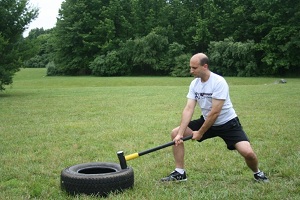
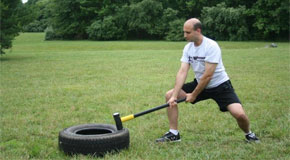
Swinging your sledge hammer at an old tire is an excellent old school conditioning exercise for anaerobic strength and work capacity.  It will insure your strikes have not only power, but endurance and as well.  Old tires are fairly easy to come by, usually any Tire and Auto place will have a bunch of old tires sitting in a pile outside waiting for disposal.  If you ask nicely, they are pretty happy to give you a couple for free.

There are a few different protocols that I like to use for this exercise:

Density training is one option. The concept of Density Training is pretty simple.  Do more work in the same amount of time or do the same amount of work in less time.  So, for example using hitting the tire with a sledge hammer as the exercise and the last time you used this protocol you managed to do 100 swings in 5 minutes, then this session you would either try to increase the number of swings you can do in 5 minutes or strive to do 100 swings in less than 5 minutes.  Not rocket science, right?  What if this is your first time attempting this type of training?  Pick an amount of time, say 5 minutes.  Then try to do as many hammer swings as you possibly can in those 5 minutes.  Crank them out.  Push yourself.  Remember the time limit used and amount of reps achieved, or preferably write it down, and the next time do more.

High Intensity Interval Training (HIIT) is another one.  It is perhaps one of the best ways to train for endurance.  It will enhance all 3 energy systems in the body (2 anaerobic and 1 aerobic – see here for an overview), as well as prime the nervous system to recover automatically during lulls in activity.  Simply put, HIIT alternates periods of high intensity exercise with periods of rest and recovery.  It can be performed with almost any exercise and can be utilized both with and without equipment.  The variety and adaptability of this style of training is second to none in results.

No discussion of interval training would be complete without touching on the Tabata Protocol.  Dr. Izumi Tabata at the National Institute of Fitness and Sports in Tokyo, Japan performed perhaps the most well known study on interval training.   A group exercising with moderate intensity endurance training was compared to another group using high intensity intermittent training.  Each group exercised 5 days a week.  The moderate intensity group exercised for 60 minutes, at 70% VO2 max.  The high intensity group did 8 intervals of 20 seconds, followed by 10 seconds of recovery.  They operated at 170% VO2 max.

After 6 weeks, both groups experienced improvements in maximal oxygen uptake.  The biggest difference between them was that only the high intensity group gained improvement in anaerobic capacity.  The high intensity group actually realized a 28% increase in anaerobic capacity AND a 14% increase in VO2max.  So, the study concluded that high intensity intermittent training can improve both the anaerobic and aerobic systems simultaneously.  Very impressive results!

I know that after reading the amazing results achieved by Dr. Tabata you’ll be ready to try using his protocol, I sure was!  The protocol itself is pretty simple, in theory.  Choose an exercise – say sledge hammer swings, for example (since we’re talking about them).  Perform the exercise for 20 seconds as fast as possible while still keeping good form.  Rest 10 seconds.  Complete 8 rounds.

There are several different ways to swing the sledge hammer.  I don’t care which way you do it – vertically, diagonally, hands apart, hands together, all are fine.  Just make sure that no matter which way you choose, you do not bend your back – we do not train bad habits!

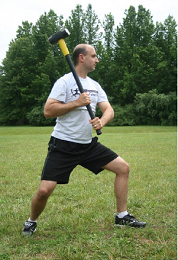
In this particular example, notice the slight turn of the spine where I store energy (SEE) in my lower back.  The hammer swing is powered by the release of that energy, not by my arms.  Also, notice the knees bend as I squat down to hit the tire and not bend my back.  Keep good structure throughout the movement.

Like this exercise?  This one and many more sledge hammer, medicine ball, resistance band, and body weight exercises are described in detail along with sample workouts in the Warrior Fitness Guide to Striking Power Pick up your copy today!!


The Warrior’s Key to Greatness – The Way Lies in Training!

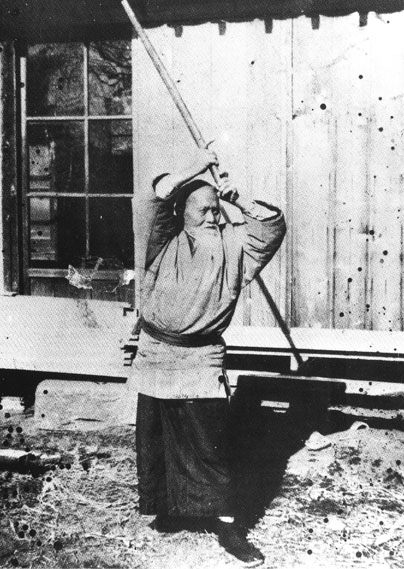
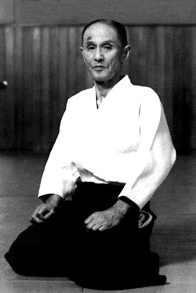
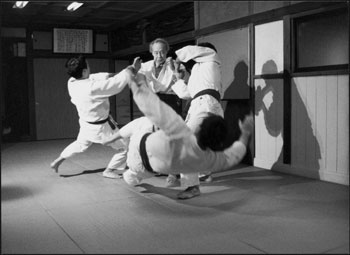
Throughout history a few exceptional martial artists have stood out from the rest of the budo landscape.

Millions of people from every country and culture on the planet have trained in innumerable styles and arts across the centuries, yet we only know a small number of them by name.

These men distinguished themselves and rose to the very uppermost levels of physical, mental, and spiritual skill in their respective arts and in some cases even took their talent to such heights as to create an entirely new martial art.

Looking back at them today, we are awed and inspired by the levels they achieved through their single minded determination in reaching a goal, dogged pursuit of excellence in their craft, and amazing amount of self-sacrifice.

Why are They Different?

What made these men different?

What pushed them to greatness?

What did they do differently or more productively that propelled them to prominence?

Why were their names and storied passed down through the years, sometimes centuries?

What one factor do all great martial artists have in common regardless of style, country, or culture?

And, more importantly, how can we learn from them and apply it to our own training?  Remember, we stand on the shoulders of giants, not to imitate them, but to be able to look farther.

 Quotes from the Greats

Instead of listening to my opinion today, why don’t we go directly to the sources themselves?  Here are some cool quotes I’ve complied by some of the greats talking about their own training.

Morihei Ueshiba – Aikido 

“The instructor can only impart a small portion of the teaching; only through ceaseless training can you obtain the necessary experience allowing you to bring these mysteries alive.  Hence, do not chase after many techniques; one by one, make each technique your own.”

“Always imagine yourself on the battlefield under the fiercest attack; never forget this crucial element of training.”

“This old man must still train and train” – said shortly before his death.

Gozo Shioda – Aikido 

“Kokyu power is produced when we push ourselves to the limit, making the most efficient use of the capabilities that lie within our own bodies.”

“Even though the body has its limits, until your death, the strength of your spirit is limitless.  This is precisely why, in the martial arts, there is no such thing as deteriorating as you age.”

Yukiyoshi Sagawa – Daito Ryu 

“Intermittent training, no matter how intensive, is utterly useless.  You must practice every day for your entire life.  That, and only that, is true training, or shugyo.”

“People who think they can ignore training their bodies and only work on techniques are amateurs.  They don’t know anything.  Actually, if you can’t prepare your body properly, you have no hope of ever perfecting your technique.”

“No matter what level of mastery you attain, you will never achieve perfection.  You should therefore never, ever assume that what you have achieved is good enough.”

“If people knew what my training regimen was like, they would be astonished.”

Masaaki Hatsumi – Bujinkan Budo Taijutsu 

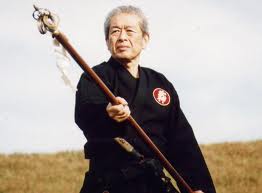
“Modern budo students often forget to practice by themselves.  I used to practice by myself.  When there was no teacher, I found the secret teachings by my own desire.”

“Studying for oneself and making one’s own discoveries is much more important than group learning, and this applies equally well to martial arts.  As I often say, ‘Life is all about solitary training.’  This is because I want serious practitioners to discover the tricks of the trade for themselves.”

Miyamoto Musashi – Niten Ichi Ryu 

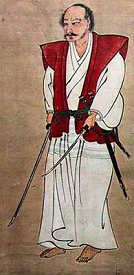
“From the time I was young I have set my mind on the Way of Martial Arts, practiced the one subject of swordsmanship with my entire being, and experienced various and different understandings.”

“See to it that you temper yourself with one thousand days of practice, and refine yourself with ten thousand days of training.”

“Never depart from the way of martial arts.”

Yamaoka Tesshu – Muto Ryu 

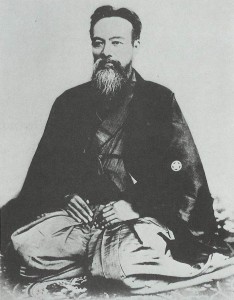
“Study hard and all things can be accomplished; give up and you will amount to nothing.”

“If you want to obtain the secrets of such wonderful techniques, drill yourself, harden yourself, undergo severe training, abandon body and mind; follow this course for years and you will naturally reach the profoundest levels.”

Inspired yet? 

Ready to train and push yourself to the next level? 

Check out the new solo training sensation – The Integrated Strength Program – and get started today!

integratedstrength3D1


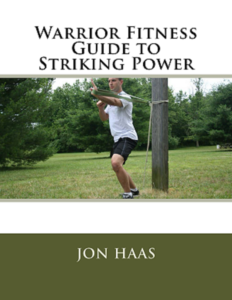
The Warrior Fitness Guide to Striking Power is Here!

by Jonathan Haas, founder of Warrior Fitness Training Systems

  • Specific Physical Preparedness for ALL striking arts from old school Traditional Martial Arts to modern MMA!
  • Learn how to build a powerful structure to stabilize punches, kicks, and martial movement!
  • Discover how to use low-tech, high yield tools to strengthen strikes throughout a range of motion!
  • Sledge Hammer for force production, rotational strength, grip strength, and old school conditioning!
  • Medicine Ball for explosive strength and rotational strength!
  • Resistance Bands for force production, rotational strength, increased stabilization!
  • Bodyweight Exercise and Isometrics for structure and stabilization!
  • Discover how to use Intelligent Tension rather than general tension to power strikes!
  • Learn Breathing and vibration exercises for recovery and restoration!
  • Over 50 pages of pure, 100% actionable content – no fluff, no BS, no filler!
  • Sample Workouts!

Buy Now for only $15 USD!!

Buy Now

Warrior Fitness Guide to Striking Power is a downloadable e-book. No physical products will be shipped. After you order, you will get INSTANT ACCESS to download the e-book and all the bonus reports onto your computer. The e-book format is adobe acrobat PDF, which can be viewed on Mac or PC.

Tools of the Trade

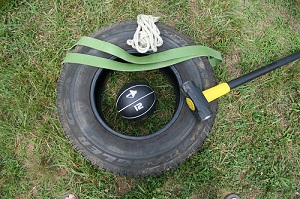
Every warrior requires certain tools to assist them in honing their craft.  Each tool is utilized in a specific manner to create a specific outcome.  In the upcoming Warrior Fitness Guide to Striking Power, we will use several different tools to accomplish the task of super-charging your striking effectiveness.

The Warrior Fitness Guide to Striking Power will utilize a 4-pronged based assault to increasing striking power, effectiveness, and efficiency. 

  1. Sledge Hammer
  2. Medicine Ball
  3. Resistance Bands
  4. Bodyweight Exercises and isometrics

Get ready to change everything you think you know about training your striking ability!