Which Warrior Fitness Program is Right for You?

I get asked this question all the time – Jon, which one of your programs should I start with?

And the answer is, it depends on your goals. 

So in this article I’m going to give you a set of general guidelines to help you decide which program is right for you.

Quick disclaimer before we get started: ALL of my programs are designed to increase functional strength, improve mobility/flexibility, and build your health and energy reserves. 

Even though my training is forged in the crucible of martial arts, you do NOT need to be a martial artist to reap all the benefits from any of my programs.

 So here goes…

 If you are a martial artist looking to unlock the methods of internal power which make ANY art powerful and useful then I recommend starting with Integrated Strength, Shadow Strength, or The Power Protocol

Each one of these looks at the secrets of internal power and strength from a slightly different perspective to guide you into becoming an all around power house in your respective art.

 If you are a weekend warrior looking for the edge in your strength and conditioning training, I suggest the WarFit Program or Sledgehammer Domination which are designed to build superior levels of functional strength, burn fat, and increase all around endurance.

If you are looking to build up your energy reserves and recover faster from all your training and life stress, I suggest Evolve Your Breathing or Vital Force. Both these programs will balance out your workouts and help build health, energy, and give you the edge in your recovery.

And lastly, if you are a man in the over 40 crowd, I highly recommend Strong(er) Over 40 and Dad Strength. These programs will guide you to growing stronger as you get older, along with building and keeping your levels of testosterone high!

At any age and in any life circumstance, keep training, keep pushing, keep growing, and always keep challenging your perceived limits!

If you want all the best that Warrior Fitness has to offer, then I highly recommend all 12 issues of the Warrior’s Inner Circle. Here is where you get my most up to date training information taken directly from what I’m working on in my own training right now!


Hope that helps guide you in your decision making process! If you have any questions let me know!


Grab my entire training library of 29 programs plus a free 30 minute coaching call with me and save over $500 here <<==


21 Day Wuji Standing Meditation Challenge

21 Day Wuji Standing Meditation Challenge

Why Wuji?

The health preserving and sustaining effects of Wuji Standing have been documented in hospitals and medical clinics across China. 
The reason this practice has such a profound impact on health and recovery from exercise is that the standing meditation acts like a system-wide reboot for the whole body.

It stimulates the nervous system, increases circulation, and raises energy levels, while providing deep relaxation for both mind and body.

Aches, pains, old injuries, muscular tensions, and imbalances are highlighted and brought to the forefront by this method and then slowly dissolved over time and completely released.

The practice provides a way of completely relaxing and letting go of the muscular tensions in the body, while the correct alignment of the bones delivers support, creating a profound neutral and relaxed, almost buoyant state.

As the whole body and mind are exercised, both relax and stimulate the nervous system, increasing circulation, opening the joints, and raising energy levels for a feeling of overall well-being.

This exercise looks easy from the outside. After all, you’re just standing there and not moving. However, there is a lot going on inside: the breath and qi (energy) are moving.

This exercise is a challenging, sometimes frustrating, yet highly beneficial and rewarding practice. The only way to truly appreciate it is to experience it for yourself.

Wuji Standing Challenge Instructions

Learn More…

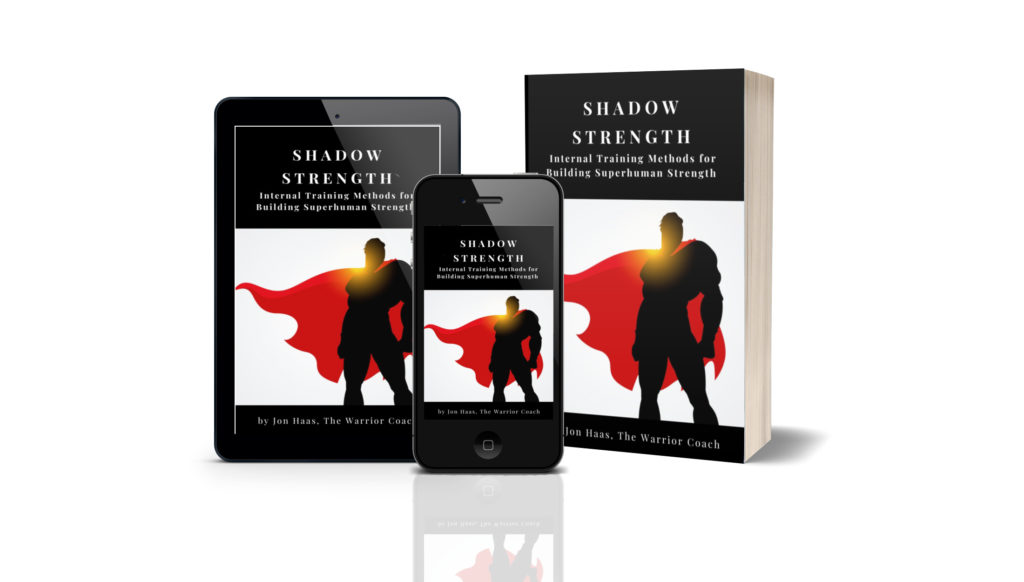
Shadow Strength utilizes a proprietary set of exercises drawn from traditional martial arts and trained in a unique combination to skyrocket your internal strength, power, and resistance to injury.

Using breath, posture, and martial mobility, Shadow Strength breaks down the barriers to superhuman strength and an unbreakable body.


5.5 Principles for More Effective Striking in ANY Martial Art

Part 1 of this series, Conditioning the Fists for Striking can be found HERE.

Being able to strike with power and precision involves a lot more than merely knowing the technique. Practice must include these principles of effective striking techniques for all martial arts…

1. Whole Body Power 

All movement in real life happens in three dimensions, so why train exercises that only incorporate one or two? Training muscles in isolation, unless it is used to rehab a specific injury, range of motion, or strengthen a particular muscle to add to the whole, does not work in martial art.

Our strike conditioning exercises must train movements in three dimensions utilizing diagonal, rotary, and angular strength, as well as prime moving muscles.

2. Stored Elastic Energy (SEE) 

Stored Elastic Energy is basically the potential energy stored in tendons and connective tissue as a way to power movement.

An easy exercise to begin to feel stored elastic energy is to stand in a natural stance with feet shoulder width apart.  Bend your right arm and raise it up to shoulder height as if you were about to throw the most telegraphed punch in history (don’t worry, it’s just an exercise).  Now, lead from the elbow and pull your fist back.  Allow your torso to rotate, but keep the feet planted and the hips facing forward.  When you reach the end of your range of motion, hang out there for a second and feel the tension (torque) on the spine.  Now simply relax and release that torque to throw the punch.  Don’t add any driving forces with muscle.  You can’t propel it any faster; you’ll just slow it down.

Feel it?

Try it again.

Do it with the other arm.  Remember the feeling.  This is stored elastic energy (SEE).

The point here about creating torque or stored elastic energy (SEE) in the spine is essential in being able to move powerfully without winding up or telegraphing the movement.

If you are having trouble feeling it, try to exaggerate the movement.

Make it much larger than necessary to study the feeling. It should feel like a tension in the lower back near the bottom of the spine. When this tension (torque) is relaxed (released), the movement happens.

3. Structure / Kamae 

Many people tend to use the terms alignment and structure almost interchangeably but in actuality, alignment is a component of structure.

For example, looking at a natural standing posture, good alignment would be:

  • Crown up
  • Chin down
  • Shoulders packed down
  • Spine lifting up (through crown)
  • Spine pulling down (through the sacrum)
  • Hips under shoulders
  • Knees under hips
  • Mid-foot balance
  • Chest is relaxed
  • Butt not sticking out nor is pelvis tucked under
  • Knees are over the toes
  • Weight evenly distributed (50/50)
  • No leaning forward or backwardThis puts the whole body into proper alignment.


Structure also includes (in my lexicon) the balance of tensions within the body’s soft tissues. The bones act as compressive struts pushing outward from the center while the soft tissues (fascia) act as the stays pulling inward towards the center keeping the tensional balance in the body.

4. Breathing 

How often do you think about breathing as it relates to striking?

Yet it is absolutely essential to maintain proper breathing when in combat or simply hitting a heavy bag, mitt, or an opponent. Lack of breath control affects the rest of your body and hinders your overall performance.

5. The S.A.I.D Principle 

Why are all the above ideas important to understand in relation to striking and martial movement?

The SAID Principle – Specific Adaptation to Implied Demand says every activity that we repeat consistently causes an adaptation in the body.

The critical thing to note here is that it does not matter at all how we value this adaptation.  It can be something that we want like how healthy exercise increases lean muscle mass and burns excess fat, or it can be something we do not want like how eating junk food to an extreme causes our body to adapt by putting on weight.

Both of these are examples of activities that cause adaptations in the body.   Our goal is to train adaptations we value highly like the enhanced neural connections in our nervous system that increase our skill level. Keep this in mind when training.  We do not want to train bad habits!

5.5 Elements of Efficiency 

Efficiency is defined as the amount of useful work divided by the amount of total work.  In other words, how much effect are you producing for the amount of effort you are expending?

  • Ever see a batter “swing for the fences” only to completely miss the pitch?
  • Ever see someone try to pick something up that is really light, but they believe is heavy?
  • How about watching someone using the general whole-body tension we discussed above trying to hit a heavy bag?

How much effect, i.e. force from the strike embedded into the target, is gained from the huge effort expended?

You must train to have your strikes be both effective (devestatingly powerful) and efficient (uses the least amount of force or energy to accomplish the movement). Only then can you be said to have mastered the art of striking!


Learn exactly how to upgrade your striking skills in ANY martial art with these resources from Warrior Fitness Training Systems…

Conditioning the Fists for Striking

One of the most underdeveloped aspects of the martial artist’s arsenal is the conditioning of his fists for striking.
The tendon strength, wrist strength and flexibility, and the overall structure of the strike is an exploitable weakness that needs to be addressed.

In this article we will examine several different push-up variations and isometric exercises to fortify the structure of our strikes.

This type of training will work to enhance the power generation of all manner of striking.

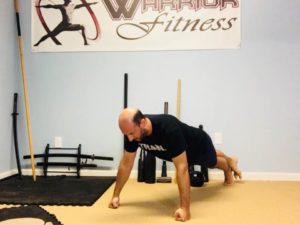
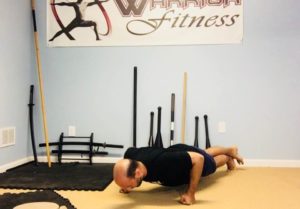
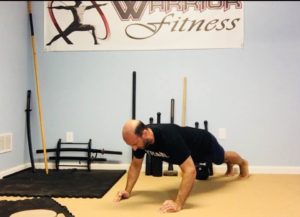
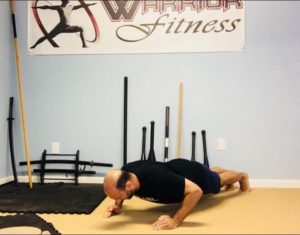
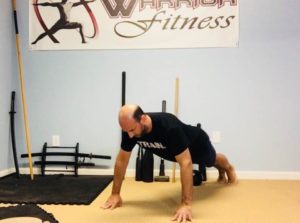
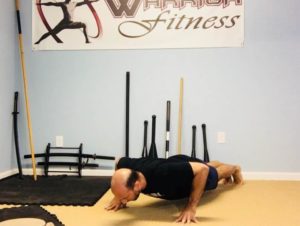
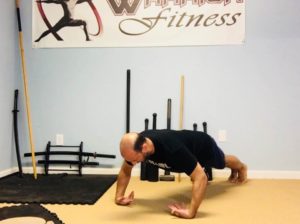
Do these push-ups slowly and purposefully with full attention to the movement.  These are not meant to pump up your beach muscles, rather they will strengthen the connective tissue in your hands, wrists, forearms, and shoulders to build structure and encourage the correct alignment for all your strikes.

Fudo-ken (fist) Push-ups 

Place the weight of the body on the fists.  Make sure the wrists do not bend. After performing several repetitions (or as a separate exercise) simply hold the body in the Fudo-ken push-up position. Relax as much as possible and allow the correct structure to support the body on the fists. Try this in the upper position, lower position, and halfway point of the push-up.


Do the same isometric holds with each exercise.


Shuto (sword hand) Push-ups 

Hold the hands in the form of a shuto strike.  They should close to a 45 degree angle with the thumbs supporting the fingers.  The weight is on the meaty, inside portion of the hand.


Fingertip Push-ups 

Place the pads of the fingers on the ground like you are clawing it.  Try to squeeze the ground as you press up.


Wrist Push-ups

Place the wrists on the ground. These will be very difficult at first if you have not done them before.  Take them slowly.  If necessary, perform them on your knees to build strength.


Train these basic exercises thoroughly. Study this well!

Be sure to check out part 2 of this article, 5.5 Principles for More Effective Strking in ANY Martial Art.

Learn exactly how to upgrade your striking skills in ANY martial art with these resources from Warrior Fitness Training Systems…


10 Books Every Warrior Should Read

I am what you would call an avid reader. Some would even say my reading habit borders on a reading obsession since at any one time I can be found to have at least three, sometimes four books going simultaneously. I have several on my nightstand next to my bed, a couple on the coffee table downstairs, one or two on the kitchen counter and, of course, my bathroom book.

Usually I am reading one book on fitness or health, one book on business, and one fiction.  I also continuously have audio books playing in my car anytime I drive, creating a mobile library.

Great warriors train all the time. Reading is a form of training that must be practiced by the warrior on a daily basis. Feeding and training the mind is just as important as feeding and training the body. Remember – knowledge is power!

Here are 10 books that are a must in every warrior’s library. Expand your mind and pick up these books!

Also, if you have any recommendations, be sure to let me know in the Comments section below – I am always on the look out for new books to add to my collection.


1) The Warrior Ethos by Steven Pressfield

WARS CHANGE, WARRIORS DON’T We are all warriors. Each of us struggles every day to define and defend our sense of purpose and integrity, to justify our existence on the planet and to understand, if only within our own hearts, who we are and what we believe in. Do we fight by a code? If so, what is it? What is the Warrior Ethos? Where did it come from? What form does it take today? How do we (and how can we) use it and be true to it in our internal and external lives?

2) The Ethical Warrior: Values, Morals and Ethics – For Life, Work and Service by Jack Hoban

Jack Hoban was shaped by service in the U.S. Marine Corps, a life-changing epiphany at a Cold War bar, and mentorship under two masters: The 34th generation grandmaster of the shadowy art of the Ninja and a sage of the Natural Law who may just have deciphered the meaning of life. He now delivers a revolutionary view of moral values for our time epitomized by the Ethical Warrior – protector of self and others as equal human beings. Hoban’s methodology reaches from the Greek ancients to the counterinsurgency efforts of today’s Marines to provide ethical clarity and confidence in our moral actions.

Having been exposed to both Dr. Humphrey’s and Jack’s teaching on this since I began studying Bujinkan martial arts back in 1989, I cannot recommend this book enough!!

3) The Book of Five Rings by Miyamoto Musashi

Composed in 1643 by the famed duelist and undefeated samurai Miyamoto Musashi, The Book of Five Rings analyzes the process of struggle and mastery over conflict that underlies every level of human interaction. For Musashi, the way of the martial arts was a mastery of the mind rather than simply technical prowess—and it is this path to mastery that is the core teaching in The Book of Five Rings. This brilliant manifesto is written not only for martial artists but for anyone who wants to apply the timeless principles of this text to their life.

The classic book on strategy by Japan’s most famous swordsman. This book is one I read over again every few years and constantly find more nuance and deeper understanding as my training and years of experience grow.

4) Lone Survivor: The Eyewitness Account of Operation Redwing and the Lost Heroes of SEAL Team 10 by Marcus Lutrell

This is the story of the only survivor of Operation Redwing, SEAL fire team leader Marcus Luttrell, and the extraordinary firefight that led to the largest loss of life in American Navy SEAL history. His squadmates fought valiantly beside him until he was the only one left alive, blasted by an RPG into a place where his pursuers could not find him. Over the next four days, terribly injured and presumed dead, Luttrell crawled for miles through the mountains and was taken in by sympathetic villagers who risked their lives to keep him safe from surrounding Taliban warriors.

5) The Rise of Theodore Roosevelt (Modern Library Paperbacks) by Edmund Morris

This book tells the story of TR’s irresistible rise to power. (He himself compared his trajectory to that of a rocket.) It is, in effect, the biography of seven men—a naturalist, a writer, a lover, a hunter, a ranchman, a soldier, and a politician—who merged at age forty-two to become the youngest President in our history. Rarely has any public figure exercised such a charismatic hold on the popular imagination. Edith Wharton likened TR’s vitality to radium. H. G. Wells said that he was  “a very symbol of the creative will in man.” Walter Lippmann characterized him simply as our only “lovable” chief executive.

6) Eric Greitens: Resilience : Hard-Won Wisdom for Living a Better Life (Hardcover); 2015 Edition by Eric Greitens

Eric’s letters—drawing on both his own experience and wisdom from ancient and modern thinkers—are now gathered and edited into this timeless guidebook. Greitens shows how we can build purpose, confront pain, practice compassion, develop a vocation, find a mentor, create happiness, and much more. Resilience is an inspiring meditation for the warrior in each of us.

7) Meditations (Penguin Classics) by Marcus Aurelius (1995) Mass Market Paperback by Marcus Aurelius

One of the world’s most celebrated and persuasive books, Meditations, by the Roman ruler Marcus Aurelius (A.D. 121– 180), fuses the stoic statutes he used to adapt to his life as a warrior and manager of a domain. Rising to the royal position of authority in A.D. 161, Aurelius discovered his rule assailed by catastrophic events and war. In the wake of these difficulties, he set down a progression of private reflections, plotting a logic of sense of duty regarding prudence above joy and peacefulness above joy. Mirroring the sovereign’s own particular honorable and generous set of accepted rules, this persuasive and moving work draws and advances the convention of Stoicism, which focused on the look for internal peace and moral sureness in a clearly confused world.

8) Unbeatable Mind: Forge Resiliency and Mental Toughness to Succeed at an Elite Level (Third Edition) by Mark Divine

You are capable of twenty times more than what you believe. Are you living in your 20X factor?  Or have you settled for a lesser productivity taught by society, your upbringing, or the things you believe about yourself?  I want to wake up the authentic, connected warrior within you.

But waking up to a bigger reality is only the first step.  The next step is learning to win in your mind before you ever enter the battlefield of life.  Unbeatable Mind will teach you to starve your fear, overcome negativity and connect with a deeper and heightened sensitivity to what’s going on around you.  You’ll clear emotional blocks, step into the shoes of self-mastery, and become the leader of others you know you were made to be.

9) Spiritual Journey of Joseph L. Greenstein: The Mighty Atom by Ed Spielman (1-Mar-1998) Paperback by Ed Spielman

The Spiritual Journey of Joseph L. Greenstein, World’s Strongest Man is a fully-documented and illustrated biography that also details the methods Greenstein used to train himself for the “impossible”. As a vaudeville star, he bit through iron bars, crushed steel spikes in his hands, and held back airplanes tied to his hair. These feats were all the more amazing because he stood only five feet four inches and weighed in at just 145 pounds. But The Mighty Atom had developed his own technique for tapping into the “life-force; ” a technique that encompassed Asian methods of concentration, Jewish mystical writings, and a then-unheard-of vegetarian natural diet. He unlearned the subconscious mechanism that forces us to stop when we think we have reached our physical limits. Each time he broke an iron chain, he revealed the enormous potential of the life-force. That potential exists inside every one of us and, as The Mighty Atom showed, it is within our grasp.

This is literally one of my all-time favorite books!

10) The Unfettered Mind: Writings from a Zen Master to a Master Swordsman by Takuan Soho

Here’s the classic samurai-era text that fused Japanese swordsmanship with Zen, and influenced the direction that the art has taken ever since. Written by the 17th-century Zen master Takuan Soho (1573–1645), The Unfettered Mind is a book of advice on swordsmanship and the cultivation of right mind and intention. It was written as a guide for the samurai Yagyu Munenori, who was a great swordsman and rival to the legendary Miyamoto Musashi.

Pick up a free copy of my book, Warrior Fitness: Conditioning for Martial Arts HERE
 

MEN – Pick up a free copy of my book, Dad Strength HERE 
The Top 3.5 Reasons Training is Hard

The other day a student said to me during training: “This is hard.”

My reply was, “Well of course it’s hard. You don’t come to me to learn how to do things you’re already good at, do you?” 

But why is this difficult?

In my experience,training is hard for approximately 3.5 main reasons…

1. You are learning new skills. It’s hard to be good at movements, exercises, and concepts that are new to you. Your nervous system must adapt to the new and different stimulus and create, or sharpen pathways to build competence and skill.

2. You must work on your weak points. Working on things you are already good at is fun, but the only way to truly become all-around strong is to eliminate your weak points.

3. Your ego. No one wants to look inept or silly. But the only way to become better means that we must put ego aside in order to learn.

3.5. Superficial Expert Status. The amount of information available today gives people immediate access to any body of knowledge out there, no matter how obscure, in a matter of seconds.  We have all become SMEs – “Superficial Matter Experts”.  We think that just because we know “about” something we actually understand it. No one wants to spend the time and effort required to learn something deeply.

But these reasons are exactly why we need to train. And why we need to train with people who have greater, or more specialized knowledge, higher levels of experience, and greater levels of skill than we do.

This is why I still train with my martial arts teachers. This is why I still have a strength coach. This is why I participate in masterminds and have business coaches.

Because I know that I need to be pushed and challenged in order to grow, just like I must push and challenge my students and clients in order for them to grow.

Ready to be pushed and challenged?

It begins here <<===

Kata (Alone) Will Never Build Internal Power

Trying to develop Internal Power by training kata (alone) in martial art is problematic.  On one hand, you may inadvertently have minor success in creating some internal connection over the course of 20-30 years of training, but you will most likely have no idea how you did it, no idea why it worked (minimally at best), and most importantly, no idea how to correctly transmit it to the next generation.

The only advice you will be able to offer your students and fellow seekers is to keep doing this (kata training) and somehow you *might* get the correct result.  This is insufficient and irresponsible, at best, on the part of the teacher.

Assuming that you want to stand out from the crowd as a powerful martial artist, and Internal Power/Aiki is your goal, then the scatter approach to trying (and for the most part, failing) to build IP through kata alone is a waste of a career.  I say this because there exist clearly defined, step-by-step processes that rewire the body for Internal Power specifically for martial arts.

Solo Training Precedes Kata Training

Power building models as solo training exercises have existed for hundreds (if not thousands) of years  throughout the martial arts from India to China to Japan.  Why anyone would try to reinvent the wheel by attempting to create their own hodgepodge of exercises or think that merely training kata would develop real Internal Power is a mystery to me.  The reality is that solo training exercises burn in specific ways of moving that are not normal which create a very stable, powerful structure capable of absorbing, re-translating, and projecting incoming force.

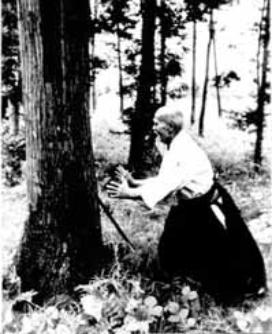
osensei_tree_kokyu1-272x334

Internal Power training is a type of General Physical Preparedness (GPP) for budo.  The goal of regular GPP for fitness, athletics, or martial arts is enhanced work capacity. This is the ability to run faster, jump higher, and hit harder. When work capacity increases, it allows the budding warrior to adapt more easily to increases in both mental and physical demands. In other words, it increases your capacity and level of readiness to absorb higher levels of specificity.

The solo training exercises for internal power training change the way outside forces act on the body.  The structure becomes dynamically stable so that applied force can either be distributed throughout the chain and dissipated or, at a higher level, simply reflected right back onto the opponent.  When force is reflected back this is what is known in Japanese as Yamabiko, or Mountain Echo.

Just to help further differentiate the two practices, solo training exercises for building internal power (there are other types of solo training exercises, obviously) are always made up of the following: standing, open/close, winding, spiraling, and breathing – all supported by Yin/Yang Theory (the union of opposites) and 6 directions (Heaven Earth Man).

Kata are for the purposes of patterning correct martial movement.

These solo training exercises are trained BEFORE kata to condition the body for powerful martial movement. They are not martial movement drills in and of themselves like sanshin no kata, kihon happo, and kata.

Kata – The Slow Boat to China

The reason it is so difficult to train IP via kata is that the vast majority of students get caught up in learning the movements of the kata correctly.  They get caught up in the application of technique and the idea of trying to make it work correctly.  What they don’t realize is that having a correctly trained body built by solo Internal Power exercises makes all the kata work much better and easier.

If you have a choice – why not learn a proven step-by-step method of developing unusual strength and Internal Power?


Join My New 21 Lessons on Internal Power Coaching Program <<==

Following a clearly defined path up the mountain is much faster and more effective than wandering around the base working on kata for 30 years and thinking you will somehow magically arrive at the summit.

Caution – While I did just say “more effective and faster” I by no means meant easier!!  Internal Power takes a lot of dedicated work.  Do not think it is a shortcut!

Gyokko Ryu’s Internal Power Training

There is no doubt in my mind that Hatsumi Sensei possesses unusual power in his budo.  Anyone who has trained with him can tell you that!  But what is it and where does it come from?  More importantly, how can YOU develop it as well?

Soke’s martial movement displays many of the characteristics associated with Internal Power training: ghostly movement, immovability (static and dynamic), shockingly powerful strikes with little windup, adhesion caused by movement, kuzushi on contact, and others. Continue reading

We Were Once Warriors…

We Were Once Warriors…

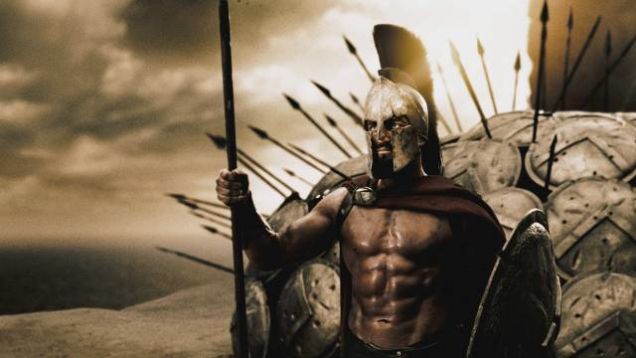
For centuries the warrior has been the archetypical model of physical fitness and power.  This is due to the extreme nature of their training and overwhelming odds that they must have had to go through waging war in the ancient world.

The multifaceted development of skills required for the warrior’s brand of life and death combat is second to none.

Spartans


Warriors needed to be able to carry heavy loads over long distances on uneven terrain, wield heavy weapons while wearing armor, wrestle and engage in other forms of hand-to-hand combat, fight for hours or perhaps even days on end in mud, sweat, and blood, all while continuing to display power, coordination, agility, and speed.

This was not a game with a medal or trophy at stake, but their lives and the lives of their comrades in arms, not to mention the entire village or tribe who were relying on them for protection.  All of this placed immense demands on the warrior physically, mentally, and spiritually.

Today’s Training from Yesterday’s Triumph

The skills we know today as fitness, or strength and conditioning, depending on whether your term is all inclusive or a specific subset, all evolved over time from man’s need and ability to wage war.  In fact, one of the earliest examples of sport in the western world is from ancient Greece; we now call it the Olympics.  These early games were created as a way for warriors to channel their aggressive and competitive natures, while simultaneously allowing them to hone their battle skills, in times of peace.

So we can see from this quick look back in time that originally almost all athletics and sport competitions were based on the martial skills of the warrior and utilized as a way to sustain and practice those skills.

Now, working backward this time, is there a way to reverse engineer a warrior’s training regimen and use it to improve the components of martial skill, conditioning, AND athletic performance?  Absolutely!!

Try This Warrior Workout on for Size

1)  Heavy Sandbag Carry (Zercher carry, bear hug carry, over head carry) – 3 x 300 ft.

2A) Pike Push-ups on Fists – 4 x 10

2B) Mixed Grip Pull-ups (change grip each set) – 4 x SM

2C)  Loaded Airborne Squats (load up with clubbell, Kettlebell, dumbbell, or sandbag) – 4 x 5/5

3)  H2H Touch & Go Kettlebell Swings x 100

If you train in MMA…

NOW go punch, kick, knee, and elbow a heavy bag or have a partner hold focus mitts for 3 rounds x 3-5 minutes each!  How is your performance?

Or, if you’re really daring and want to test your mettle, now is the time to go spar with a completely fresh opponent for 3 rounds of 3-5 minutes!  How has your performance changed?

If you train in Bujinkan or other form of combatives…

Do the same as above but utilizing the basic techniques of your particular style.  For Bujinkan peeps that means try out all the Kihon Happo on a fresh uke!

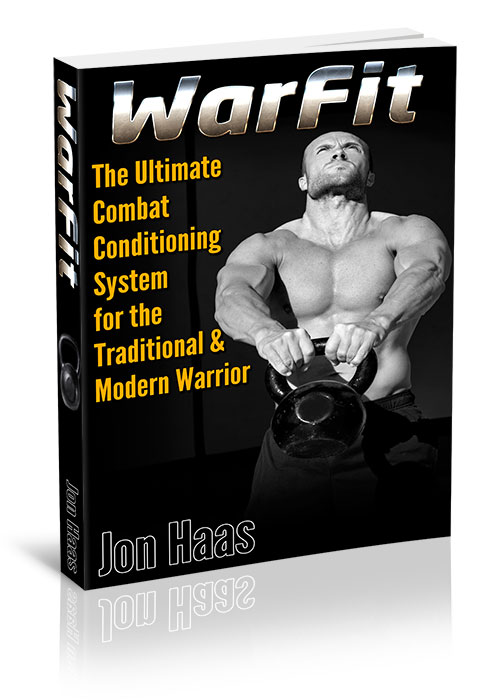
My brand new WarFit Combat Conditioning Program is perfect for the warrior athlete who wants to build superhuman strength, endurance, and conditioning:


Training Through Injuries

Four weeks ago I injured my ankle.  The diagnosis?  Peroneal tendonitis.  Walking was painful.  Squating was painful.  Lunging was out of the question.  Heck, even balancing on my injured foot hurt. Continue reading