Ninja Walking

The following article is an excerpt from Warrior Fitness: Conditioning for Martial Arts…  Enjoy!
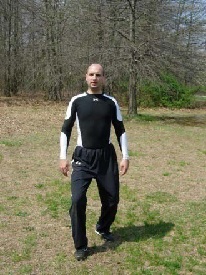
Proper walking is footwork training for budo. How we walk in day-to-day life is how we will walk (move) in combat. Efficiency in more complex movement begins with efficiency in simple movements. How can we expect to move with ease in the chaos of a combative environment when most of us have trouble walking with natural gait? Walking is a ubiquitous activity that many people simply take for granted. They move through the day without any awareness of the strain they place on their knees, hips, and lower backs by their poor movement patterns. Just a little awareness will do wonders for your balance, posture, and lightness of step. When Hatsumi Sensei first came to the U.S., of the things he noticed immediately was how heavy and inefficiently people walked. His comment was that most people walked “like Frankenstein”!

 Walking Exercises:

1. Stand in shizen no kamae (natural posture) and balance on one leg. Lift the other foot a few inches off the ground and then lower again in a slow, controlled manner using the flexing of the grounded leg to regulate the descent. Gently bounce a few times getting the feeling of how the grounded leg’s flexion and extension controls the lowering of the other foot. The balance on your leg should be such that you are able to lower the opposite foot to the ground in any direction and easily maintain kamae (balance). Switch legs and now balance on the other leg while lowering the foot.

2. Stand in shizen no kamae (natural posture). Use your right hip to lift the right foot off the ground. It will feel strange at first since this is not a very commonly used muscle action, but once you get used to it, it will become an efficient way of lifting the leg. With the right leg lifted, pull back with the right shoulder.  Notice how this has the effect of creating a slight torque in the spine and moves the right foot forward at the same time. Release the tension in the spine by placing the right foot down in a forward step. Feel how the release of tension propels the body forward and allow it to create the same lift from the hip and pulling back of the shoulder on the left side.

3. Combine the previous two exercises together and begin to walk.

 4.  Another idea to try when walking is to alternate periods of normal, regular breathing with holding your breath for duration when “full”, after an inhale, and when “empty”, after an exhale. Try inhaling for a count of 5 (steps or seconds), hold your breath for a count of 5, exhale for a count of 5, and finally, hold your breath empty for a count of 5 while walking. Repeat as long as you can continue the pace. Note that 5 is just an arbitrary number and can be raised or lowered to suit your own needs. This practice will help you to understand how your body can function during situations when you must suddenly hold your breath yet still continue to work. Another benefit of this exercise is that it also helps the body to process oxygen to brain, heart, and other working muscles more efficiently.

Don’t forget “light feet and soft knees” when walking!
A Case for Mini Workouts

These days everyone is short on time.  Most are content to allow the daily grind and family time to fill their days while lamenting about the fact that they have no time for working out.  The complaints are common and heard often.  But somehow these same people are able to find time to watch an hour or more of TV every night before going to bed.

Now, I’m not going to ask you to forego your Sunday night Walking Dead episode (I certainly won’t!) in favor of hitting the gym for an hour, so don’t worry – just using the ability to watch TV as an example of “finding time”.

While it may be a stretch for many people to find 45 minutes to an hour each day for exercise or martial arts training, how about just finding 5 minutes?  Surely everyone can find a spare 5 minutes even a few times a day, right???

Recently, as my own daily grind has become busier and busier, I have been finding just how effective mini workouts can be to fill in the gaps in one’s training.  These types of workouts are often overlooked because of their brevity.

After all, how can one possibly get a complete workout in 5 minutes?!  Well, you can’t.  But that’s not the point.  The effects of mini workouts are cumulative.  In other words, they add up over time (that’s what cumulative means… :).

They are not meant to completely replace your regular training, but are meant to enhance it and compliment it.

They are an effective way to keep yourself on track and focused when short on time, or if you have already completed a full workout and still want to get in some extra training – nothing wrong with that either!  Remember, the goal of the mini workout is not to be too complicated or over-involved.  Make them short, sweet, and to the point!

Examples of Mini Workouts

Here are just a few ideas I’ve found that make ideal mini workouts:

  • 10 push-ups + 10 v-ups + 10 squats (repeat 3-5 x’s)
  • Finger tip push-ups (see how many you can do)
  • Tabata exercises (pick one and go)
  • 5 Kettlebell Snatches (each side) + 5 Kettlebell Swings (each side) + 10 Hindu Push-ups (Perform AMRAP for 5 or 10 minutes)
  • Isometrics
  • Breathing exercises combined with bodyweight training
  • Joint mobility work
  • Pull-ups (5-4-3-2-1 rep scheme)
  • Burpees or Sprawls for 50 to 100 reps

Mini Workouts for Martial Arts

The mini workout should be an essential aspect of any martial artist’s training.  It is said that great martial artists are training all the time.  Well known and respected masters from Musashi to Tesshu to Ueshiba to Hatsumi Soke have constantly extolled the importance of solo-training and dedicated practice.

While mini workouts do not form a complete picture of solo- training, they do play an important role.  In the future, I’ll be sharing a more extensive look at solo-training for martial arts, particularly for Bujinkan practitioners.  But for now, here’s a short list to get you started:

  • Ukemi practice – mix up rolls, change directions freely, roll over obstacles
  • San Shin no Kata
  • Solo flow drill – move continuously for 5 minutes. Flow from strikes to kicks to leaps to rolls, from kamae to kamae – be creative!
  • Kamae work in a mirror
  • Striking practice
  • Junan taiso (see above!)

Make sure to make time for mini workouts!

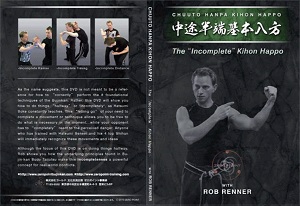
The “Incomplete” Kihon Happo DVD Review

Chuuto Hanpa Kihon Happo or, The “Incomplete” Kihon Happo, is a new DVD by Bujinkan instructor, Rob Renner.  Rob has been training in the Bujinkan since 1986 and living in Japan since 2005.  He trains with Hatsumi Soke and the Shihan, senior instructors, typically 5 to 6 days a week.

This DVD is, as Rob points out, not the “official” version of the foundational techniques of the Bujinkan, but rather a synthesis of each Japanese Shihans’ take on the techniques as studied and interpreted by Rob.

The DVD begins with Rob’s expanation of Hanmi, or “half-body” kamae.  This incomplete Ichimoni no Kamae has the hips at a 45 degree angle forward to facilitate structure, stability, and mobility instead of the traditionally taught kamae with the hips completely sideways while the head looks forward.  Not only is Rob teaching 1/2 kamae, but as each technique is analyzed, he shows how to utilize 1/2 the distance, and 1/2 the time as well to create more efficient, and effective, technique.

Each technique of the Kihon Happo is then presented, first as they are usually performed in Bujinkan Dojos worldwide, followed by a discussion of common problems and mistakes when done as shown.  Make sure to pay attention here as you may recognize some of your own mistakes.  This discussion alone is worth the price of the DVD! 

Rob then moves on to demonstrating and explaining how to use the principles of Bujinkan Taijutsu to effectively do the techniques.  Each section begins with a quick bulleted list of principles that will be taught for each technique.  This is an effective way to prepare the audience for the material to be reviewed in the section and also serves as an effective reminder as the same principles are presented, and added to, each time.  Throughout the principle-based discussions, Rob constantly stresses the importance of correct kamae by using hips, knees, feet, and shoulders in alignment to be able to control distance and move in any direction. 

In the Torite Goho section of Kihon Happo, Rob makes a very important distinction between translating kuzushi as “breaking balance” versus “breaking structure”.  When you break an opponent’s structure, he is still very much on balance, but simply can’t generate force in any meaningful way.  And, since his balance is not compromised, he still believes in his mind that he is okay.  Hmm… sounds like kyojitsu to me.  However, when breaking an opponent’s balance, his body will automatically endeavor to correct it and suddenly you’re in a fight.

Kihon Happo Techniques Taught on the DVD

Koshi Sanpo:

  • Ichimonji no Kata
  • Jumonji no Kata
  • Hicho no Kata

Torite Goho:

  • Omote Gyaku
  • Mushadori
  • Onikudaki
  • Ura Gyaku
  • Ganseki Nage / Musodori

In the final section of the DVD, Rob uses the Torite Goho to show examples of Hatsumi Sensei’s movement as it is today.  This is done by following all the principles espoused in the earlier parts of the DVD and through manipulation of the kukan and kyojitsu.  It’s a great way to wrap up, pull everything together, and show a progression of the material all at the same time.  This is a very well done DVD with tons of detailed instruction.  Highly recommended!

For more information, and to purchase the DVD, please see Rob Renner’s website, Bujinkan Zeropoint Dojo.