With It or On It

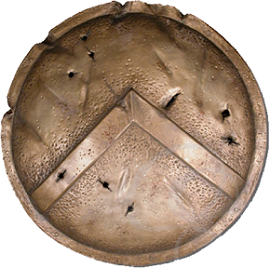
The ancient Spartan maxim, “with it or on it” is a very stark reminder that we must be fully committed to whatever battle we are waging.  The full meaning of this phrase that Spartan mothers used to say to their sons before heading off to war is, to either come back with your shield – as a returning hero – or come back upon it. 

There is no middle ground. 

No room for wavering or debating. 

No having your cake and eating it too. 

When moving towards a goal, there must be no hesitation in your actions.

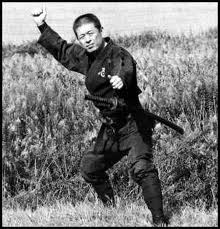
In the Bujinkan martial arts that I study, there is a similar saying, “Hell gapes beneath the upraised sword, step in to heaven.”  This may seem like crazy advice, after all who in their right mind would step forward when faced with an opponent armed with a 3 foot razor blade?!  But in training, through experience, one comes to understand and realize that the safest place when facing an upraised sword, paradoxically, is to move forward and step closer, thus finding “heaven”.

Again and again throughout warrior cultures, from ancient Greeks to Japanese Ninja and Samurai, we see this idea of complete and utter commitment, 100% determination in moving forwards towards our goals, no matter what they are.

So how about you?  How committed are you?  How much do you talk about taking action rather than actually taking action?  Do you step forward into heaven and achieve your goals when confronted with difficulty and adversity?  Do you walk the razor’s edge in life, or just in your mind? 

It’s time to step forward.  Take action.  With it or on it.

Click HERE to take action on your health and fitness goals today!

8 Reasons Why YOU Need Striking Power

Remember, striking power is not just about hitting harder; it’s about hitting smarter.  Here’s a few reasons why this program is something you should incorporate into your martial training:


  1. New, innovative exercises to push through plateaus in your training and stave off boredom.
  2. The right tools for the job – low tech / high yield!
  3. Teach your body how to increase force production through stored elastic energy rather than recruiting more tension.
  4. Efficiency is the key to preserving energy levels.  Efficiency is defined as useful work over total work.
  5. Coordinated whole body power in 3 dimensions.  Life, sport, and martial art happen in 3D – the same old 2 dimensional exercises are NOT up to task!
  6. Specifically develop angular and rotary strength to augment and assist prime movers.
  7. Target postural and stabilizer muscles to strengthen structure behind the strikes.  You can‘t fire a cannon from a canoe!
  8. Solo training is the key to martial greatness – how do you train?

Want to know more about this unique Warrior Fitness product?  Click HERE!


What Does a Ninja Need?

Historically, ninja were the consummate combination of super spy / super soldier.  They possessed outstanding levels of fitness due to their intensely physical training and highly demanding mission requirements.

Their levels of fitness and training have been the subject of many stories and the genesis for many myths surrounding them.

How did they do it?

How did they train?

What type of methodology did they employ since creating this kind of warrior certainly required a very diverse fitness profile?

Ninja fitness needs were much more multi-faceted than most physical pursuits.  They had to be as they were at once a combination of Olympic decathlete, Navy Seal, and martial arts master rolled into one.  Let’s examine this a little more closely though, what kind of qualities did they possess and what did they need to be able to do?

Ninja Must Possess …

  • Strength
  • Agility
  • Coordination
  • Excellent balance
  • Flexibility / Mobility
  • Whole body power
  • Endurance

Ninja Must Be Able to….

  • Move silently
  • Run fast
  • Walk far
  • Leap high
  • Climb trees, walls, castles fortifications, etc.
  • Wield weapons
  • Fight unarmed – striking, kicking, grappling, locking, choking, etc.
  • Roll / fall / dodge / avoid
  • Crawl
  • And more…

As you can see from the 2 lists above, the ninja had a wide range of skills and abilities that had to be supported by a comprehensive fitness program keeping him at the top of his game.

Remember that for a ninja, fitness wasn’t just a nice to have; it was an absolute necessity to accomplishing his mission and getting him home safely.  And the kicker is, they did it all with little to no fitness equipment.

Certainly a 16th century ninja did not possess a Gold’s Gym membership.  Nor did he own an Olympic weight set or have a stair master at his disposal.  And, while kettlebells and dumbbells would have been great, he most likely had never laid eyes on either one.

So here we have one of the most highly trained and fit agents the world has ever seen created without the use of modern training equipment or modern training methods.

What might some of this training looked like?

I’m glad you asked.  One of my favorite scenes in Hatsumi Sensei’s early Bujinkan training videos (DVDs now for you younger folks!) comes from Shinden Fudo Ryu.  Here’s a short clip I found on Youtube.  This stuff is seriously old school!

“One trains using the things of nature to make the body strong” – Hatsumi Sensei

What if we were to take the spirit of historical ninja fitness training and combine it with a little modern sports science and know how?

Modern methods allow us to take advantage of periodization, or programing and organizing training, to create a comprehensive fitness plan which will apply logical sequences to get the most out of each session.  Protocols like HIIT, high intensity interval training, will be utilized to maximize both aerobic and anaerobic endurance in the same short, high intensity session.

Advances in recovery work from such sessions will allow us to recover faster thus making gains greater, and increasing our overall general physical preparation (GPP) will allow us to push higher into more sophisticated training.  Effectiveness and efficiency will be combined in order to allow for shorter training sessions which maximize the use of one’s time.

As the ancient ninja did, we will create a strong, supple, highly conditioned warrior and accomplish this with little to no fitness equipment.  We will, as Hatsumi Sensei says in the video clip above, use the things of nature to make the body strong.

If I were able to point to just one resource for the warrior that combines old school training with modern sports science, I’d look here… Ninja Missions <<==


The Warrior’s Key to Greatness – The Way Lies in Training!

Throughout history a few exceptional martial artists have stood out from the rest of the budo landscape.

Millions of people from every country and culture on the planet have trained in innumerable styles and arts across the centuries, yet we only know a small number of them by name.

These men distinguished themselves and rose to the very uppermost levels of physical, mental, and spiritual skill in their respective arts and in some cases even took their talent to such heights as to create an entirely new martial art.

Looking back at them today, we are awed and inspired by the levels they achieved through their single minded determination in reaching a goal, dogged pursuit of excellence in their craft, and amazing amount of self-sacrifice.

Why are They Different?

What made these men different?

What pushed them to greatness?

What did they do differently or more productively that propelled them to prominence?

Why were their names and storied passed down through the years, sometimes centuries?

What one factor do all great martial artists have in common regardless of style, country, or culture?

And, more importantly, how can we learn from them and apply it to our own training?  Remember, we stand on the shoulders of giants, not to imitate them, but to be able to look farther.

 Quotes from the Greats

Instead of listening to my opinion today, why don’t we go directly to the sources themselves?  Here are some cool quotes I’ve complied by some of the greats talking about their own training.

Morihei Ueshiba – Aikido 
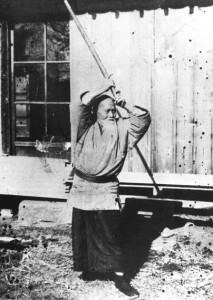
“The instructor can only impart a small portion of the teaching; only through ceaseless training can you obtain the necessary experience allowing you to bring these mysteries alive.  Hence, do not chase after many techniques; one by one, make each technique your own.”

“Always imagine yourself on the battlefield under the fiercest attack; never forget this crucial element of training.”

“This old man must still train and train” – said shortly before his death.

Gozo Shioda – Aikido 
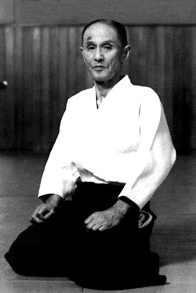
“Kokyu power is produced when we push ourselves to the limit, making the most efficient use of the capabilities that lie within our own bodies.”

“Even though the body has its limits, until your death, the strength of your spirit is limitless.  This is precisely why, in the martial arts, there is no such thing as deteriorating as you age.”

Yukiyoshi Sagawa – Daito Ryu 
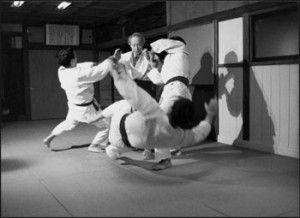
“Intermittent training, no matter how intensive, is utterly useless.  You must practice every day for your entire life.  That, and only that, is true training, or shugyo.”

“People who think they can ignore training their bodies and only work on techniques are amateurs.  They don’t know anything.  Actually, if you can’t prepare your body properly, you have no hope of ever perfecting your technique.”

“No matter what level of mastery you attain, you will never achieve perfection.  You should therefore never, ever assume that what you have achieved is good enough.”

“If people knew what my training regimen was like, they would be astonished.”

Masaaki Hatsumi – Bujinkan Budo Taijutsu 
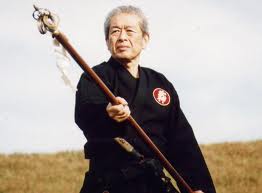
“Modern budo students often forget to practice by themselves.  I used to practice by myself.  When there was no teacher, I found the secret teachings by my own desire.”

“Studying for oneself and making one’s own discoveries is much more important than group learning, and this applies equally well to martial arts.  As I often say, ‘Life is all about solitary training.’  This is because I want serious practitioners to discover the tricks of the trade for themselves.”

Miyamoto Musashi – Niten Ichi Ryu 
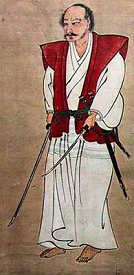
“From the time I was young I have set my mind on the Way of Martial Arts, practiced the one subject of swordsmanship with my entire being, and experienced various and different understandings.”

“See to it that you temper yourself with one thousand days of practice, and refine yourself with ten thousand days of training.”

“Never depart from the way of martial arts.”

Yamaoka Tesshu – Muto Ryu 
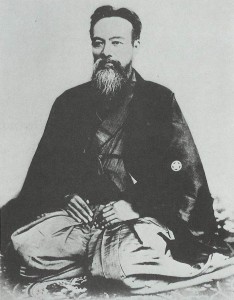
“Study hard and all things can be accomplished; give up and you will amount to nothing.”

“If you want to obtain the secrets of such wonderful techniques, drill yourself, harden yourself, undergo severe training, abandon body and mind; follow this course for years and you will naturally reach the profoundest levels.”

Inspired yet? 

Ready to train and push yourself to the next level? 

Check out the new solo training sensation – The Integrated Strength Program – and get started today!
integratedstrength3D1


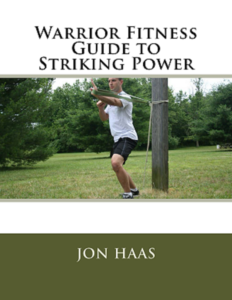
The Warrior Fitness Guide to Striking Power is Here!

by Jonathan Haas, founder of Warrior Fitness Training Systems

  • Specific Physical Preparedness for ALL striking arts from old school Traditional Martial Arts to modern MMA!
  • Learn how to build a powerful structure to stabilize punches, kicks, and martial movement!
  • Discover how to use low-tech, high yield tools to strengthen strikes throughout a range of motion!
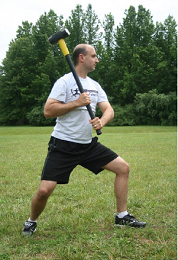
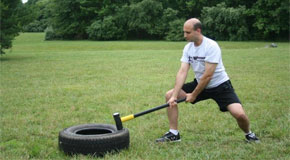
  • Sledge Hammer for force production, rotational strength, grip strength, and old school conditioning!
  • Medicine Ball for explosive strength and rotational strength!
  • Resistance Bands for force production, rotational strength, increased stabilization!
  • Bodyweight Exercise and Isometrics for structure and stabilization!
  • Discover how to use Intelligent Tension rather than general tension to power strikes!
  • Learn Breathing and vibration exercises for recovery and restoration!
  • Over 50 pages of pure, 100% actionable content – no fluff, no BS, no filler!
  • Sample Workouts!

Buy Now for only $15 USD!!

Buy Now

Warrior Fitness Guide to Striking Power is a downloadable e-book. No physical products will be shipped. After you order, you will get INSTANT ACCESS to download the e-book and all the bonus reports onto your computer. The e-book format is adobe acrobat PDF, which can be viewed on Mac or PC.

Ninja Endurance – Part II

In part one of Ninja Endurance called,  How to Train for the Endurance of a Ninja, we discussed strength endurance and I provided a sample workout to help you build yours.  Here in part 2, I ‘d like to delve a little deeper into the whys of endurance training and how specifically high intensity interval training is an excellent choice for it.

What is Endurance?

Endurance is defined as being able to keep going without fatigue setting in, or being able to push oneself through fatigue.  Essentially, it is the ability to resist or bear fatigue.  What is fatigue?  Fatigue is weariness or exhaustion from exertion, or the temporary loss of power to respond.  An equally critical corollary to the definition of endurance, especially for the warrior,  is that your level of endurance also determines how quickly you are able to recover between bouts of activity.  Combat, like life, does not happen at one constant rate of speed.  It is multi-faceted in nature.  There will be periods of brutally intense activity followed by lulls in the action, again followed by another flurry of activity.  Being able to use those lulls in action to recover is a critical ability for the warrior.

Steady state cardio, Long Slow Distance (LSD) training simply will not cut it.  Running on a treadmill may be appropriate for a hamster in a cage, but human beings require more.  Long distance running can be beneficial for mental toughness and/or active recovery, but it should not be the primary focus of a warrior’s endurance training.  So then how should we train to maximize our ability to endure?

Warriors Need to HIIT!

High Intensity Interval Training (HIIT) is one of the best ways to train for endurance.  It will enhance all 3 energy systems in the body (2 anaerobic and 1 aerobic – see here for an overview), as well as prime the nervous system to recover automatically during lulls in activity.  Simply put, HIIT alternates periods of high intensity exercise with periods of rest and recovery.  It can be performed with almost any exercise and can be utilized both with and without equipment.  The variety and adaptability of this style of training is second to none in results.

How else does improving your endurance through this type of conditioning aid your martial arts training?  I’m glad you asked!  If the benefits discussed above weren’t enough, consider that having a high level of conditioning also aids in learning new skills.  How’s that possible?  To put it simply, when the central nervous system (CNS) is fatigued, the body cannot effectively process new skills, especially technically advanced skills.  So, in essence your lack of a general level of fitness and conditioning will actually impede your learning process as you will tire more readily and not have the ability to recover quickly enough during training.  Want to train more, at a higher level, for a longer period of time?  Want to get more out of your training time both at home and in the dojo?  Want to build new skills and enhance your technical arsenal?  Get yourself in shape!

There are several sample conditioning workouts here on the Warrior Fitness site.  Here are a few examples:

Workout of the Week #1


Workout of the Week #5


Stay tuned for more Warrior Fitness style conditioing workouts to help you get and stay in fighting shape!

The Sanshin of Warrior Fitness

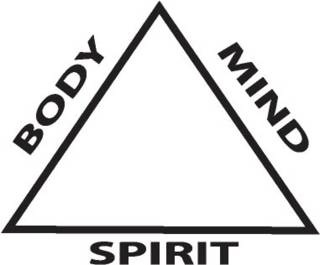
A short introduction may be necessary for those readers not familiar with Bujinkan Budo Taijutsu.  Sanshin no kata is a basic training exercises within the system that templates movement patterns for Bujinkan Budo Taijutsu.  In English, it translates to “form of three hearts”.  These three hearts are mind, body, and spirit.  All three must be united for technique to come alive for the martial arts practitioner.  Without all three aspects of body, mind, and spirit unified the kata become  empty shells of movement, devoid of essence.

Bujinkan martial arts are the wellspring from which my concept of Warrior Fitness sprung as a natural outcropping.  So as my philosophy of Warrior Fitness continues to evolve, it naturally gravitates to this type of structure for me to express it.  In keeping with the trinity of mind, body, and spirit, here is how I see it for Warrior Fitness:

Mind Concentration and focus along with an understanding of the interrelationship of the exercises and how they integrate with and enhance the way we move in the world.

Body Forging a strong body to carry us through the challenges we face. 

Spirit Pushing the edge to consistently increase resistance to failure.

The Sanshin no kata consist of 5 forms which are called, Chi no kata (earth form), Sui no kata (water form), Ka no kata (fire form), Fu no kata (wind form), and Ku no kata (void form).  Those who have read Miyamoto Musashi’s famous work, Go Rin No Sho – A Book of 5 Rings, are most likely familiar with the terminology as well.  Here is how each is expressed in Warrior Fitness:

Earth Building strength, stability, and structure in movement and stillness

Water Freedom of movement through all ranges of motion, flow state

Fire Metabolic conditioning to ignite fat loss and sculpt lean muscle

Wind Breathing exercises to vitalize every cell in the body

Void Pushing the edge of our limitless potential


Hone Your Mind, Invigorate Your Spirit, and Make Fierce the Body with Warrior Fitness!

The Top 7.5 Reasons Warrior Fitness is for You

Since Top 10 lists have been so overused of late, especially in the internet blog area, here are 7 and a 1/2 reasons why the Warrior Fitness program is for you.

1.  No gym memberships required!  Still paying for a gym membership you don’t use, or not getting the results you want from your gym?  Start thinking outside the gym with Warrior Fitness!

2.  Low-tech fitness solutions.  Don’t have the budget for expensive training equipment?  Warrior Fitness offers a complete body-weight workout for strength and conditioning.

3.  Quality workouts that work around your schedule.  It doesn’t take hours in a gym to achieve the results you’re looking for.  Our program encourages quality over quantity.  Got 15 minutes?  Then you have time for a workout.

4.  Lose fat, gain lean muscle.  Our workouts are short, but intense to encourage lean muscle growth while stimulating fat loss.  No more boring hours of mindless cardio!

5.  Sample workouts and programing guidance.  Do some fitness training manuals you’ve purchased in the past leave you wondering how to put it all together or how to fit into your schedule?  Warrior Fitness provides sample workouts you can follow or use as templates to create your own.

6.  Ongoing support and new ideas.  Got questions?  Send me an email.  Post a question in the comments section.  I’m here to make sure you are successful!

7.  Fully integratable with your martial arts training.  Ever wonder which fitness programs make sense to use within the context of your martial arts training?  Ever feel like you may be hindering your progress by the type of workouts you’re doing instead of enhancing it?  Since the program is designed by a martial artist with 30 years of experience and a fitness training background, Warrior Fitness provides a clear path to integrating your fitness and martial arts.

7.5  Comprehensive!  Warrior Fitness covers supremely functional strength and conditioning drills, joint mobility, flexibility, breathing exercises, workout recovery, performance enhancement for martial arts, internal strength development, and more!

Knowing is Not Enough!

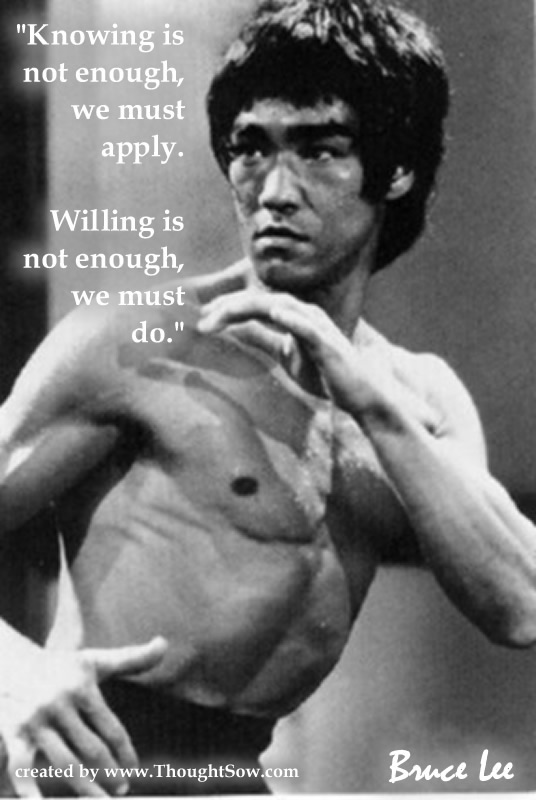
With the proliferation of the Internet and the incredible wealth of resources available in book, DVD, and digital formats, many of us already know more than enough to be martial arts masters!  Yep.  You heard me right – you know more than enough right now to be a master martial artist.  Cool, eh?  Heck, some of us even have more disposable information on budo history, lineage, techniques, kata, and principles at our fingertips than all of the past generations of Bujinkan Soke combined!  Think about that for a second.  Now, at this time in history, the sheer amount of knowledge in the form of information available to us is greater than at any other time, and it’s only going to continue.  Yet, with all of this knowledge, why aren’t we all amazingly skilled?  Why do the legendary feats of past budoka seem so remote and unachievable to us today?  Why are there so few with real skill among the millions of people practicing martial arts worldwide?  Because knowing is not enough, that’s why!  Hatsumi Sensei has emphatically stated on many occasions, that “budo is not an academic subject.”  Why then do we continue to view it as such?  There has only ever been one way to become as highly skilled at a craft as to be called a master.  “Knowing is not enough, we must apply.  Willing is not enough we must do.”    

Is Your Cup Already Full?

Another way we limit ourselves is by equating knowing with being able to do.  For example, when your teacher demonstrates a fundamental principle of movement for the hundredth, or maybe hundred thousandth time, do you smile smugly to yourself and think, “I know that already”?  Maybe you have.  I know I have.  I admit it.  But this type of attitude makes us lazy.  It lowers our skill level because it allows us to hold fast to the superficial without the hard work of plumbing the depths.  It lets us check those basic movement(s) or principles of movement off our mental list and move on to something more advanced; more worthy of our time (we may think)… big mistake.  If we were truly honest with ourselves, we’d be asking a different question.  The better, more appropriate question to be asking ourselves is -”how well can I do that?” or “How well do I truly understand those movement(s) bodily, not intellectually?”   This is hard though because most often the most authentic answer we can give ourselves is, not well enough.   Watch your teacher closely.  Look deeper.  Pay attention because there’s always more.  Be careful.  Practice.  Practice.  Practice!

Your Sanshin No Kata Under a Microscope

Sanshin no Kata (form of the three hearts) forms the basis for movement in the Bujinkan. These five foundational exercises cannot be overlooked, especially with regard to solo training.

When I first began training in the Bujinkan over 20 years ago there were very few training resources.  There was no Internet!  In a way it was much easier for a beginner since there weren’t a lot of distractions.  Today we are bombarded by information and perhaps sometimes even overwhelmed by it.  Back in the day, practicing alone was easy.  You had kamae.  You had some basic strikes.  You had ukemi.  You had basic hanbo movements.  And, you had Sanshin No Kata.  In the early days of my training, Jack Hoban used to drill us in these basics virtually every class.  I remember many a hot, sweaty night in the old gym dojo back in Asbury Park, NJ where the small class would work Sanshin No Kata in front of full length mirrors for the entire class, usually followed by basic kicking and punching an ancient heavy bag in the corner.  This kind of practice may seem boring or at least unsexy these days, but I assure you it built a very strong foundation.

How to Practice

Today, one of the best ways to practice these kata is still in front of a full-length mirror. This way, you will be able to notice all the little “hitches” and inconsistencies in your movement. Use the mirror as a training device to evaluate your posture and movement. For each kamae, and especially including the transitory movements between kamae, make sure that:

  • back is straight (crown lifted up),
  • shoulders are down,
  • head is not transposed forward over the neck,
  • chest is relaxed,
  • butt not sticking out,
  • hips are open,
  • knees are over the toes,
  • weight evenly distributed (50/50)
  • no leaning forward or backward

These are the very obvious, glaring errors that will be easily noticed as you start this practice. Chronic tension and tightness when in transition between kamae will be abated with continued practice – the key to eliminating the excess tension in your movement is first being aware of it! With consistency and patience, you will gradually shape your body to conform to the characteristics of good taijutsu. This is not an easy process and can be painstakingly difficult due to the constant attention to detail working to chip away at all the unnecessary, inefficient movement built up over years of chronic tension and unnatural movement. You may also notice a particular lack of flow between movements because you are concentrating so much. Build efficiency in steps. First, work on the static kamae. Next begin to add the steps and strikes. Finally, work the entire kata in a flow with no pauses or breaks in the movement. This process will gradually streamline your movement and eliminate the unwanted tension and imbalances. It takes a lot of practice, dedication, and hard work to move with ease!

Chi No Kata as an Example

Let’s take a look at the first kata, Chi no Kata, as an example.

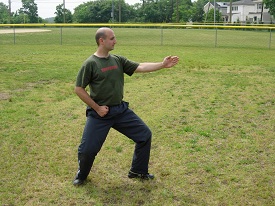
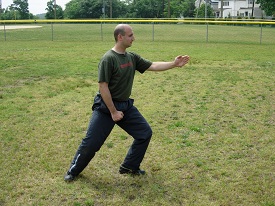
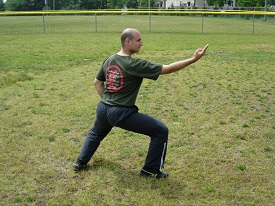
To begin, start in Boubi No Kamae, left hand straight out in front with a natural bend in the elbow, pointed at the opponent’s heart, right hand held in a fist in the crook of your right hip. Move with exaggerated slowness as if practicing a Tai Chi version of the kata.

Drop the weight from your hips, shift over the front knee, and let your rear elbow straighten, dropping the hand in front of the hip to create a slight tension in the spine. This point here about creating torque or stored elastic energy (SEE) in the spine is essential in being able to move powerfully without winding up or telegraphing the movement. If you are having trouble feeling it, try to exaggerate the movement. Make it much larger than necessary to study the feeling. It should feel like a tension in the lower back near the bottom of the spine.

When this tension (torque) is relaxed (released), the movement happens. See if you can figure out where the energy is stored and how it’s released in the rest of the San Shin no Kata!

Be very careful when transferring your weight that you do not bob up and down; move smoothly through the same plane by shifting your weight laterally. Another point to be mindful of during the weight transfer is that you should be in balance (kamae) at all times. If you were to stop the movement at any point in the transition, you should not lose your balance.

Try it.  Practice it.  Create a strong foundation upon which to build, expand, and grow so that all the information and knowledge being handed down to you today takes root.

You can pick up my video tutorial on how to use Sanshin No Kata to create stability and power in your movement as a FREE Bonus with my Martial Power Program. OR, you can click HERE and get the Sanshin No Kata video separately for just $7!

Martial Power Cover1