How do you get great at so many different facets of martial art at one time?
What one thing can you do to bring up your game across the board, no matter what are you practice?
Train the body.
✅ Want to get better at grappling? Train the body
✅ Want to get better at striking? Train the body
✅ Want to get better at weapons work? Train the body
✅ Want to become more powerful? Train the body
✅ Want to become harder to throw? Train the body
Why does this work?
Your body is the delivery platform for every skill in martial arts. Thus, if you properly condition the body, you improve your ability to acquire higher and higher levels of skill across the board. Build a stronger foundation and the tower can go much higher.
Once you build a highly conditioned body for martial arts, all your other skills instantly become much easier to train.
Instead of focusing on all the many different skills, weapons, tactics, techniques, etc. in the martial arts, look at the one commonality between them all – YOU. To be more specific, your body.
If you put in the work at the level of conditioning the body, ALL your skills improve. You are focusing your energy on creating a body specific for budo. This type of training precedes all of your techniques. It builds a stronger, broader foundation so that any skill you choose to work on is automatically improved!
Over the past 30 years of training in martial arts, I have been privileged to cross-train in many different arts from Jujutsu to Karate to Russian Systema to BJJ and MMA to Krav Maga and Combatives to Internal Arts and weapons training. In each of these I was able to, not only hold my own, but develop a remarkable degree of skill in a very short amount of time – why?
Body skills are the foundation of ALL martial and athletic movement.
In fact, in my mind, they are the foundation of all good, powerful, pain-free human movement!
What are body skills?
They are the qualities that connect, support, mobilize, and strengthen the body from the inside out. They create a highly resilient, dynamically stable body that underpins all other skill acquisition. In short, you want to get better at the specific skill sets within your martial art, quickly – train the body!
The ancients who created yoga, qigong, and various systems of martial arts knew a thing or 2 about training the body as a whole, integrated unit and not a series of disparate parts.
In fact the word yoga means “to yolk” or to unite together.
Each separate system that came down to us from the ancient world had one thing in common no matter where they originated…
They all utilized breath, posture, and movement to create a balanced healthy body, energetic, and free from pain.
When you combine exercises using all 3 modalities you get a powerful synergistic effect on health and strength that modern methods lack.
Learn exactly how to unite all 3 here =>
Shadow Strength utilizes a proprietary set of exercises drawn from traditional martial arts and trained in a unique combination to skyrocket your internal strength, power, and resistance to injury.
Using breath, posture, and martial mobility, Shadow Strength breaks down the barriers to superhuman strength and an unbreakable body.
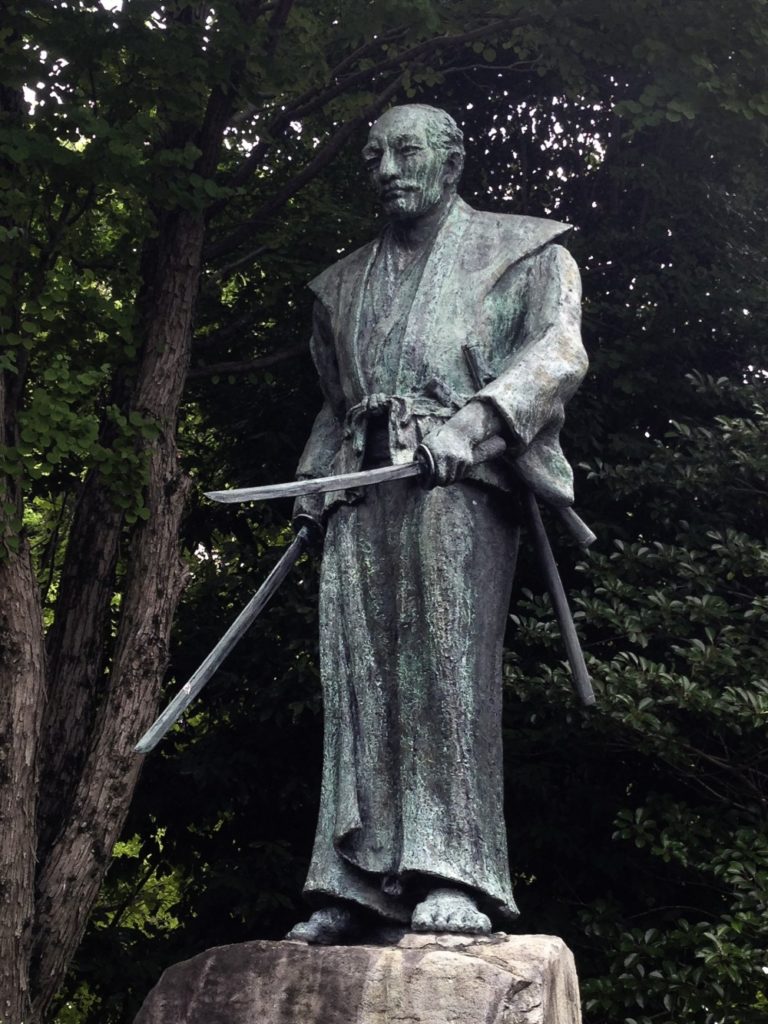
In his classic work on the art of strategy, Go Rin No Sho, Musashi gives the following instructions on Posture in his art.
“Keep your neck straight, putting some force in the hollow of the nape; lower your shoulders, with the sensation that the torso from the shoulders down forms a unity; keep the back straight, do not stick out your buttocks, push your force downward from your knees to the tips of your toes, Advance the belly slightly forward so that the pelvis does not lose its stability…
It is necessary for you to have as your posture in strategy just the ordinary one, and it is essential that the posture of strategy be the ordinary one for you. This must be examined well.”
Notice how adamant he is that your stance for combat and your everyday stance be the same…
Isn’t it interesting that Musashi’s instructions for how to stand in his system of strategy sound remarkably similar to zhan zhuang (standing meditation) and shizen no kamae (natural posture).
Coincidence? I think not…
For comparison here is a video I made on how to stand in Shizen no Kamae (natural posture).
Now let’s take a deeper look into the standing practice as the world’s oldest and most effective form of Qigong.
Tachi Geiko (Standing Training) or Ritsu Zen (Standing Zen)
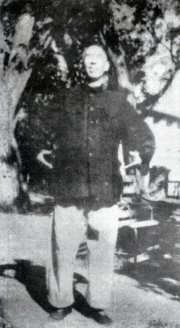
Zhan zhuang, or standing meditation exercise, has been used as a method of relaxation and health cultivation for thousands of years. The earliest known reference to standing appears inThe Yellow Emperor’s Classic of Chinese Medicine. Martial arts master Wang Xiangzhai wrote the following in his book on zhan zhuang:
“It is said that already 2000 years ago there existed the book Internal Canon, the gem of Chinese medicine, which even today is a guide for medical practice. The chapter Simple questions concentrates on cultivating health. For example we can read there: “In ancient times great masters stood on earth, supporting heaven, controlling yin and yang, breathing with essence of qi, standing alone, guarding spirit, with body being as one.”… Before the eastern Han dynasty many scholars and warriors knew the methods of “tranquil cultivating.” The exercises could be done walking, standing, sitting, lying. It was popular form of cultivating health. Later, during reign of Liang dynasty’s emperor Wu, Damo came to China to teach. He transmitted methods of “washing marrow” and “changing tendons.”
The health preserving and sustaining effects of zhan zhuang have been documented in hospitals and medical clinics across China. The reason this practice has such a profound impact on health and recovery from exercise is that the standing meditation acts like a system-wide reboot for the whole body. It stimulates the nervous system, increases circulation, and raises energy levels, while providing deep relaxation for both mind and body.
Aches, pains, old injuries, muscular tensions, and imbalances are highlighted and brought to the forefront by this method and then slowly dissolved over time and completely released. The practice provides a way of completely relaxing and letting go of the muscular tensions in the body, while the correct alignment of the bones delivers support, creating a profound neutral and relaxed, almost buoyant state. As the whole body and mind are exercised, both relax and stimulate the nervous system, increase circulation, open the joints, and raise energy level for a feeling of overall well-being.
This exercise looks easy from the outside. After all, you’re just standing there and not moving. However, inside, there is a lot going on – the breath and the qi (energy) are moving. This exercise is a challenging, sometimes frustrating, yet highly beneficial and rewarding practice. The only way to truly appreciate it is to experience it for yourself.
How Do We Stand?
In practical terms, how should we stand? Let’s start with the head and work our way down.
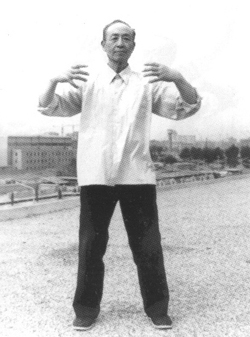
Begin by standing in a natural stance. Feet shoulder width apart, knees slightly bent.
Lift upward slightly with the crown of the head, as if being pulled up by a string, allowing the chin to lower. This straightens the vertebrae at the back of the neck.
Shoulders are back and down sitting on the spine.
The back should be flat. Do not tuck the pelvis. The spine should be suspended from above like a skeleton hanging in a science classroom.
Hold the arms in front of the body, level with the solar plexus, as if hugging a tree. There should be a golf-ball sized space under the armpits.
The bottom of the spine pulls straight down from the tailbone, as if there is a weight attached to the sacrum. You should feel like you are sitting on a high stool yet trying to stand up at the same time.
Allow the knees to bend slightly. Feet should be shoulder width apart and pointed straight forward as if on railroad tracks.
Legs should feel like they are squeezing a beach ball. Remember, though, the ball puts outward pressure on the legs as they squeeze in, so there is pressure both directions, not just one.
The weight is carried in the hollow behind the balls of the feet. In Chinese medicine, this is known as the yongquan or bubbling well point.
All of the above points must be maintained to have a truly “natural” standing posture.
Maintaining a relaxed posture is key to beginning your standing meditation.
Supercharge Your Standing Practice
Now that you have the external mechanics down, let’s talk about how to supercharge your relaxation process.
Mentally scan the body for areas of tension. The usual suspects will be the neck, shoulders, low back, and quads.
Begin to actively release each area of tension one by one with your mind. For example, think of the tightness in your shoulders and relax it by telling yourself, “The tightness in my shoulders is letting go and relaxing.” Then proceed to the next area until you have systematically gone through them all.
If one particular area is giving you trouble, then work on breathing into it. Inhale into the area, hold for a few seconds, and then exhale from the area to release it. Use this process over and over again until all the tension has let go.
Once you have removed all the residual tension in the body, continue to stand holding that relaxed feeling. Think of your body as a drop of ink dissolving in the ocean, spreading out in all directions.
Start with ten minutes of zhan zhuang standing. Work up to thirty minutes. In Chinese medicine, it is said that it takes approximately 28 minutes for the blood to complete one full cycle though the body, thus the recommendation to stand for thirty minutes. This can be increased to sixty minutes over time to allow for two full cycles of blood to be completed.
A New Way to Recover
In teaching this method to both my fitness clients and martial arts students I find that in addition to our usual compliment of recovery drills (consisting of mobility exercises, yoga asana, and compensatory movement), the addition of this simple practice of standing meditation has consistently accelerated our recovery process, allowed us to reach new levels of relaxation, and strengthened the mind-body connection beyond any other work we have done. Additionally, it has managed to increase energy levels while fortifying our bodies against the daily rigors of life, work, and family stresses.
While this method is elegantly simple to practice, requires little space and no special equipment, and can be done at virtually any time of day, it also is startlingly deep.
Go Deeper – Take the 100 Day Challenge!
Traditionally it is said that a minimum period of 100 days is necessary for the body to acclimatize and adapt to a practice. As our goal is to completely rewire the nervous system in order to change the body, 100 days seems like the perfect length of time.
How to Do It
Work your way up to standing for 30 minutes a day for 100 days – think you can do it?
Take the Integrated Strength Program challenge for 100 days and seriously upgrade your strength, health, and martial power!
Part 1 of this series, Conditioning the Fists for Striking can be found HERE.
Being able to strike with power and precision involves a lot more than merely knowing the technique. Practice must include these principles of effective striking techniques for all martial arts…
1. Whole Body Power
All movement in real life happens in three dimensions, so why train exercises that only incorporate one or two? Training muscles in isolation, unless it is used to rehab a specific injury, range of motion, or strengthen a particular muscle to add to the whole, does not work in martial art.
Our strike conditioning exercises must train movements in three dimensions utilizing diagonal, rotary, and angular strength, as well as prime moving muscles.
2. Stored Elastic Energy (SEE)
Stored Elastic Energy is basically the potential energy stored in tendons and connective tissue as a way to power movement.
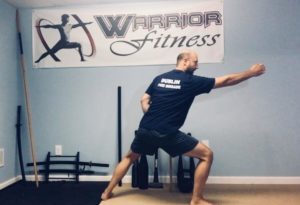
An easy exercise to begin to feel stored elastic energy is to stand in a natural stance with feet shoulder width apart. Bend your right arm and raise it up to shoulder height as if you were about to throw the most telegraphed punch in history (don’t worry, it’s just an exercise). Now, lead from the elbow and pull your fist back. Allow your torso to rotate, but keep the feet planted and the hips facing forward. When you reach the end of your range of motion, hang out there for a second and feel the tension (torque) on the spine. Now simply relax and release that torque to throw the punch. Don’t add any driving forces with muscle. You can’t propel it any faster; you’ll just slow it down.
Feel it?
Try it again.
Do it with the other arm. Remember the feeling. This is stored elastic energy (SEE).
The point here about creating torque or stored elastic energy (SEE) in the spine is essential in being able to move powerfully without winding up or telegraphing the movement.
If you are having trouble feeling it, try to exaggerate the movement.
Make it much larger than necessary to study the feeling. It should feel like a tension in the lower back near the bottom of the spine. When this tension (torque) is relaxed (released), the movement happens.
3. Structure / Kamae
Many people tend to use the terms alignment and structure almost interchangeably but in actuality, alignment is a component of structure.
For example, looking at a natural standing posture, good alignment would be:
Crown up
Chin down
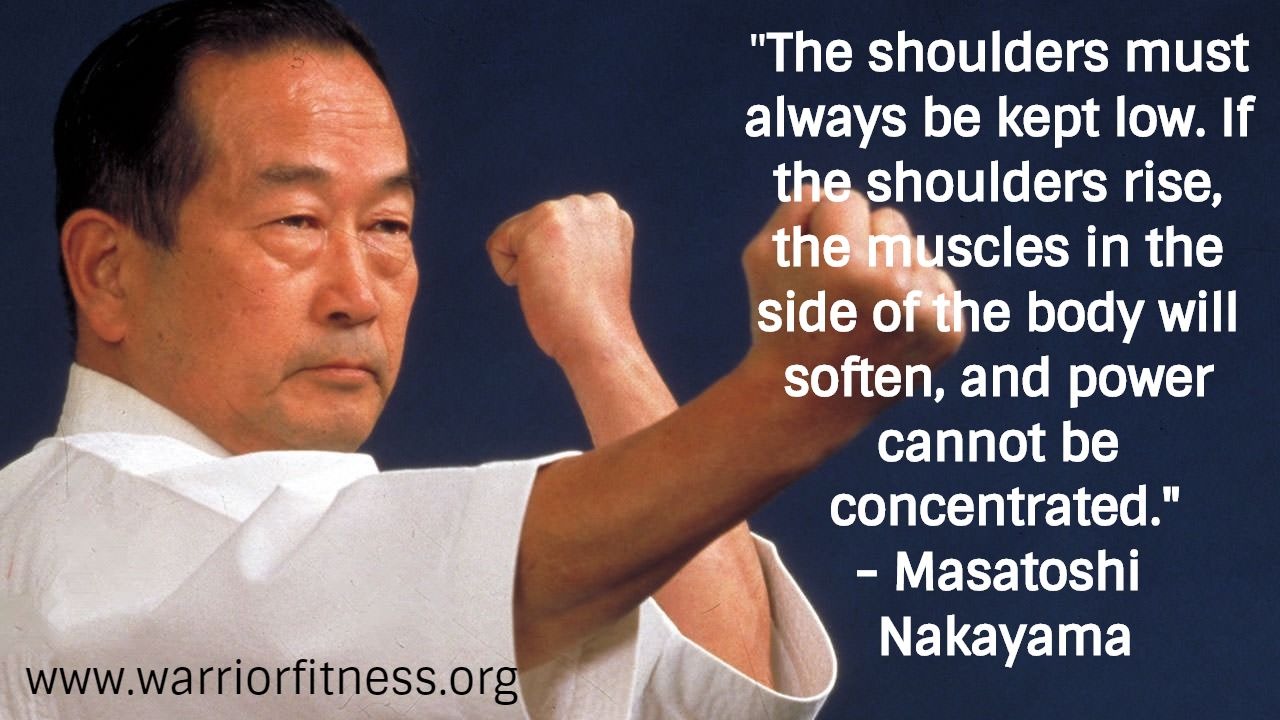
Shoulders packed down
Spine lifting up (through crown)
Spine pulling down (through the sacrum)
Hips under shoulders
Knees under hips
Mid-foot balance
Chest is relaxed
Butt not sticking out nor is pelvis tucked under
Knees are over the toes
Weight evenly distributed (50/50)
No leaning forward or backwardThis puts the whole body into proper alignment.
Structure also includes (in my lexicon) the balance of tensions within the body’s soft tissues. The bones act as compressive struts pushing outward from the center while the soft tissues (fascia) act as the stays pulling inward towards the center keeping the tensional balance in the body.
4. Breathing
How often do you think about breathing as it relates to striking?
Yet it is absolutely essential to maintain proper breathing when in combat or simply hitting a heavy bag, mitt, or an opponent. Lack of breath control affects the rest of your body and hinders your overall performance.
5. The S.A.I.D Principle
Why are all the above ideas important to understand in relation to striking and martial movement?
The SAID Principle – Specific Adaptation to Implied Demand says every activity that we repeat consistently causes an adaptation in the body.
The critical thing to note here is that it does not matter at all how we value this adaptation. It can be something that we want like how healthy exercise increases lean muscle mass and burns excess fat, or it can be something we do not want like how eating junk food to an extreme causes our body to adapt by putting on weight.
Both of these are examples of activities that cause adaptations in the body. Our goal is to train adaptations we value highly like the enhanced neural connections in our nervous system that increase our skill level. Keep this in mind when training. We do not want to train bad habits!
5.5 Elements of Efficiency
Efficiency is defined as the amount of useful work divided by the amount of total work. In other words, how much effect are you producing for the amount of effort you are expending?
Ever see a batter “swing for the fences” only to completely miss the pitch?
Ever see someone try to pick something up that is really light, but they believe is heavy?
How about watching someone using the general whole-body tension we discussed above trying to hit a heavy bag?
How much effect, i.e. force from the strike embedded into the target, is gained from the huge effort expended?
You must train to have your strikes be both effective (devestatingly powerful) and efficient (uses the least amount of force or energy to accomplish the movement). Only then can you be said to have mastered the art of striking!
Learn exactly how to upgrade your striking skills in ANY martial art with these resources from Warrior Fitness Training Systems…
One of the most underdeveloped aspects of the martial artist’s arsenal is the conditioning of his fists for striking.
The tendon strength, wrist strength and flexibility, and the overall structure of the strike is an exploitable weakness that needs to be addressed.
In this article we will examine several different push-up variations and isometric exercises to fortify the structure of our strikes.
This type of training will work to enhance the power generation of all manner of striking.
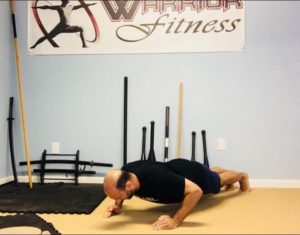
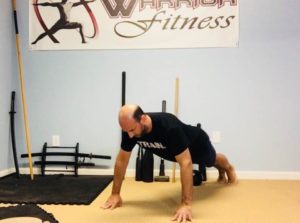
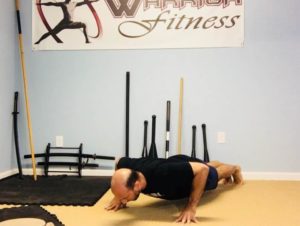
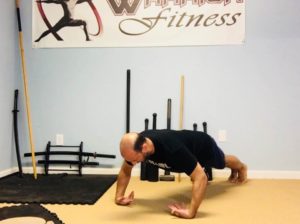
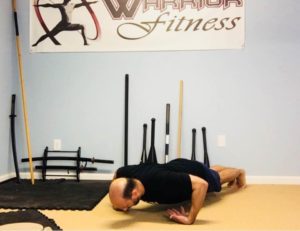
Do these push-ups slowly and purposefully with full attention to the movement. These are not meant to pump up your beach muscles, rather they will strengthen the connective tissue in your hands, wrists, forearms, and shoulders to build structure and encourage the correct alignment for all your strikes.
Fudo-ken (fist) Push-ups
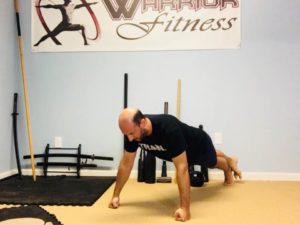
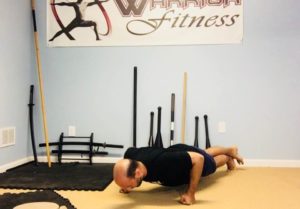
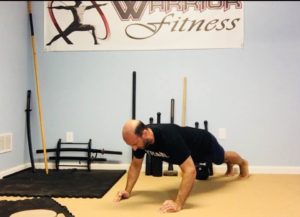
Place the weight of the body on the fists. Make sure the wrists do not bend. After performing several repetitions (or as a separate exercise) simply hold the body in the Fudo-ken push-up position. Relax as much as possible and allow the correct structure to support the body on the fists. Try this in the upper position, lower position, and halfway point of the push-up.
Do the same isometric holds with each exercise.
Shuto (sword hand) Push-ups
Hold the hands in the form of a shuto strike. They should close to a 45 degree angle with the thumbs supporting the fingers. The weight is on the meaty, inside portion of the hand.
Fingertip Push-ups
Place the pads of the fingers on the ground like you are clawing it. Try to squeeze the ground as you press up.
Wrist Push-ups
Place the wrists on the ground. These will be very difficult at first if you have not done them before. Take them slowly. If necessary, perform them on your knees to build strength.
Train these basic exercises thoroughly. Study this well!
As we discussed in the previous post (see here), all martial movement must be based on a platform of both mobility and stability. Today we will discuss stability.
Kamae is much more than just a stance or ready position. It is the platform from which all movements are made and from which all techniques are delivered. Your kamae is quite literally the foundation upon which your entire martial art practice rests.
A weak, or structurally flawed, kamae will limit the amount of power delivered and reduce the effectiveness of every technique employed. Conversely, a strong kamae is the key to the effective execution of all your techniques. A strong kamae carries the support of the ground and efficiently conducts that power through the user with minimal noise creating, in effect, a transparent power.
“You can’t shoot a cannon out of a canoe.”
Water provides a very poor base of support to maximally fire a cannon ball thus it will not travel very far. This is exactly what happens with a poorly constructed kamae. So much power bleeds off in different directions that the mean effect of the movement is extremely reduced and more energy is required in order to compensate for the inefficiency.
How Do We Build a Strong Kamae?
There are many different forms of strength training but only a few, very specific, methods of strengthening the structure (kamae). The key to strengthening structure, as you will see, is training the connective tissue – fascia, tendons, and ligaments, and strengthening the bones, rather than working on muscle. The benefits of this type of training are enormous; not only does having a stronger structure increase the effectiveness of martial movement and techniques, but also acts as a natural form of injury prevention by improving the strength and elasticity of the tissues and increasing the body’s overall resilience.
We will examine 4 main ones here from the EARTH section of Warrior Fitness working on strength, structure, and stability.
Loaded Carries – These provide a unique challenge to the body as they are a type of moving isometric exercise. Kettlebells or dumbbells are a great place to start, but loaded carries can be done with just about anything.
There are 3 basic loaded carries we will discuss here:
Farmer Walk – Hold 2 kettlebells at the sides and go for a walk. Try to maintain a neutral balance and move from center.
Rack Walk – Hold 2 kettlebells in the rack position and go for a walk. Try to maintain a neutral balance and move from center.
Overhead Carry – Hold 2 kettlebells overhead and go for a walk. Try to maintain a neutral balance and move from center.
Static Holds – Unlike lifting or carrying, static holds can be done anywhere with zero equipment. They also place a great emphasis on strengthening connective tissue for supporting the body.
Static Kamae Hold: Pick a kamae and hold it for time. The goal here is to relax in position and allow the connective tissue to do the work, not the muscle.
Static Push-up: Hold the top, middle, or bottom portion of a push-up for time. The goal here is to relax in position and allow the connective tissue to do the work, not the muscle.
Partial Lifts – Partials allow you to develop the connective tissues and bones in a way that full range of movement lifting cannot. By doing partials you are supporting more weight than you would be able to in a full range lift.
Push Testing – The push test is a very practical way of testing the quality of one’s solo training for internal power. The body, when properly trained, acts as an omni-directional structure. This allows the practitioner to neutralize any incoming force by diffusing it throughout the structure rather than having to surrender to it or resist against it.
I cannot over emphasize how critical this type of training is to your development as a powerful martial artist. Not only does this type of training condition the connective tissues, bones, and muscles, but it forms the body into a cohesive unit that is both resilient and powerful.
“Remember that mastery is not attained once after a lifetime of practice, but earned every day.”
– Jon Haas
Usually when we think of someone who is a master, be it a master martial artist or the master of some other craft, we think of them as attaining mastery at the end of a long lifetime of practice.
But mastery is NOT something that’s attained once after years or decades of training – mastery is something that is EARNED every day!!
You can be masterful in one moment and then a fumbling fool in the next (ask me how I know!).
The goal of becoming masterful isn’t to wait until some distant future when every move you make is perfect and every word that comes out of your mouth is sage advice, it’s to consciously create those moments of mastery every day until you have more of them rather than less of them.
Daily practice is the key.
Do you ever think about what it would be like to be a master martial artist?
Not just to be awarded the title “master” but to really and truly embody all of the sublime skill of martial mastery at the highest level of human achievement…
What would it feel like to know, without a shadow of a doubt, that you could easily control and subdue the most violent opponent with the most minimal effort, like a lion playing with a cub?
What if I told you that mastery is NOT something automatically attained after a lifetime of practice, but is instead conferred only upon those rare few individuals who, through their own efforts, take consistent, specific daily actions to achieve it?
Then mastery would not be just a far away, imagined future state, but instead a real and attainable goal built by taking action every day, right here and right now.
Remember This
Remember this – it is critical to your success – EVERY single legendary martial master: Musashi, Ueshiba, Bruce Lee, Kano, Takeda, Takamatsu, Gracie, Hatsumi, etc…
ALL of them began as unskilled, know nothing novices, white belts without a clue.
Their consistent daily training formed them, forged them, into the revered and feared masters that we know today.
“What one man can do, another can do.”
You can choose to follow in their footsteps. You can choose to be masterful, to be legendary.
However, as you follow them, do NOT seek to become them – instead, seek what they sought, the process of mastery.
Every once in a while it’s fun to think about how much the exercises we train on a daily and weekly basis actually translate, or carry over, to the activities for which we’re training.
Depending on your training program this can either be a great way to confirm that you are moving in the right direction, continuing to make progress and see results, or it can be a bit disheartening to realize just how little what you are doing actually carries over to your chosen field of endeavor.
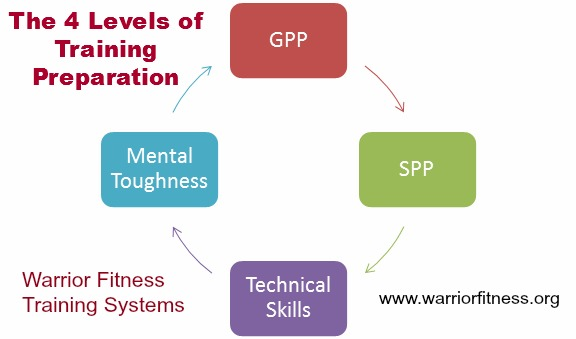
In the case of budo (martial arts) practice, like any other sport or physical activity, there must be exercises specifically crafted to enhance performance. A solid base of General Physical Preparation (GPP) is necessary, but not sufficient.
What is GPP?
The first step in ensuring you are building martial skills on top of a solid foundation is General Physical Preparedness (GPP). The goal of GPP is enhanced work capacity. This is the ability to run faster, jump higher, and hit harder.
When work capacity increases, it allows the budding warrior to adapt more easily to increases in both mental and physical demands. In other words, it increases your capacity and level of readiness to absorb higher levels of specificity in training. In order to be more, we must become more.
When talking about the martial arts, which tend to be seemingly limitless, one must possess the physical, mental, and spiritual endurance to “keep going!”
Moving From GPP to SPP
While the goal of GPP is muscular adaptation and general readiness for training, the main focus of SPP is neurological adaptation — to train movements, not muscles.
Specific Physical Preparedness builds on GPP by increasing the development of characteristics necessary for a particular sport or activity — or, in our case, martial arts.
It is a uniquely designed and targeted system for enhancing strength, flexibility, endurance, and conditioning which builds on the GPP base by furthering development in the exact physiological profile of the martial art.
Therefore, GPP helps to make you effective while SPP makes you efficient. The end stage goal is of course to be both effective and efficient in each and every movement.
The Training Process Cycle
If your strength and conditioning program is stuck in the GPP phase of development then you may not be realizing the type of performance gains that are possible with a specifically crafted SPP level.
Strength and conditioning training must eventually approach as close as possible to the demands of the activity to maximize the training effect.
Since your body adapts specifically to the stresses placed on it, you improve according to the type of training you do. This is exactly why your training program must cycle through from the general to the specific.
Ready to take your martial art training to the next level?
Check out the vast array of SPP for Martial Art Training Programs Available from Warrior Fitness Training Systems HERE <<===
The other day a student said to me during training: “This is hard.”
My reply was, “Well of course it’s hard. You don’t come to me to learn how to do things you’re already good at, do you?”
But why is this difficult?
In my experience,training is hard for approximately 3.5 main reasons…
1. You are learning new skills. It’s hard to be good at movements, exercises, and concepts that are new to you. Your nervous system must adapt to the new and different stimulus and create, or sharpen pathways to build competence and skill.
2. You must work on your weak points. Working on things you are already good at is fun, but the only way to truly become all-around strong is to eliminate your weak points.
3. Your ego. No one wants to look inept or silly. But the only way to become better means that we must put ego aside in order to learn.
3.5. Superficial Expert Status. The amount of information available today gives people immediate access to any body of knowledge out there, no matter how obscure, in a matter of seconds. We have all become SMEs – “Superficial Matter Experts”. We think that just because we know “about” something we actually understand it. No one wants to spend the time and effort required to learn something deeply.
But these reasons are exactly why we need to train. And why we need to train with people who have greater, or more specialized knowledge, higher levels of experience, and greater levels of skill than we do.
This is why I still train with my martial arts teachers. This is why I still have a strength coach. This is why I participate in masterminds and have business coaches.
Because I know that I need to be pushed and challenged in order to grow, just like I must push and challenge my students and clients in order for them to grow.
Trying to develop Internal Power by training kata (alone) in martial art is problematic. On one hand, you may inadvertently have minor success in creating some internal connection over the course of 20-30 years of training, but you will most likely have no idea how you did it, no idea why it worked (minimally at best), and most importantly, no idea how to correctly transmit it to the next generation.
The only advice you will be able to offer your students and fellow seekers is to keep doing this (kata training) and somehow you *might* get the correct result. This is insufficient and irresponsible, at best, on the part of the teacher.
Assuming that you want to stand out from the crowd as a powerful martial artist, and Internal Power/Aiki is your goal, then the scatter approach to trying (and for the most part, failing) to build IP through kata alone is a waste of a career. I say this because there exist clearly defined, step-by-step processes that rewire the body for Internal Power specifically for martial arts.
Solo Training Precedes Kata Training
Power building models as solo training exercises have existed for hundreds (if not thousands) of years throughout the martial arts from India to China to Japan. Why anyone would try to reinvent the wheel by attempting to create their own hodgepodge of exercises or think that merely training kata would develop real Internal Power is a mystery to me. The reality is that solo training exercises burn in specific ways of moving that are not normal which create a very stable, powerful structure capable of absorbing, re-translating, and projecting incoming force.
Internal Power training is a type of General Physical Preparedness (GPP) for budo. The goal of regular GPP for fitness, athletics, or martial arts is enhanced work capacity. This is the ability to run faster, jump higher, and hit harder. When work capacity increases, it allows the budding warrior to adapt more easily to increases in both mental and physical demands. In other words, it increases your capacity and level of readiness to absorb higher levels of specificity.
The solo training exercises for internal power training change the way outside forces act on the body. The structure becomes dynamically stable so that applied force can either be distributed throughout the chain and dissipated or, at a higher level, simply reflected right back onto the opponent. When force is reflected back this is what is known in Japanese as Yamabiko, or Mountain Echo.
Just to help further differentiate the two practices, solo training exercises for building internal power (there are other types of solo training exercises, obviously) are always made up of the following: standing, open/close, winding, spiraling, and breathing – all supported by Yin/Yang Theory (the union of opposites) and 6 directions (Heaven Earth Man).
Kata are for the purposes of patterning correct martial movement.
These solo training exercises are trained BEFORE kata to condition the body for powerful martial movement. They are not martial movement drills in and of themselves like sanshin no kata, kihon happo, and kata.
Kata – The Slow Boat to China
The reason it is so difficult to train IP via kata is that the vast majority of students get caught up in learning the movements of the kata correctly. They get caught up in the application of technique and the idea of trying to make it work correctly. What they don’t realize is that having a correctly trained body built by solo Internal Power exercises makes all the kata work much better and easier.
If you have a choice – why not learn a proven step-by-step method of developing unusual strength and Internal Power?
Following a clearly defined path up the mountain is much faster and more effective than wandering around the base working on kata for 30 years and thinking you will somehow magically arrive at the summit.
Caution– While I did just say “more effective and faster” I by no means meant easier!! Internal Power takes a lot of dedicated work. Do not think it is a shortcut!
 How do you get great at so many different facets of martial art at one time?
 They are the qualities that connect, support, mobilize, and strengthen the body from the inside out. They create a highly resilient, dynamically stable body that underpins all other skill acquisition. In short, you want to get better at the specific skill sets within your martial art, quickly – train the body!
 For example, looking at a natural standing posture, good alignment would be: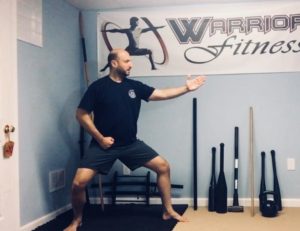
 What would it feel like to know, without a shadow of a doubt, that you could easily control and subdue the most violent opponent with the most minimal effort, like a lion playing with a cub?