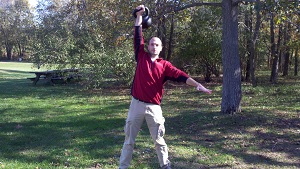
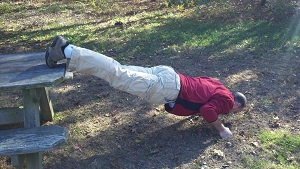
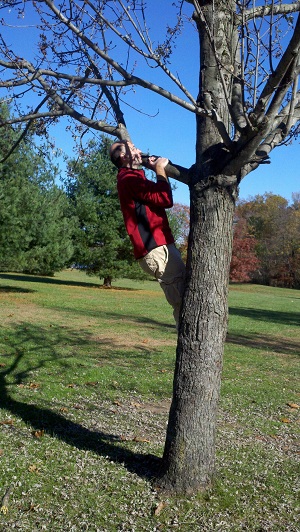
This past Saturday was a beautiful fall day here in Jersey. A perfect day for a Warrior’s Workout in the Park! This workout was directly inspired by Zach Even-Esh’s Ultimate Underground Strength System.
Warrior Workout
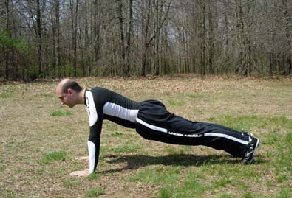
15 minute warm-up – mobility, movement, animal crawls, band work, breathing exercises followed by… 1) KB Clean & Press – 5×5 2A) Picnic Table Push-ups on fists – 4 x submax 2B) Thick Tree Branch Pull-ups – 4 x submax
3A) KB Goblet Squats 4×10 (forgot to take pics of these – sorry guys!) 3B) KB Swings 4×10
4) Abs / Grip work 3 sets each
The cool-down consisted of various yoga asana and breathing exercises as both normalizing work and compensatory movement.
Hope you enjoyed this! How did you workout this weekend? Let me know!
Ever have one of those days when nothing goes right?
The alarm clock is blaring yet you hit the snooze again for the 5th time dreading the prospect of getting up and facing the day. When you finally drag yourself out of from under the covers and realize just how late it is, your heart jumps into overdrive as you rush through your morning routine desperately trying to get out of the house to make it in to work on time. If you have small children to get ready for school, daycare, or other activities as well, that simply throws more chaos into the mix.
In your rush, you forgot to eat breakfast and left your steaming mug of coffee sitting on the kitchen counter while you ran out of the house. Traffic sucks, of course, because you’re late, and when you finally get in to work there are 6 messages from your boss wondering why you missed the morning project meeting… and your day goes downhill from there.
Some days it just seems like the universe is conspiring against you and this time it’s personal!
What do you do?
How do you respond to the myriad changes and vicissitudes life throws at you?
Do you find yourself tossed about like a small boat on a rough sea constantly overreacting and over-correcting with each wave?
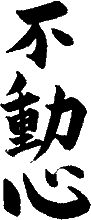
Or, do you have a quiet calm reserve of energy and strength that allows you to maintain a state of fudoshin – “immovable spirit”?
Fudoshin is a state of mind that remains undisturbed and not easily upset by either internal thoughts or external factors. It is the even keel that keeps your craft steady and on course during rough seas of life.
How do you develop fudoshin though? How do you cultivate that quiet reserve of strength and energy?
Prepare Yourself Daily
Daily preparation is the key. A reserve of strength must be built up gradually and nurtured daily, even when you don’t need it, especially when you don’t need it, so it’s there when you do. Like a savings account you invest a little bit each day so that when the unexpected happens the funds are there for you to draw upon. So let’s get to the nuts and bolts.
How do you prepare yourself daily? Here’s what I do…
Get up earlier each morning. Yes, earlier. Allow 30 to 45 minutes BEFORE you actually need to be up to get ready for the day.
Grab a cup of coffee. I love my coffee; there’s nothing like that first sip in the morning. Feel free to skip this step if you don’t drink coffee. 🙂
Head outside for a breath of fresh morning air (feel free to bring your coffee). According to Chinese Medicine, early morning is the springtime of the day and thus best for planting seeds to cultivate good health.
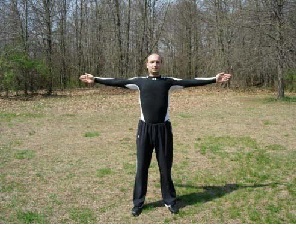
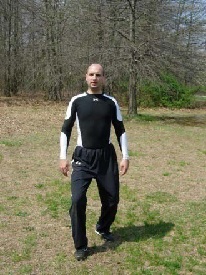
Stand tall, feet shoulder width apart, knees slightly bent, spine straight. Raise the arms laterally up over head breathing in slowly and deeply with the movement. As you inhale imagine the oxygen and energy carried by the breath is filling up your entire body. Hold the full breath for a moment or two, then slowly exhale completely bringing the arms back down. On the exhale, imagine the body is expelling tiredness. Repeat 3 to 5 times. Feel free to add other imagery to this exercise as well. For example, on the inhale imagine drawing in the positive qualities of strength, health, and confidence, and on the exhale imagine the breath drawing out and expelling negative qualities of weakness, sickness, and fear.
Perform a full, head to toe joint mobility routine to further wake up and enliven the body. For a complete discussion on joint mobility work and much, much more, see my book, Warrior Fitness: Conditioning for Martial Arts.
Depending on how much extra time you have, relax a few more minutes enjoying the strength and energy you have cultivated – and finish that cup of coffee before heading in to start your day!
Before leaving on our 11-day family vacation at Walt Disney World in Florida, I was a little concerned about the possibility of missing my regularly scheduled Warrior Fitness workouts. While I was looking forward to the family time and the amazing experiences that only Disney (and Universal Studios – Harry Potter was awesome!) can provide, I was also trying to figure out how I could escape from the parks and get in some Warrior Fitness style training every day. Well, it turns out I couldn’t break away. We were in the parks almost every day from opening to dinner time, and sometimes back after dinner for fire works too! But, since I’m a good ninja, I adapted! Here’s how…
It’s amazing how much walking you do on a daily basis at Disney. Whether it’s with Mickey, Donald, and Goofy in the Magic Kingdom, or walking through 11 different countries in Epcot, exploring Hogsmeade and Hogwarts Castle at Universal Studios, or hanging with the mammals over at Animal Kingdom, you are walking or standing in line literally all day long. So, the question for the warrior is, how do you put all this walking and standing to good use? Train while you do it, of course! While the walking alone is good enough for most ordinary folks, warriors require a little more. So here’s a little sample of what I did to enhance it:
Push a child in a stroller as you walk. Add a backpack to increase the weight.
Carry that child intermittently while walking or standing in long lines. A child is an odd object – who needs kegs, kettlebells, or sandbags when you can carry a kid! They constantly move, squirm, change posture or position while being carried!!
Focus on moving and pushing the stroller from the core (hara) and not from the shoulders.
Balance – stand in line on one foot. Do it while holding your odd object (child).
Grip training – crush grip the stroller handle for 5 seconds. Rest and repeat. Do left, then right, then both hands. Contract the core, exhale hard and crush the handle. Also, isometrically try to “bend” the handle – first make sure it’s sturdy enough, your wife will kill you if you actually succeed!
Breathing – there are tons of opportunities to enhance walking and carrying through breath training. Match your breath to your steps. 1 step inhale, 1 step exhale. Try to make it up to 10 steps on an inhale followed by 10 steps on an exhale. Or, 5 steps inhale, 5 steps hold full, 5 steps exhale, 5 steps hold empty. Try to see how many steps you can take carrying your child on an empty breath hold. Do the same on a full breath hold. Don’t forget to ride a rollercoaster too – screaming and laughing are great breath training!
Bodyweight squats while holding your child in line.
These examples above will help keep you focused, training, entertained, challenged, and present while your kids have a magical time in the parks.
If you have any energy left when you get back to the hotel room, bang out a few sets of push-ups to round out your workout for the day. And, lastly, joint mobility and yoga asana are a great way to prepare your body for the rigours of Disney. Don’t neglect your 10 minute warm-up in the morning before heading out. It’s a life saver!!
Trust me, there are ample training opportunies outside of your regular workouts. You just have to be a little flexible and creative.
Today we’re going to do a fun workout based on the Tabata Protocol. If you are not familiar with Tabata, please check out the Warrior Fitness Tabata Primer found here, What’s Tabata You?
I highly suggest you warm up before doing this workout. In fact, I insist on it. What’s a good way to warm-up? I’m glad you asked. One of my favorite warm-ups is found here in my Morning Wake Up Routine. Don’t let the fact that it says morning dissuade you. It’s a quick, highly effective recharge/warm-up that can be used anytime of day.
Now, onto the workout. Warmed up? OK. Here we go –
Remember, Tabata is 8 rounds of exercise, 20 seconds on, 10 seconds off, for a total of 4 minutes for each exercise. Take one minute rest upon completion of each set of 8 rounds.
Exercise 1 – Bodyweight Squats
1 minute Rest
Exercise 2 – Hindu Push-ups
1 minute Rest
Exercise 3 – Sit Thrus
1 minute Rest
Exercise 4 – Burpees
Out of breath? Want to learn how to recover your breathing in between exercises and at the end of the conditioning session? Check out the section on restoring breath in Evolve Your Breathing.
What’s sapping your energy and, unbeknownst to you, hindering your performance in martial arts, athletics, or simply the daily art of living, working, and taking care of your family? Residual muscle tension, or tonus, is the continuous, passive partial contraction of muscles in the body that aids in posture and support. Unfortunately, any type of exercise, stress, fear, and trauma, all cause an unwanted and unnecessary increase in the normal residual muscle tension of the body. Usually this extra tonus goes unnoticed, or worse is simply deemed an acceptable and natural side effect of living. The problem with this added tension is that the continuous contraction of muscle throughout the day, ever day, is using up energy. Energy that can, and should, be available to us is being siphoned off thereby putting the brakes on our performance. It’s like driving a car around all day with the emergency brake on. You can still get where you need to go, but that extra, unnecessary drag is killing the car’s performance and guzzling gas.
So how do we remove these insidious restrictive forces on our body? Besides a daily dose of joint mobility, which has been covered extensively in Warrior Fitness: Conditioning for Martial Arts, and in various other posts, I have come across 2 methods that work wonders:
1. Tension/Relaxation Exercises
At first glance, it may seem odd to increase tension in order to relieve tension, but remember, residual muscle tension is held unconsciously while these exercises will intentionally increase muscular tension for the purposes of identifying and releasing it. Stand naturally and lift your shoulders as high as possible up to your ears while simultaneously squeezing them as tight as possible. Hold for a couple seconds then drop with an exhale. Do it again. Feel the tension in your shoulders, neck, and upper back start to release? You can do this locally with any area of the body, or the whole body all together. For example, tense your left arm as tight as possible on an inhalation, hold for 3 seconds, then completely relax on an exhale. Do this with the legs, the abdomen, chest, back, shoulders. Tense each area while inhaling, hold for 3 seconds, then release and relax on the exhale.
2. Vibration Exercises
These are very simple, yet highly effective exercises which have been used for centuries in yoga and qigong to shake out and release residual muscle tension in the body. So how do you do them? Stand naturally, feet shoulder-width apart, knees slightly bent. Spine straight. Lift up from the crown of your head. Begin to bounce gently with the legs shaking the whole body up and down. On each down bounce allow the body to exhale – don’t force it. Don’t try to breath, just let the motion breath the body. Slightly round the shoulders and tuck the pelvis to help the motion push air out. Continue shaking the body up and down for about 30 seconds to a minute. Stay loose. Stay relaxed. Shake out the tension.
These 2 simple exercises, done on a daily basis, will go a long way toward helping you recover the energy that’s been bound up in holding residual muscle tension. Let me know how they work out for you!
In our last article on breathing exercises, here, we introduced the concept of using the basic push-up form as a vehicle for training the breath. Today we will continue with the push-up as the outward expression, but take a look at different types of breathing patterns to increase the depth and complexity of the the exercise.
4 Phases of Breathing
The breath cycle can be broken down into 4 distinct phases of breathing:
Inhale
Pause after inhale (full hold)
Exhale
Pause after exhale (empty hold)
Each of these phases can be manipulated within the framework of our exercise to create variation and change the focus of the exercise. Previously we had discussed how to use the inhale and exhale phases of breathing to increase capacity by fitting more movement into each breath. Today we will focus on the other 2 phases, pause after inhale and pause after exhale. These breath holds will allow us to teach the body how to utilize the oxygen it already has more effciently by working longer in a state of oxygen deprivation.
As a side note, please be aware of your body’s physiological response to breathing exercises. In general, inhalation causes a slight increase in tension and blood pressure, while exhalation causes a relaxation response and an accompanying lowering of blood pressure. These effects can be magnified by holding the breath after inhalation and holding the breath after exhalation. Therefore, please proceed with caution.
Inhale and Hold
In this exercise we will be working with the pause after inhalation. Assume the push-up position. Inhale deeply by expanding the belly. Don’t force it. Just inhale as much as comfortable for you. Pause. Do not exhale.
Perform 1 push-up.
Exhale at the top and inhale again. Perform 2 push-ups on the full hold. Exhale at the top portion and then inhale and hold. Perform 3 push-ups on the full hold.
How does it feel?
Can you do 4? 5?
Make sure you are not trying to move faster just because you’re holding the breath.
Perform the push-ups smoothly and in a relaxed manner. A side benefit of this type of work is that it helps you to work under stress. When you can’t breathe, the body begins to panic. Even though your mind knows it’s just an exercise and you can breathe at any time, your body is responding to the lack of air and begins to sound the alarm. Understand this and work with it to teach yourself to remain calm in difficult situations.
Exhale and Hold
Now let’s look at the pause after exhale, or empty hold. You know the drill by now – assume the position!
Inhale and exhale in the top portion of the push-up. Hold on the exhale and do 1 push-up. Inhale and exhale. Do 2 push-ups. Inhale at the top, exhale. Do 3 push-ups.
What do you notice about holding on the exhale versus holding on the inhale?
Much more difficult, right?
Again, note the reaction your body is having to the exercise. Are you speeding up to get through it? Are you using more muscle tension than necessary? How does the increased muscle tension affect your body’s oxygen usage? Relax and slow down. You’ll be able to handle more.
Hip to be Square Breathing
Okay. Time to put it all together. Square breathing means that each of the 4 segments or phases of the breath cycle will be of equal length. For example, inhale to a count of 5, hold on the inhale for a count of 5, exhale for a count of 5, then hold on exhale for a count of 5. The count itself doesn’t matter as long as each part is equal. Obvioudly, the difficultly level can be increased with a higher count and decreased with a lower count. For our purposes, let’s stick with the 5 count for one push-up. Begin in the up portion of the push-up. Don’t move yet, but inhale for a count of 5. Now hold the breath and slowly lower down to a count of 5. At the bottom portion of the push-up, exhale in position for a count of 5. Hold on the exhale and raise yourself back up slowly to a count of 5. Make sense?
Let me know how you make out with the above exercises and if there are any questions you have.
Today we are going to talk about push-ups. I can hear the groans already.
But these aren’t the dull, boring, uninspired push-ups you had to do in grade school gym class for some lame physical fitness challenge. Nor are these the repetitious calisthenics you had to do by the hundreds in Army Boot Camp.
Today, we are using the basic push-up as a tool, a vehicle to study and work our breath. The push-up is simply the form our breathing exercise will take, nothing more.
Sound a little more interesting now?
Let’s explore a little more…
Usually, breathing exercises are done in a very relaxed, non-stressful manner in a seated, or even lying down position.
Not today.
Breathing push-ups will help us explore our breath while moving and while under load.
Why is this important, you ask?
Consider that it’s pretty easy to control your breath while comfortably seated on the mat, and easy to relax while lying down. But how much carryover do those types of breathing exercises have to helping you withstand pressures in real life or stress in fighting? Some, certainly, but their emphasis is different. Please don’t misunderstand here though. We need a myriad of exercises to be able to influence and control physiological processes. The stationary relaxed breathing exercises absolutely do have a place in your tool kit and are important for health, stress relief, and relaxation, but are just not the focus of our discussion today.
The Structure of a Push-Up
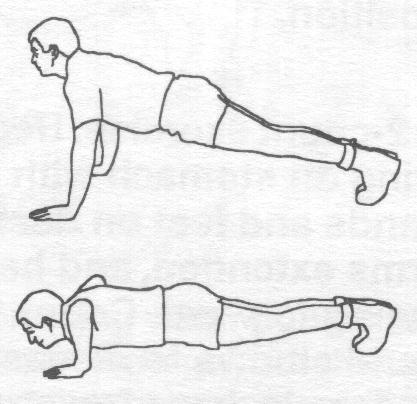
Let’s begin in the up portion of the push-up position. Hands should be about shoulder-width apart, elbow pits facing forward. Back is straight, aligned from crown to coccyx. Very important with all the exercises here, do not use any more muscle tension than absolutely necessary to accomplish the exercise. As you progress, you’ll find less and less muscle power is needed for the same result. We’re working toward efficiency here. So, relax as much as possible and remember that the push-up is just the form, the real goal is the breath work.
Begin to inhale slightly before starting the push-up this way your breath leads the way. As you lower down, continue to inhale by expanding your belly.
No chest breathers here!
Pause at the bottom portion, then begin to exhale again slightly before initiating the upward push. The breath should guide the movement.
Play with this for several repetitions trying to really get the feel of the breath leading and supporting the movement.
Now reverse the breathing pattern. Exhale on the way down and inhale on the way up. Same rules apply.
If you feel excessive muscle tension being used, stop. Stand up and lean against a wall or a staircase in the push-up position. This will greatly reduce the demand of the exercise allowing you to concentrate on the breathing aspect while still performing the movement of a push-up. When you feel comfortable with the movement, drop back down to the floor and try again. Keep the same light feeling you had while doing the push-ups against the wall or stairs.
Building Capacity
Once you get the hang of the breath leading the movement of the push-up, we will begin to work on expanding your breathing capacity. Here we will stretch out the inhale and exhale to fit more movements into each breath cycle.
For example, begin again in the upward portion of the push-up position. Exhale completely without moving. Begin the inhale slightly before the lowering movement and continue to inhale all the way down and all the way back up. Exhale. Now try to do 2 push-ups on one inhale. If you can do 2, try 3. See how many movements you can fit into one inhale, it’s not easy! Make sure you don’t rush that will only add tension and gas you out even quicker. Maintain relaxation and an even pace throughout.
Once you’ve done a few reps by expanding your inhale, try to do the same thing on an exhale. Start in the top portion of the push-up, inhale completely without moving. Begin your exhale slightly before the downward movement and continue through the whole push-up. Try 2, 3, 4, see how many reps you can do on one exhale.
One way to do this in a set is to do a breathing ladder. Do one push-up on one inhale. Exhale at the top. Then do 2 push-ups on one inhale. Exhale at the top. Then do 3 push-ups on one inhale. Exhale at the top. Try to do 4 on one inhale. Now, reverse it, inhale at the top and do 4 push-ups on one exhale. Then 3 on one exhale. Then 2. Then one push-up on one exhale. Get the idea?
Hopefully this is a fun and productive exercise for you. Let me know how it works and if you have any questions!
Stay tuned for Part 2 of this article where we’ll discuss breath holding.
Proper walking is footwork training for budo. How we walk in day-to-day life is how we will walk (move) in combat. Efficiency in more complex movement begins with efficiency in simple movements. How can we expect to move with ease in the chaos of a combative environment when most of us have trouble walking with natural gait? Walking is a ubiquitous activity that many people simply take for granted. They move through the day without any awareness of the strain they place on their knees, hips, and lower backs by their poor movement patterns. Just a little awareness will do wonders for your balance, posture, and lightness of step. When Hatsumi Sensei first came to the U.S., of the things he noticed immediately was how heavy and inefficiently people walked. His comment was that most people walked “like Frankenstein”!
Walking Exercises:
1. Stand in shizen no kamae (natural posture) and balance on one leg. Lift the other foot a few inches off the ground and then lower again in a slow, controlled manner using the flexing of the grounded leg to regulate the descent. Gently bounce a few times getting the feeling of how the grounded leg’s flexion and extension controls the lowering of the other foot. The balance on your leg should be such that you are able to lower the opposite foot to the ground in any direction and easily maintain kamae (balance). Switch legs and now balance on the other leg while lowering the foot.
2. Stand in shizen no kamae (natural posture). Use your right hip to lift the right foot off the ground. It will feel strange at first since this is not a very commonly used muscle action, but once you get used to it, it will become an efficient way of lifting the leg. With the right leg lifted, pull back with the right shoulder. Notice how this has the effect of creating a slight torque in the spine and moves the right foot forward at the same time. Release the tension in the spine by placing the right foot down in a forward step. Feel how the release of tension propels the body forward and allow it to create the same lift from the hip and pulling back of the shoulder on the left side.
3. Combine the previous two exercises together and begin to walk.
4. Another idea to try when walking is to alternate periods of normal, regular breathing with holding your breath for duration when “full”, after an inhale, and when “empty”, after an exhale. Try inhaling for a count of 5 (steps or seconds), hold your breath for a count of 5, exhale for a count of 5, and finally, hold your breath empty for a count of 5 while walking. Repeat as long as you can continue the pace. Note that 5 is just an arbitrary number and can be raised or lowered to suit your own needs. This practice will help you to understand how your body can function during situations when you must suddenly hold your breath yet still continue to work. Another benefit of this exercise is that it also helps the body to process oxygen to brain, heart, and other working muscles more efficiently.
Don’t forget “light feet and soft knees” when walking!
At the suggestion of my good friend, and West Coast Buyu, Dave Furukawa, I am presenting a look at one of my daily workouts. Please see Dave’s comments on my previous post here for reference.
This is a record of my activity from yesterday, Memorial Day 2010:
Morning
Life begins early here, even on long holiday weekends, since our 19 month old, Juliana, doesn’t distinguish weekends from weekdays yet! So at 6 am I was up making coffee and searching through her Elmo DVDs to find the particular episode she wanted that morning. As the coffee was brewing I began working through my joint mobility routine in the kitchen. Each joint from neck down to ankles and toes is rotated through its entire range of motion to flush the joints with synovial fluid and increase blood flow to the surrounding muscles. This has the effect of lubricating the joints and removing the “rust”, as well as awakening the entire body.
As interest in her Elmo episode waned and Juliana wandered off to “read” her books and play with toys, I began working through San Shin no Kata, the Bujinkan basic movement exercises. Each movement was practiced stationary, then walking forward and backward with emphasis on using the spine to generate power for the movements.
Mid-Afternoon
In the afternoon I took the kids to the playground. My older daughter, Caitlin, rode her bike while I pushed the baby along in her little buggy. As I walked each step was coordinated with breathing to work on breath capacity. For example, inhale for 5-steps, hold on the inhale for 5-steps, exhale for 5-steps, then hold on the exhale for 5-steps. This can be done continuously with the same pattern or you can alter the number of steps for each breath cycle up or down to make it easier or more challenging. See my post entitled Breathing 101 for more breathing related exercises. At the playground, in between pushing the kids on the swings and taking the little one down the slide, I used the monkey bars for random amounts of pull-ups and chin-ups.
Evening
Finally got the kids to bed around 8:30 and went down to the basement gym for my workout proper. My current program is geared towards developing unarmed striking power and basic weapons work.
Brief joint mobility warm-up
Suburi with Yari (spear) – 3 rounds of 10 thrusts from Seigan no Kamae, 10 thrusts from Jodan no Kamae, each side
Suburi with heavy bokken – 3 rounds of 10 cuts from Jodan no Kamae, advancing and retreating
Swipes with 15 lb clubbell – 3 sets of 10
Mills with 15 lb clubbell (think omote shuto type movement) – 3 sets of 10
Reverse Mills with 15 lb clubbell (think ura shuto type movement) – 3 sets of 10
Clean to Order with 25 lb clubbell – 3 sets of 5 each arm
Clean to Order with 45 lb clubbell – 1 set of 5 each arm
5 minutes of various yoga asana to cool-down
This is just a quick glimpse into a much larger program that I am testing on myself for eventual release. For more information on my previous programs, please check out my ebook, Warrior Fitness: Conditioning for Martial Arts.
Ever have one of those mornings when you have to be up early for work or school, but simply can’t summon the energy to start your day? This is a routine I have been using successfully for years to shake out the cobwebs and get me moving on the mornings when just a cup of coffee isn’t going to do it. It’s not your fault, and bear that in mind – some people just aren’t morning people.
Back when I was travelling for weeks on end and putting in long hours every day for consulting work this routine was my morning staple in the hotel room before meeting my colleagues for breakfast. I find it most effective on the mornings when I am most tired. Just as an aside, it doesn’t have to be used in the mornings, it has benefits any time of the day when you need a little pick me up. One caution, and although this should be obvious I’ll say it anyway, don’t do it before going to bed – you won’t sleep!
The Routine
Joint Mobility
This has the effect of increasing synovial fluid to lubricate the joints while at the same time increasing blood flow to the surrounding muscles. For the quick version we will concentrate on the neck, shoulders, hips, and spine.
Neck:
Up/Down – lift up from crown of head; slide down along plane of jaw for 3 to 6 repetitions.
Left/Right – turn head as far left as possible without pain, turn as far right as possible for 3 to 6 repetitions.
Full circles in both directions.
Shoulders:
Roll both shoulders – lift shoulders up towards ears, roll backward fully articulating the range of motion (ROM), drop them down as far as comfortable for 3 repetitions, then repeat by rolling forward for 3 reps.
Alternate shoulder rolls – roll left shoulder back as described above while pushing right shoulder forward then switch. Perform 3 times each.
Swing both arms as fast as possible windmilling them forward for 20 seconds then backward for 20 seconds.
Hips:
Circle hips clockwise and counter-clockwise 10 times in each direction.
Spine:
Keep the spine straight and fold forward at the hips, then rotate around to the left and back to center, then forward and around to the right.
Keep the spine straight and fold backward at the hips, then rotate around to the left and back to center, then forward and around to the right.
Energizing Breath
In this breathing exercise we will utilize a protocol founded by yoga and improved upon by Russian sport science and martial art. Here the breath is divided into 3 levels: clavicular (upper level), intercostal (mid level), and diaphragmatic (lower level). This exercise will focus only on the clavicular, or upper level. For more information on breathing exercises, please see Evolve Your Breathing.
Exhale through the mouth in a short, quick burst by compressing the upper chest.
Do not actively inhale. Allow the inhale to happen by relaxing the muscles in the chest.
Repeat rapidly 20 to 40 times.
Build up to where you can perform continuously for 60 seconds.
If you become dizzy, stop and sit down!
Slap Yourself Silly!
This is actually an ancient Qigong exercise designed to improve circulation and disperse stagnant energy. The execution is pretty simple. You may want to avoid practicing this in public though!
Gently, but vigorously, slap your shoulders, upper back, and lower back with the palms of the hands.
Then slap down the inside of one arm and up the outside. Switch arms.
Slap down the outside of both legs – you can slap a little harder here – and up the inside.