Every warrior requires certain tools to assist them in honing their craft. Each tool is utilized in a specific manner to create a specific outcome. In the upcoming Warrior Fitness Guide to Striking Power, we will use several different tools to accomplish the task of super-charging your striking effectiveness.
The Warrior Fitness Guide to Striking Power will utilize a 4-pronged based assault to increasing striking power, effectiveness, and efficiency.
Sledge Hammer
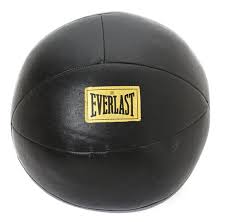
Medicine Ball
Resistance Bands
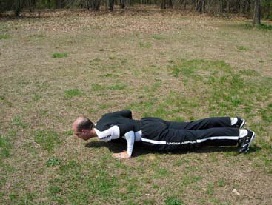
Bodyweight Exercises and isometrics
Get ready to change everything you think you know about training your striking ability!
Summer is coming and, hey, let’s face it – even warriors need to look good at the beach, right?! So, if you’re going to workout with the intention of getting is shape for summer, why not do it in a balanced, functional manner that syncs up with and supports your other activities rather than distracting from them? To that end, here’s a newly designed Warrior Fitness workout to help tone and sculpt that beach body!
Pull-up Pyramid
Start with 1, pyramid up to 3, then back down to 1
Depending on your fitness level, do pull-ups, chin-ups, or commando pull-ups
Push-ups
5 Pike Push-ups(begin in downward facing dog posture, bend arms to touch head to ground)
10 Hindu Push-ups
5 Diamond Push-ups (hands are touching at pointer fingers and thumbs directly under chest)
10 Fist Push-ups
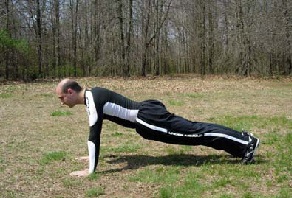
End with a static hold mid range of the push-up position for 1 minute
Dips
4 sets of 10
Use a bench, chair, or couch
Bodyweight Squats
4 sets of 15
If too easy, make them jumping squats
Seiza Step-ups(Begin in seiza, Japanses kneeling posture, on the balls of your feet. Step up right leg, followed by left leg to half squat so legs are 90 degrees, then back down to seiza.)
4 sets of 10/10
Static 1/2 Squat
Hold mid range of squat for 1 minute (wall sit)
V-ups
2 sets of 10
Warrior Sit-ups
2 sets of 10
Plank
Finish with static plank hold for 1 minute
Side plank 30 seconds per side
Take a look at the vibration drills in this article to see how to shake out and release that residual muscle tension.
Want to know more? The strength and conditioning exercises in Warrior Fitness will not only provide a strong, functional body, but help burn fat and build lean muscle as well. When used in conjunction with the mobility warm-ups, breathing exercises, and compensatory cool-down movements in the book, Warrior Fitness is a fully balanced approach to fitness and conditioning!
In our last article on breathing exercises, here, we introduced the concept of using the basic push-up form as a vehicle for training the breath. Today we will continue with the push-up as the outward expression, but take a look at different types of breathing patterns to increase the depth and complexity of the the exercise.
4 Phases of Breathing
The breath cycle can be broken down into 4 distinct phases of breathing:
Inhale
Pause after inhale (full hold)
Exhale
Pause after exhale (empty hold)
Each of these phases can be manipulated within the framework of our exercise to create variation and change the focus of the exercise. Previously we had discussed how to use the inhale and exhale phases of breathing to increase capacity by fitting more movement into each breath. Today we will focus on the other 2 phases, pause after inhale and pause after exhale. These breath holds will allow us to teach the body how to utilize the oxygen it already has more effciently by working longer in a state of oxygen deprivation.
As a side note, please be aware of your body’s physiological response to breathing exercises. In general, inhalation causes a slight increase in tension and blood pressure, while exhalation causes a relaxation response and an accompanying lowering of blood pressure. These effects can be magnified by holding the breath after inhalation and holding the breath after exhalation. Therefore, please proceed with caution.
Inhale and Hold
In this exercise we will be working with the pause after inhalation. Assume the push-up position. Inhale deeply by expanding the belly. Don’t force it. Just inhale as much as comfortable for you. Pause. Do not exhale.
Perform 1 push-up.
Exhale at the top and inhale again. Perform 2 push-ups on the full hold. Exhale at the top portion and then inhale and hold. Perform 3 push-ups on the full hold.
How does it feel?
Can you do 4? 5?
Make sure you are not trying to move faster just because you’re holding the breath.
Perform the push-ups smoothly and in a relaxed manner. A side benefit of this type of work is that it helps you to work under stress. When you can’t breathe, the body begins to panic. Even though your mind knows it’s just an exercise and you can breathe at any time, your body is responding to the lack of air and begins to sound the alarm. Understand this and work with it to teach yourself to remain calm in difficult situations.
Exhale and Hold
Now let’s look at the pause after exhale, or empty hold. You know the drill by now – assume the position!
Inhale and exhale in the top portion of the push-up. Hold on the exhale and do 1 push-up. Inhale and exhale. Do 2 push-ups. Inhale at the top, exhale. Do 3 push-ups.
What do you notice about holding on the exhale versus holding on the inhale?
Much more difficult, right?
Again, note the reaction your body is having to the exercise. Are you speeding up to get through it? Are you using more muscle tension than necessary? How does the increased muscle tension affect your body’s oxygen usage? Relax and slow down. You’ll be able to handle more.
Hip to be Square Breathing
Okay. Time to put it all together. Square breathing means that each of the 4 segments or phases of the breath cycle will be of equal length. For example, inhale to a count of 5, hold on the inhale for a count of 5, exhale for a count of 5, then hold on exhale for a count of 5. The count itself doesn’t matter as long as each part is equal. Obvioudly, the difficultly level can be increased with a higher count and decreased with a lower count. For our purposes, let’s stick with the 5 count for one push-up. Begin in the up portion of the push-up. Don’t move yet, but inhale for a count of 5. Now hold the breath and slowly lower down to a count of 5. At the bottom portion of the push-up, exhale in position for a count of 5. Hold on the exhale and raise yourself back up slowly to a count of 5. Make sense?
Let me know how you make out with the above exercises and if there are any questions you have.
Since Top 10 lists have been so overused of late, especially in the internet blog area, here are 7 and a 1/2 reasons why the Warrior Fitness program is for you.
1. No gym memberships required! Still paying for a gym membership you don’t use, or not getting the results you want from your gym? Start thinking outside the gym with Warrior Fitness!
2. Low-tech fitness solutions. Don’t have the budget for expensive training equipment? Warrior Fitness offers a complete body-weight workout for strength and conditioning.
3. Quality workouts that work around your schedule. It doesn’t take hours in a gym to achieve the results you’re looking for. Our program encourages quality over quantity. Got 15 minutes? Then you have time for a workout.
4. Lose fat, gain lean muscle. Our workouts are short, but intense to encourage lean muscle growth while stimulating fat loss. No more boring hours of mindless cardio!
5. Sample workouts and programing guidance. Do some fitness training manuals you’ve purchased in the past leave you wondering how to put it all together or how to fit into your schedule? Warrior Fitness provides sample workouts you can follow or use as templates to create your own.
6. Ongoing support and new ideas. Got questions? Send me an email. Post a question in the comments section. I’m here to make sure you are successful!
7. Fully integratable with your martial arts training. Ever wonder which fitness programs make sense to use within the context of your martial arts training? Ever feel like you may be hindering your progress by the type of workouts you’re doing instead of enhancing it? Since the program is designed by a martial artist with 30 years of experience and a fitness training background, Warrior Fitness provides a clear path to integrating your fitness and martial arts.
7.5 Comprehensive! Warrior Fitness covers supremely functional strength and conditioning drills, joint mobility, flexibility, breathing exercises, workout recovery, performance enhancement for martial arts, internal strength development, and more!
Today we are going to talk about push-ups. I can hear the groans already.
But these aren’t the dull, boring, uninspired push-ups you had to do in grade school gym class for some lame physical fitness challenge. Nor are these the repetitious calisthenics you had to do by the hundreds in Army Boot Camp.
Today, we are using the basic push-up as a tool, a vehicle to study and work our breath. The push-up is simply the form our breathing exercise will take, nothing more.
Sound a little more interesting now?
Let’s explore a little more…
Usually, breathing exercises are done in a very relaxed, non-stressful manner in a seated, or even lying down position.
Not today.
Breathing push-ups will help us explore our breath while moving and while under load.
Why is this important, you ask?
Consider that it’s pretty easy to control your breath while comfortably seated on the mat, and easy to relax while lying down. But how much carryover do those types of breathing exercises have to helping you withstand pressures in real life or stress in fighting? Some, certainly, but their emphasis is different. Please don’t misunderstand here though. We need a myriad of exercises to be able to influence and control physiological processes. The stationary relaxed breathing exercises absolutely do have a place in your tool kit and are important for health, stress relief, and relaxation, but are just not the focus of our discussion today.
The Structure of a Push-Up
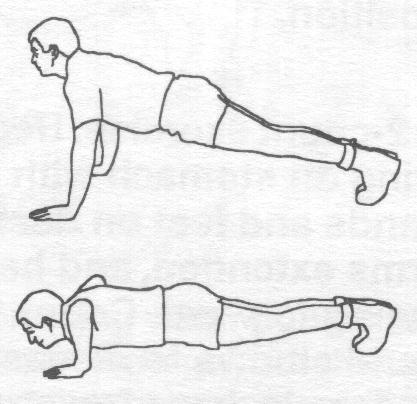
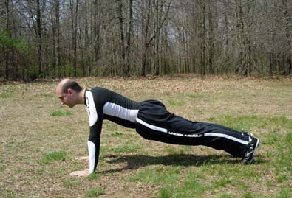
Let’s begin in the up portion of the push-up position. Hands should be about shoulder-width apart, elbow pits facing forward. Back is straight, aligned from crown to coccyx. Very important with all the exercises here, do not use any more muscle tension than absolutely necessary to accomplish the exercise. As you progress, you’ll find less and less muscle power is needed for the same result. We’re working toward efficiency here. So, relax as much as possible and remember that the push-up is just the form, the real goal is the breath work.
Begin to inhale slightly before starting the push-up this way your breath leads the way. As you lower down, continue to inhale by expanding your belly.
No chest breathers here!
Pause at the bottom portion, then begin to exhale again slightly before initiating the upward push. The breath should guide the movement.
Play with this for several repetitions trying to really get the feel of the breath leading and supporting the movement.
Now reverse the breathing pattern. Exhale on the way down and inhale on the way up. Same rules apply.
If you feel excessive muscle tension being used, stop. Stand up and lean against a wall or a staircase in the push-up position. This will greatly reduce the demand of the exercise allowing you to concentrate on the breathing aspect while still performing the movement of a push-up. When you feel comfortable with the movement, drop back down to the floor and try again. Keep the same light feeling you had while doing the push-ups against the wall or stairs.
Building Capacity
Once you get the hang of the breath leading the movement of the push-up, we will begin to work on expanding your breathing capacity. Here we will stretch out the inhale and exhale to fit more movements into each breath cycle.
For example, begin again in the upward portion of the push-up position. Exhale completely without moving. Begin the inhale slightly before the lowering movement and continue to inhale all the way down and all the way back up. Exhale. Now try to do 2 push-ups on one inhale. If you can do 2, try 3. See how many movements you can fit into one inhale, it’s not easy! Make sure you don’t rush that will only add tension and gas you out even quicker. Maintain relaxation and an even pace throughout.
Once you’ve done a few reps by expanding your inhale, try to do the same thing on an exhale. Start in the top portion of the push-up, inhale completely without moving. Begin your exhale slightly before the downward movement and continue through the whole push-up. Try 2, 3, 4, see how many reps you can do on one exhale.
One way to do this in a set is to do a breathing ladder. Do one push-up on one inhale. Exhale at the top. Then do 2 push-ups on one inhale. Exhale at the top. Then do 3 push-ups on one inhale. Exhale at the top. Try to do 4 on one inhale. Now, reverse it, inhale at the top and do 4 push-ups on one exhale. Then 3 on one exhale. Then 2. Then one push-up on one exhale. Get the idea?
Hopefully this is a fun and productive exercise for you. Let me know how it works and if you have any questions!
Stay tuned for Part 2 of this article where we’ll discuss breath holding.
In part one of this series, here, we discussed why it makes sense for Bujinkan practitioners, and indeed all martial artists, to include a fitness regimen as part of their training.
We also reviewed the basics of General Physical Preparedness (GPP), and why it is necessary.
Today, I’d like to talk about some specific examples of GPP type exercises and how to incorporate them into an overall training plan for both martial arts and fitness.
If you are attending classes and training on your own outside of dojo (highly recommended by the way), then you probably already have a pretty full schedule. Add in a full-time job, spouse and kids to the mix and any extra time you may have dwindles down fairly quickly. What is required is a way to obtain the benefits of this supplementary training without consuming more time you just don’t have.
Therefore, let’s make it easy and eliminate a few of the top time-consuming excuses right off the bat:
Time Saving Strategies
1. No gym will be required. Right here you save the time it takes to commute to and from the gym, waiting for equipment, and the general socializing chit-chat around the water cooler.
2. Virtually no space required. We can do these exercises anywhere from a park and backyard to a small apartment living room or hotel room.
3. No (or minimal) equipment required. We can begin training right now with only our bodyweight as resistance and obtain amazing results. Adding in portable equipment like clubs, sandbags, kettlebells and dumbbells will also add to the results!
So, we have pretty much eliminated time constraints, space constraints, and financial constraints from the equation. No more excuses! Let’s get down to work!
Oh, did I forget to mention that this workout will be brief, but intense, and help to build whole-body functional strength? Another time management function brought to you by Warrior Fitness. The only caveat I have is this – remember that GPP exercises are not sexy. Yes, they will help you to look sexy, but the exercises themselves don’t get seriously cool until we move up to Specific Physical Preparedness and beyond.
Exercise One
Push-ups. Do them on your fists to strengthen the structural alignment for striking. We will be incorporating the Dynamic Effort Method here, which is basically lifting a non-maximal load (your bodyweight) as fast as possible. Begin in the top portion of the push-up. Descend in a slow, controlled manner. At the bottom portion of the exercise, explode upwards as fast as possible. Do 10-25 repetitions. Rest 60 seconds, then move on to exercise two.
Exercise Two
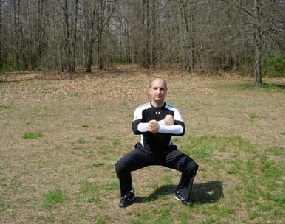
Bodyweight Squats. Do them in Jumonji no Kamae, as shown below. Utilize the same protocol as above. Descend in a slow, controlled manner. At the bottom of the squat, explode back to standing. Do 25 repetitions. Rest for one minute, then move on to exercise three.
Exercise Three
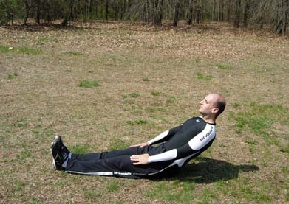
Straight Leg Sit-up. Lie flat on your back. Exhale, contract the core, and begin to sit up slowly keeping your spine straight. Inhale at the top of the movement. Exhale again and slowly lie back down. Perform 5 repetitions of the straight leg sit-up. Rest for 60 seconds and return to exercise one. Continue until you have completed 5 sets of all 3 exercises.
How Often?
This workout can be performed 3 times a week, depending on your schedule and your fitness needs. If you are including conditioning work as well, for an example see the WarFit Combat Conditioning System then this strength based GPP workout should only be done twice a week. Here is an example of what a weekly schedule may look like:
This is just one option of how fitness and marital arts can be combined in a weekly schedule. If you have the luxury of being able to do a conditioning workout after your martial arts class instead of on a separate day, you can save more time. Or, try getting up earlier and doing the workouts in the morning so your evenings are free for family time or more budo.
Future articles in the series will look at Specific Physical Preparedness, as well as Activity (martial art) Specific Exercises for Bujinkan training. Additionally, I will expand on GPP, showing new exercises, and how to increase the difficulty levels of the exercises discussed today.
A question I often receive through email (which, by the way is great, please keep them coming!) is whether or not Warrior Fitness is strictly a bodyweight training system. In short, no it’s not, but let me expand on that. Bodyweight training is an outstanding way to exercise. It requires absolutely no equipment, no gym membership, a small amount of space, and can be done virtually anywhere. It works equally well for the business traveler, the stay at home parent, or the vacationer. In my opinion bodyweight training should be the foundation of your fitness program, especially if you are just starting out. My rationale behind this is a simple one: if you cannot master your own bodyweight first, you really have no business adding weight. Now, obviously there are exceptions to this rule. For example, if you are being treated by a Physical Therapist and they recommend a weighted exercise to help your condition, then you must follow their advice. Additionally, I said it should be the foundation of your program, but that doesn’t mean equipment cannot be added for variety, to increase the combined exercises effectiveness, or to shore up a particular strength or mobility deficit.
With that out of the way, here is a short list of the equipment I do use for myself and with my clients and highly recommend.
The Equipment List
1. Sandbags – Cheap and easy to make yourself. Great for taking strength and conditioning outside the box. Want to make one? Get an army duffle bag, two 50 lb bags of sand from your local Home Dept, a box of gallon freezer bags, and some duct tape. Fill the freezer bags with sand. Double bag them, then duct tape them to make sure they are secure. Place the duct-taped, sand filled freezer bags inside the duffel bag (make heavier or lighter depending on your preference), zip up the bag, secure it, and you’re good to go!
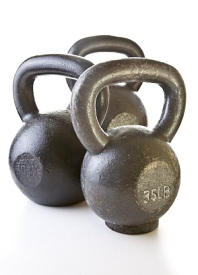
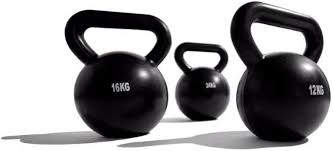
2. Kettlebells – I got my first kettlebell from Dragondoor back in 2002 when they were the only supplier outside of Russia. Nowadays kettlebells have gone mainstream and can be found at your local Walmart (along with pretty much anything and everything else!).
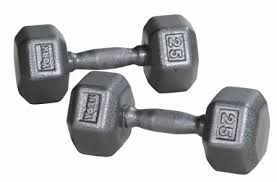
3. Dumbbells – The cheaper kettlebell alternative, just not as cool looking.
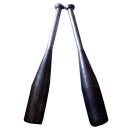
4. Clubbells – These are excellent for targeting angular and rotational strength, as well as sport or activity-specific performance enhancement. They are currently only available through RMAX.
5. Resistance Bands – Can be obtained from Elite Fitness Systems here.
6. Pull-up Bar – I made my own in the basement from a couple pieces of wood, some rope, and a metal bar, but there are also portable pull-up bars you can buy for under $40. Here’s an example: EZ Chin Up Bar – Portable, Powerful, Personal and Effective Exercise Machine. The other option is to train outside and use a sturdy tree branch. This is an excellent alternative when the weather turns warmer!
7. Medicine Balls – Can be found at Sports Authority, or most other sporting good stores, for about $30.
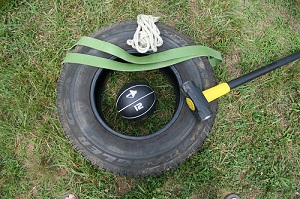
8. Sledge Hammer and Tire– Hitting a tire with a sledge hammer is not only an incredible conditioning exercise, it’s also really fun and great stress relief! Make sure you do this outside though! Pick up a sledge hammer from your local Home Depot or Lowes. I got mine for about $25. Tires are usually free. Stop by any Tire and Auto shop and ask them for a used tire. Since they are disposing of them anyway, they are more than happy to allow you to take one.
As you can see, each piece of equipment is portable, able to cover a wide array of exercises and levels of ability, and, with the exception of clubbells and kettlebells, are all inexpensive to make or buy. Which one is best? All of them and none of them, depending on the specific goals you set for your health and fitness. They are all tools in the Warrior’s arsenal to be used as needed. Stay tuned for more information as to how the Warrior Fitness Training System utilizes all of the above fitness equipment!
In today’s hectic world it seems we are all continually struggling to fit more and more into less and less time. Whether it’s squeezing more work into a 9 to 5 day, cramming more activities into a 2-day weekend, or condensing a week’s worth of email posts into a digestible digest version, it seems we are all trying to become more dense. In that spirit, I’d like to offer the option of Density Training. This is by no means the only way to train, nor is it recommended to use it as your sole form of conditioning, but when you are short on time and are looking for ways to do more with less, Density Training is definitely a viable option.
Density Training Concept
The concept of Density Training is pretty simple. Do more work in the same amount of time or do the same amount of work in less time. So, for example if you were using push-ups as the exercise and the last time you used this protocol you managed to do 100 push-ups in 10 minutes, then this session you would either try to increase the number of push-ups you can do in 10 minutes or strive to do 100 push-ups in under 10 minutes. Not rocket science, right? What if this is your first time attempting this type of training? Pick your exercise, let’s stick with push-ups for continuity’s sake, and pick an amount of time, say 10 minutes. Then try to do as many push-ups as you possibly can in that 10 minutes. Crank them out. Push yourself (pun intended). Remember the time limit used and amount of reps achieved, or preferably write it down, and the next time do more. Simple as that.
More Options
Density Training can be used with almost any exercise. Here are some additional examples:
Sprints – pick a relatively short distance, maybe 30 to 50 yards, and see how many sprints you can complete in 10 minutes
Rope Skipping – not my thing really, but hey, who’s discriminating?
Heavy Bag punching, kicking, elbowing, kneeing, or any combination – how many strikes can you throw in 10 minutes (Yes I know I keep using 10 minutes, but you don’t have to. Find something that works for you.)
Any Bodyweight exercise – Burpees are great for this!
Make it martial arts specific and see how many sword cuts you can do in 10 minutes. Just remember to keep the technique level high or you’re wasting your time!!
Remember, this is not the only option out there for those short on time, but it is a good one. Give it a try and let me know how it works out for you. Try it with different exercises. Experiment. Have fun!


 . The other option is to train outside and use a sturdy tree branch. This is an excellent alternative when the weather turns warmer!