The Warrior’s Key to Greatness – The Way Lies in Training!

Throughout history a few exceptional martial artists have stood out from the rest of the budo landscape.

Millions of people from every country and culture on the planet have trained in innumerable styles and arts across the centuries, yet we only know a small number of them by name.

These men distinguished themselves and rose to the very uppermost levels of physical, mental, and spiritual skill in their respective arts and in some cases even took their talent to such heights as to create an entirely new martial art.

Looking back at them today, we are awed and inspired by the levels they achieved through their single minded determination in reaching a goal, dogged pursuit of excellence in their craft, and amazing amount of self-sacrifice.

Why are They Different?

What made these men different?

What pushed them to greatness?

What did they do differently or more productively that propelled them to prominence?

Why were their names and storied passed down through the years, sometimes centuries?

What one factor do all great martial artists have in common regardless of style, country, or culture?

And, more importantly, how can we learn from them and apply it to our own training?  Remember, we stand on the shoulders of giants, not to imitate them, but to be able to look farther.

 Quotes from the Greats

Instead of listening to my opinion today, why don’t we go directly to the sources themselves?  Here are some cool quotes I’ve complied by some of the greats talking about their own training.

Morihei Ueshiba – Aikido 
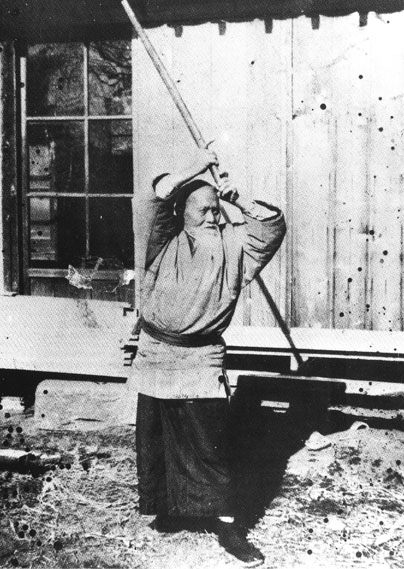
“The instructor can only impart a small portion of the teaching; only through ceaseless training can you obtain the necessary experience allowing you to bring these mysteries alive.  Hence, do not chase after many techniques; one by one, make each technique your own.”

“Always imagine yourself on the battlefield under the fiercest attack; never forget this crucial element of training.”

“This old man must still train and train” – said shortly before his death.

Gozo Shioda – Aikido 
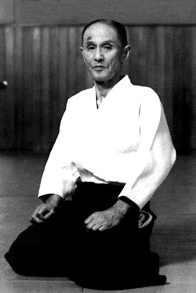
“Kokyu power is produced when we push ourselves to the limit, making the most efficient use of the capabilities that lie within our own bodies.”

“Even though the body has its limits, until your death, the strength of your spirit is limitless.  This is precisely why, in the martial arts, there is no such thing as deteriorating as you age.”

Yukiyoshi Sagawa – Daito Ryu 
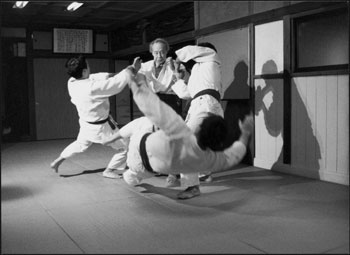
“Intermittent training, no matter how intensive, is utterly useless.  You must practice every day for your entire life.  That, and only that, is true training, or shugyo.”

“People who think they can ignore training their bodies and only work on techniques are amateurs.  They don’t know anything.  Actually, if you can’t prepare your body properly, you have no hope of ever perfecting your technique.”

“No matter what level of mastery you attain, you will never achieve perfection.  You should therefore never, ever assume that what you have achieved is good enough.”

“If people knew what my training regimen was like, they would be astonished.”

Masaaki Hatsumi – Bujinkan Budo Taijutsu 
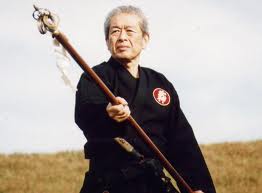
“Modern budo students often forget to practice by themselves.  I used to practice by myself.  When there was no teacher, I found the secret teachings by my own desire.”

“Studying for oneself and making one’s own discoveries is much more important than group learning, and this applies equally well to martial arts.  As I often say, ‘Life is all about solitary training.’  This is because I want serious practitioners to discover the tricks of the trade for themselves.”

Miyamoto Musashi – Niten Ichi Ryu 
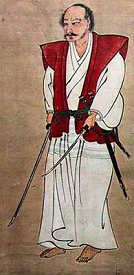
“From the time I was young I have set my mind on the Way of Martial Arts, practiced the one subject of swordsmanship with my entire being, and experienced various and different understandings.”

“See to it that you temper yourself with one thousand days of practice, and refine yourself with ten thousand days of training.”

“Never depart from the way of martial arts.”

Yamaoka Tesshu – Muto Ryu 
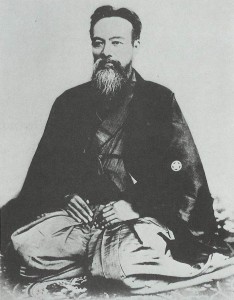
“Study hard and all things can be accomplished; give up and you will amount to nothing.”

“If you want to obtain the secrets of such wonderful techniques, drill yourself, harden yourself, undergo severe training, abandon body and mind; follow this course for years and you will naturally reach the profoundest levels.”

Inspired yet? 

Ready to train and push yourself to the next level? 

Check out the new solo training sensation – The Integrated Strength Program – and get started today!
integratedstrength3D1


Prepare Yourself Every Day

Ever have one of those days when nothing goes right?

The alarm clock is blaring yet you hit the snooze again for the 5th time dreading the prospect of getting up and facing the day.  When you finally drag yourself out of from under the covers and realize just how late it is, your heart jumps into overdrive as you rush through your morning routine desperately trying to get out of the house to make it in to work on time.  If you have small children to get ready for school, daycare, or other activities as well, that simply throws more chaos into the mix.

In your rush, you forgot to eat breakfast and left your steaming mug of coffee sitting on the kitchen counter while you ran out of the house.  Traffic sucks, of course, because you’re late, and when you finally get in to work there are 6 messages from your boss wondering why you missed the morning project meeting…  and your day goes downhill from there.

Some days it just seems like the universe is conspiring against you and this time it’s personal!

What do you do?

How do you respond to the myriad changes and vicissitudes life throws at you?

Do you find yourself tossed about like a small boat on a rough sea constantly overreacting and over-correcting with each wave?

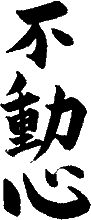
Or, do you have a quiet calm reserve of energy and strength that allows you to maintain a state of fudoshin – “immovable spirit”?

Fudoshin is a state of mind that remains undisturbed and not easily upset by either internal thoughts or external factors.  It is the even keel that keeps your craft steady and on course during rough seas of life.

How do you develop fudoshin though?  How do you cultivate that quiet reserve of strength and energy?

Prepare Yourself Daily

Daily preparation is the key.  A reserve of strength must be built up gradually and nurtured daily, even when you don’t need it, especially when you don’t need it, so it’s there when you do.  Like a savings account you invest a little bit each day so that when the unexpected happens the funds are there for you to draw upon.  So let’s get to the nuts and bolts.

How do you prepare yourself daily?  Here’s what I do…

  1. Get up earlier each morning.  Yes, earlier.  Allow 30 to 45 minutes BEFORE you actually need to be up to get ready for the day.
  2. Grab a cup of coffee.  I love my coffee; there’s nothing like that first sip in the morning.  Feel free to skip this step if you don’t drink coffee. 🙂
  3. Head outside for a breath of fresh morning air (feel free to bring your coffee).  According to Chinese Medicine, early morning is the springtime of the day and thus best for planting seeds to cultivate good health.
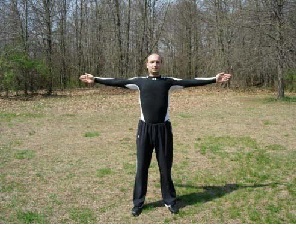
  4. Stand tall, feet shoulder width apart, knees slightly bent, spine straight.  Raise the arms laterally up over head breathing in slowly and deeply with the movement.  As you inhale imagine the oxygen and energy carried by the breath is filling up your entire body.  Hold the full breath for a moment or two, then slowly exhale completely bringing the arms back down.  On the exhale, imagine the body is expelling tiredness.  Repeat 3 to 5 times.  Feel free to add other imagery to this exercise as well.  For example, on the inhale imagine drawing in the positive qualities of strength, health, and confidence, and on the exhale imagine the breath drawing out and expelling negative qualities of weakness, sickness, and fear.
  5. Perform a full, head to toe joint mobility routine to further wake up and enliven the body.  For a complete discussion on joint mobility work and much, much more, see my book, Warrior Fitness: Conditioning for Martial Arts.
  6. Depending on how much extra time you have, relax a few more minutes enjoying the strength and energy you have cultivated – and finish that cup of coffee before heading in to start your day!


 Life is Stressful – Prepare Yourself!


Double Your Training Without Doubling Your Training

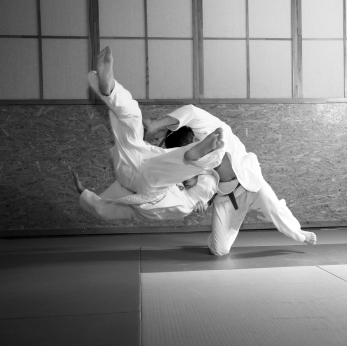
In my teacher’s and my own dōjō (道場 – “martial arts training hall”) we spend a lot of time cultivating our skills as uke. An uke (受け) is a martial arts student who, during a given training session, “receives” a technique from another student acting as the tori (取り). Wikipedia defines the difference as one “who completes a successful technique [tori] rather than who initiates one [uke].” Having a good uke as a training partner is very important, but being a good uke is paramount.

The role of uke often gets a bad rap. Too many times I have seen students relegate themselves to becoming little more than an “I attack, then stand around while the other guy does something to me” participant. When it’s time to be uke, the “pause” button gets pressed and human punching bags are born. That doesn’t seem right, does it?

It certainly doesn’t feel right, at least not to me.

Continue reading

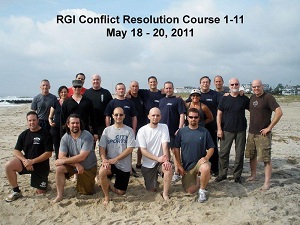
RGI Conflict Resolution Course Review

Last week I had the very special privilege of attending the RGI Conflict Resolution Certification Course.  Resolution Group International (RGI) is a conflict resolution company specializing in: Ethics presentations, Leadership training, Tactical Communication, Cross-Culture Conflict Resolution, and Defensive Tactics and Combatives.  It was hosted in Spring Lake, NJ and taught by a panel of experts in the field of conflict with decades of real world experience and credentials behind them. 

The RGI seminar format utilizes a unique teaching methodology which blends values-based lessons, conflict communication skills, and ethics with physical training and exercise to activate and clarify the principles being taught.  The interchange of movement with the classroom style lecture increases the absorption and retention of the intellectual and values-bases lessons.  This concept is backed up by latest research into combining education with physical exercise.  Check out the book, Spark: The Revolutionary New Science of Exercise and the Brain by John J. Ratey, MD for a more detailed discussion of the science behind it. 

RGI’s Conflict Resolution course starts with a premise: in order to resolve conflict one must be moral, knowing right from wrong; one must be ethical, putting that morality into action; and one must have the physical skills and confidence from which to proceed.  The Dual Life Value (DLV) theory is the linchpin holding the course together.  It permeates the philosophy, intellectual discussions, physical skills, and emotional stories.  The DLV states that we are all equal because my life and the lives of my loved ones are as important to me as your life and the lives of your loved ones are to you.  Further, the life value is a universal value by which all other values are judged.  If they support the life value, they are moral, if they don’t, then they are not.  This is a very high level summary of an extremely important concept.  To really gain a full understanding and appreciation of the DLV theory, you really need to attend the course and be immersed in the philosophy.  This review can do nothing more than offer a taste to whet your appetite.  I hope it makes you hungry!

PT with Joe Marine

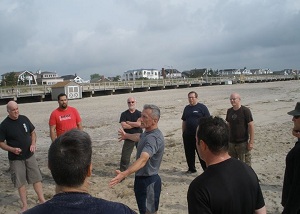
Joseph C. Shusko AKA “Joe Marine” is a decorated veteran who served the United States Marine Corps for over 30 years.  He is now serving as the Deputy Director, Marine Corps Martial Arts Center of Excellence overseeing the Corps’ Martial Arts Program.  Joe Marine is also known as the “combat conditioning guru”.  He took the class through 2 morning PT sessions Thursday and Friday.  The Thursday morning PT session began with a discussion on health and fitness in which Joe Marine shared his outlook and really brought home the importance of taking care of oneself, especially as we get older.  We then proceeded to go through a simple, yet highly effective workout Joe calls “5-10-15-20”.  It’s basically a plug –n- play type workout template which uses a variety of bodyweight exercise for the prescribed number of repetitions, 5, 10, 15, and 20, respectively.  The set is repeated as many times as possible in 10 minutes.  This allows trainees to work at their own pace and to their own fitness level.  But as Joe says, you only get out of it what you put into it!  Friday morning’s PT was a real treat as we moved the location outdoors to the beach on Spring Lake.  This time the workout was done in teams of 2.  This really pulled the participants together as they struggled to overcome the shared adversity of the physical challenges together.

In addition to being the combat conditioning guru, Joe Marine is also known for his “tie-ins”.  These are values-based stories which serve to illustrate points and drive home the intellectual or physical lessons with an emotional impact.  Never miss an opportunity to ask for a tie-in!

Maneuver Martial Arts

Maneuver Martial Arts is the term RGI President, Jack Hoban uses to describe RGI’s approach to physical conflict.  Jack is a speaker, writer and Subject Matter Expert (SME) for the U.S. Marine Corps Martial Arts Program (MCMAP).  His business and military experiences, as well as an extensive 30-year background in martial arts, give him a unique and interesting perspective.  Jack, along with co-instructors Craig Gray and Artie Mark, skillfully introduced the participants to the concept of tactical movement, striking, escapes, takedowns, submissions, and protecting others.  Tactical movement and being able to control the tactical space around the opponent(s) was emphasized as primary, over and above the concept of technique.  This allowed the participants, some of whom had no prior martial arts experience, to gain an understanding and quickly absorb the principles of martial movement as the seminar progressed.  As a martial artist of almost 30 years of experience myself, it was hugely gratifying to watch this process unfold!

The crown jewel of RGI’s martial arts training though is really the protecting others piece.  As Jack mentioned in his introduction to this section, in a typical martial arts school setting, if 100 techniques are taught, 100% of those techniques are geared towards defending yourself.  How many look at how to defend others?  Usually none.  This segment of the training served to rectify that deficiency in current martial arts training, as well as to drive home the importance of the universal life value of self and others – all others.  Protecting others activates the life value and solidifies the concepts, principles, and ethics in a very real and effective way.

Conflict Communication

RGI’s approach to conflict communication is both an art and a science.  Gary Klugiewicz is employed by PoliceOne as a police and corrections subject matter expert. He is retired from the Milwaukee County Sheriff’s Department after 25 years of service where he was promoted to the rank of captain. Gary has been a Verbal Judo Instructor for the last fifteen years.  Gary expertly distilled the essence of Dr. George Thompson’s Verbal Judo, to give the participants a highly beneficial introduction to tactical communication.  Take a look at what Verbal Judo calls the 5 Universal Truths and see if they resonate with you.  They certainly did with me.  Also, try them out on your kids.  You’ll be amazed at the level of compliance!

5 Universal Truths

  1. All people want to be treated with dignity and respect.
  2. All people want to be asked rather than told to do something.
  3. All people want to be told why they are being asked to do something.
  4. All people want to be given options rather than threats.
  5. All people want a second chance.

Real world experience in conflict communication from both the ER and out on the street from a law enforcement perspective was also shared by Joseph Lau, RN, veteran police detective Arthur “Artie” Mark, and decorated veteran detective James Shanahan.  Additional presentations were given by heavy hitters such as Brian Pensak, Marine Corps Martial Arts Program Instructor Trainer and SME, and Bruce Gourlie, Special Agent of the FBI.  There is so much experience, expertise, and information to unpack from just one of these gentlemen’s presentations that it’s impossible to delve into in a short seminar review.  My advice?  If you deal with any type of conflict in your job, in your family, in your life, get to an RGI Conflict Resolution course ASAP – you’ll never look at conflict the same way again!

The RGI Conflict Resolution Course has a synergistic effect whereby the whole is much, much greater than the sum of its individual parts.  The combined impact of the instructors’ professional presentations, the interchange of physical skills with values, morals, and ethics, and the engaging course material create an outstanding professional development course. 5 out of 5 stars – highly recommended!!

For more information on RGI upcoming events and seminars, please click here.

The Sanshin of Warrior Fitness

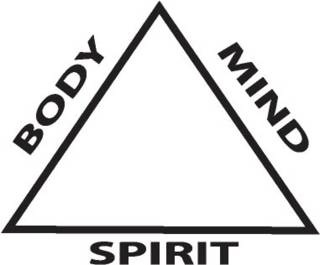
A short introduction may be necessary for those readers not familiar with Bujinkan Budo Taijutsu.  Sanshin no kata is a basic training exercises within the system that templates movement patterns for Bujinkan Budo Taijutsu.  In English, it translates to “form of three hearts”.  These three hearts are mind, body, and spirit.  All three must be united for technique to come alive for the martial arts practitioner.  Without all three aspects of body, mind, and spirit unified the kata become  empty shells of movement, devoid of essence.

Bujinkan martial arts are the wellspring from which my concept of Warrior Fitness sprung as a natural outcropping.  So as my philosophy of Warrior Fitness continues to evolve, it naturally gravitates to this type of structure for me to express it.  In keeping with the trinity of mind, body, and spirit, here is how I see it for Warrior Fitness:

Mind Concentration and focus along with an understanding of the interrelationship of the exercises and how they integrate with and enhance the way we move in the world.

Body Forging a strong body to carry us through the challenges we face. 

Spirit Pushing the edge to consistently increase resistance to failure.

The Sanshin no kata consist of 5 forms which are called, Chi no kata (earth form), Sui no kata (water form), Ka no kata (fire form), Fu no kata (wind form), and Ku no kata (void form).  Those who have read Miyamoto Musashi’s famous work, Go Rin No Sho – A Book of 5 Rings, are most likely familiar with the terminology as well.  Here is how each is expressed in Warrior Fitness:

Earth Building strength, stability, and structure in movement and stillness

Water Freedom of movement through all ranges of motion, flow state

Fire Metabolic conditioning to ignite fat loss and sculpt lean muscle

Wind Breathing exercises to vitalize every cell in the body

Void Pushing the edge of our limitless potential


Hone Your Mind, Invigorate Your Spirit, and Make Fierce the Body with Warrior Fitness!

Battling Demons

To get good at any discipline, you must practice every day.  To become great, you must practice all the time.  The problem is, with so many pressures, responsibilities, and draws on our time in daily life, how does one manage to train every day?

For me, it’s a daily battle with my demons.  These are the insidious little creatures that lurk in the dark recesses of my mind.  Their sole purpose being to distract me from becoming the person I want to be.  They rationalize and cajole to pull me off the path of self improvement.  The path of training.  For others, the path may be their daily struggle to make good food choices and lose weight, or it may be the daily battle to study at night while working a full-time job in order to earn that MBA.  The path is personal.  The demons are universal.

Currently I train for a few minutes every morning which provides the dual function of waking me up and setting me on the right path for the day.  It primes my muscles, movements, and nervous system for the more involved training I will perform later that night.  Additionally, I will train during the day at odd intervals when I have a few minutes of down time.  These little periods provide the consistency I need to help me keep going.  But, as I stated above, the bulk of my training is done at night after putting the kids to bed.  Usually around 9 pm or so I head down the basement to my home gym.  This is my dedicated training spot.  For me, it helps to focus my efforts since the only thing I do there is train.  It’s minimalist with very few distractions.  Perfect for doing the work.  For the most part, I beat the demons by just getting downstairs and setting foot in the gym.  Getting there is the most difficult part, but once there, the demons are beat and the daily training progresses.

Sometimes, like last night, the battle isn’t won by just getting to the gym.  Last night was different.  I was tired.  I was comfortable sitting on the couch watching TV with my wife.  The kids were asleep.  The house was quiet.  Peaceful.  I thought that the demons hadn’t even shown up to fight because getting down there was so easy.  Once I was in the gym though, they attacked.  It was a sudden, violent onslaught that took me by surprise!  “You’re tired,” they told me. 

“You don’t need to train anymore today…”,

“You did enough over the weekend.  Relax.  Take it easy.”, 

“Why don’t you just go to bed early for a change?  You need your rest!”

On and on it went, not just verbal but real feelings of being sleepy.  Feeling like I should go upstairs and go to sleep.  I almost gave in.  Almost succumbed.  Almost quit.

But mental fortitude kicked in.  Training kicked in.  The battle was on!  I heard myself talking to one of my training buddies saying – “you have to train every day.  You have to want it bad enough.  How do I do it?  Well, it’s like brushing your teeth, Dude.  You just do it every day (usually twice!) no matter what.”  This began the rally.  But it was far from won.  What won the battle once and for all (at least for last night) was the fact that I just started doing my solo conditioning exercises.  I was in the right place.  My mindset was returning.  But the way to win the battle is to simply begin doing the work.  Understand that your training is a necessary part of becoming who you want to be.  Understand that daily training is a necessary part of that process.  And get it done.

Create Your Own Adversity!

“Let me embrace thee, sour adversity, for wise men say it is the wisest course.”  ~William Shakespeare

Philosophers and sages throughout the ages have consistently extolled the virtues of facing adversity for the purposes of becoming a better, stronger person.

No matter what form this adversity takes, wisdom dictates that it must be faced head-on, weathered through, and successfully beaten by coming out the other side, maybe scarred, but assuredly battle-hardened and spiritually tougher.

Oftentimes, adversity comes to us unbidden simply due to the path we choose to follow, or even for no fathomable reason at all.  It tends to be one of those things life throws at us unexpectedly to “help” us prove our mettle and forge our character.

It has been said that “God comforts the disturbed and disturbs the comfortable”.  If this is so, perhaps creating your own adversity isn’t a bad thing at all.

The goal in creating your own adversity is to design a challenge that will push the limits of your physical strength, mental toughness, and spiritual fortitude in order to propel you forward to the next level in your training.  For the warrior, this process is known as Shugyo.  Shugyo (修行) may be defined as “conducting oneself in a way that inspires mastery”.  These periods of severe training were usually undertaken by warriors to achieve a type of enlightening experience which opened their minds by destroying their concept of previously perceived limits.  It is the same for us today.

Ueshiba Morihei, the founder of Aikido, was well known for taking his students up into the mountains for periods of Shugyo.

“Once a year, Morihei took several of his best disciples to train with him on Mount Kurama, located near Kyoto. The small group lived on rice, pickles, miso soup, and wild herbs. Morihei would rise at five AM to pray. After morning prayers and misogi, they would swing heavy swords five hundred times and then practice footwork. From ten AM to noon they trained in body techniques. Afternoon training ran from three to five PM; the disciples took turns acting as Morihei’s partner as he ran through series after series of techniques. In the evenings the disciples would review the day’s training. Every three days, Morihei would announce at midnight ‘time for night training’…”
Excerpt from “Invincible Warrior”, by John Stevens pg. 125

Now, do you have to seclude yourself in the mountains for several days in order to practice Shugyo?

No.  For most of us, that’s not realistic or practical, but that doesn’t mean we can’t create the same type of experience for ourselves.

So, how do we do it?

Create Your Own Adversity!

Caution:This type of training is not for everyone.  Before you begin, there are a few common sense type precautions you should take.  First, prepare adequately.  For example, you would not go out to run the NY Marathon tomorrow if you’ve never run more than 5 miles.  Second, if you decide to conduct your Shugyo outdoors, let someone know where you’re going, what you’re doing, and how long you’ll be gone, or better yet, take them with you!  Third and most importantly, think before you do and plan accordingly.

1.  Pick a time or day that has personal significance to you – it can be your birthday, New Years Day, or the anniversary of something important in your life.  Is this absolutely necessary?  No.  You can pick next Tuesday if you’d like, but I think tying your Shugyo to a significant day makes it more special.

2.  Decide what form your Shugyo will take.  This must be unique to your goals and capabilities.  Choose something that is currently beyond your reach, but not so far as to make it completely unattainable.  You want to focus and hone your physical, mental, and spiritual abilities, not your imagination.  Some examples are:

  • Run a marathon
  • Run a Spartan Race or Tough Mudder
  • Climb a mountain
  • 1000 cuts with a heavy bokken (wooden sword)
  • 1000 Kettlebell snatches
  • 1000 Kettlebell Swings
  • 1000 reps of any basic techniques or combination of techniques
  • Sparring 20 opponents in a row, nonstop
  • 1000 Push-ups/Squats/Sit-ups

While any of the above would more than qualify as Shugyo, my personal preference is to plan an entire day where the whole becomes greater than the sum of the individual parts.  Some recommendations for the parts are:

Junan Taiso warm-up, run (distance TBD by you), practice the basic strikes, kicks, and footwork of your particular martial art, Bujinkan Budo Taijutsu for me (high reps to push your limits, of course!), weapons practice (sword cuts, spear thrusts, bo swinging, etc.), high repetition bodyweight exercise(s) or workout with weights (dumbbells, kettlebells, clubbells, sandbags), end with an extra long yoga session to wring out all the tension accumulated throughout the day followed by meditation and rest.

3.  Create a training program to get you there.  Let’s face it, most of the above examples are not something most people can decide to do in a day, they take time, preparation, and work to bring the goal within reach.  Remember the “6 P’s”: Proper Prior Planning Prevents Poor Performance!

4.  Get to work!!

Creating your own adversity through Shugyo has the effect of focusing not just your mind, but your entire being for the purposes of expanding your potential.  Push yourself harder than you ever thought possible and blow through your preconceived limitations – remember, the only limits that truly exist are those set up in your own mind – there are no limits!

“God brings men into deep waters, not to drown them, but to cleanse them.”  ~John Aughey

So Ya Wanna Be a Ninja?

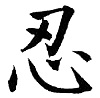
Masaaki Hatsumi, Grandmaster of the Bujinkan Dojo, once stated, “endurance is of primary importance for the ninja.”  One definition of endurance is the ability to resist fatigue.  Looking at the kanji (Chinese character) for Nin, there is the ideogram for “sword” over the ideogram for “heart” giving Nin a meaning of, “even though you hold a sword over my heart, I will endure.” 

How many of us training in the Bujinkan, or any other martial art, can truthfully claim that ability?  How long can you train?  How far can you push yourself?  In martial art, endurance, or the ability to “keep going” is defined in years, not minutes, hours, or days.  How can we create an effective training program that will instill in us the ability to continue, to endure?

Physical Endurance

Let’s begin by examining the concept of physical endurance.  There are 3 basic types of physical endurance:

  1. Aerobic endurance
  2. Anaerobic endurance
  3. Strength endurance

We discussed the body’s 3 energy systems and how using the Tabata Protocol can effectively improve both the aerobic and anaerobic systems here.  Strength endurance is defined as the ability to effectively maintain muscular functioning under work conditions of long duration.  There are two basic ways to increase the ability of your body to do more physical work.  One is the continuous adding of weights, sets, reps, and time to push the body to create an adaptation to allow it to perform more work for a longer duration.  As we discussed previously in the article on GPP, the body’s capacity is expanded.  Progress is incremental and continuous for as long as one is able to keep increasing driving forces in the body.  The next one, however, is often overlooked in our “just add more volume” culture.  More is always better, right?  If one vitamin is good for you, take 4, that’s even better (please don’t!).  But, there is another way to allow the body to continue training in addition (no pun intended) to adding more work.  By removing restrictions in your body, like unnecessary tension or extra body weight or lack of flexibility/mobility in a particular area, you then free up resources in your body that were spent holding that tension that you weren’t even aware of on a conscious level.  These restrictions, once removed, allow even greater leaps in performance than simply adding more work.  When the 2 are combined, it’s a powerful combination!

How Do We Program It?

By programming our workouts so that we effectively build in both the removal of restrictive forces, while also increasing driving forces, we can maximize our progress.  This idea is present in traditional methods of Hatha Yoga in the form of balancing strength and surrender.  Contrary to popular opinion, yogi’s do not simply work to become more flexible.  They actively work to increase both strength and flexibility as complimentary opposites in order to achieve a state of balance.  Now, I’m not asking you to become a yogi here, merely pointing out that this is not a new concept at all, but has been used by traditional arts for thousands of years.  Our program for developing ninja-like endurance will utilize both joint mobility exercises and yoga asana (poses), as well as breathing exercises, to aid in the removal of restrictive forces binding your training and slowing your progress.  Next week I will be putting out an article on breathing exercises that can be used for relaxation, stress management, removing residual tension, and also for increasing energy – keep your eyes out!

For an example of some easy yoga postures that can start helping you right now, head over to my good friend Josh Sager’s excellent blog, Fretterverse, and check out my article on Yoga for Guitarists.   A free sample joint mobility training program can be obtained simply by signing up for the Warrior Fitness Mailing List at the top right of the page.  Sign up now and begin working on removing restrictive forces today!

And, don’t forget to check out Warrior Fitness: Conditioning for Martial Artists for more exercises, options, explanations, and program design!

Stay tuned for a sampleStrength Endurance Workout coming soon!

Do You Know the Enemy?

Do you know the enemy?

I do.  It inhibits peak performance.  It makes you lazy and keeps you unmotivated.  It cajoles you into seeking comfort.

It distracts you from your goals and dulls your mind. The enemy sells you on an “easy” lifestyle and lulls you into a false sense of security.

It conspires to sabotage every move toward a healthier diet or consistent workout program.  It will aim to destroy any action or activity that moves you towards bettering yourself, be it education, a new job venture, a move towards a more spiritual life, or writing the great American novel.

Ultimately, it weakens your spirit.

What is The Enemy?

The enemy comes in many forms and assumes many guises.  It may tell you that it’s alright to sit down on the sofa and watch Lifetime Television with your wife after dinner; you can get to that workout later.  It may convince you that just one brownie bite is okay, after all, they’re just “bites”.  You may feel tired from a busy day at the office, and rightly so – the enemy will whisper in your ear that you can begin your fitness regimen tomorrow and that will be good enough.  What exactly is this enemy who kills our motivation and procrastinates our calling (sometimes indefinitely)?  Steven Pressfield identifies the enemy as “Resistance” in his excellent book, The War of Art.

“Resistance will tell you anything to keep you from doing your work.  It will perjure, fabricate, falsify; seduce, bully, cajole… If you take Resistance at its word, you deserve everything you get.  Resistance is always lying and always full of shit.”

Sometimes the most insidious form the enemy can take is the form of knowledge.  We fall into the trap of, I know what I need to do, I just need to do it.  Knowledge comforts us.  It allows us to rationalize that since we are in possession of it, we can carry out the action at any time.  We don’t need to do it now.  Tomorrow is fine.  Next week is OK to start.  So, why worry?  One of my favorite quotes (just ask my daughter, she’s heard it often enough!) on this subject is:

“Knowing is not enough; we must apply. Willing is not enough; we must do.”
-Johann Wolfgang von Goethe

How Do I Defeat The Enemy?

In his book, Awakening Spirits, famed wilderness survival guru, Tom Brown Jr., gives the enemy a different name, calling it the “Demon of Distraction”.  No matter what you call it, if you call it anything at all, it’s the very same impersonal, unrelenting force pushing us away from our calling, deferring our goals to a “better time”, or for when “conditions are just right”.

Here’s a hint – conditions are never perfect.

There is no better time than right now.

How do you defeat this omnipresent enemy?  By doing your work.  By starting right now.  Don’t delay.  Don’t defer.  Begin.  Do the work(out).  Trade  the 3 o’clock junk food snack for an apple.  Skip McDonald’s on the way home from work and prepare a healthy meal.  Don’t allow yourself the luxury of excuses.  Be firm.  Be strong.  Get it done.  Be resolute and committed to your health and fitness goals.


Get the First 2 Weeks of Training from My NEW WarFit Program for FREE!

This Program is Designed To Build Whole Body Strength, Power, & Insane Endurance!!