About Jon

Jon Haas, "The Warrior Coach" has been training in Bujinkan Budo Taijutsu for more than 25 years and is currently ranked as a Kudan (9th degree black belt) under Jack Hoban Shihan. He has also trained in Okinawan Karate, Tae Kwon Do, Russian Systema, BJJ, Krav Maga, as well as Internal Martial Arts of Yiquan and Aiki.He is a certified Underground Strength Coach-Level 2, a certified Personal Trainer as well as founder of Warrior Fitness Training Systems. In 2008, Jon wrote the book, Warrior Fitness: Conditioning for Martial Arts, and since then has created numerous other online training and coaching programs helping people around the world become the strongest, most capable versions of themselves!

Why Sitting All Day is Slowly Killing You

There’s more to leading an active lifestyle than just getting in a workout a few times a week.  Check out this Men’s Health article on Why Sitting All Day is Slowly Killing You.  Think your 45 minute exercise session 3-4 times a week is protecting you from heart disease?  Think again.

For some ideas on how to add beneficial movement to your sedentary office worker life, check out the Corporate Warriors section of Warrior Fitness.

Knowing is Not Enough!

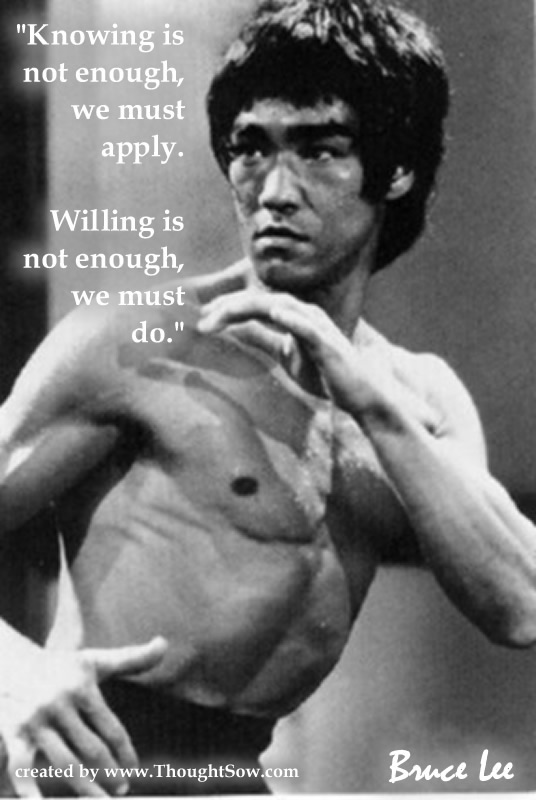
With the proliferation of the Internet and the incredible wealth of resources available in book, DVD, and digital formats, many of us already know more than enough to be martial arts masters!  Yep.  You heard me right – you know more than enough right now to be a master martial artist.  Cool, eh?  Heck, some of us even have more disposable information on budo history, lineage, techniques, kata, and principles at our fingertips than all of the past generations of Bujinkan Soke combined!  Think about that for a second.  Now, at this time in history, the sheer amount of knowledge in the form of information available to us is greater than at any other time, and it’s only going to continue.  Yet, with all of this knowledge, why aren’t we all amazingly skilled?  Why do the legendary feats of past budoka seem so remote and unachievable to us today?  Why are there so few with real skill among the millions of people practicing martial arts worldwide?  Because knowing is not enough, that’s why!  Hatsumi Sensei has emphatically stated on many occasions, that “budo is not an academic subject.”  Why then do we continue to view it as such?  There has only ever been one way to become as highly skilled at a craft as to be called a master.  “Knowing is not enough, we must apply.  Willing is not enough we must do.”    

Is Your Cup Already Full?

Another way we limit ourselves is by equating knowing with being able to do.  For example, when your teacher demonstrates a fundamental principle of movement for the hundredth, or maybe hundred thousandth time, do you smile smugly to yourself and think, “I know that already”?  Maybe you have.  I know I have.  I admit it.  But this type of attitude makes us lazy.  It lowers our skill level because it allows us to hold fast to the superficial without the hard work of plumbing the depths.  It lets us check those basic movement(s) or principles of movement off our mental list and move on to something more advanced; more worthy of our time (we may think)… big mistake.  If we were truly honest with ourselves, we’d be asking a different question.  The better, more appropriate question to be asking ourselves is -”how well can I do that?” or “How well do I truly understand those movement(s) bodily, not intellectually?”   This is hard though because most often the most authentic answer we can give ourselves is, not well enough.   Watch your teacher closely.  Look deeper.  Pay attention because there’s always more.  Be careful.  Practice.  Practice.  Practice!

All Strength is Not the Same for the Warrior!

As martial artists most of us tend to cringe and shy away from words like “strength” and “power” in favor of seemingly more budo-friendly fitness words like “agility”, “coordination”, or “balance”. Yet, often we do not understand the actual definitions of the words and simply avoid them because of some misplaced fear that they will be detrimental to our taijutsu and make us “muscle” through our techniques. Nothing could be further from the truth! Let’s examine some of the components that make up strength in more detail to understand just how much they are applicable to creating a strong physical and mental base from which to launch the rest of our Budo Taijutsu skills.

General physical conditioning is essential for the warrior to develop a broad-based platform of strength, endurance, agility, coordination, and flexibility from which to launch and further refine skills. But, what exactly is strength? Strength is defined as “the ability of a given muscle or group of muscles to exert force against resistance.” It is a function of the appropriate muscles contracted by effective nervous stimulation. This alone, however, is insufficient. There are also at least five different sub-categories of strength which we will break down to give you a more complete understanding of the term.

 The first sub-category is Maximal Strength. This is the maximum amount of force that a person can voluntarily produce. Example exercises to cultivate Maximal Strength are: one arm pushups, one arm chin-ups, one legged squats, and heavy weight lifting. But what on earth does Maximal Strength have to do with Budo Taijutsu? Aren’t we training to only use as much force as necessary and appropriate to a specific movement or technique? Why would we need our maximal voluntary strength output when training for taijutsu fitness? These are all good questions. On the surface, it would seem like this sub-category of strength is a big “N/A” for us. What possible benefit could this particular strength quality have for budoka? To begin to appreciate the benefits of training maximal strength, we must first understand the different types of muscle fibers. Generally, when people speak about fast twitch and slow twitch muscle fibers, they tend to separate them out as two distinct types. This can be a little misleading due to the fact that muscle fibers are not either /or, but in actuality they appear to lie somewhere on a continuum between the two. Thus to emphatically state that one type or the other is predominate within certain groups of muscles can cause confusion. Because low intensity exercise, like jogging at a steady-state pace for example, does not activate the fast twitch (FT) muscle fibers, we must increase the intensity of the exercise to stimulate the motor units that contain the FT fibers. If the motor units are not stimulated, then no response occurs and no adaptation occurs. Fast twitch muscle fibers and slow twitch muscle fibers are both recruited in high percentages when performing maximal strength exercises. Maximal strength training creates potent neural adaptations which lead to increased intermuscular and intramuscular coordination. A side bonus for working on maximal strength with body weight exercises is that the majority of them that fall in this category also require balance, coordination, flexibility, and appropriate tension throughout the entire body. Examples include, but are by no means limited to, one arm push-ups, one-legged squats, one arm chin-ups/pull-ups, etc.

Does this mean that we should devote every training session to developing maximal strength? No – far from! As warriors, we must understand the different qualities that make up strength and learn how to apply them to optimize our fitness levels specific to our goals. Since our goals do not revolve around winning any Strongman competitions or Power lifting contests, we can relegate working on maximal strength to only once a week, at the most, or a every couple weeks at the very least, to reap the benefits. The rest of the time, consign maximal strength to its rightful place back in our strength and conditioning toolbox. Too much emphasis on maximal strength can lead to becoming muscle “bound”, as in bound, constrained, unable to move freely and without appropriate tension.

The second sub-category of Strength is Explosive Strength. This is the ability to produce maximal force (see above) in a minimal amount of time. Explosive strength? Jon, you’ve got to be kidding me! We don’t use explosive strength in Bujinkan Budo Taijutsu! Really? Are you sure? Every time you leap, sprint, dive out of the way of an errant sword strike, or (and this is a big one!) use stored elastic energy to create power in your movement, you are using explosive strength. Sure, the terminology sounds like something that will adversely affect our taijutsu and that any serious budoka should avoid like the plague, but rest assured, that the much maligned concept of strength does play an important role in budo taijutsu and utilizing the strength exercises prescribed in this manual will provide a solid physical basis on which to build real skill. Plyometrics is a specific training means for developing explosive strength designed by Russian sports scientist, Yuri Verkhoshansky in the early 1960’s.  Closely linked to Explosive Strength are Speed Strength and Reactive Strength.

The third sub-category of strength is probably one of the most familiar to us. It is Strength-Endurance. OK; much better… now we are in familiar territory. Endurance is a concept that a ninja can relate to! This strength quality involves the production of muscular tension without a noticeable decrease in efficiency over long periods of time. Development of strength-endurance is a fundamental necessity for warriors, whether on the battlefield, in training, or just everyday life. A helpful analogy to keep in mind when applying the different aspects of strength training to budo is that they are like a recipe for success. All of the ingredients in any recipe are not utilized in the same amounts. A little bit of salt may be all that’s required to enhance the flavor, while a lot of flour may be necessary to provide the base. The same idea applies to strength training. Warriors will normally require a lot of strength endurance and cardio-respitory endurance, but maybe only a little bit of maximal strength development is necessary to round out their overall skill. “When effective methodology is used, exercises with resistance promote not only an increase in movement speed but also perfection of coordination, motor reaction, quickness and frequency of movements, the ability to relax muscles, development of local muscular endurance and an increase in maximal anaerobic capacity.” (Verkhoshansky, Special Strength Training – A Practical Manual for Coaches) The key here is in how these various strength qualities are trained. For martial arts, specifically Bujinkan Budo Taijutsu, we want to work exercises which emphasize intermuscular coordination of the whole body. Isolation exercises should be avoided as they are antithetical to what we are trying to accomplish in training. When performing all of the exercises listed here, try to use as little tension and muscular effort as possible; just enough to accomplish the task and no more. Try not to utilize general tension (tightening of the entire body) to carry you through the exercise. Since everything that we do acts as conditioning for our Central Nervous System (CNS), for good or for bad, we want to make sure our exercise philosophy is in harmony with our overall training strategy. Remember that in our day-to-day Bujinkan Budo training we are striving to perform techniques efficiently and effectively with minimal muscular recruitment, therefore our physical fitness training should not use a separate strategy.

Hopefully this short look at the various types of strength has been helpful!

Your Sanshin No Kata Under a Microscope

Sanshin no Kata (form of the three hearts) forms the basis for movement in the Bujinkan. These five foundational exercises cannot be overlooked, especially with regard to solo training.

When I first began training in the Bujinkan over 20 years ago there were very few training resources.  There was no Internet!  In a way it was much easier for a beginner since there weren’t a lot of distractions.  Today we are bombarded by information and perhaps sometimes even overwhelmed by it.  Back in the day, practicing alone was easy.  You had kamae.  You had some basic strikes.  You had ukemi.  You had basic hanbo movements.  And, you had Sanshin No Kata.  In the early days of my training, Jack Hoban used to drill us in these basics virtually every class.  I remember many a hot, sweaty night in the old gym dojo back in Asbury Park, NJ where the small class would work Sanshin No Kata in front of full length mirrors for the entire class, usually followed by basic kicking and punching an ancient heavy bag in the corner.  This kind of practice may seem boring or at least unsexy these days, but I assure you it built a very strong foundation.

How to Practice

Today, one of the best ways to practice these kata is still in front of a full-length mirror. This way, you will be able to notice all the little “hitches” and inconsistencies in your movement. Use the mirror as a training device to evaluate your posture and movement. For each kamae, and especially including the transitory movements between kamae, make sure that:

  • back is straight (crown lifted up),
  • shoulders are down,
  • head is not transposed forward over the neck,
  • chest is relaxed,
  • butt not sticking out,
  • hips are open,
  • knees are over the toes,
  • weight evenly distributed (50/50)
  • no leaning forward or backward

These are the very obvious, glaring errors that will be easily noticed as you start this practice. Chronic tension and tightness when in transition between kamae will be abated with continued practice – the key to eliminating the excess tension in your movement is first being aware of it! With consistency and patience, you will gradually shape your body to conform to the characteristics of good taijutsu. This is not an easy process and can be painstakingly difficult due to the constant attention to detail working to chip away at all the unnecessary, inefficient movement built up over years of chronic tension and unnatural movement. You may also notice a particular lack of flow between movements because you are concentrating so much. Build efficiency in steps. First, work on the static kamae. Next begin to add the steps and strikes. Finally, work the entire kata in a flow with no pauses or breaks in the movement. This process will gradually streamline your movement and eliminate the unwanted tension and imbalances. It takes a lot of practice, dedication, and hard work to move with ease!

Chi No Kata as an Example

Let’s take a look at the first kata, Chi no Kata, as an example.

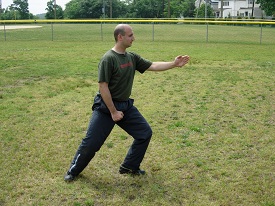
To begin, start in Boubi No Kamae, left hand straight out in front with a natural bend in the elbow, pointed at the opponent’s heart, right hand held in a fist in the crook of your right hip. Move with exaggerated slowness as if practicing a Tai Chi version of the kata.

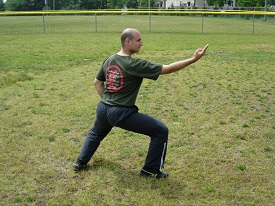
Drop the weight from your hips, shift over the front knee, and let your rear elbow straighten, dropping the hand in front of the hip to create a slight tension in the spine. This point here about creating torque or stored elastic energy (SEE) in the spine is essential in being able to move powerfully without winding up or telegraphing the movement. If you are having trouble feeling it, try to exaggerate the movement. Make it much larger than necessary to study the feeling. It should feel like a tension in the lower back near the bottom of the spine.

When this tension (torque) is relaxed (released), the movement happens. See if you can figure out where the energy is stored and how it’s released in the rest of the San Shin no Kata!

Be very careful when transferring your weight that you do not bob up and down; move smoothly through the same plane by shifting your weight laterally. Another point to be mindful of during the weight transfer is that you should be in balance (kamae) at all times. If you were to stop the movement at any point in the transition, you should not lose your balance.

Try it.  Practice it.  Create a strong foundation upon which to build, expand, and grow so that all the information and knowledge being handed down to you today takes root.

You can pick up my video tutorial on how to use Sanshin No Kata to create stability and power in your movement as a FREE Bonus with my Martial Power Program. OR, you can click HERE and get the Sanshin No Kata video separately for just $7!

Martial Power Cover1

Ninja Walking

The following article is an excerpt from Warrior Fitness: Conditioning for Martial Arts…  Enjoy!

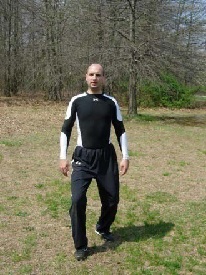
Proper walking is footwork training for budo. How we walk in day-to-day life is how we will walk (move) in combat. Efficiency in more complex movement begins with efficiency in simple movements. How can we expect to move with ease in the chaos of a combative environment when most of us have trouble walking with natural gait? Walking is a ubiquitous activity that many people simply take for granted. They move through the day without any awareness of the strain they place on their knees, hips, and lower backs by their poor movement patterns. Just a little awareness will do wonders for your balance, posture, and lightness of step. When Hatsumi Sensei first came to the U.S., of the things he noticed immediately was how heavy and inefficiently people walked. His comment was that most people walked “like Frankenstein”!

 Walking Exercises:

1. Stand in shizen no kamae (natural posture) and balance on one leg. Lift the other foot a few inches off the ground and then lower again in a slow, controlled manner using the flexing of the grounded leg to regulate the descent. Gently bounce a few times getting the feeling of how the grounded leg’s flexion and extension controls the lowering of the other foot. The balance on your leg should be such that you are able to lower the opposite foot to the ground in any direction and easily maintain kamae (balance). Switch legs and now balance on the other leg while lowering the foot.

2. Stand in shizen no kamae (natural posture). Use your right hip to lift the right foot off the ground. It will feel strange at first since this is not a very commonly used muscle action, but once you get used to it, it will become an efficient way of lifting the leg. With the right leg lifted, pull back with the right shoulder.  Notice how this has the effect of creating a slight torque in the spine and moves the right foot forward at the same time. Release the tension in the spine by placing the right foot down in a forward step. Feel how the release of tension propels the body forward and allow it to create the same lift from the hip and pulling back of the shoulder on the left side.

3. Combine the previous two exercises together and begin to walk.

 4.  Another idea to try when walking is to alternate periods of normal, regular breathing with holding your breath for duration when “full”, after an inhale, and when “empty”, after an exhale. Try inhaling for a count of 5 (steps or seconds), hold your breath for a count of 5, exhale for a count of 5, and finally, hold your breath empty for a count of 5 while walking. Repeat as long as you can continue the pace. Note that 5 is just an arbitrary number and can be raised or lowered to suit your own needs. This practice will help you to understand how your body can function during situations when you must suddenly hold your breath yet still continue to work. Another benefit of this exercise is that it also helps the body to process oxygen to brain, heart, and other working muscles more efficiently.

Don’t forget “light feet and soft knees” when walking!

Your Keys to Progress

How many people do you know who rarely, if ever, get the results they are seeking from their exercise regimen?  You may be one of them!  The question is, why don’t you (they) get results?  These people may be “exercise nuts” or “gym rats” or even “exer-holics”, or they could just be fascinated with the idea of exercise, but never actually doing any.  The four points below summarize what I feel to be the most important keys to progress when it comes to getting results and achieving your health and fitness goals, whatever they may be.

1.  Joint mobility on a daily basis. 

Daily joint mobility is a requirement to keep your progress moving forward.  Not only does it provide nutrition and lubrication for every joint in your body, but it also aids in removing waste products and deposits that tend to form over time causing pain.  The mobility increases our range of motion and acts as a prehab for enabling us to avoid injuries.  Additionally, it is an excellent way to warm-up the body prior to exercise or to get ready for the day first thing in the morning by increasing local blood flow to muscles.

2.  Yoga asana as compensatory movement for post-exercise cool down work. 

Since every action we do, as in exercise, or don’t do, as in couch sitting, causes an adaptation in our body, movements need to be specifically unloaded to bring us back into balance.  Compensatory movements remove tension caused by exercise and leaving us with the beneficial effects.  These movements are generally used as a cool down right after exercise or as a low impact recovery workout in and of themselves.  The selection of yoga asana (postures) has to be paired with each exercise performed as the complementary functional opposite of the movement to have the maximum desired effect.  By effectively integrating compensatory movements into your program, you can accelerate your progress, avoid injury, and keep moving forward.

3.  An incremental approach. 

Incremental progression is what keeps us from doing too much too soon and causing an injury.  Often we find that our bravado outweighs our brain when it comes to exercises, especially in the beginning.  We tend to want to jump right into the deep end in order to “get results faster”, but often end up injured, exhausted, or both with this approach and are unable to sustain the effort.  Health is about the long haul, not the short term effort.  If your program is unsustainable then it really has no value nor will it aid you in achieving your goals. 

4.  A plan sewing together all of the above. 

Having a plan is what brings all the prior elements together in cohesive, useable manner.  There is a tendency among some people out there to avoid having a program and to simply do the type of exercise they feel like on a particular day.  They also change the selection constantly in order to avoid boredom or so they can be “ready for anything”.  On the surface, this seems logical, but in reality unpredictable exercise selection simply leads to unpredictable results.  That’s no way to make progress.

Unlocking Flow in Your Taijutsu Practice

Here’s another one for all my Bujinkan Budo Taijutsu friends out there.

The following set of exercises is specifically designed to increase flow (nagare) in your taijutsu. However, before we get into the exercises themselves we should address the question, what is flow?

Flow is efficiency and continuity in movement. Flow is smoothness of movement that is unencumbered by mechanical, jerky actions. Moving at a faster pace and working harder, does not necessarily mean that the movement is flowing. In fact, if you are working harder, I can almost guarantee the movement is not flowing.


Get Out the Way – Move!

Flow is not something you do; it is something you get out of the way of!

What types of internal distractions, tensions, hitches in movement are preventing you from getting out of your own way?

The following flow exercises are culled from basic exercises of Bujinkan Budo Taijutsu, but can be utilized by anyone to expand your movement potential and increase flow.

When training these exercises, the idea is, of course, continuous movement. Begin with a slow and smooth protocol, working on keeping a good technique level and efficient transition between the movements. One discovers the key to developing flow by examining the in between stages of movement. Often, we see the kamae (structure) and then we see the roll, but what we miss is the essence of flow – the small, transitory movements between them.

Do not attempt to “accomplish” the exercise; that is not the point. Use it as a vehicle to unlock the flow in your movement. Try to keep moving. Don’t pause to think in the middle. Increase the speed as you begin to feel comfortable, but if the technique begins to get sloppy or the movements begin to look mechanical, drop down the intensity level until you are once again performing the flows with good technique. Remember, there is zero training value in simply trying to do the exercises for a “cardio” workout. Go buy a treadmill!

Chi No Kata

1. Step back from a natural posture into left leg forward Ichimonji No Kamae. Do Chi No Kata. From the end point of the kata, continue lowering your center of gravity and extend the right arm to effectively blend the transition from Chi No Kata into a front roll. Allow the momentum of the front roll to carry you to your feet, lifting up from the crown of your head and using your spine, into right Ichimonji No Kamae and, without stopping in the kamae, leap forward landing again in right Ichimonji No Kamae. Continue the movement by reaching forward with the left hand with a feeling of the body being pulled by the hand into left Ichimonji No Kamae. Repeat on the other side.

Sui No Kata

2. Step back from a natural posture into left Ichimonji No Kamae. Do Sui No Kata. From the omote shutou strike at the end of the kata, continue lowering the body with the weight on the front leg, simultaneously stepping through with the back leg to transition from the strike into a back roll. Allow the momentum of the back roll to carry you to your feet, lifting up from the crown of your head and using your spine, into right Ichimonji No Kamae and, without stopping in the kamae, leap backward landing again in right Ichimonji No Kamae. Repeat on the other side.

Ka No Kata

3. Step back from a natural posture into left Ichimonji No Kamae. Do Ka No Kata. From the ura shutou strike at the end of the kata, bring your left foot forward next to the right foot a little more than shoulder width apart to transition into Hira No Kamae. Without stopping in the kamae, lower your center of gravity and flow into a side roll to the right. Roll right back into Hira No Kamae and leap sideways to the right, landing again in Hira No Kamae. Repeat on the other side.

Fu No Kata

4. Step back from a natural posture into left Ichimonji No Kamae. Do Fu No Kata. Immediately transition to Hoko No Kamae and flow into a cartwheel. Land back in Hoko No Kamae and leap down into a kneeling Ichimonji No Kamae. Repeat on the other side.

Ku No Kata

5. Step back from a natural posture into left Ichimonji No Kamae. Do Ku No Kata. Immediately transition to a forward break-fall followed by a forward roll into Jumonji No Kamae. Leap directly upwards. Repeat on the other side.

Enjoy!

Flow drills from the book, Warrior Fitness: Conditioning for Martial Arts

WFBookcover3d

Ukemi Flow Conditioning Workout

This one is for all the martial artists out there –  I created the following ukemi conditioning workout for myself a few years ago to specifically target the transitions between my rolls and begin to unlock flow.  Additionally, it has the effect of really getting your heart pumping and makes a great workout!  Start out slowly and smoothly by practicing for the first few rounds.  Groove the movement and then begin to increase the speed.  Remember, you do yourself and your training a disservice if you rush through the movements simply to say you accomplished the workout.  Flow is not something you do, it’s something you allow – you have to be able to get out of your own way!  That being said, give this a try and let me know how it works for you.

Ukemi Flow

  1. Begin in Shizen No Kamae (natural stance), squat down to ball of foot squat
  2. Zenpo Kaiten (front roll) over the right shoulder
  3. Ushiro Kaiten (back roll)
  4. Stand up into Shizen No Kamae (natural stance), squat down to ball of foot squat
  5. Zenpo Kaiten (front roll) over the left shoulder
  6. Ushiro Kaiten (back roll)
  7. Stand up into Shizen No Kamae (natural stance)
  8. Yoko Nagare (side roll) with the leg crossing in front to the right
  9. Yoko Nagare (side roll) with the leg crossing in front to the left
  10. Stand up into Shizen No Kamae (natural stance)
  11. Zempo Ukemi (forward break fall)
  12. Stand up into Shizen No Kamae (natural stance)
  13. Yoko Nagare (side roll) with the leg crossing behind to the right
  14. Yoko Nagare (side roll) with the leg crossing behind to the left
  15. Stand up into Shizen No Kamae (natural stance) – repeat!

Start out with 4 rounds of 3 minutes each with a 1 minute break between rounds.  Use the minute break to get your breathing back under control and shake out the tension.  When this becomes easier, decrease the rest period to 30 seconds between rounds. Finally, try to perform the Ukemi Flow continuously for 12 minutes.  You can also adjust the difficulty level of the flow by adding directional leaps at the end of each roll.  Or, it can be made easier by performing it from kneeling in Seiza no Kamae instead of standing.

Notes: Make sure you warm-up with brief joint mobility session prior to the workout.

Got your own version of an ukemi-specific workout?  Please share with us in the comments section below!

Create Your Own Adversity!

“Let me embrace thee, sour adversity, for wise men say it is the wisest course.”  ~William Shakespeare

Philosophers and sages throughout the ages have consistently extolled the virtues of facing adversity for the purposes of becoming a better, stronger person.

No matter what form this adversity takes, wisdom dictates that it must be faced head-on, weathered through, and successfully beaten by coming out the other side, maybe scarred, but assuredly battle-hardened and spiritually tougher.

Oftentimes, adversity comes to us unbidden simply due to the path we choose to follow, or even for no fathomable reason at all.  It tends to be one of those things life throws at us unexpectedly to “help” us prove our mettle and forge our character.

It has been said that “God comforts the disturbed and disturbs the comfortable”.  If this is so, perhaps creating your own adversity isn’t a bad thing at all.

The goal in creating your own adversity is to design a challenge that will push the limits of your physical strength, mental toughness, and spiritual fortitude in order to propel you forward to the next level in your training.  For the warrior, this process is known as Shugyo.  Shugyo (修行) may be defined as “conducting oneself in a way that inspires mastery”.  These periods of severe training were usually undertaken by warriors to achieve a type of enlightening experience which opened their minds by destroying their concept of previously perceived limits.  It is the same for us today.

Ueshiba Morihei, the founder of Aikido, was well known for taking his students up into the mountains for periods of Shugyo.

“Once a year, Morihei took several of his best disciples to train with him on Mount Kurama, located near Kyoto. The small group lived on rice, pickles, miso soup, and wild herbs. Morihei would rise at five AM to pray. After morning prayers and misogi, they would swing heavy swords five hundred times and then practice footwork. From ten AM to noon they trained in body techniques. Afternoon training ran from three to five PM; the disciples took turns acting as Morihei’s partner as he ran through series after series of techniques. In the evenings the disciples would review the day’s training. Every three days, Morihei would announce at midnight ‘time for night training’…”
Excerpt from “Invincible Warrior”, by John Stevens pg. 125

Now, do you have to seclude yourself in the mountains for several days in order to practice Shugyo?

No.  For most of us, that’s not realistic or practical, but that doesn’t mean we can’t create the same type of experience for ourselves.

So, how do we do it?

Create Your Own Adversity!

Caution:This type of training is not for everyone.  Before you begin, there are a few common sense type precautions you should take.  First, prepare adequately.  For example, you would not go out to run the NY Marathon tomorrow if you’ve never run more than 5 miles.  Second, if you decide to conduct your Shugyo outdoors, let someone know where you’re going, what you’re doing, and how long you’ll be gone, or better yet, take them with you!  Third and most importantly, think before you do and plan accordingly.

1.  Pick a time or day that has personal significance to you – it can be your birthday, New Years Day, or the anniversary of something important in your life.  Is this absolutely necessary?  No.  You can pick next Tuesday if you’d like, but I think tying your Shugyo to a significant day makes it more special.

2.  Decide what form your Shugyo will take.  This must be unique to your goals and capabilities.  Choose something that is currently beyond your reach, but not so far as to make it completely unattainable.  You want to focus and hone your physical, mental, and spiritual abilities, not your imagination.  Some examples are:

  • Run a marathon
  • Run a Spartan Race or Tough Mudder
  • Climb a mountain
  • 1000 cuts with a heavy bokken (wooden sword)
  • 1000 Kettlebell snatches
  • 1000 Kettlebell Swings
  • 1000 reps of any basic techniques or combination of techniques
  • Sparring 20 opponents in a row, nonstop
  • 1000 Push-ups/Squats/Sit-ups

While any of the above would more than qualify as Shugyo, my personal preference is to plan an entire day where the whole becomes greater than the sum of the individual parts.  Some recommendations for the parts are:

Junan Taiso warm-up, run (distance TBD by you), practice the basic strikes, kicks, and footwork of your particular martial art, Bujinkan Budo Taijutsu for me (high reps to push your limits, of course!), weapons practice (sword cuts, spear thrusts, bo swinging, etc.), high repetition bodyweight exercise(s) or workout with weights (dumbbells, kettlebells, clubbells, sandbags), end with an extra long yoga session to wring out all the tension accumulated throughout the day followed by meditation and rest.

3.  Create a training program to get you there.  Let’s face it, most of the above examples are not something most people can decide to do in a day, they take time, preparation, and work to bring the goal within reach.  Remember the “6 P’s”: Proper Prior Planning Prevents Poor Performance!

4.  Get to work!!

Creating your own adversity through Shugyo has the effect of focusing not just your mind, but your entire being for the purposes of expanding your potential.  Push yourself harder than you ever thought possible and blow through your preconceived limitations – remember, the only limits that truly exist are those set up in your own mind – there are no limits!

“God brings men into deep waters, not to drown them, but to cleanse them.”  ~John Aughey