
Morning Wake Up Routine

Ever have one of those mornings when you have to be up early for work or school, but simply can’t summon the energy to start your day?  This is a routine I have been using successfully for years to shake out the cobwebs and get me moving on the mornings when just a cup of coffee isn’t going to do it.  It’s not your fault, and bear that in mind – some people just aren’t morning people.
Back when I was travelling for weeks on end and putting in long hours every day for consulting work this routine was my morning staple in the hotel room before meeting my colleagues for breakfast.  I find it most effective on the mornings when I am most tired.  Just as an aside, it doesn’t have to be used in the mornings, it has benefits any time of the day when you need a little pick me up.  One caution, and although this should be obvious I’ll say it anyway, don’t do it before going to bed – you won’t sleep!

The Routine

Joint Mobility

This has the effect of increasing synovial fluid to lubricate the joints while at the same time increasing blood flow to the surrounding muscles.  For the quick version we will concentrate on the neck, shoulders, hips, and spine.

Neck:

  1. Up/Down – lift up from crown of head; slide down along plane of jaw for 3 to 6 repetitions.
  2. Left/Right – turn head as far left as possible without pain, turn as far right as possible for 3 to 6 repetitions.
  3. Full circles in both directions.

Shoulders:

  1. Roll both shoulders – lift shoulders up towards ears, roll backward fully articulating the range of motion (ROM), drop them down as far as comfortable for 3 repetitions, then repeat by rolling forward for 3 reps.
  2. Alternate shoulder rolls – roll left shoulder back as described above while pushing right shoulder forward then switch.  Perform 3 times each.
  3. Swing both arms as fast as possible windmilling them forward for 20 seconds then backward for 20 seconds.

Hips:

  1. Circle hips clockwise and counter-clockwise 10 times in each direction.

Spine:

  1. Keep the spine straight and fold forward at the hips, then rotate around to the left and back to center, then forward and around to the right.
  2. Keep the spine straight and fold backward at the hips, then rotate around to the left and back to center, then forward and around to the right.

Energizing Breath

In this breathing exercise we will utilize a protocol founded by yoga and improved upon by Russian sport science and martial art.  Here the breath is divided into 3 levels: clavicular (upper level), intercostal (mid level), and diaphragmatic (lower level).  This exercise will focus only on the clavicular, or upper level.  For more information on breathing exercises, please see Evolve Your Breathing.

  1. Exhale through the mouth in a short, quick burst by compressing the upper chest.
  2. Do not actively inhale.  Allow the inhale to happen by relaxing the muscles in the chest.
  3. Repeat rapidly 20 to 40 times.
  4. Build up to where you can perform continuously for 60 seconds.
  5. If you become dizzy, stop and sit down!

Slap Yourself Silly!

This is actually an ancient Qigong exercise designed to improve circulation and disperse stagnant energy.  The execution is pretty simple.  You may want to avoid practicing this in public though!

  1. Gently, but vigorously, slap your shoulders, upper back, and lower back with the palms of the hands.
  2. Then slap down the inside of one arm and up the outside.  Switch arms.
  3. Slap down the outside of both legs – you can slap a little harder here – and up the inside.

Enjoy and Wake Up!
A Case for Mini Workouts

These days everyone is short on time.  Most are content to allow the daily grind and family time to fill their days while lamenting about the fact that they have no time for working out.  The complaints are common and heard often.  But somehow these same people are able to find time to watch an hour or more of TV every night before going to bed.

Now, I’m not going to ask you to forego your Sunday night Walking Dead episode (I certainly won’t!) in favor of hitting the gym for an hour, so don’t worry – just using the ability to watch TV as an example of “finding time”.

While it may be a stretch for many people to find 45 minutes to an hour each day for exercise or martial arts training, how about just finding 5 minutes?  Surely everyone can find a spare 5 minutes even a few times a day, right???

Recently, as my own daily grind has become busier and busier, I have been finding just how effective mini workouts can be to fill in the gaps in one’s training.  These types of workouts are often overlooked because of their brevity.

After all, how can one possibly get a complete workout in 5 minutes?!  Well, you can’t.  But that’s not the point.  The effects of mini workouts are cumulative.  In other words, they add up over time (that’s what cumulative means… :).

They are not meant to completely replace your regular training, but are meant to enhance it and compliment it.

They are an effective way to keep yourself on track and focused when short on time, or if you have already completed a full workout and still want to get in some extra training – nothing wrong with that either!  Remember, the goal of the mini workout is not to be too complicated or over-involved.  Make them short, sweet, and to the point!

Examples of Mini Workouts

Here are just a few ideas I’ve found that make ideal mini workouts:

  • 10 push-ups + 10 v-ups + 10 squats (repeat 3-5 x’s)
  • Finger tip push-ups (see how many you can do)
  • Tabata exercises (pick one and go)
  • 5 Kettlebell Snatches (each side) + 5 Kettlebell Swings (each side) + 10 Hindu Push-ups (Perform AMRAP for 5 or 10 minutes)
  • Isometrics
  • Breathing exercises combined with bodyweight training
  • Joint mobility work
  • Pull-ups (5-4-3-2-1 rep scheme)
  • Burpees or Sprawls for 50 to 100 reps

Mini Workouts for Martial Arts

The mini workout should be an essential aspect of any martial artist’s training.  It is said that great martial artists are training all the time.  Well known and respected masters from Musashi to Tesshu to Ueshiba to Hatsumi Soke have constantly extolled the importance of solo-training and dedicated practice.

While mini workouts do not form a complete picture of solo- training, they do play an important role.  In the future, I’ll be sharing a more extensive look at solo-training for martial arts, particularly for Bujinkan practitioners.  But for now, here’s a short list to get you started:

  • Ukemi practice – mix up rolls, change directions freely, roll over obstacles
  • San Shin no Kata
  • Solo flow drill – move continuously for 5 minutes. Flow from strikes to kicks to leaps to rolls, from kamae to kamae – be creative!
  • Kamae work in a mirror
  • Striking practice
  • Junan taiso (see above!)

Make sure to make time for mini workouts!

Everyone Needs a Coach!

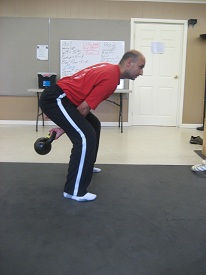
The other day, I was working out with my good friend Eric Chasko at his studio, Redemption Kettlebell Gym in East Windsor, NJ.  After our training session, we were discussing the mechanics of a basic kettlebell swing and Eric had me demo a few swings.  As I began demonstrating the basic kettlebell swing that I had been taught almost 10 years ago, he noticed a hitch in my movement during the back swing.  Instead of keeping my back flat, I was raising it slightly as the bell moved into back position.  This was something I had never noticed previously.  Initially, it would not cause a problem, but over time, and with some serious volume, it would begin to stress my low back and contribute to pain in that area if not addressed. 

Eric picked up another kettlebell and showed me the difference between what I was doing on my back swing and how it should be done correctly.  We then worked on keeping my back flat while bringing the bell back and then driving with the hips to swing the bell upwards.  After a practicing for a couple repetitions, I got it.  As Eric is fond of saying, “Kettlebell swings are not bad for your back.  The way YOU are doing them is bad for your back!”   Unless you ask questions and talk to a knowledgeable professional, you never know what you don’t know!

So, although I have done kettlebell swings for years, I still had something to learn from a coach.  Never assume you already know how to do something, even something as basic as a kettlebell swing!

Kettlebell Swing #1 - Approach


Kettlebell Swing #2 - Back Swing


Kettlebell Swing #3 – Hip Drive!