“He Opened My Eyes to Budo…”

Way back in 2009 I started studying this weird, rarely talked about, even more rarely taught aspect of traditional martial arts called internal power.
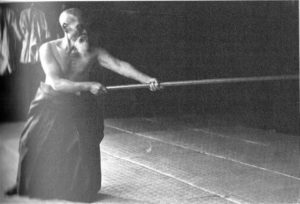
To say it opened up my worldview when it came to martial arts training would be a huge understatement!

Now, to put it in perspective, I’d been training in martial arts since I was 10, and I’d trained with high level masters all over the world. But I was blown away by this stuff!!!

I’m reminded of what Ueshiba (the founder of Aikido) said of his Daito Ryu teacher, Sokaku Takeda who taught him these internal power exercises – “He opened my eyes to budo”

To me, this training is really the underlying essence of budo. It creates a powerful body for any martial artist, no matter the art. And it gives those who are in the know a tremendous advantage!!

What is Internal Power?

I think it’s best to start with the basics.  What is internal power and how can it useful to the practitioner of any and all martial arts or combat sports?  Let me state this at the outset to hopefully clear up a rather unfortunate misinterpretation of IP.

Internal Power is physical.

It’s not some mystical mumbo jumbo or a throwing chi balls type of nonsense.

It is actually a way of conditioning the body through specific solo training exercises and paired partner training. The training method spans thousands of years and has been handed down through the ages within the warrior traditions of India, China, and Japan.  It is a body technology with a set method and detailed process of instruction that simply cannot be learned by osmosis.  It must be explicitly taught.


The basis for the method is what is known as the union of opposites or In Yo Ho, in Japanese.

By creating opposing forces within the body (up/down, left/right, front/back) through the use of intent – your own mental direction using imagery, feeling, and visualization – we begin to increase the mind-body connection to a remarkable degree.

Through the solo training exercises we condition and strengthen the entire fascia network, as well as tendons and ligaments, throughout the body.  This process serves to create a connected body through the center so that when ‘one thing move, everything moves’.

How Can YOU Learn This?

So when I had the opportunity, I put all my knowledge into a program called Integrated Strength back in 2015. This program lays the foundation of combining internal power with the warrior’s system of functional strength.

Thus in the Integrated Strength Program I have combined the two methods to create a fully integrated system of developing human strength potential.
This complete system of Internal Power Development AND Unusual Strength is presented to you for the FIRST TIME EVER inside the Integrated Strength Training Program.

I refined and added to that body of knowledge in the next installment of internal power training called Shadow Strength in 2019.
Shadow Strength contains a unique set of exercises drawn from traditional martial arts designed to utilize breath, posture, and mobility to build superhuman levels of strength and resistance to injury.


And this year I released the newest program in my internal strength series called The Power Protocol which takes all of the training so far to the next level.

The goal of The Power Protocol program is singular in nature – to cut through the morass of myth and misinformation and give you a practical, proven, results-driven method for building real martial power no matter who you are, what martial art you study, or how you’ve been let down by unknowing or unscrupulous teachers in the past.
This program is your one-stop-shop for developing knock-down, drag out power for any martial art from the inside out and the outside in. After following this program, you will be stronger, tougher, more durable, flexible, and resistant to injury.

Not to mention the ability to hit like a truck out of nowhere and be almost impossible to take down, throw, or joint lock without your express compliance

These 3 programs contain the most powerful training I’ve released publicly to date.

Now you can save 50% on all 3 powerful programs here <<==

If you train in martial arts, you owe it to yourself to grab this package and get started – your training will NEVER be the same!
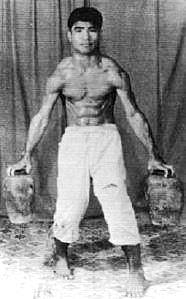
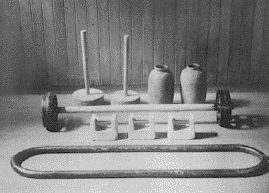
Martial Arts Training for Stability

Part 2 – Guest blog post by my friend, Jarell Lindsey from Lean Functional Muscle.  Part 1 is HERE.

Martial Arts Training for Stability

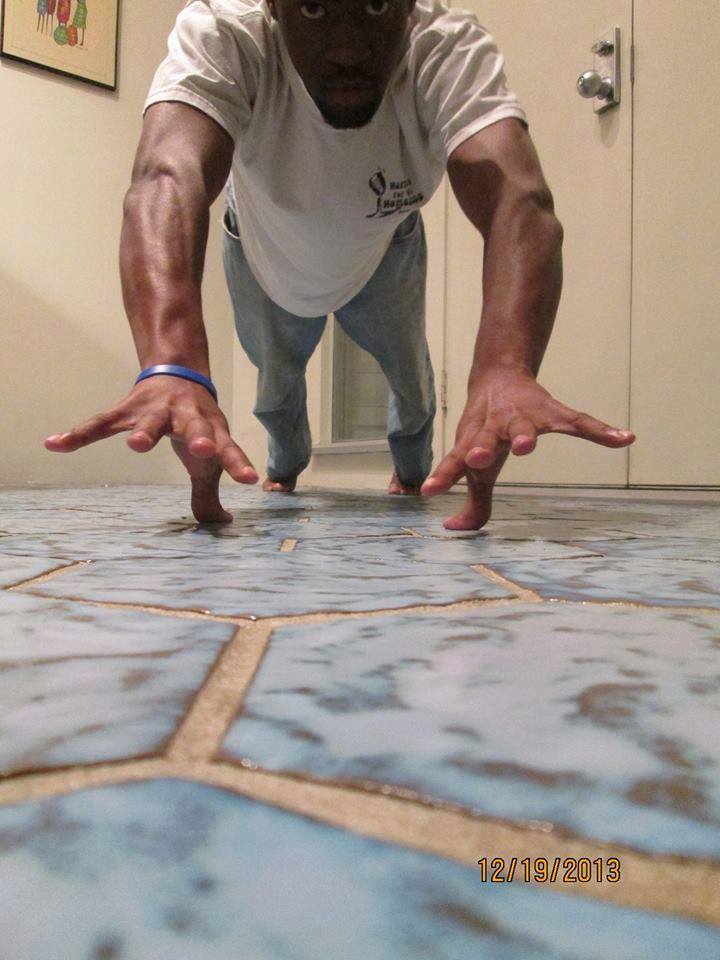
A mountain, snowcapped, reaching for the heavens but rooted down to Earth all the same. That is the image I visualize as the pinnacle of martial arts stability. This level of stability is something that marks mastery of the power in your craft. To be a martial artist, stability training is critical; to be a warrior, stability training is indispensable. Stability means being in a position of firmness; being able to combine that stability with mobility requires as much recovery as it does intensity.

Jarell Pic2

Intensity will be the most important factor in overall stability. Stability means “the strength to stand or endure”. You must have strength and endurance to have true stability, and the best way to obtain both is through intensity, like an ore refined under extreme heat. When it comes to endurance, mental and physical endurance are key. The greatest benefits of long distance running are in the mental benefits in endurance you’ll get from driving your body to the brink of its functionality. Nevertheless, I feel like interval cardio training is more advantageous for consistent cardio training as a martial artist.

Interval Training for Martial Arts

Interval cardio training allows you to train your spurts of intensity while increasing your recovery times overall. In a fight, there are often periods of ferocious exchanges followed by lulls to observe the opponent or recover; by training those intervals, you can get your heartbeat back near resting in a much quicker time than were you to solely train long distance. For instance, set your week up so that you perform 20-30 second sprints (it’ll be better to practice sprinting for time instead of sprinting for distance) throughout the week in sets, then perform a longer distance run toward the end of the week to test overall physical and mental endurance.

Remember that training your breathing is just as, if not more important for training your physical and mental endurance as cardio, so adopt a powerful breathing component into your training to help your stability and health.

You Must Train for Strength

Alas, strength seems to be a given to have when it comes to martial arts. People can say that a martial artist does not need strength, just technique, and they’d be enabling the weakness of people in the pursuit of a war art by doing so. Strength training is critical to being a martial artist; karatekas and the Shaolin have had their own weight training implements for centuries, so whoever promoted the idea that martial artists should not weight train was jaded. However, traditional martial arts have just as many methods to build strength using your bodyweight, so a lack of weight shouldn’t be an excuse.

Jarell Pic1


There are hordes of thoughts about the best method of strength training; what I will say is that your regimen should include something that builds your body from the inside out. For me, isometric exercises build strength from the tendons, ligaments, and nerves out to the muscles. I do training that isolates individual muscles for maximal muscle fatigue, and training that involves large muscle groups for fatigue of the central nervous system. As long as your training does not neglect internal principles of strength (like bodybuilding training that focuses solely on muscle without long-term development of the tendons), it can be a part of what gives you stability. Overall, intensity is key, so finding ways to progressively increase your intensity will progressively increase your stability. Coupled with mobility training that can prevent your powerful tendons from being overly rigid, your martial arts can reach an advanced level comparable to the legends of old.

Jarell Pic3

Protect. Break. Leave Behind.

How can we train for the friction and chaos of battle when following a set fitness routine?

Physical preparation for combat readiness must be, by its very nature, a multifaceted approach.  If the combatants have to be ready for anything, shouldn’t their fitness regimen reflect that?  Surely the idea of training random workouts each and every day must help better prepare the person to face any challenge, right?

Well, yes and no.

As with all things, fitness is a skill.  The body must be adequately prepared at a baseline level through rigorous training AND practice to establish a solid foundation of GPP.   To suddenly subject a trainee to an onslaught of arbitrarily selected workouts is only a recipe for creating a shallow level of skill in a bunch of random areas.  It is also a great way to cause injury rather than seek to prevent it.  Random training produces random, haphazard results.

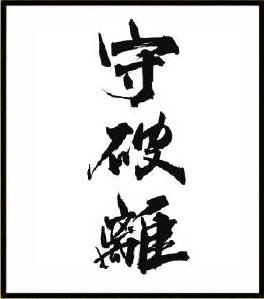
The Warrior Fitness Training methodology follows the Shu-Ha-Ri model of teaching prevalent in schools of traditional Japanese martial arts.  Shu-Ha-Ri translates to “protect the form, break the form, leave the form behind”.

shuharith

Usually within schools of traditional Japanese Budo this is a linear model where at the beginning of training the student is taught to carefully protect the form without deviation so as to template themselves to the teacher and to the martial system.  After becoming proficient in the exact techniques of the school the student is then encouraged to begin breaking the form.  And then slowly, very, very slowly, after decades of practice the student finally begins to transcend the form and leave it behind thus moving at the level of principle.

The Shu-Ha-Ri model is slightly different in the Bujinkan tradition that I study.  Rather than a strict linear progression, the model is not quite as fixed.  It may be Shu-Ha-Ri, Ri-Ha-Shu, Ha-Shu-Ri, or any combination of the three.  In this way, the student does not have to wait until he has trained for decades to learn how to break the form, nor does he always leave the form behind.  Instead the training progresses in an upward spiral where the teacher may start with the basics, circle up to breaking the form, and finally leave the form behind, followed by working again on the basics.  The same material is always looked at with fresh, new perspective and greater depth each time it is taught no matter where in the cycle it falls.  This allows for better all-around development and faster progression while still inculcating the basic forms and instilling a respect for technique.  It also gives the student the freedom to adapt to the friction and chaos of combat by learning how to both break and throw away the form when required yet still conforming to the strategic and tactical principles of the art.

How Does This Relate to Fitness?

What I have done is take the Shu-Ha-Ri model as taught within the Bujikan martial arts tradition and apply it to the programming in my Warrior Fitness Training System.  This means that within a complete training program, the student will undergo GPP (general physical preparation), SPP (specific physical preparation), TS (technical skills), and MT (mental/emotional toughness) to fully and completely prepare them for the task, goal, or mission at hand (For a more detailed description of each, please see my post on The 4 Levels of Preparation).

Following the Bujinkan model then, the progression of training may not necessarily be a straight line.  Depending on the level of the student, GPP will most likely form the bulk of the training but it will be cycled out of and back into throughout the duration of the program.  As the student progresses and increases in the skill of fitness, their training becomes blended at a higher level of SPP maybe only cycling back into GPP to shore up certain weaknesses and then coming right back out again.  This insures that the student is constantly progressing and also constantly prepared without having to resort to a random workout generator model of training.

Ready to take your Combat Conditioning to the next level? Pick up WarFit Now for Only $7!

Traditional Martial Artists of the World – UNITE!

Traditional martial arts all have a long history of intense, sometimes downright brutal, physical training to forge the warrior’s combative body, mindset, and spirit.

This training has, up until very recently in history, never been optional. If you did not have the strength of will to endure it and push through then you simply did not make the cut and were not taught higher level skills. Not that you would be considered somehow unworthy or anything silly like that, but you would be thought physically incapable and therefore not worth the teacher’s time to train you.

Each school of martial art had its own type of tanren or forging process to harden the aspiring martial student. Continue reading

The Warrior Fitness Guide to Striking Power is Here!

by Jonathan Haas, founder of Warrior Fitness Training Systems

  • Specific Physical Preparedness for ALL striking arts from old school Traditional Martial Arts to modern MMA!
  • Learn how to build a powerful structure to stabilize punches, kicks, and martial movement!
  • Discover how to use low-tech, high yield tools to strengthen strikes throughout a range of motion!
  • Sledge Hammer for force production, rotational strength, grip strength, and old school conditioning!
  • Medicine Ball for explosive strength and rotational strength!
  • Resistance Bands for force production, rotational strength, increased stabilization!
  • Bodyweight Exercise and Isometrics for structure and stabilization!
  • Discover how to use Intelligent Tension rather than general tension to power strikes!
  • Learn Breathing and vibration exercises for recovery and restoration!
  • Over 50 pages of pure, 100% actionable content – no fluff, no BS, no filler!
  • Sample Workouts!

Buy Now for only $15 USD!!

Buy Now

Warrior Fitness Guide to Striking Power is a downloadable e-book. No physical products will be shipped. After you order, you will get INSTANT ACCESS to download the e-book and all the bonus reports onto your computer. The e-book format is adobe acrobat PDF, which can be viewed on Mac or PC.