In response to a question I received the other day via email, here are my top 5 grip strength exercises for warriors… Continue reading
Top 5 Grip Strength Exercises for Warriors
Reply
In response to a question I received the other day via email, here are my top 5 grip strength exercises for warriors… Continue reading
If you are a martial artist, it is essential to train your art outside in the elements. Since most traditional arts were born outside, and not in a gym or dojo setting, it is important to every once in a while get back to the roots of your art. Correct me if I’m wrong, but as far as I know most wars have been fought outside in the elements, through all different types of weather conditions, and on changing terrain. I think we have all become way too spoiled and comfortable by training in a sheltered and heated (or air conditioned) dojo, on a flat, mat covered surface all the time. Get out of your comfort zone! Start to get comfortable being uncomfortable! Get a little wet and dirty. Have some fun! Continue reading
Before proceeding onto this Advanced Level of my Ninja 300 Workout, make sure you have successfully completed the Level 1 Warm-up and the Level 2 Intermediate Workout! Continue reading
Did you do the basic level of my Ninja 300 Warm-up? How did you like it? I’ve had several positive responses to the basic version, along with requests for the next level, so here you go! Continue reading
When I first began talking about internal power in the context of Bujinkan training, I realized that many people might be skeptical of this type of training at the very least, or have many preconceived misconceptions that would not allow them to even consider the method as a viable form of training for budo.
Therefore I decided to write this blog post to gauge the interest of my readership and how accepting you might be of internal power training and my interpretation of its role within Bujinkan training. I hope you find it helpful!
I think it’s best to start with the basics. What is internal power and how can it useful to the practitioner of Bujinkan Budo Taijutsu? Let me state this at the outset to hopefully clear up a rather unfortunate misinterpretation of IP.
Internal Power is physical.
It’s not some mystical mumbo jumbo or a throwing chi balls type of nonsense.
It is actually a way of conditioning the body through specific solo training exercises and paired partner training. The training method spans thousands of years and has been handed down through the ages within the warrior traditions of India, China, and Japan. It is a body technology with a set method and detailed process of instruction that simply cannot be learned by osmosis. It must be explicitly taught.
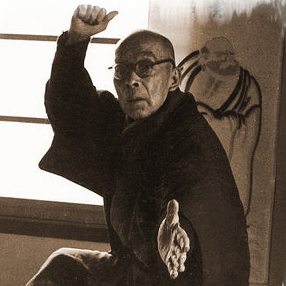
The basis for the method is what is known as the union of opposites or In Yo Ho, in Japanese.
By creating opposing forces within the body (up/down, left/right, front/back) through the use of intent – your own mental direction using imagery, feeling, and visualization – we begin to increase the mind-body connection to a remarkable degree.
Through the solo training exercises we condition and strengthen the entire fascia network, as well as tendons and ligaments, throughout the body. This process serves to create a connected body through the center so that when ‘one thing move, everything moves’.
Internal Power training changes the way outside forces act on the body. The structure becomes dynamically stable so that applied force can either be distributed throughout the chain and dissipated or, at a higher level, simply reflected right back onto the opponent. When force is reflected back this is what is known in Japanese as Yamabiko, or Mountain Echo.
At first blush it may sound like a party trick, but the budo applications are quite staggering. Think about it.
How does every martial art technique work?
What is the first thing you are taught to do prior to applying a technique?
Break the opponent’s balance, right? Get kuzushi.
What if no one can compromise your structure?
What does that do to every throw, lock, and take down applied to you? Yeh. You’re getting it now, aren’t’ you?
And that’s just the beginning.
Every time you move, you are completely and dynamically stable, balanced. You gain the ability to hit like a truck using the full mass of a connected body without dedicating your weight. (Remember – when one thing moves, everything moves.)
This becomes very profound, especially when you start to incorporate weapons.
And, since you are connected through the middle of your body due to the specific solo training exercises, you will finally and probably for the first time, actually be moving from center, hara, or dantien.
Sound interesting?
You can learn my full method of integrating and training the mind-body system HERE.
 I am also more than happy to share what I know about internal power training, especially in the context of how it can be fully integrated into our Bujinkan Budo Taijutsu practice. I teach it in my weekly classes and seminars upon request. Contact me HERE.
I thought I would share with you today the new Ninja Warm-up I’ve been using in my own daily personal practice.
Since the New Year routinely brings our training focus back to the basics I figured a great way to incorporate more Bujinkan Basics practice was to include them in my warm-up as well.
Of course, I still do my full body mobility routine as taught in the Martial Power Program and ukemi practice too. Continue reading
Here are my top 10 picks for the best Warrior Fitness Posts of 2013… What do you think?

In no particular order, here they are… ENJOY!
1) Top 7 Exercises for Warriors
2) Intelligent Tension for Striking
3) How I Healed My Neck with Mobility and Breathing
4) How to Train More Every Day
5) How Natural is Your Shizen No Kamae?
6) Fitness Dangers for Bujinkan Students
7) Where Do You Locate “Your Control?
9) Protect. Break. Leave Behind
Wishing you all a very Merry Christmas and a Happy New Year!!
Recently I was asked about how to use a single kettlebell to train footwork for Bujinkan martial arts. Here is a video I put together showing a couple different exercises to enhance stability and mobility for footwork training using the kettlebell. Enjoy!! Continue reading
Matching breath to body movement is a key skill in learning how to power movement with the breath. This matching can be as simple as inhaling on an expanding, opening, or lengthening movements and exhaling on contracting or closing movements.
Under resistance though we begin to look at the idea of exhaling on effort to coordinate breath and body. Here it can also become a little more sophisticated in using the activation of the core via the breath to send power out to the extremities.
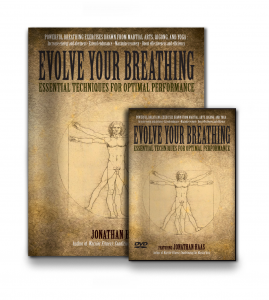
The following is a short clip from my Evolve Your Breathing program showing how the breath can be used to power a push-up. The concept itself is easy enough to grasp, but the application is a lifetime of study.
The following is a free preview of my upcoming program of the same name, The Warrior Workouts.
This sample program consists of a complete 4 weeks of training and is designed to give you a taste of the various types of training methods used within the Warrior Fitness Training System.
Each of these workouts has been specifically crafted to provide complete, full-body strength, conditioning, and power for martial art, sport, or anything else life can throw at you!

Download your FREE copy by clicking ====>>>>Warfit -The Ultimate Combat Conditioning System