The Process of Becoming Masterful

“Remember that mastery is not attained once after a lifetime of practice, but earned every day.”

– Jon Haas

Usually when we think of someone who is a master, be it a master martial artist or the master of some other craft, we think of them as attaining mastery at the end of a long lifetime of practice.
But mastery is NOT something that’s attained once after years or decades of training – mastery is something that is EARNED every day!!
You can be masterful in one moment and then a fumbling fool in the next (ask me how I know!).
The goal of becoming masterful isn’t to wait until some distant future when every move you make is perfect and every word that comes out of your mouth is sage advice, it’s to consciously create those moments of mastery every day until you have more of them rather than less of them.

Daily practice is the key.

Do you ever think about what it would be like to be a master martial artist?

Not just to be awarded the title “master” but to really and truly embody all of the sublime skill of martial mastery at the highest level of human achievement…

What would it feel like to know, without a shadow of a doubt, that you could easily control and subdue the most violent opponent with the most minimal effort, like a lion playing with a cub?

What if I told you that mastery is NOT something automatically attained after a lifetime of practice, but is instead conferred only upon those rare few individuals who, through their own efforts, take consistent, specific daily actions to achieve it?

Then mastery would not be just a far away, imagined future state, but instead a real and attainable goal built by taking action every day, right here and right now.


Remember This

Remember this – it is critical to your success – EVERY single legendary martial master: Musashi, Ueshiba, Bruce Lee, Kano, Takeda, Takamatsu, Gracie, Hatsumi, etc…

ALL of them began as unskilled, know nothing novices, white belts without a clue.

Their consistent daily training formed them, forged them, into the revered and feared masters that we know today.

“What one man can do, another can do.”

You can choose to follow in their footsteps. You can choose to be masterful, to be legendary.

However, as you follow them, do NOT seek to become them – instead, seek what they sought, the process of mastery.

Find the process of daily mastery <<==

Finally… There is a Researched, Tested, and PROVEN Method for Developing Internal Power and Unusual Strength from Martial Arts…

HeavyBody Foundations Course – My Review

The HeavyBody Foundations course is the first section in Coach Chris Davis’ new Martial Body System. The Martial Body system is an attribute-based approach to training. This non-denominational systematic method of training the body is not only revolutionary, but much needed by today’s martial artist!

Coach Chris has spent many years training with high level martial masters from several different arts, researching their approach, understanding and highlighting the commonalities between BJJ world champions, UFC fighters, Chinese martial artists, Koryu adepts and cleverly reverse engineering them into a cohesive, attribute based approach to building the ultimate body for martial arts.

The approach has been “specifically and painstakingly developed with the sole goal of creating real and lasting changes to how martial artists from any style feel to their partners or opponents, and how their body remains strong, healthy and able to perform as they age.”

The 6 qualities are presented in the MartialBody system are:

HeavyBody | StableBody | ConnectedBody | ElasticBody | SpiralBody | FluidBody

HeavyBody Foundations

The aim of the HeavyBody section is to develop the quality of heaviness through relaxation in martial exchanges. This allows the practitioner to fully utilize their connection to gravity and turn off unwanted tension in the body.

The course is broken down into 5 chapters, each complete with a series of introductory explanation videos, demonstrations and instructions for each exercise, as well as warm-up and cool down routines, and follow along routines covering all aspects of the training. Coach Chris also covers several examples of push testing designed to act as real time feedback for the process. All in all, an excellent resource for any martial artists!

As you will see inside the course, the exercises act on multiple levels and are designed to increase the level of relaxation, open up the joints, and condition and massage the tissues.

Coach Chris takes great care in explaining and demonstrating each exercise in detail as well as providing commentary as to how each one will develop the HeavyBody attribute and be useful in striking or grappling. I found myself getting up from my computer and turning the monitor around so I could work through the exercises with him as he was demonstrating on video – as they say, FEELING is believing!

HeavyBody may be the first foundations course, but foundation does not mean basic. It is, in my opinion, essential training for all martial artists, regardless of style. The exercises in this module are meant to be trained over a lifetime always coming back and plumbing greater depth.

My recommendation? HeavyBody foundations is a MUST for ANY martial artist’s library. Pick up this course NOW and get started training today!

Get your copy here.


UPDATE – The new courses: StableBody FoundationsConnectedBody Foundations, and ElasticBody Foundations are Available Now!

The Aiki Push-Up

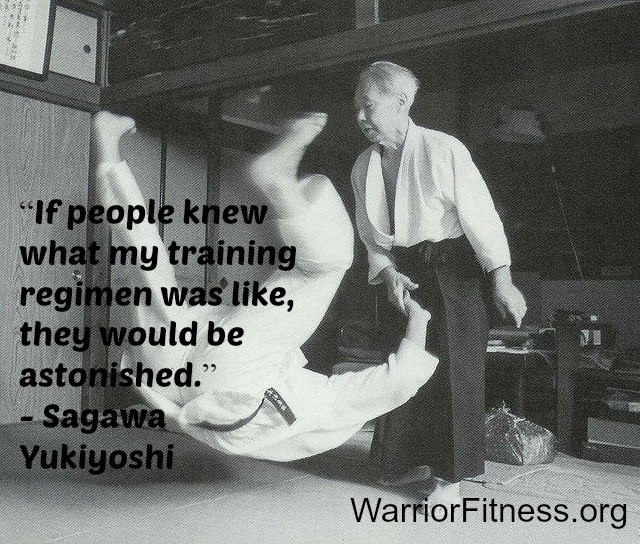
The Aiki Push-up is a literally a one-stop-shop in the study of internal power building. It was rumored to be part of Daito Ryu master, Yukiyoshi Sagawa’s secret training regimen.

Sagawa Training
Here’s a video where I explain the purpose and it and how to do it.

Watch carefully as the Aiki Push-up may look similar to what you already know, but the entire engine driving it is different!

Don’t fall prey to the common idea of thinking you know something just because you know about something! Be diligent in your study and your training – go deep!

“A little knowledge is a dangerous thing…”

Learn all the fundamental building blocks to the Aiki Push-up, as well as creating Internal Power (plus much more!) HERE!

Kata (Alone) Will Never Build Internal Power

Trying to develop Internal Power by training kata (alone) in martial art is problematic.  On one hand, you may inadvertently have minor success in creating some internal connection over the course of 20-30 years of training, but you will most likely have no idea how you did it, no idea why it worked (minimally at best), and most importantly, no idea how to correctly transmit it to the next generation.

The only advice you will be able to offer your students and fellow seekers is to keep doing this (kata training) and somehow you *might* get the correct result.  This is insufficient and irresponsible, at best, on the part of the teacher.

Assuming that you want to stand out from the crowd as a powerful martial artist, and Internal Power/Aiki is your goal, then the scatter approach to trying (and for the most part, failing) to build IP through kata alone is a waste of a career.  I say this because there exist clearly defined, step-by-step processes that rewire the body for Internal Power specifically for martial arts.

Solo Training Precedes Kata Training

Power building models as solo training exercises have existed for hundreds (if not thousands) of years  throughout the martial arts from India to China to Japan.  Why anyone would try to reinvent the wheel by attempting to create their own hodgepodge of exercises or think that merely training kata would develop real Internal Power is a mystery to me.  The reality is that solo training exercises burn in specific ways of moving that are not normal which create a very stable, powerful structure capable of absorbing, re-translating, and projecting incoming force.

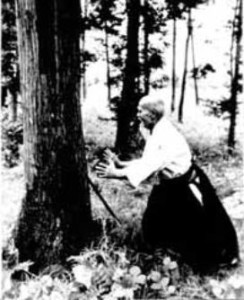
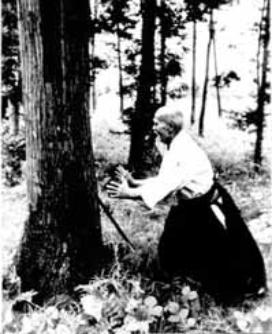
osensei_tree_kokyu1-272x334

Internal Power training is a type of General Physical Preparedness (GPP) for budo.  The goal of regular GPP for fitness, athletics, or martial arts is enhanced work capacity. This is the ability to run faster, jump higher, and hit harder. When work capacity increases, it allows the budding warrior to adapt more easily to increases in both mental and physical demands. In other words, it increases your capacity and level of readiness to absorb higher levels of specificity.

The solo training exercises for internal power training change the way outside forces act on the body.  The structure becomes dynamically stable so that applied force can either be distributed throughout the chain and dissipated or, at a higher level, simply reflected right back onto the opponent.  When force is reflected back this is what is known in Japanese as Yamabiko, or Mountain Echo.

Just to help further differentiate the two practices, solo training exercises for building internal power (there are other types of solo training exercises, obviously) are always made up of the following: standing, open/close, winding, spiraling, and breathing – all supported by Yin/Yang Theory (the union of opposites) and 6 directions (Heaven Earth Man).

Kata are for the purposes of patterning correct martial movement.

These solo training exercises are trained BEFORE kata to condition the body for powerful martial movement. They are not martial movement drills in and of themselves like sanshin no kata, kihon happo, and kata.

Kata – The Slow Boat to China

The reason it is so difficult to train IP via kata is that the vast majority of students get caught up in learning the movements of the kata correctly.  They get caught up in the application of technique and the idea of trying to make it work correctly.  What they don’t realize is that having a correctly trained body built by solo Internal Power exercises makes all the kata work much better and easier.

If you have a choice – why not learn a proven step-by-step method of developing unusual strength and Internal Power?


Join My New 21 Lessons on Internal Power Coaching Program <<==

Following a clearly defined path up the mountain is much faster and more effective than wandering around the base working on kata for 30 years and thinking you will somehow magically arrive at the summit.

Caution – While I did just say “more effective and faster” I by no means meant easier!!  Internal Power takes a lot of dedicated work.  Do not think it is a shortcut!

Gyokko Ryu’s Internal Power Training

There is no doubt in my mind that Hatsumi Sensei possesses unusual power in his budo.  Anyone who has trained with him can tell you that!  But what is it and where does it come from?  More importantly, how can YOU develop it as well?

Soke’s martial movement displays many of the characteristics associated with Internal Power training: ghostly movement, immovability (static and dynamic), shockingly powerful strikes with little windup, adhesion caused by movement, kuzushi on contact, and others. Continue reading

Martial Software or Martial Hardware?

Remember in The Matrix when Morpheus downloaded those dozens of different martial arts programs (software) into Neo’s brain and he instantly could perform all the techniques from those arts?

That is a perfect example of a software upgrade.  Techniques instantly available at your fingertips – literally! Continue reading

Places of Power

Training outside in the elements has always been one of my favorite ways to practice martial arts and the art of strength, or Warrior Fitness.  There’s something special about the fresh air, sunshine, and changing terrain that gives life to the training and makes it hugely satisfying for me.  In fact, my weekly Bujinkan Martial Arts class trains outside all year round in all sorts of weather from the bitterly cold and snowy winters to the blisteringly hot and humid summers.  This type training not only helps increase our physical resilience, but our mental fortitude as well by helping us to become comfortable being uncomfortable. Continue reading

Never Take Ukemi Again

What if you never had to take ukemi again?

Not because you stopped training or avoided it or anything negative like that, but simply because no one who came in contact with you was able to throw you.

Interesting idea, eh?

Although for the sake of paired training and being a good training partner, perhaps a better model would be this – what if you only took ukemi from someone when you wanted to, and not when you had to?

What if you had the skill to naturally reflect incoming force so that an attacker was not able to throw you, joint lock you, take you down, or even off balance you? Continue reading

Internal Power and Bujinkan Training

When I first began talking about internal power in the context of Bujinkan training, I realized that many people might be skeptical of this type of training at the very least, or have many preconceived misconceptions that would not allow them to even consider the method as a viable form of training for budo.

Therefore I decided to write this blog post to gauge the interest of my readership and how accepting you might be of internal power training and my interpretation of its role within Bujinkan training. I hope you find it helpful!

What is Internal Power?

I think it’s best to start with the basics.  What is internal power and how can it useful to the practitioner of Bujinkan Budo Taijutsu?  Let me state this at the outset to hopefully clear up a rather unfortunate misinterpretation of IP.

Internal Power is physical.

It’s not some mystical mumbo jumbo or a throwing chi balls type of nonsense.

It is actually a way of conditioning the body through specific solo training exercises and paired partner training. The training method spans thousands of years and has been handed down through the ages within the warrior traditions of India, China, and Japan.  It is a body technology with a set method and detailed process of instruction that simply cannot be learned by osmosis.  It must be explicitly taught.
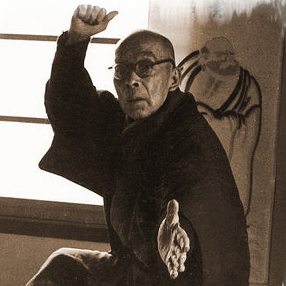
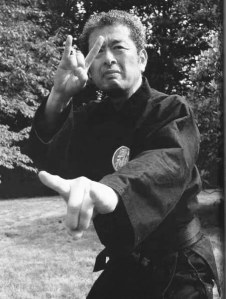
takamatsuSensei

The basis for the method is what is known as the union of opposites or In Yo Ho, in Japanese.

By creating opposing forces within the body (up/down, left/right, front/back) through the use of intent – your own mental direction using imagery, feeling, and visualization – we begin to increase the mind-body connection to a remarkable degree.

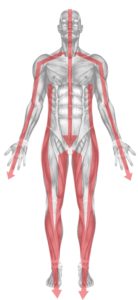
Through the solo training exercises we condition and strengthen the entire fascia network, as well as tendons and ligaments, throughout the body.  This process serves to create a connected body through the center so that when ‘one thing move, everything moves’.

The Ultimate Ukemi

Internal Power training changes the way outside forces act on the body.  The structure becomes dynamically stable so that applied force can either be distributed throughout the chain and dissipated or, at a higher level, simply reflected right back onto the opponent.  When force is reflected back this is what is known in Japanese as Yamabiko, or Mountain Echo.

At first blush it may sound like a party trick, but the budo applications are quite staggering.  Think about it.

How does every martial art technique work?

What is the first thing you are taught to do prior to applying a technique?

Break the opponent’s balance, right?  Get kuzushi.

What if no one can compromise your structure?

What does that do to every throw, lock, and take down applied to you?  Yeh.  You’re getting it now, aren’t’ you?

And that’s just the beginning.

Every time you move, you are completely and dynamically stable, balanced.  You gain the ability to hit like a truck using the full mass of a connected body without dedicating your weight.  (Remember – when one thing moves, everything moves.)

This becomes very profound, especially when you start to incorporate weapons.

And, since you are connected through the middle of your body due to the specific solo training exercises, you will finally and probably for the first time, actually be moving from center, hara, or dantien.

Sound interesting?

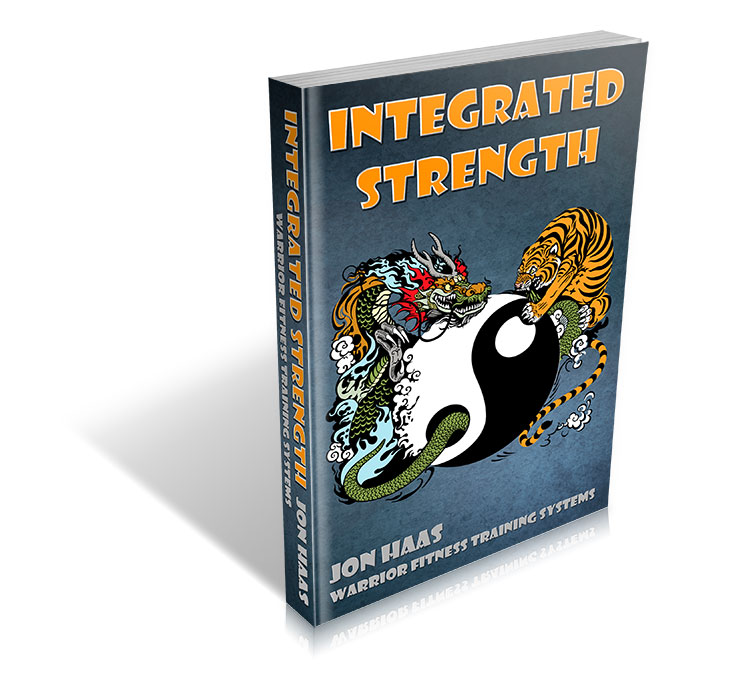
You can learn my full method of integrating and training the mind-body system HERE.
 

I am also more than happy to share what I know about internal power training, especially in the context of how it can be fully integrated into our Bujinkan Budo Taijutsu practice.  I teach it in my weekly classes and seminars upon request. Contact me HERE.
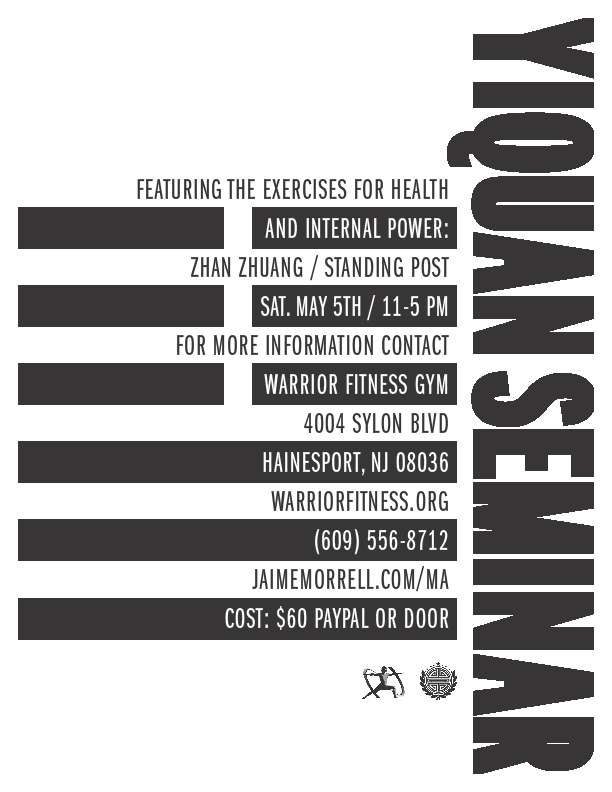
Yiquan Seminar Announcement


Warrior Fitness Gym is proud to present a seminar with Jaime Morrell on Yiquan, featuring exercises for health and internal power.

For more information on Yiquan please see our 2 part interview with Jaime Morrell:

An Introduction to Yiquan: Martial Art, Health, and Physical Fitness

An Introduction to Yiquan: Part 2

Map and Directions to Warrior Fitness Gym are HERE.

Any questions on the Yiquan Seminar or Warrior Fitness Gym Programs, call Jon at (609) 556-8712 or email me HERE.

To pay online, click Paypal link below: