Your Keys to Progress

How many people do you know who rarely, if ever, get the results they are seeking from their exercise regimen?  You may be one of them!  The question is, why don’t you (they) get results?  These people may be “exercise nuts” or “gym rats” or even “exer-holics”, or they could just be fascinated with the idea of exercise, but never actually doing any.  The four points below summarize what I feel to be the most important keys to progress when it comes to getting results and achieving your health and fitness goals, whatever they may be.

1.  Joint mobility on a daily basis. 

Daily joint mobility is a requirement to keep your progress moving forward.  Not only does it provide nutrition and lubrication for every joint in your body, but it also aids in removing waste products and deposits that tend to form over time causing pain.  The mobility increases our range of motion and acts as a prehab for enabling us to avoid injuries.  Additionally, it is an excellent way to warm-up the body prior to exercise or to get ready for the day first thing in the morning by increasing local blood flow to muscles.

2.  Yoga asana as compensatory movement for post-exercise cool down work. 

Since every action we do, as in exercise, or don’t do, as in couch sitting, causes an adaptation in our body, movements need to be specifically unloaded to bring us back into balance.  Compensatory movements remove tension caused by exercise and leaving us with the beneficial effects.  These movements are generally used as a cool down right after exercise or as a low impact recovery workout in and of themselves.  The selection of yoga asana (postures) has to be paired with each exercise performed as the complementary functional opposite of the movement to have the maximum desired effect.  By effectively integrating compensatory movements into your program, you can accelerate your progress, avoid injury, and keep moving forward.

3.  An incremental approach. 

Incremental progression is what keeps us from doing too much too soon and causing an injury.  Often we find that our bravado outweighs our brain when it comes to exercises, especially in the beginning.  We tend to want to jump right into the deep end in order to “get results faster”, but often end up injured, exhausted, or both with this approach and are unable to sustain the effort.  Health is about the long haul, not the short term effort.  If your program is unsustainable then it really has no value nor will it aid you in achieving your goals. 

4.  A plan sewing together all of the above. 

Having a plan is what brings all the prior elements together in cohesive, useable manner.  There is a tendency among some people out there to avoid having a program and to simply do the type of exercise they feel like on a particular day.  They also change the selection constantly in order to avoid boredom or so they can be “ready for anything”.  On the surface, this seems logical, but in reality unpredictable exercise selection simply leads to unpredictable results.  That’s no way to make progress.

Sometimes It’s OK to Not Follow the Program

Every have one of those days when no matter how fun, exciting, and productive your workout program happens to be, you just don’t feel like doing it?  I don’t mean out of lack of enthusiasm or laziness here though; motivation is not the problem.  You’re energetic and ready to train, but really just want to break out of the mold for a minute instead of sticking to the program.  This happened to me last night.  I went downstairs to my basement gym after putting the kids to bed ready, willing, and able to train.  I went through my standard head to toe joint mobility warm-up (sign up for the Warrior Fitness Mailing List to recieve a free chapter on Joint Mobility from my book, Warrior Fitness), followed by some breathing exercises to flush my bloodstream with oxygen and give me a little extra “go”, and then it hit me.  I had no desire to do my planned workout for the day.  Boom.  Just like that.  No warning, no indication, no nothing.  I stood there stunned for a minute just sort of staring into space, looking around the gym with a “what the heck do I do now” expression on my face.  Now don’t get me wrong here, I love the workout program I created for myself that I’ve been following for the past 3 weeks.  My results have been spectacular, my energy levels high, and I have, until last night, genuinely been looking forward to the workouts.  The exercises I was scheduled to perform were a combination of dumbbell lifts and bodyweight exercises designed to push my anaerobic threshold and build lean muscle while burning fat.  Great stuff!  So, what was the problem? 

What Did I Do?

I took a look around my little corner basement gym and my eyes settled on a pair of 15 lb clubbells against the wall, next to the dumbbell rack and thought to myself, Hmmm… haven’t picked those up in a while…. why not?  So I scrapped my preplanned workout for the day and picked up a clubbell.  I started out with some basic cleans to order, then moved into working shield casts, followed by mills, reverse mills.  No sets.  No rep scheme.  No timed rest intervals.  No plan.  Just playing with the movements and enjoying the freedom.  By the time I was done, 30 minutes had gone by and I was drenched in sweat and smiling ear to ear.

Sometimes it’s ok to not follow the program.  But, tomorrow it’s back to the dumbbells!

You Have No Idea What Being Fat is Costing You

Special thanks to guest author, Alan Livelsberger for this insightful post!

I have a secret to share with you; I used to carry a few extra pounds with me.  Almost fifty, actually.  But that’s not the secret.  Anyone looking at me could have told you that.  You’ll have to keep reading to learn my secret. 

Several months ago, I decided to do something about the extra weight.  It wasn’t easy and I am certainly not perfect with regard to adherence to my weight loss plan, but I’m halfway to my goal weight.  One of the reasons I am so far along is the Warrior Fitness blog and my access to Jon.  The blog keeps me motivated and Jon is great for keeping me honest about working out.  He’s part of my support system that is so crucial to success and I urge you to make him part of yours.

This brings me to my secret, “Looking thin is cool, but being thin is awesome.” It is a hard feeling to describe, almost like waking up from a drug induced stupor.  The best way that I’ve found to describe it is that it’s like when you’re not getting enough sleep.  Any parent knows what that is like with a new born in the house.  Months of getting up one, two, or three times a night.  You’re grumpy, you can’t focus and then . . . you get two great nights of sleep in a row.  All of a sudden you notice how you are supposed to function and what you have been missing. 

Well that is what losing 20 pounds of fat is like.  You have more energy.  I used to struggle to finish my Muay Thai class.  Now, not only can I finish the class, I can jump rope or lift weights afterward.  You can think more clearly.  I feel I am retaining more of what I read and also making those connections among seemingly unconnected data pieces.  I’ve also noticed that I have more confidence and less aches and pains. 

One of the most surprising benefits is that you feel like a winner.  You are literally piling up victories.  Every time you forgo an unapproved food or get a workout in, you are instilling a culture of winning within yourself.  Not a bad thing to have in life, for sure.

Those are some great benefits to dropping a few pounds, and I urge you to examine how you feel each and every day.  If you think there is something more to life, there is – go find it.

About the Author

Ever since being inspired by Kung Fu Theatre, Alan has been a martial arts enthusiast.  Over the course of 20 years, he has dabbled in Judo, BJJ, and Russian Martial Art.  He is currently an Instructor Candidate in ROSS and a Muay Thai practitioner.

Basics Ain’t So Basic After All

As a teacher and student of Bujinkan Budo Taijutsu, I often hear the same question over and over again – how can I improve my skill?  What should I practice to get better?  Since I remember myself asking that question several times (probably several hundred times if you ask some people!) to my teacher and seniors in the art, I always take time to give a thoughtful and honest answer.  And, my answer to these sincere seekers is always the same  – practice the basics. 

Basic Does NOT Equal Simple 

I think maybe the term “basic” itself is a little misleading.  When someone says, basic, most of us immediately translate it in our minds to “simple”.  Nothing could be further from the truth for the basics of our martial art.  What I’d like us to do today for the purposes of our discussion is to suspend the judgement that basic = simple.  Instead, replace the word basic with foundational.  How do you continue to build upon a skill set indefinitely?  Well, the foundation must be strong.  It must be broad.  And, to keep going higher still, it must be deep.

Each January, every year, for the past 20 years I have been training in the Bujinakn, my teacher, Jack Hoban, spends the entire month with us reviewing nothing but the basics of our art.  This sets the tone for the year and helps to increase the capacity of the entire class to absorb the higher level lessons for that year.  Guess what?  Invariably, I learn something new each time Jack teaches.  Every year, just by practicing the basics… eh… excuse me… the foundational training of our system new ideas, new concepts are born as we go deeper into the details and application of the techniques.

Shu Ha Ri

In traditional Japanese arts, there’s a concept called Shu-Ha-Ri.  This is a method of progression, or more accurately, a cycle of progression, for learning any art.

Shu – “Protect” the form. 

Ha – “Break” the form

Ri – “Leave behind” the form

This process is a continuous cycle in our Bujinakn training.  In order to progress higher in the art, our base must be solid, so we protect the form.  In order to understand the art, we must begin to break the form.  In order to master the art, we must leave the form behind.  Yet, this is not a linear progression at all!  Working on the foundation is never a step backwards.  Think of it more as a ratcheting back to spring forward.  Want to surpass your current level?  Strengthen the foundation.

Think you know the basics?  Think again.

I will be sharing my interpretation and experience of the foundational skills of Bujinkan Budo Taijutsu here.  Please come and check it out!

What’s Tabata You?

If you have been keeping up with the latest trends in conditioning research then you probably already know that interval training is the most efficient way to train.  Interval training alternates periods of high intensity exercise with periods of rest to produce gains in both aerobic and anaerobic systems.  Forget about those long slow distance runs to improve aerobic fitness!

The Body’s 3 Energy Systems

To briefly summarize, the body has three energy systems, 2 anaerobic, or non-oxidative, and 1 aerobic, that serve to create ATP (adenosine triphosphate).  ATP is utilized by every cell in your body; it fuels muscular contractions, cognitive processes, and internal regulatory functions.   Both anaerobic systems fuel maximally intensive activity, while the aerobic system fuels sustained low to moderate level activity.

The ATP-PC system provides immediately available energy for high intensity efforts from ATP stored within the muscles.  This system is the most powerful, but least enduring of the three, lasting only about 10 to 30 seconds max.

The Glycolytic system, the second most powerful, is only slightly more enduring than the ATP-PC system.  It derives energy from glycogen stored in the muscles and liver converting it to ATP in a process called glycolysis.  Its capacity is approximately 90 to 120 seconds.  Rest intervals allow the body to recuperate and restore ATP.

Lastly, the Aerobic system uses proteins, fats, and carbohydrates to produce ATP.  As the intensity of the effort increases, the aerobic system relies more on glycogen for energy.  If the intensity continues to increase, the anaerobic systems must kick-in to provide energy.  The important idea to realize here is that all 3 energy systems are always supplying the body with the energy it needs for any activity, at any level of intensity.  It’s just that one may be more dominant than the other 2 at a specific time.

If Anaerobic is ‘Without Oxygen’, Why am I Sucking Wind?

If you have been following any of the Warrior Fitness Training Programs, you are already familiar with examples of anaerobic exercises and how they affect the body.  Have you noticed how after even a brief, but intense anaerobic session you are breathing heavily?

If anaerobic really means ‘without oxygen’, how come you are so out of breath?

What happens is that your aerobic system is trying like heck to help restore your anaerobic systems.  All that extra oxygen is being used to metabolize the lactate that’s accumulated in the muscles during the bout of intense activity.  In order to continue to supply energy for all-out, intense efforts, the anaerobic system must be replenished.  Excess Post-exercise Oxygen Consumption (EPOC) is the term used to identify this process of extra oxygen being taken in to restore all systems.  So, basically, as the intensity of your exercise increases, so does your EPOC.  And, that’s why you’re sucking wind!

Tabata Protocol

No discussion of interval training would be complete without touching on Tabata.  Dr. Izumi Tabata at the National Institute of Fitness and Sports in Tokyo, Japan performed perhaps the most well known study on interval training.   A group exercising with moderate intensity endurance training was compared to another group using high intensity intermittent training.  Each group exercised 5 days a week.  The moderate intensity group exercised for 60 minutes, at 70% VO2 max.  The high intensity group did 8 intervals of 20 seconds, followed by 10 seconds of recovery.  They operated at 170% VO2 max.

After 6 weeks, both groups experienced improvements in maximal oxygen uptake.  The biggest difference between them was that only the high intensity group gained improvement in anaerobic capacity.  The high intensity group actually realized a 28% increase in anaerobic capacity AND a 14% increase in VO2max.  So, the study concluded that high intensity intermittent training can improve both the anaerobic and aerobic systems simultaneously.  Very impressive results!

How Can I Use Tabata?

I knew that after reading the amazing results achieved by Dr. Tabata you’d be ready to try using his protocol, I sure was!  The protocol itself is pretty simple, in theory.  Choose an exercise – say sprints, for example.  Perform the exercise for 20 seconds as fast as possible while still keeping good form.  Rest 10 seconds.  Complete 8 rounds.  Sprints are an easy example, but really the Tabata Protocol can be applied to almost any exercise.  Try some of these:

  • Bodyweight squats
  • Burpees
  • Kettlebell swings or snatches
  • Sledgehammer swings
  • Push-ups
  • Sprawls
  • Renegade Rows
  • Sandbag Shouldering
  • Mountain climbers
  • Jumping

These are just a few examples of exercises that can be used with Tabata. Just make sure you don’t overly complicate it because you do have to be able to perform several reps within the 20 seconds!!

Additionally, try grouping together 4 to 6 different exercises to increase the effectiveness of the workout and create a synergistic effect where the total combined effect is greater than the sum of the individual exercises.  This, I think, is where the real fun begins!

To seriously amp up your conditioning, learning how to use various breathing techniques to restore yourself quicker, lower your heart rate, and increase the effectiveness of your conditioning sessions is a MUST!

warfit3d3

Top 5 Mistakes When Starting an Exercise Program

In my experience there are several things that can contribute to failure in an exercise program, or any other goal for that matter.

In the past when I would fail to achieve a specific fitness goal or suffer a setback, minor or major, I’d chalk it up to fate and just try harder the next time.

As I grew older, and smarter, I began to see a pattern emerge.  These things didn’t just happen, there were particular sets of circumstances, most often at the outset of an exercise program, that combined to allow them to happen.

The list below comprises what I consider to be the top 5 mistakes.

You may have discovered others, and I would encourage you to share them in the Comments section below, but in my mind these are the most critical errors.  As Saint Thomas Aquinas rightly taught many times, “An error in the beginning is an error indeed.” 

An Error in the Beginning

1.  Too much too soon.

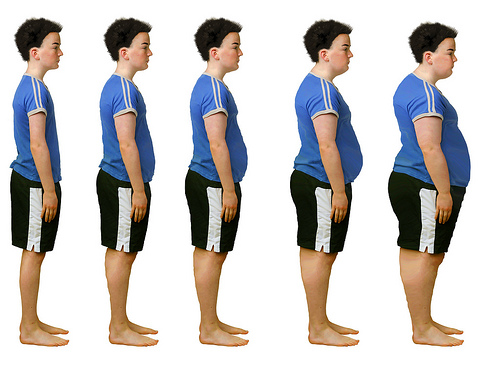
Everyone wants results NOW!  The problem here is that when talking about results, incremental progression reigns supreme.  Let’s face it, if you are trying to lose weight, for example, it took a long time, maybe years, to get to be over-weight.  Losing fat is not going to happen overnight, no matter what the TV ads tell you.  It took time to condition yourself to be out of shape, it will take time to re-condition your body to be in shape.  Be patient.  Focus on the process – you’ll get there!

2.  Lack of a training plan.

In my mind, it is essential to have some knowledge of how to program an exercise selection to correlate with the goals to be achieved.  Without this it’s pretty much hit or miss as to whether you achieve your goals, or even remain consistent.

3.  Lack of effective warm-up and cool-down strategies.

This goes hand-in-hand with lack of a training plan above.  DOMS, or Delayed Onset Muscle Soreness, is a significant contributor to people actively deciding to not pursue their fitness program.  When joint mobility as a warm-up, and yoga postures, as a cool-down, are effectively combined with the exercise selection needed to be successful, they tend to reduce or eliminate DOMS.

4.  Nutrition that does not support the exercise program.

While the diet OR exercise approach has some merrits, it’s simply not enough.  Get your eating in line with your workouts, and in line with your goals.  Diet AND exercise is a powerhouse combination.

5.  Quitting.

Yes, this will really ruin an exercise program.  But seriously, how many people begin a regimen with the best intentions yet due to other life pressures, lack of motivation, lack of results, or lack of interest, fail to be consistent? What’s the best, most effective way to prevent quitting? Have a coach who will hold your feet to the fire!

Check out the elite Warrior Fitness Distance Coaching Program HERE!

How about you?  What things contribute to derailing you from the fitness track?  And, more importantly, how do you remain focused?  I’d love to hear from you!

Warrior Fitness Recommended Equipment

A question I often receive through email (which, by the way is great, please keep them coming!) is whether or not Warrior Fitness is strictly a bodyweight training system.  In short, no it’s not, but let me expand on that.  Bodyweight training is an outstanding way to exercise.  It requires absolutely no equipment, no gym membership, a small amount of space, and can be done virtually anywhere.  It works equally well for the business traveler, the stay at home parent, or the vacationer.  In my opinion bodyweight training should be the foundation of your fitness program, especially if you are just starting out.  My rationale behind this is a simple one: if you cannot master your own bodyweight first, you really have no business adding weight.  Now, obviously there are exceptions to this rule.  For example, if you are being treated by a Physical Therapist and they recommend a weighted exercise to help your condition, then you must follow their advice.  Additionally, I said it should be the foundation of your program, but that doesn’t mean equipment cannot be added for variety, to increase the combined exercises effectiveness, or to shore up a particular strength or mobility deficit. 

With that out of the way, here is a short list of the equipment I do use for myself and with my clients and highly recommend.

The Equipment List


1.  Sandbags – Cheap and easy to make yourself.  Great for taking strength and conditioning outside the box.  Want to make one?  Get an army duffle bag, two 50 lb bags of sand from your local Home Dept, a box of gallon freezer bags, and some duct tape.  Fill the freezer bags with sand.  Double bag them, then duct tape them to make sure they are secure.  Place the duct-taped, sand filled freezer bags inside the duffel bag (make heavier or lighter depending on your preference), zip up the bag, secure it, and you’re good to go!

2.  Kettlebells – I got my first kettlebell from Dragondoor back in 2002 when they were the only supplier outside of Russia.  Nowadays kettlebells have gone mainstream and can be found at your local Walmart (along with pretty much anything and everything else!).

3.  Dumbbells – The cheaper kettlebell alternative, just not as cool looking.

4. Clubbells – These are excellent for targeting angular and rotational strength, as well as sport or activity-specific performance enhancement.  They are currently only available through RMAX.

5.  Resistance Bands – Can be obtained from Elite Fitness Systems here

6.  Pull-up Bar – I made my own in the basement from a couple pieces of wood, some rope, and a metal bar, but there are also portable pull-up bars you can buy for under $40.  Here’s an example: EZ Chin Up Bar – Portable, Powerful, Personal and Effective Exercise Machine.  The other option is to train outside and use a sturdy tree branch.  This is an excellent alternative when the weather turns warmer!

7. Medicine Balls – Can be found at Sports Authority,  or most other sporting good stores, for about $30.

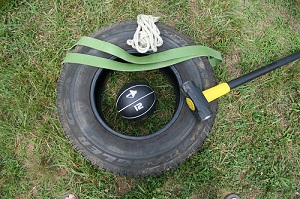
8.  Sledge Hammer and Tire–  Hitting a tire with a sledge hammer is not only an incredible conditioning exercise, it’s also really fun and great stress relief!  Make sure you do this outside though!  Pick up a sledge hammer from your local Home Depot or Lowes.  I got mine for about $25.  Tires are usually free.  Stop by any Tire and Auto shop and ask them for a used tire.  Since they are disposing of them anyway, they are more than happy to allow you to take one.   

As you can see, each piece of equipment is portable, able to cover a wide array of exercises and levels of ability, and, with the exception of clubbells and kettlebells, are all inexpensive to make or buy.  Which one is best?  All of them and none of them, depending on the specific goals you set for your health and fitness.  They are all tools in the Warrior’s arsenal to be used as needed.  Stay tuned for more information as to how the Warrior Fitness Training System utilizes all of the above fitness equipment!

8 Ways to Fit in Your Fitness

It’s often been said that if you want something done you should give it to a busy person.  While this may be true of some busy people, namely the ones who are highly motivated, highly productive, and highly efficient, what about all the other busy people?

What about those who are busy through poor time management skills, or maybe those who are simply overwhelmed?  How about them?  Does the task they are given merely get thrown on top of a growing pile of “To-Do’s”, or even worse, shuffled to the bottom?  What if the task they are given, or give themselves, is directly related to increasing their quality of life and most likely longevity as well?  What if that task will help them be more productive at all their other tasks by reducing stress levels, increasing energy, and their overall sense of well being?  What if that task would help them to reduce, remove, or otherwise prevent a host of daily aches, pains, and illnesses that are stoically (or sometimes not so) suffered as things that “just happen” as we grow older?


Here’s a list of 8 ways for these busy people to fit in their fitness and reclaim a healthy lifestyle:

1.  Plan it out.

Scheduling is the key to successful time management.  Look at your weekly calendar and plan to exercise just as you would plan an important client meeting, a lunch with an old friend, or coaching your kid’s Little League team.

2.  Exercise wherever you are.

Joint mobility sessions can be done at your desk – see here.

3.  Take the Stairs.

Work in an office building?  Take the stairs instead of the elevator.  See how fast you can make it to your floor – beat those lazy suckers in the elevator to your floor!

4. Get outside.

Have a lunch break?  Go outside and go for a walk.  10 minutes in the fresh air will do wonders for you.  Eat at your desk while you work and then go for a walk.  Want to make your walk more productive?  Try inhaling for 5 steps, holding you breath on the inhale for 5 steps, exhaling for 5 steps, then holding the breath after the exhale for 5 steps.  When you can comfortably do that for the entire duration of your walk, increase to 6, 8, 10 steps!

5. Get up earlier.

Get up earlier and workout **warning – this one requires effort and commitment!!**

6.  Exercise together.

Spend quality time with your kids.  Exercise together – see Warrior Fitness for Kids.

7.  Brief workouts.

Got a spare 15 minutes?  Bring the intensity and lose the long, boring workouts.  See the Warrior Fitness WOWs for some ideas.

8.  Isometrics.

These require very little time to be effective, need no equipment, and can be done literally anywhere.

Obviously, this list is neither exhaustive nor all inclusive,  but I do hope it has helped you and sparked some ideas to help you fit in your fitness no matter how busy you are.  What ideas do you have?

A Worthy Cause…

Hi Everyone,

My cousin, Karen, is raising money for the Crohn’s and Colitis Foundation by running a 1/2 Marathon in July (yeah, I know, crazy) and I’m asking you to help by making a contribution!  Please use the link in below to donate online quickly & securely.  You will receive email confirmation of your donation and I will be notified as soon as you make your donation. I thank you in advance for your support, and really appreciate your generosity!!

http://www.active.com/donate/boston10newjersey/KarenRunsNapa

This is a great cause and I love the fact that it involves fitness as the mode to raise money for research!  I have already made a donation, please support Karen and the Crohn’s and Colitis Foundation by making yours today!