Internally Rotate My What???

This post was inspired by a Facebook conversation started by my friend Jarell Lindsey talking about a mobility-based squatting motion with the feet parallel as opposed to splayed out (BTW, have you check out the Physical Culture Club page yet???)

There are many different ways to squat whether it is bodyweight only or with an implement such as a barbell, kettlebell, sandbag, or even another person.

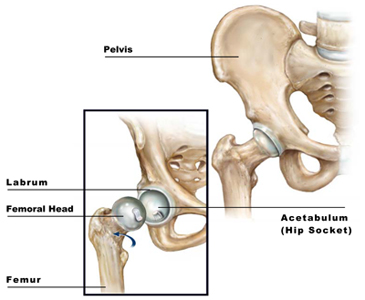
The particular squat I am talking about here is what I refer to as an Internal Rotation Squat.  The Internal Rotation Squat differs from the traditional bodyweight squat in that the feet are parallel, as opposed to opened outward, and the squatting motion is accomplished by internally rotating the femoral heads within the hip sockets rather than relying on quad muscle power alone.
hip-anatomy-new

The Internal Rotation Squat requires MUCH more mobility, control, and mind power to accomplish since you must actually teach your body how to rotate the bones of the femurs within the hip sockets.  This will take some practice!

 Why Do This?

In order to begin generating what known as Internal Power (IP), you must have mobility in the inguinal area that the Chinese Internal Martial Arts refer to as the kwa.  There is much, much more to IP than this, but having mobility in the kwa is an essential requirement.  Additionally, even if you have no interest in IP or Chinese Martial Arts, having this type of mobility and control is an asset in any athletic endeavor or martial art, regardless of style.

Internal Rotation Squat – Bodyweight Version

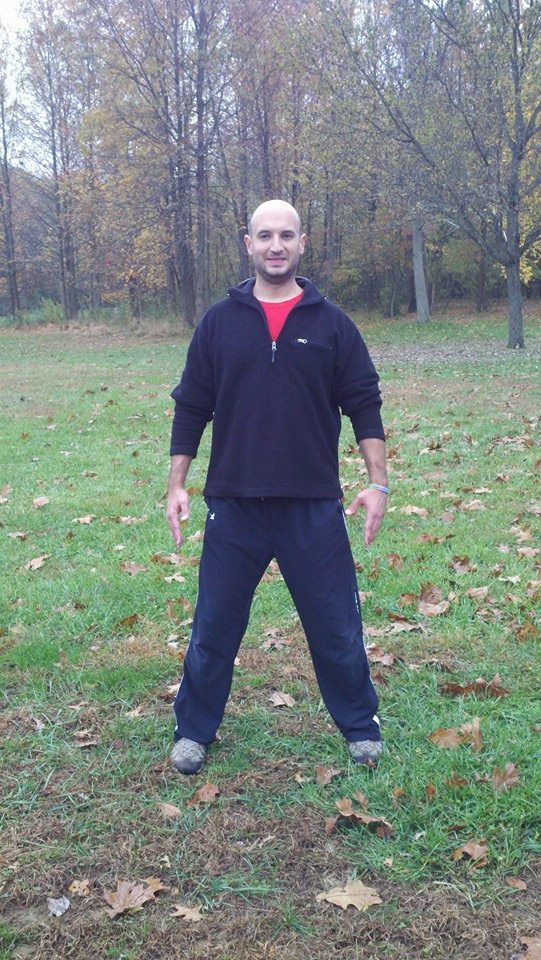
Begin with feet slightly more than shoulder-width apart.  Keep the feet facing forwards, as if on railroad tracks.
Squat1

This will be important later when working on winding the tissues, but for now, just do it.  Place your fists on either side of the kwa (inguinal area) where the femur bones connect in to the hip sockets.  Use the imagery of turning your fists to aid in turning the bones.  Internally rotate the femoral heads and sit down into the kwa.
Squat2

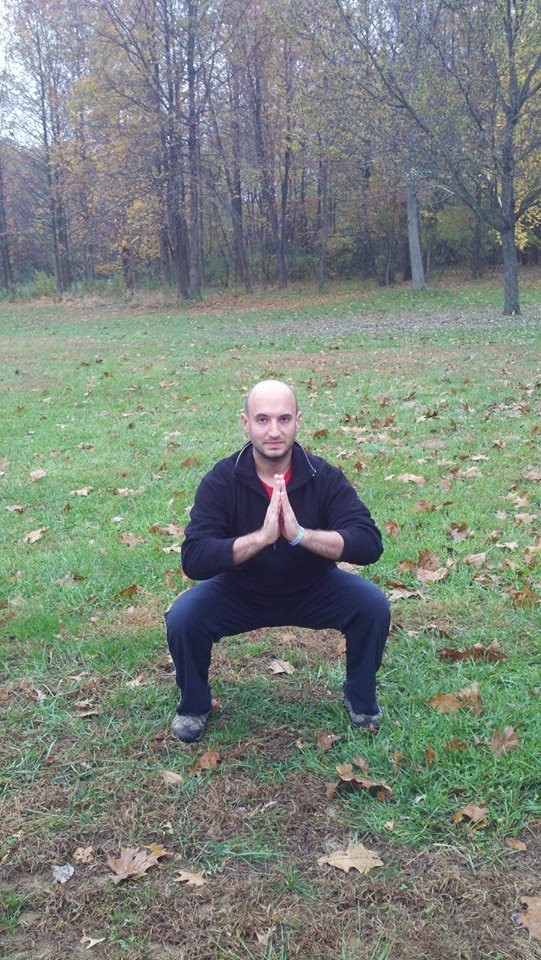
Squat as low as possible while keeping your back straight and the weight mid-foot balance.  Pause at the bottom then externally rotate the femoral heads to stand back up.

Internal Rotation Squat – Goblet Squat Version

All requirements are the same as above with the addition of holding the kettlebell in front of your chest in the Goblet Squat position.  Use the weight of the kettlebell to allow you to sink further into the kwa.
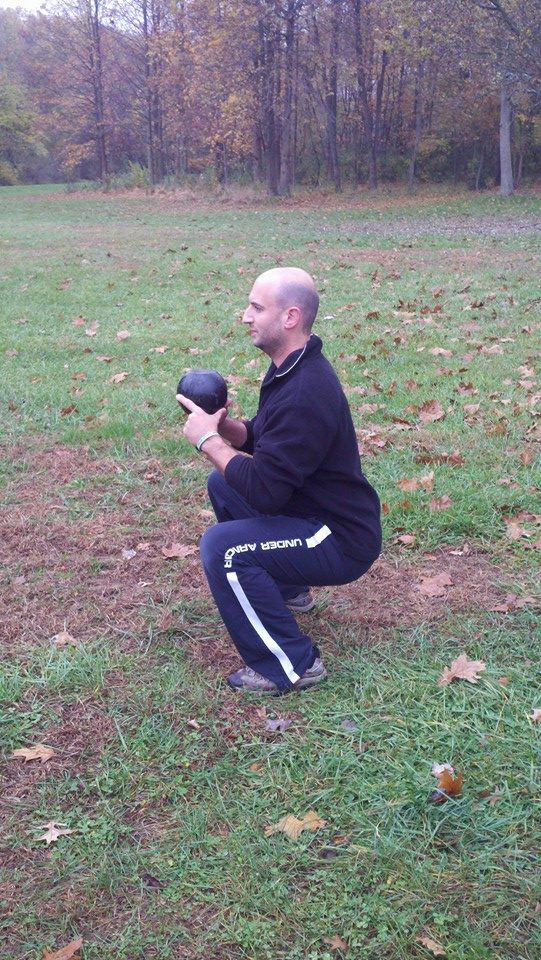
Goblet Squat2

Thanks to Dan Harden for teaching me this exercise in the context of working on Aiki/IP.  Any errors or omissions are my own and not the responsibility of my teachers.  Also, thanks to Jaime for helping me to refine the squat and for taking the pictures!

Also, Dan Harden will be back in NJ in March 2014.  Details on the seminar can be found HERE <<====
 

Brand New Services from Warrior Fitness!

Warrior Fitness is going mobile!!

You may have heard the news that I am closing the physical location of Warrior Fitness Gym this week.  This is not a bad thing.  The Warrior Fitness Training System existed prior to the gym location (I wrote the original Warrior Fitness book in 2008), and it will go on after it.

Now that I am no longer shackled to a brick and mortar location I have the ability to expand my global reach and provide even more coaching, teaching, and results to you.

This change allows me much greater adaptability and mobility to train my local clients here at home and also frees me to teach more workshops, seminars, and classes in other locations, both here in the US and abroad.

With that preface, I am introducing 3 brand new services from Warrior Fitness:


1) Local Warrior Training.

There are 3 new options here: Weekly Warrior Bootcamps in the park (see Class Schedule HERE) and Warrior Personal Training at your home, office, or other location.  Corporate Warrior Training is also available – short, intense, highly effective workouts for the busy executive and employees to train both mind AND body!

Email me for details on scheduling and pricing.


2) Seminars and Workshops.

Topics include:

  • Warrior Fitness Training,
  • Building Martial Power,
  • Bujinkan Budo Taijutsu,
  • Building Power and Flow in Taijutsu,
  • Women’s Self Defense,
  • Combat Conditioning,
  • Introduction to Internal Power for Bujinkan Martial Arts.

Email me for details on scheduling and pricing.

3) Online Coaching Opportunities.

I will put together an individualized program specifically tailored to you and your training goals.  Check HERE for all the details.


journey1_large

Warrior Podcast with Eric Guttmann

In an effort to provide you, my dear readers, with the best information out there on strength, health, fitness, and martial arts, I am interviewing top coaches, professionals, martial arts masters, and ordinary people who do extraordinary things. Continue reading

10 Reasons I Love Kettlebells by Logan Christopher

I want to share with you all the reasons that I love training with kettlebells.

1 – They’re Different

Back when I first tried a kettlebell I was pretty much a bodyweight only guy. I had been led to believe that “weights didn’t build functional strength”. The thing that led me to believe this was when I worked out in a gym I didn’t get much in the way of results, but when I switched 100% to bodyweight training I started making real gains. Now I know that it wasn’t the weights themselves that caused my lack of gains, but how I was training. Continue reading

Why I Hate Kickboxing

For months now people have been asking me to implement a Kick Boxing program at Warrior Fitness Gym.  I’ve been resisting the pressure mainly due to one important factor – I hate kick boxing. 🙂

Allow me to clarify.  I hate what real kick boxing has devolved into, the dreaded “cardio” kick boxing.  To me, cardio kick boxing is almost worse than Zumba as far as fitness goes. Continue reading

4 Principles For Punching Power

Principles of Striking Power


1.    Whole Body Power

All movement happens in real life happens in three dimensions, so why train exercises that only incorporate one or two?  Training muscles in isolation, unless it is used to rehab a specific injury, range of motion, or strengthen a particular muscle to add to the whole, does not work in martial art.  With very few special exceptions, the majority of exercises in this manual will train movements in three dimensions utilizing diagonal, rotary, and angular strength, not muscles. As discussed above, this is the goal of SPP – neurological adaptation.


2.  Stored Elastic Energy (SEE)

Stored Elastic Energy is basically the potential energy stored in tendons and connective tissue as a way to power movement.  An easy exercise to begin to feel stored elastic energy is to stand in a natural stance with feet shoulder width apart.  Bend your right arm and raise it up to shoulder height as if you were about to throw the most telegraphed punch in history (don’t worry, it’s just an exercise).  Now, lead from the elbow and pull your fist back.  Allow your torso to rotate, but keep the feet planted and the hips facing forward.  When you reach the end of your range of motion, hang out there for a second and feel the tension (torque) on the spine.  Now simply relax and release that torque to throw the punch.  Don’t add any driving forces with muscle.  You can’t propel it any faster; you’ll just slow it down.  Feel it?  Try it again.  Do it with the other arm.  Remember the feeling.  This is stored elastic energy (SEE). This point here about creating torque or stored elastic energy (SEE) in the spine is essential in being able to move powerfully without winding up or telegraphing the movement. If you are having trouble feeling it, try to exaggerate the movement. Make it much larger than necessary to study the feeling. It should feel like a tension in the lower back near the bottom of the spine. When this tension (torque) is relaxed (released), the movement happens.

WF UG Cover1

3.   Structure / Kamae

 Many people tend to use the terms alignment and structure almost interchangeably but in actuality, alignment is a component of structure. For example, looking at a natural standing posture, good alignment would be:

  • Crown up
  • Chin down
  • Shoulders packed down
  • Spine lifting up (through crown)
  • Spine pulling down (through the sacrum)
  • Hips under shoulders
  • Knees under hips
  • Mid-foot balance
  • Chest is relaxed
  • Butt not sticking out
  • Hips are open
  • Knees are over the toes
  • Weight evenly distributed (50/50)
  • No leaning forward or backward

This puts the whole body into proper alignment. Structure also includes (in my lexicon) the balance of tensions within the body’s soft tissues. Think of spine as the mast of a sail boat while the soft tissues (fascia) act as the stays keeping the tensional balance.


4.           Breathing

 How often do you think about breathing as it relates to striking?  Yet it is absolutely essential to maintain proper breathing when in combat or simply hitting a heavy bag, mitt, or an opponent.  Lack of breath control affects the rest of your body and hinders your overall performance.

This article is from my e-book manual, Warrior Fitness Guide to Striking Power.

Want to learn even more about how to bring together fitness training with your martial art practice for vast performance improvement?  Join me on a 6-week journey where I take you behind the curtain and show you how to build Martial Power!

MP

Intelligent Tension For Striking

How intelligent is your usage of tension in striking?

All too often in training our punching and kicking techniques, we find what I’ve come to label as “dumb tension”.  This is used by martial artists across the board either accidentally through lack of understanding of how the body should work, or taught and passed down from teacher to student on purpose through a lack of knowledge.

Dumb tension is defined as either the complete usage of whole body, generalized tension to attempt to deliver extra power to a specific kick or strike, OR the complete lack of any and all tension to attempt to whip a wet noodle-like strike at the opponent or target.  Both of these things miss the boat, in my opinion.

Walk the Middle Path

Intelligent Tension (IT) is simply walking the middle path between the two extremes and using the appropriate amount of tension required, and only that amount, to coordinate whole body power into a strike.  More tension does not necessarily equal more power in terms of striking.  Actually, the more tension recruited for a movement, the more you apply the brakes physiologically since your body is now moving against itself in an attempt to use generalized tension.  When both the agonist muscle and antagonist muscle are working against each other the result is less overall power delivery for the strike.  Learning to appropriately activate only the muscles necessary to accomplish the task removes the brakes, ups the power wattage, and increases the efficiency since you are no longer using energy you don’t need.

Additionally, the more tension created in a movement, the less mobility you have.  If you look at tension and mobility on one line with tension on one side and mobility on the other, the more you have of one, the less you have of the other.  When we train the nervous system to fire high tension all the time, we lose mobility and range of motion.  While this is perfectly acceptable and absolutely essential for a purely low-gear strength based activity like dead lifting, it is not fine for martial arts.

This article was a short excerpt from my manual, Warrior Fitness Guide to Striking Power.

WF UG Cover1

Get The Warrior Fitness Guide to Striking Power (e-book) and the original book, Warrior Fitness: Conditioning for Martial Arts (e-book) FREE when you pick up my brand new program –          WarFit Combat Conditioning!

warfit3d3


Top 7 Exercises for Warriors

Here is the list I put together of my Top 7 Exercises for Warrior Training.  Not that these are the ONLY exercises you should do or would ever need but, if I were forced to narrow down my selection to my top 7, these would be my picks.

The great thing about this list is that if you were to just do these 7 exercises combined into a progressive training program, you would get amazing results of strength building, metabolic conditioning, fat loss, and endurance.  The side benefits would also include greater core strength, agility, and coordination.  So go forth and add these to your training program!


1. Clubbell Mills / Reverse Mills

2. Jumping

Burpee 4

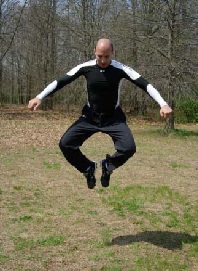
Any type of jumping is not only excellent conditioning for explosive strength, but also mandatory for a warrior.  You must be able to leap out the way of a sword strike or over an obstacle!  So, whether it’s box jumps, tire jumps, broad jumps, lateral jumps, etc, they are all important and necessary training.

3. Pull-ups

Warriors need pulling strength.  Get on the bar, the rope, the tree branch, or even the monkey bars at the local playground and start pulling!  Change up your grip each set.

4. Push-ups

Most people consider push-ups a basic exercise and only know a handful of variations.  I consider push-ups an amazing developer of whole body strength, coordination, and agility with almost limitless variations – ask my clients! 🙂

5. Tire Flips

Whole body strength and power plus the added satisfaction of flipping a 400 lb tire.  Simply badass!

6. Ground up lift

This can be any lift from the ground up to overhead.  Use a barbell, dumbbells, kettlebell, sandbag, keg, small child, whatever!  Clean and press it.  Snatch it.  Jerk it. Turkish Get Up it!  Just lift it!

7. Sledge hammer swings


These are simply awesome for conditioning, developing striking power, and super-transferable nonstop core power.  Plus they are fun as hell and great for stress relief after a bad day!

Bonus exercise – KB Swings

You are your weakest link!  For most people their posterior chain is a weak area on the body.  This exercise will fix it.  Oh yeah, if you still think you need to do more cardio, try banging out a few hundred reps of these bad boys!


What exercises would you include as part of your top 7?  Drop a comment below!

Martial Power


  • Ready for a 6 week program that will explode your development as martial artist?

  • Ready to take strength and conditioning to a whole new level?

  • Ready to become agile, mobile, and hostile?

  • Ready to blow away all your former training plateaus?

  • Ready to build insane mental toughness and work capacity?

Then the Martial Power Coaching Program is for you!  Spots are limited so ACT now!

The 4 Top Strength Training Myths for Women

When talking about strength training for women there are several pervasive myths that seem to never go away.  Here are the four  most common ones.

  1. I’ll Bulk Up.  This is probably one of the most pervasive, albeit incorrect myths out there.  Women simply do not have the correct hormone profile to build huge, bodybuilder type muscle. Continue reading

How Conditioning Can Boost Strength

Thanks to my good friend, Coach Chris “Jersey Beast” Lopez, for this cool guest blog post!

The Benefits of Strategic Conditioning

When you hear someone talk about conditioning (especially combat athletes), it usually refers to the training they are doing to boost their endurance or drop weight. Very rarely do we hear about conditioning that will also directly boost strength and strength endurance. But if structured correctly, adding conditioning to your strength training split can directly increase cardio capacity, strength over time, performance, speed of muscular contraction, and even raw strength itself! Check out the video! Continue reading