Fighter Conditioning at the Cave

Guest post by my friend, Coach Frank DiMeo!

Ever since my early days of martial arts training I have always looked for ways to become more effective.

Much of the best information I gathered over the years came at a painful, and often humbling, price.

No matter what type of fighter you are, being stronger and faster is essential. Being able to “go the distance” is also a must as is developing greater stopping power in your strikes and kicks. Continue reading

Why I Hate Kickboxing

For months now people have been asking me to implement a Kick Boxing program at Warrior Fitness Gym.  I’ve been resisting the pressure mainly due to one important factor – I hate kick boxing. 🙂

Allow me to clarify.  I hate what real kick boxing has devolved into, the dreaded “cardio” kick boxing.  To me, cardio kick boxing is almost worse than Zumba as far as fitness goes. Continue reading

4 Principles For Punching Power

Principles of Striking Power


1.    Whole Body Power

All movement happens in real life happens in three dimensions, so why train exercises that only incorporate one or two?  Training muscles in isolation, unless it is used to rehab a specific injury, range of motion, or strengthen a particular muscle to add to the whole, does not work in martial art.  With very few special exceptions, the majority of exercises in this manual will train movements in three dimensions utilizing diagonal, rotary, and angular strength, not muscles. As discussed above, this is the goal of SPP – neurological adaptation.


2.  Stored Elastic Energy (SEE)

Stored Elastic Energy is basically the potential energy stored in tendons and connective tissue as a way to power movement.  An easy exercise to begin to feel stored elastic energy is to stand in a natural stance with feet shoulder width apart.  Bend your right arm and raise it up to shoulder height as if you were about to throw the most telegraphed punch in history (don’t worry, it’s just an exercise).  Now, lead from the elbow and pull your fist back.  Allow your torso to rotate, but keep the feet planted and the hips facing forward.  When you reach the end of your range of motion, hang out there for a second and feel the tension (torque) on the spine.  Now simply relax and release that torque to throw the punch.  Don’t add any driving forces with muscle.  You can’t propel it any faster; you’ll just slow it down.  Feel it?  Try it again.  Do it with the other arm.  Remember the feeling.  This is stored elastic energy (SEE). This point here about creating torque or stored elastic energy (SEE) in the spine is essential in being able to move powerfully without winding up or telegraphing the movement. If you are having trouble feeling it, try to exaggerate the movement. Make it much larger than necessary to study the feeling. It should feel like a tension in the lower back near the bottom of the spine. When this tension (torque) is relaxed (released), the movement happens.

WF UG Cover1

3.   Structure / Kamae

 Many people tend to use the terms alignment and structure almost interchangeably but in actuality, alignment is a component of structure. For example, looking at a natural standing posture, good alignment would be:

  • Crown up
  • Chin down
  • Shoulders packed down
  • Spine lifting up (through crown)
  • Spine pulling down (through the sacrum)
  • Hips under shoulders
  • Knees under hips
  • Mid-foot balance
  • Chest is relaxed
  • Butt not sticking out
  • Hips are open
  • Knees are over the toes
  • Weight evenly distributed (50/50)
  • No leaning forward or backward

This puts the whole body into proper alignment. Structure also includes (in my lexicon) the balance of tensions within the body’s soft tissues. Think of spine as the mast of a sail boat while the soft tissues (fascia) act as the stays keeping the tensional balance.


4.           Breathing

 How often do you think about breathing as it relates to striking?  Yet it is absolutely essential to maintain proper breathing when in combat or simply hitting a heavy bag, mitt, or an opponent.  Lack of breath control affects the rest of your body and hinders your overall performance.

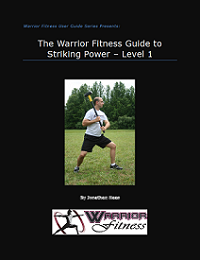
This article is from my e-book manual, Warrior Fitness Guide to Striking Power.

Want to learn even more about how to bring together fitness training with your martial art practice for vast performance improvement?  Join me on a 6-week journey where I take you behind the curtain and show you how to build Martial Power!

MP

Healing Yourself With Mobility – Part 3

Healing and Mobility Part 3 – Everyday healing of neck, vertigo, and surviving training mistakes with mobility


Guest blog post by Eric Guttmann, U.S. Navy Officer, Author, Fitness Enthusiast and More!

In everyday matters joint mobility also saves the day.  If for some reason you sleep with a craned neck and you wake up with neck pain you can easily and quickly get rid of it or reduce it significantly before you even head out to work by doing joint mobility.  I have done so on various occasions and believe me that it is better to work with a “little nagging pain” that goes away that day than endure the day with the kind of pain that makes you think about taking a pain killer or that seriously interferes with your quality of life.

Joint mobility also PROTECTS you by giving you a resilient body that can handle training mistakes a lot better.  As an example I was in Cartagena, Colombia, (yes, the same city where the Secret Service got in trouble) with the Navy and I woke up early to do incline sprints on the 300 year old walled city.  The particular incline I chose was made of cobblestones and had holes in it.  On my second sprint up this incline I completely twisted my ankle 90 degrees.  Because I had already warmed up my ankle to FULL mobility I was able to finish the sprint, and more importantly FINISH my workout like nothing had happened.  In fact, when I came down to do another set of sprints after I twisted my ankle a local came to me and said to me in Spanish “I saw what had happened to your ankle” somewhat concerned for my ability to safely walk on back to the hotel.  I simply laughed, shrugged it off, thanked him for his concern and FINISHED my work out by doing FOUR more sets of sprints.  I know for a fact that if the same thing had happened to me in my college days I would have been done for, because the same thing DID happen to me when I was in track and field and it took three weeks to heal!

Joint mobility has also helped me with my wife.  She had a case of vertigo a year ago and I taught her joint mobility, as the medicines the doctor gave her only made her feel worse.  The joint mobility (and acupuncture I gave her) where the keys to her recovery.  To this day she does the neck series everyday as a preventative and feels great every time she does it.

As I mentioned in my previous article, many of my friends I teach these drills comment on how their lower backs loosen up and become pain-free after the mobility series.  In fact, it was at the prodding of these friends that I decided to do my FULL mobility DVD, because they wanted something they could study in their homes after I left.

Now, in the first article I mentioned my father’s statement of “If you do something everyday, then everyday you will be able to do it.”  Every morning I go through my routine and establish full mobility in every joint.  I easily touch my wrists to the ground every morning.  Now I ask you, if I establish full mobility every morning and touch my wrists to the floor easily and gracefully every morning, am I going to have full mobility and easily touch  my wrists to the floor at 100 years of age?  The answers is ABSOLUTELY YES! All I have to do is keep doing my FULL mobility routine every morning.

I have been practicing joint mobility for five years now ever since I had the epiphany with my healed ankle.  I have been studying, incorporating, experimenting and refining my routine based on the works and/or my personal interaction with Pavel, Steve Maxwell, Scott Sonnon, Navy kinesiologists, Chek Practitioners, Z-Health, Mike Mahler, Chuck Habbaken, Bud Jeffries and others.

If you want to get your hands on the best mobility training out there and the EXACT one I have used to heal myself multiple times from the injuries sustained through training and life then click in the link below:
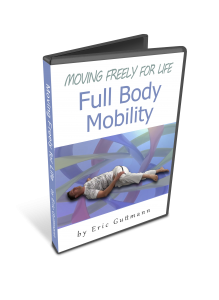
 MovingFreelyDVD-219x300As an added bonus I am including a FREE BONUS which is my SECRET stretching routine to open up the hip and lengthen the spine which I found are the keys to maximizing my Qigong practice (which would be the second thing I most recommend for longevity).

Done together the joint mobility and stretches can be knocked out in under 26 minutes, yet your health and quality of life will expand to new and greater levels that will seem like a 1000% return on your investment.

Another bonus is a makeshift mobility test that you can do to gage whether you are at a Level 1, Level 2, or Level 3 joint mobility.  If you train others you can also use it to gage where your clients are at and to monitor their progress over time.

So order this DVD now and try it for yourself. I know that you will feel immediately freer and open, even diminishing or completely getting rid off nagging pain if you are carrying any, at the end of the instructional session.  That is right, I am saying that after going through the instructional part just ONCE you will feel an immediate improvement in your mobility!  Commit to doing it everyday and you WILL have FULL mobility for the rest of your LIFE!

MovingFreelyDVD-219x300If you live in the New Jersey area and prefer personal instruction in mobility then I highly recommend you check out my friend Jon Haas’ school, Warrior Fitness at 4004 Sylon Blvd, Hainesport NJ, 08036, or give him a call at 609-556-8712 to set up an appointment or attend a class.

Read Eric’s complete bio HERE.
Intelligent Tension For Striking

How intelligent is your usage of tension in striking?

All too often in training our punching and kicking techniques, we find what I’ve come to label as “dumb tension”.  This is used by martial artists across the board either accidentally through lack of understanding of how the body should work, or taught and passed down from teacher to student on purpose through a lack of knowledge.

Dumb tension is defined as either the complete usage of whole body, generalized tension to attempt to deliver extra power to a specific kick or strike, OR the complete lack of any and all tension to attempt to whip a wet noodle-like strike at the opponent or target.  Both of these things miss the boat, in my opinion.

Walk the Middle Path

Intelligent Tension (IT) is simply walking the middle path between the two extremes and using the appropriate amount of tension required, and only that amount, to coordinate whole body power into a strike.  More tension does not necessarily equal more power in terms of striking.  Actually, the more tension recruited for a movement, the more you apply the brakes physiologically since your body is now moving against itself in an attempt to use generalized tension.  When both the agonist muscle and antagonist muscle are working against each other the result is less overall power delivery for the strike.  Learning to appropriately activate only the muscles necessary to accomplish the task removes the brakes, ups the power wattage, and increases the efficiency since you are no longer using energy you don’t need.

Additionally, the more tension created in a movement, the less mobility you have.  If you look at tension and mobility on one line with tension on one side and mobility on the other, the more you have of one, the less you have of the other.  When we train the nervous system to fire high tension all the time, we lose mobility and range of motion.  While this is perfectly acceptable and absolutely essential for a purely low-gear strength based activity like dead lifting, it is not fine for martial arts.

This article was a short excerpt from my manual, Warrior Fitness Guide to Striking Power.

WF UG Cover1

Get The Warrior Fitness Guide to Striking Power (e-book) and the original book, Warrior Fitness: Conditioning for Martial Arts (e-book) FREE when you pick up my brand new program –          WarFit Combat Conditioning!

warfit3d3


The Importance Of Isometrics

Thanks to Benjamin Bergman for this great guest post!

In most training methods, you learn to train the big muscles in the major muscle groups or for most in the gym, they isolate the muscle to a certain degree. Many neglect those little muscles that keep you intact and help avoid injuries. When you do your training, keep to your goals as much as possible but don’t forget to add in a little supplemental training. Isometrics work those little muscles like there’s no tomorrow and the amount of angles you can hit are limitless.


A key ingredient to having successful training is to be able to hit your Range Of Motion as best as you can. Some people have terrible ROM because of either an injury, just learning the basics or because of the way their body functions at that particular ROM. We all have different body types and we don’t always have the same leverage as everyone else but Isometrics can help your ROM from a specific position and increase the speed and strength of that position to your best capacity. I had trouble at one time with pull-ups and since I’m a big guy (245+ lbs.) It’s difficult sometimes to do a good amount of them but what helped me was holding specific positions in the pull-up or chin-up and after a while I began to hit reps like crazy being my best at 21 chin-ups and 17 at Pull-ups.


Working muscles especially the big ones can be good but only to a certain degree. When you don’t work the tendons and ligaments as often as possible, you’ll find that your body doesn’t function the way you want it to. Take a bodybuilder for example, he works big muscles but forgets building the tendons and so has a greater risk for injury and it only takes one minor mishap and he’s out for the count. The old-time Physical Culturists used Isometrics to enhance their strength gains in ways very rarely seen since that time. Some of them were Gymnasts, Wrestlers, Bodybuilders, Acrobats and others but one way or another they all used Isometrics to give them that edge because of that positional strength and how it keeps the joints healthy.


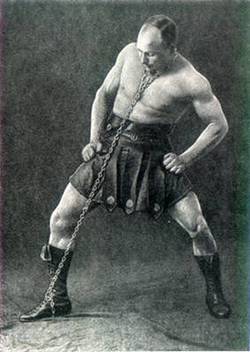
One thing you’ll learn about Isometrics not too many these days tell you is the dense and hardened muscle you develop from working different types of Isometrics. You see no matter how you work specific muscles or specific positions whether you hold for a few seconds or a few minutes, the blood rushing through the body and stressing that particular muscle or position puts density into that muscle. This can help build bone density and keep you from having long-term pain in the joints. One of the perfect examples of hard and sense muscle is the late strongman Alexander Zass, his style of Isometrics came from being in a POW camp during the 1st World War. He was chained up and instead of sulking and feeling sorry for him he pushed and pulled on those chains from as many angles as he can muster. He eventually broke the chains and escaped the camp. The muscle he developed was extraordinary and looked like a man that was carved by Michelangelo himself and this type of training made him one of the strongest men who ever lived by bending bars, twisting steel and bending spikes like they were a clothes hanger.

isometric-exercises-Alexander-Zass


Remember when I told you that you can hit an Isometric exercise from just about any angle? It’s true. One of the greatest wrestlers of his generation Karl Gotch once said “you always work your muscles from as many angles as possible.” This implies to not only dynamic movements but holding positions as well. When you hold a certain position say for instance a curl, you can work that particular exercise in the main three positions (down, middle and upper) but when you turn it in a different angle say if your arm is turned towards away or within the torso you’re still working a curl but your now working different muscles within that curl. You can do this with any exercise doesn’t matter.


Now I must warn you, doing Isometric Training in and of itself isn’t the only way to get super strong but when you add them in your current training, you can go beyond plateaus and this can help your ROM in a particular exercise like I’ve said before. A key thing is to use your imagination, think of what you want to improve and see in your mind’s eye how strong you want to be. One of the things I like to think of when I do Isometrics is when I work on my Arm Wrestling and I put a belt around a tree, I picture as if that tree was going to come down, I see it as a giant redwood and by the power of my own hands that tree will fall and I pull at times with everything I have and just want to toss that sucker right over the fence.


PT Barnum once said “Imagination is the elixir of life.” When you use your imagination no matter what it is, your results can come quicker, your body will move in a different way and your strength will skyrocket in ways you never thought of before. Make it a habit to live your training as if it was an adventure. Sure Isometrics are just holds but pictures how you use those holds, where you are and what is happening. You’d be surprised what you might find.

Check out Benjamin’s blog over at Ben’s Power and Might Writings!

Healing Yourself With Mobility – Part 2

Healing and Protecting the Lower Back

Guest blog post by Eric Guttmann, U.S. Navy Officer, Author, Fitness Enthusiast and More!

In my last article I mentioned how I healed a sprained ankle myself using joint mobility. Now whenever something happens I can quickly and easily fix it myself.  For example I was training my heavy snatches with a training plan I wrote for myself.  This plan laid out progressively heavier snatches as I got stronger and perfected my technique.  I was to spend a minimum of a week with each weight class or until I mastered the weight before going up another level.

I started to progress faster than I anticipated and I got so eager that I ignored my own training protocol and quickly jumped to the 88lb kettlebell instead of spending time training that week with the 70lb kettlebell like I had planned.  As I snatched the 88lb with abandon I felt a sharp pain in my back and instantly knew something had gone wrong.  On the drive back to work the curves on the road became sheer AGONY for my lower back! I managed to see the chiropractor the next day and did my joint mobility everyday morning and night, slowly working through the pain and increasing my range of motion.  Within FOUR days I was snatching the 70lb kettlebell with perfect form and also learned to honor my innate wisdom in planning.

Many of my friends to whom I teach the lower back and spine mobility drills comment on how their lower backs loosen up and become pain-free after the mobility series.  In fact, it was at the prodding of these friends that I decided to do my FULL mobility DVD, because they wanted something they could study in their homes after I left.

200177292-001


Now, if you remember on the first article I mentioned my father’s statement of “If you do something everyday, then everyday you will be able to do it.”  Every morning I go through my routine and establish full mobility in every joint.  I easily touch my wrists to the ground every morning.  Now I ask you, if I establish full mobility every morning and touch my wrists to the floor easily and gracefully every morning, am I going to have full mobility and easily touch  my wrists to the floor at 100 years of age?  The answers is ABSOLUTELY YES! All I have to do is keep doing my FULL mobility routine every morning.

I have been practicing joint mobility for five years now ever since I had the epiphany with my healed ankle.  I have been studying, incorporating, experimenting and refining my routine based on the works and/or my personal interaction with Pavel, Steve Maxwell, Scott Sonnon, Navy kinesiologists, Chek Practitioners, Z-Health, Mike Mahler, Chuck Habbaken, Bud Jeffries and others.

If you want to get your hands on the best mobility training out there and the EXACT one I have used to heal myself multiple times from the injuries sustained through training and life then click in the link below:

MovingFreelyDVD-219x300As an added bonus I am including a FREE BONUS which is my SECRET stretching routine to open up the hip and lengthen the spine which I found are the keys to maximizing my Qigong practice (which would be the second thing I most recommend for longevity).

Done together the joint mobility and stretches can be knocked out in under 26 minutes, yet your health and quality of life will expand to new and greater levels that will seem like a 1000% return on your investment.

Another bonus is a makeshift mobility test that you can do to gage whether you are at a Level 1, Level 2, or Level 3 joint mobility.  If you train others you can also use it to gage where your clients are at and to monitor their progress over time.

So order this DVD now and try it for yourself. I know that you will feel immediately freer and open, even diminishing or completely getting rid off nagging pain if you are carrying any, at the end of the instructional session.  That is right, I am saying that after going through the instructional part just ONCE you will feel an immediate improvement in your mobility!  Commit to doing it everyday and you WILL have FULL mobility for the rest of your LIFE!

MovingFreelyDVD-219x300If you live in the New Jersey area and prefer personal instruction in mobility then I highly recommend you check out my friend Jon Haas’ school, Warrior Fitness at 4004 Sylon Blvd, Hainesport  NJ, 08036, or give him a call at 609-556-8712 to set up an appointment or attend a class.


Eric GuttmannRead Eric’s complete bio HERE.