Are You a Martial Artist or Martial Hobbyist?

Sometimes the lines between martial artist and martial hobbyist get blurred.  How do you determine whether you are a true martial artist or just a martial hobbyist?  Here is a quick and easy way to find out…

Martial Hobbyist Quiz

  •  Do you train only when it is convenient?
  • Do you train only when you feel good?
  • Do you train only when you have nothing better to do?
  • Do you train as a way to get out of the house?
  • Do you train to socialize?
  • Do you train only when it’s fun?
  • Do you only train when you are in class?
  • Do you only train when someone is watching?

If you answered YES to one or more of these questions, then congratulations, you are a Martial Hobbyist.  Not that there’s anything wrong with that.

hobbyist

Martial Artist Quiz

  • Do you train regardless of whether you feel like it or not?
  • Do you train when you have a headache?
  • Do you train when other people are relaxing?
  • Do you train when it’s raining outside?
  • Do you train even when there is a new episode of Big Bang Theory on TV?
  • Do you train every day no matter what?
  • Do you train for life?
  • Do you train even when there are better things to do?
  • Do you train when it’s boring, repetitive, and dull?
  • Do you train on your own without supervision?
  • Do you constantly strive to get better each time you train?
  • Do you define yourself through your martial practice?
  • Do you look at everything else in life through the lens of your martial training?


If you answered YES to 3 or more of these questions, then congratulations, you are a Martial Artist.

Miyamoto_Musashi_Self-Portrait


This post was inspired by reading about a dedicated yoga practice earlier this morning and what it takes to achieve a committed, dedicated practice.  Hopefully no egos were bruised in the reading of this post!

By the way, if you want to move from hobbyist status to artist status, here is great article on How to Train More Every Day.  Enjoy!


Internally Rotate My What???

This post was inspired by a Facebook conversation started by my friend Jarell Lindsey talking about a mobility-based squatting motion with the feet parallel as opposed to splayed out (BTW, have you check out the Physical Culture Club page yet???)

There are many different ways to squat whether it is bodyweight only or with an implement such as a barbell, kettlebell, sandbag, or even another person.

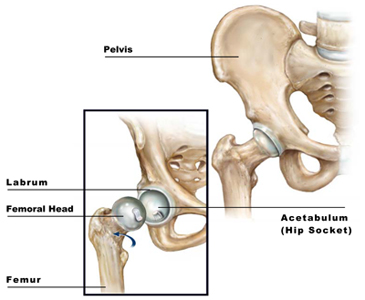
The particular squat I am talking about here is what I refer to as an Internal Rotation Squat.  The Internal Rotation Squat differs from the traditional bodyweight squat in that the feet are parallel, as opposed to opened outward, and the squatting motion is accomplished by internally rotating the femoral heads within the hip sockets rather than relying on quad muscle power alone.

hip-anatomy-new

The Internal Rotation Squat requires MUCH more mobility, control, and mind power to accomplish since you must actually teach your body how to rotate the bones of the femurs within the hip sockets.  This will take some practice!

 Why Do This?

In order to begin generating what known as Internal Power (IP), you must have mobility in the inguinal area that the Chinese Internal Martial Arts refer to as the kwa.  There is much, much more to IP than this, but having mobility in the kwa is an essential requirement.  Additionally, even if you have no interest in IP or Chinese Martial Arts, having this type of mobility and control is an asset in any athletic endeavor or martial art, regardless of style.

Internal Rotation Squat – Bodyweight Version

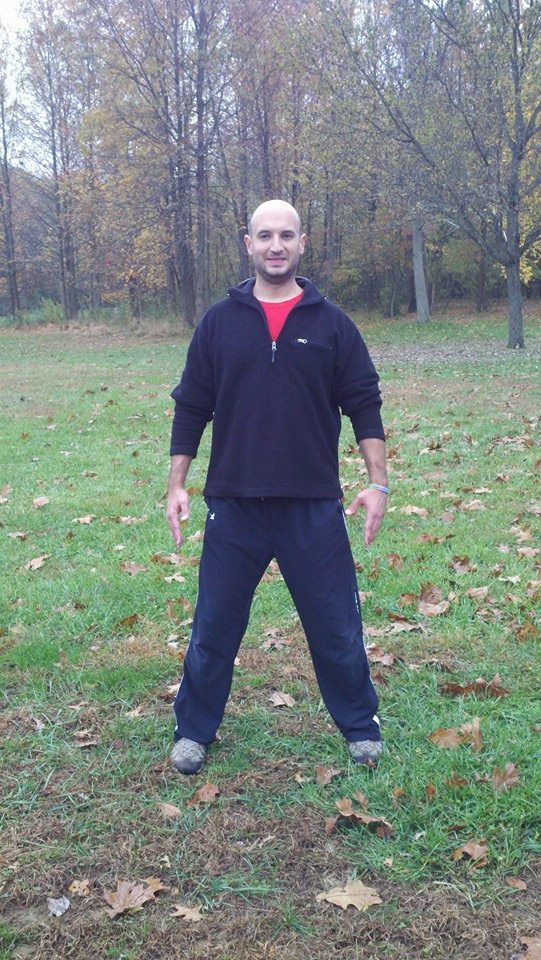
Begin with feet slightly more than shoulder-width apart.  Keep the feet facing forwards, as if on railroad tracks.

Squat1

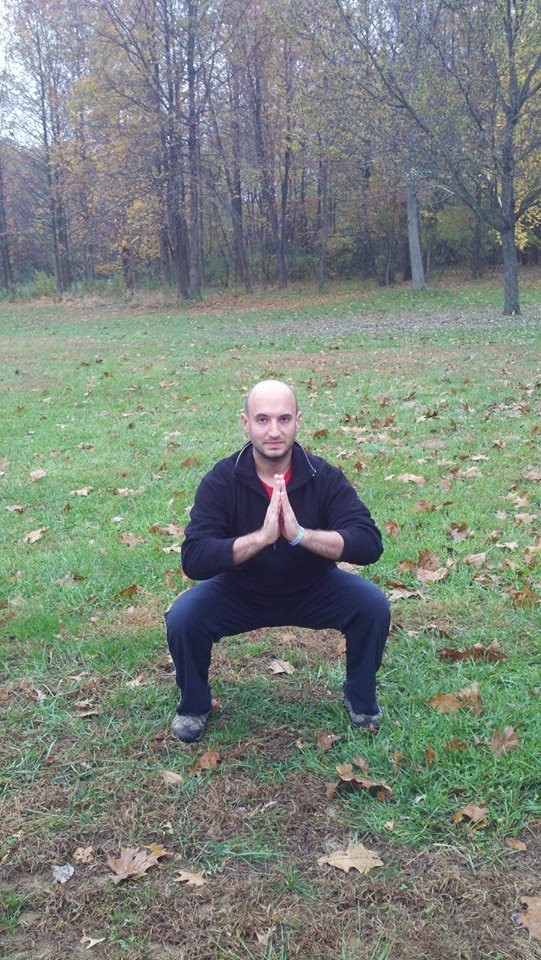
This will be important later when working on winding the tissues, but for now, just do it.  Place your fists on either side of the kwa (inguinal area) where the femur bones connect in to the hip sockets.  Use the imagery of turning your fists to aid in turning the bones.  Internally rotate the femoral heads and sit down into the kwa.

Squat2

Squat as low as possible while keeping your back straight and the weight mid-foot balance.  Pause at the bottom then externally rotate the femoral heads to stand back up.

Internal Rotation Squat – Goblet Squat Version

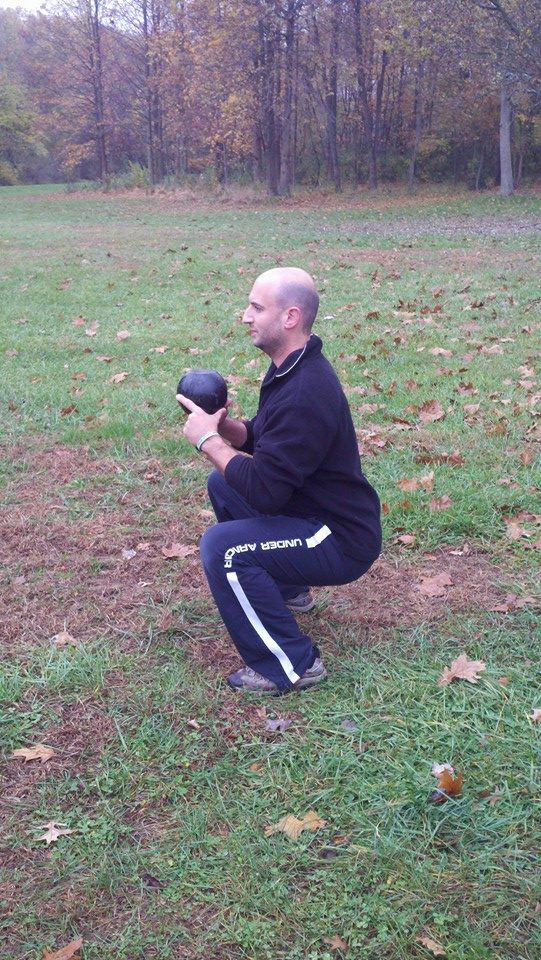
All requirements are the same as above with the addition of holding the kettlebell in front of your chest in the Goblet Squat position.  Use the weight of the kettlebell to allow you to sink further into the kwa.

Goblet Squat2

Thanks to Dan Harden for teaching me this exercise in the context of working on Aiki/IP.  Any errors or omissions are my own and not the responsibility of my teachers.  Also, thanks to Jaime for helping me to refine the squat and for taking the pictures!

Also, Dan Harden will be back in NJ in March 2014.  Details on the seminar can be found HERE <<====


Coulda Killed Ya (A.I.F)

I have a confession to make.  And after my last post on the 13 Deadly Sins of Fitness this seems to be becoming a theme!

Here goes… sometimes I let my situational awareness slip and find myself in a position where a person with bad intentions could take advantage.  Ever happen to you?danger

Let me back up a little bit and tell you what brought this confession about.  This morning as I sat in my car beside the pump at a busy gas station waiting for the attendant to come over and fill up the tank (yes, there is no self-service in NJ!), I sort of drifted.  It seemed to take forever for the guy to come over to the car so I let my attention wander while I was waiting.  As I was lost in my thoughts about the million and a half things going on in my life, I was suddenly startled out of my reverie by the attendant at the window asking if he could help me.  I flinched slightly (think I covered it up pretty well), and then told him to please fill up the tank with regular.

As he walked away to gas up my car, it occurred to me – he coulda killed me!  I was completely not paying attention and did not even notice him amble up to my car window.  Had he been a bad guy (insert your own bad guy of choice here), I would have been in serious doo-doo (yes, that’s a technical term).

Not only was I embarrassed that he startled me, but I was pissed at my own lack of vigilance .  I usually pride myself on my awareness skills and rarely, if ever, do people sneak up on me.  But rather than chalking it up as just “one of those things” I figured I would write about it as a lesson, not just for you guys, but for me as well.

So what is the moral of the story?  As I tell all my martial arts students and the women in my Women’s Self Defense workshops….

A.I.F!

Awareness is Fundamental.  This is the basic requirement to keep yourself and those around you safe from harm.  Yes, I probably could have beaten up the gas station attendant had he attacked me, but that’s not the point.  The best way to stay safe is to be aware enough to avoid a potentially bad situation to begin with.  So, here’s your homework (and mine!):

When you are out in public, whether it’s at work, at school, in a mall, walking in a park or down a busy street, or – GASP – at a gas station waiting at the pump, you must keep your awareness up.

How do you do this?

1) Look around!  Keep your head and eyes scanning the environment.  Use wide angle vision.

2) Do not fixate all your attention on one task, especially if it takes your eyes off the environment around you.  Look up every once in a while and note the position of people in your general vicinity.  As I am writing this post I am sitting in a Panera nursing a delicious cup of dark roast coffee.  My eyes are on the computer screen and keyboard, but also scanning around me.

3) Keep your ears open!  Rather than blasting music in your ears with your ipod as you walk, run, or sit in public, keep your ears open and listening around you.

4) Listen to your gut!  If something feels wrong, it probably is.  Do not ignore the hair raising on the back of your neck or the feeling in the pit of your stomach that something is off.  Ever feel like someone is staring at you and when you turn around, they are?  You have the primal ability to know when you are in danger.  Do not disregard this sense, it can save your life!


The 13 Deadly Sins of Fitness

Bless me Coach for I have sinned.  It’s been a while since my last fitness confession.  These are my top 13 most deadly fitness sins… (Yes, I know there are only 7 deadly sins but I just couldn’t stop at 7…)

  1. I did not make the time to work out consistently.
  2. I was too lazy and did not train.
  3. I have not supported my training with the proper nutritional strategies.  Remedy that with my free Ninja Nutrition Program!
  4. I allowed myself to be tempted by the latest, sexiest, “flavor of the week” training program in some crappy fitness magazine.
  5. I ignored my coach’s advice and did not perform a proper warm-up thus increasing my chances for injury.
  6. I further ignored my coach’s advice and did not follow the correct cool down protocol thus increasing my odds of soreness and residual tension.
  7. I did not seek out a knowledgeable coach to help me program my workouts and get me to my fitness goals thus leaving myself floundering in a fitness limbo of getting nowhere fast.
  8. I fell prey to becoming complacent in my workouts and never vary my routine thus insuring I stay stranded on this damn plateau.
  9. I fell prey to my fitness ADD and constantly change up my workouts to “confuse” my muscles thereby insuring my results are as random as my training
  10. I placed other “important” tasks before my training while knowing that my training is the one thing that allows me to be my best and support ALL my other tasks and activities.
  11. I allowed myself to get drawn into “paralysis by analysis” and become overwhelmed with all the information out there and thus I do nothing.
  12. I coveted my friend’s training program and did not stick to my own.
  13. I am weak and in poor condition but I voluntarily choose to sit on my ass and watch TV rather than getting up and doing something about it.

Need to do penance?  Or do you need guidance on your physical, mental, and spiritual journey?  The scriptures of Warrior Fitness can be found HERE.  Use these resources!!

skull+and+crossbones

11 Self Defense Tips for Women

1) Know Your Outcome

You must have it in your mind that no matter what, you will fight and you will survive.  You will get home safe.  This is your ultimate goal.  Additionally, you must also know in advance what you are willing to do, how far you are willing to go, in order to protect yourself.

2) Action First

Do not allow yourself to get pulled into “paralysis by analysis”.  It doesn’t matter (right now) why this is happening to you, only that it IS happening and you must take action NOW.  You can analyze and Monday Morning Quarterback yourself when you are home safe.

3) Do the Math!

If you are attacked by only one opponent, but you doubt yourself, you are outnumbered!
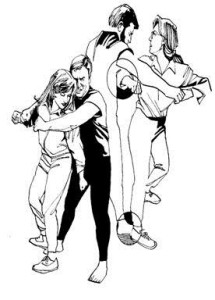
Women Self Defense

4) Breathe and Move

Intense stress wreaks havoc on the body.  Heart rate and blood pressure elevate.  Vision narrows.  Blood roars in your ears.  Your breathing gets faster and higher in your chest, or you may even hold your breath as your heart pounds.  You freeze.  The way to break this cycle of destruction is to sharply exhale and MOVE!

5) Keep Your S.A.

S.A. stands for situational awareness.  Do not walk in public with you head down buried in your cell phone.  Do not run with headphones on oblivious to your surroundings.  Do not walk to your car alone at night without knowing where your keys are!

6) Stand Tall

This is a corollary to the one above.  Stand up straight and walk with confidence.  Keep your eyes scanning around you and look like you are aware.  This signals to a potential attacker that maybe you are not a good target and they will move on to someone else less likely to notice them.

7) C.W.C.T

This stands for Closest Weapon Closest Target.  Do not fixate and focus on a particular target.  Do not over analyze where you should strike your attacker.  Just strike fast, hard, and often.  Hit the closest thing on him with the nearest weapon you have whether that is your fist, foot, knee, elbow, purse, keys, etc.  Also, ladies, please note that the groin is not always the best target.  Yes, it hurts, but guys are trained from birth to protect that area.  Make sure you have more in your bag of tricks than just a groin shot.

8) Get Away!

Remember your outcome in #1.  Your job is not to subdue your attacker and hold him for a citizen’s arrest.  Your job is also not to beat him to a pulp.  Your one and only job (assuming you are by yourself) is to get away as soon as possible, as fast as possible and to a safe location.

9) Be the Momma Bear

Remember that you are powerful.  When you see a bear in the woods, are you scared?  Yes, of course.  When you see a Momma Bear with 2 cubs in the woods, are you more scared or less scared?  MORE!

10) Who Do You Love?

Building on the Momma Bear concept above – even if you are alone, you still must fight and survive for your your kids, your family, your loved ones.  If you don’t fight, who will protect and nurture them when you are gone?  Get it into your head to fight.  Always.

11) Beware of Normalcy Bias

I owe this one to my good friend, Josh Sager of the New Jersey Personal Defense Academy.  From Josh’s article on Normalcy Bias:

“In layman’s terms, normalcy bias is the condition where a person’s fear manifests itself so acutely that they cannot process a traumatic event and, essentially, blocks it out of their mind. ”  I highly suggest you read the entire article HERE.

As the father of 2 young girls, women’s self defense is a subject very near and dear to my heart.  Over the past 15 years I have taught women’s self defense workshops to schools, clubs, companies, MOMs groups, church groups, and women from all walks of life who simply want to know more, be more confident, and learn the mindset, psychology, and skills that will help them survive in the event they are attacked.

To book a Women’s Self Defense Workshop for your organization, please contact me HERE.


Jon Haas, “The Warrior Coach” has been training in Bujinkan Budo Taijutsu for more than 25 years and is currently ranked as a Kudan (9th degree black belt) under Jack Hoban Shidoshi. He has also trained in Okinawan Karate, Tae Kwon Do, Russian Systema, BJJ, Krav Maga, as well as Internal Martial Arts of Yiquan and Aiki.He is also a certified Underground Strength Coach-Level 2, an ACE and FMS certified Personal Trainer and the founder of Warrior Fitness Training Systems. In 2008, Jon wrote the book, Warrior Fitness: Conditioning for Martial Arts, and since then has created numerous other online training and coaching programs helping people around the world become the strongest, most capable versions of themselves!


Protect. Break. Leave Behind.

How can we train for the friction and chaos of battle when following a set fitness routine?

Physical preparation for combat readiness must be, by its very nature, a multifaceted approach.  If the combatants have to be ready for anything, shouldn’t their fitness regimen reflect that?  Surely the idea of training random workouts each and every day must help better prepare the person to face any challenge, right?

Well, yes and no.

As with all things, fitness is a skill.  The body must be adequately prepared at a baseline level through rigorous training AND practice to establish a solid foundation of GPP.   To suddenly subject a trainee to an onslaught of arbitrarily selected workouts is only a recipe for creating a shallow level of skill in a bunch of random areas.  It is also a great way to cause injury rather than seek to prevent it.  Random training produces random, haphazard results.

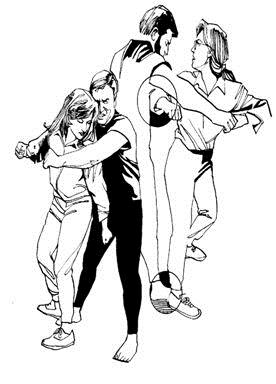
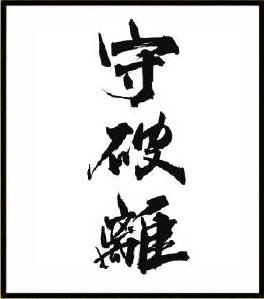
The Warrior Fitness Training methodology follows the Shu-Ha-Ri model of teaching prevalent in schools of traditional Japanese martial arts.  Shu-Ha-Ri translates to “protect the form, break the form, leave the form behind”.

shuharith

Usually within schools of traditional Japanese Budo this is a linear model where at the beginning of training the student is taught to carefully protect the form without deviation so as to template themselves to the teacher and to the martial system.  After becoming proficient in the exact techniques of the school the student is then encouraged to begin breaking the form.  And then slowly, very, very slowly, after decades of practice the student finally begins to transcend the form and leave it behind thus moving at the level of principle.

The Shu-Ha-Ri model is slightly different in the Bujinkan tradition that I study.  Rather than a strict linear progression, the model is not quite as fixed.  It may be Shu-Ha-Ri, Ri-Ha-Shu, Ha-Shu-Ri, or any combination of the three.  In this way, the student does not have to wait until he has trained for decades to learn how to break the form, nor does he always leave the form behind.  Instead the training progresses in an upward spiral where the teacher may start with the basics, circle up to breaking the form, and finally leave the form behind, followed by working again on the basics.  The same material is always looked at with fresh, new perspective and greater depth each time it is taught no matter where in the cycle it falls.  This allows for better all-around development and faster progression while still inculcating the basic forms and instilling a respect for technique.  It also gives the student the freedom to adapt to the friction and chaos of combat by learning how to both break and throw away the form when required yet still conforming to the strategic and tactical principles of the art.

How Does This Relate to Fitness?

What I have done is take the Shu-Ha-Ri model as taught within the Bujikan martial arts tradition and apply it to the programming in my Warrior Fitness Training System.  This means that within a complete training program, the student will undergo GPP (general physical preparation), SPP (specific physical preparation), TS (technical skills), and MT (mental/emotional toughness) to fully and completely prepare them for the task, goal, or mission at hand (For a more detailed description of each, please see my post on The 4 Levels of Preparation).

Following the Bujinkan model then, the progression of training may not necessarily be a straight line.  Depending on the level of the student, GPP will most likely form the bulk of the training but it will be cycled out of and back into throughout the duration of the program.  As the student progresses and increases in the skill of fitness, their training becomes blended at a higher level of SPP maybe only cycling back into GPP to shore up certain weaknesses and then coming right back out again.  This insures that the student is constantly progressing and also constantly prepared without having to resort to a random workout generator model of training.

Ready to take your Combat Conditioning to the next level? Pick up WarFit Now for Only $7!

Ask Yourself Better Questions

Do you ever talk to yourself?  Of course you do.  I don’t mean the talking out loud like the crazy lady down the street talking to yourself, I mean the normal everyday conversation that goes on inside your head.

Ever notice that most of your thinking is done in the form of asking yourself a question?  It’s true.  Take a moment and listen to your self-talk.  It usually takes the form of asking and answering questions.  We’ll say something to ourselves like, “why can’t I ever get that movement right?”  And since your brain doesn’t want you to lie to yourself it will come up with what seems to be an appropriate answer to the question – “because you’re a screw up.”

But what did we just do?  We’ve created a self-fulfilling prophecy.  Remember, you are what you think.  If you think you’re going to always mess up that movement because you’re a screw up, guess what?  You will.

How about the person who tries to go on a diet but no matter what he does he’s never able to lose weight.  What question and answer process is going on in his head?  Maybe something like – “why the heck can’t I ever lose weight?”  And, his brain comes back with – “because you eat too much, fatty!”  So what happens?  He continues to eat too much and fulfills what he’s told himself over and over again.

Questions

We need to start asking ourselves better questions.  The answers are out there.  We can lose weight.  We can exercise consistently.  We can train our martial art every day.  We can be masterful.  We can tap into our own innate greatness.  We can meet the woman/man of our dreams.  It’s not impossible.  It’s not even all that difficult.  We just have to ask ourselves better questions so that our brain gives us more helpful, actionable answers.  We have to understand how to use the human mind to get what we want, not what we don’t want.

Here’s the problem…

How often during the day do you focus and think about the things you don’t want?  You don’t want to be miserable.  You don’t want to be broke.  You don’t want to be depressed.  You don’t want to be fat.  You don’t want to be unmotivated.  You don’t want to be uncreative.  You don’t want… (Fill in the blank.)  But if all we do all day is think about the things, circumstances, ideas, that we DON’T want, and we know that what we focus on grows, for we are what we think, than what is the one thing we can do to change our outcomes?  (c’mon people, don’t make me do all the heavy lifting on this one, say it with me…)

Change our thinking by changing the questions we ask ourselves.  Got it?  Do it.  Ask yourself better, more productive questions so that you get better, more useful answers.  Change your life by changing your process of thinking.

Life Advice from Musashi

If you are not already familiar, Miyamoto Musashi (宮本 武蔵, c. 1584 – June 13, 1645) is arguably one of Japan’s most famous swordsmen.  He is the author of Go Rin No Sho, or The Book of 5 Rings, one of the most widely read yet probably least understood guides to strategy ever written.

Miyamoto_Musashi_Self-Portrait

The Book of 5 Rings is divided into (as you might expect) 5 chapters.

Within the first chapter, The Ground Book (or “earth” depending on which translation you read), is one of my all time favorite Musashi quotes in which he outlines his broad principles of strategy, he gives 9 principles for those who wish to study his way:

1.Do not think dishonestly.
2.The Way is in training.
3.Become acquainted with every art.
4.Know the Ways of professions.
5.Distinguish between gain and loss in worldly matters.
6.Develop intuitive judgement and understanding for everything.
7.Perceive those things which cannot be seen.
8.Pay attention even to trifles.
9.Do nothing which is of no use.

He then goes on to say how important it is to set these broad principles in your heart in order to begin learning the way of strategy.

While I agree with Musashi that each one of these principles is important and deserves greater exploration, in this post I want to hone in on my favorite one, number 9, “Do nothing which is of no use.”

Do Nothing Which is of No Use

Wow.  Read that again.  What an unbelievable qualifier on how to live your life.  Imagine if you could actually take this principle to heart and follow it every day for the rest of your life.  How much would you accomplish?  To what great heights would you soar?  Think about this deeply…

If you really followed Musashi’s advice to do nothing which is of no use, what would change?

How would your job change is you eliminated all the superfluous crap that you do on a daily basis?  The busy work that seems urgent, but is not very important.  The mundane tasks that you somehow inherited that really contribute nothing to your overall productivity, but you still have to deal with day after day.  What would transform in your job or your business if you simply eliminated them because they are of no use?

How would your relationships with other people change?  Would you continue to make time for people who are a complete drain on your life and your energy?  Would you choose your relationships differently be they business relationships, friend relationships, or intimate relationships?  How much closer and stronger would your real relationships grow if you could push aside and remove the ones that were of no use?

How would your training change if you did nothing which is of no use?  Where would you focus your time?  What unbelievable results could you obtain if you only spent time on the training, the exercises, the movements that contributed the most to your overall development as an individual martial artist or athlete or complete human being?  How fast would you progress towards and achieve your goals if you eliminated the things which were of no use?

How would your entire life change?  Think about it.  Put it into practice.  Live it.  Do Nothing Which is of No Use.


Going Further into Musashi’s Teachings….

Miyamoto Musashi penned several other lesser-known manuscripts prior to his much more widely known Go Rin No Sho, or The Book of 5 Rings.

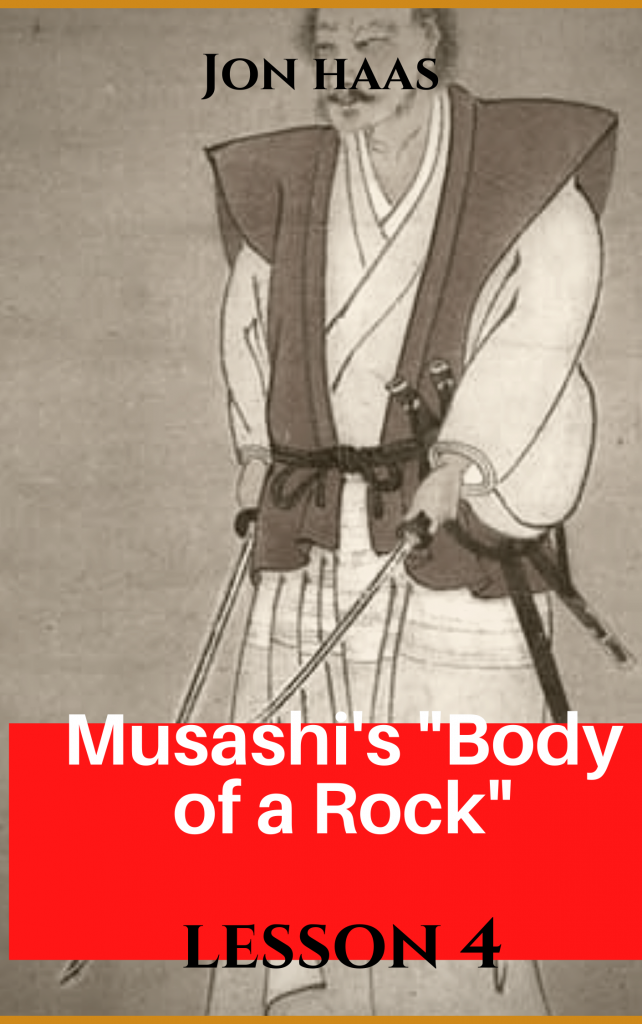
In his Thirty-Five Instructions on Strategy, written 2 years prior in 1641, he discusses The Body of a Rock.

The Body of a Rock

“The body of a rock is the state of an unmoving mind, powerful and large. Something inexhaustible that comes from the universal principle exists in the body. It is through this that the power of the mind resides in every living being.”

How does one obtain the body of a rock where the mind permeates every aspect of the body?

Learn exactly how to implement Musashi’s “Body of a Rock” strategy in both your strength training and martial art practice to build superhuman strength and incredible all around martial power inside Lesson 4 of the Warrior’s Inner Circle – you can grab that here.


What Muscles Does This Work?

As humans we have a unique, sometimes almost obsessive need to catalog, categorize, and label things.  Exercise is no different.

In the midst of a tough workout session, almost invariably someone will suddenly stop and ask the pressing question – “by the way, what muscles is this working?”

muscles_human_body_front1

Why do our brains do this?

In my opinion, it’s part curiosity, part obsessive need to categorize, but also part delaying tactic.  Just like the little kid who suddenly has a million and one questions about anything under the sun in order to delay having to go to bed, we ask a seemingly pertinent question to delay having to do the exercise a little longer.  Because we associate some type of pain with the workout, be it the physical pain of muscle ache, or the psychological pain of having to push through our limits, we do the logical thing (to us) and stall the inevitable.  The question allows us to push that pause button in the movement and stop for a few moments while we regroup ourselves for the effort ahead.

But What Muscles Does It Work?

Within the Warrior Fitness Training System, the answer to the question of which muscles are working in a particular exercise requires a little more explanation.  In conventional fitness training the answer is usually confined to something like, “well, this exercise works your biceps, that next exercise works your chest, and this last one is working your lats.”

The exercises we do in Warrior Fitness tend to have a much broader, system-wide effect.  Our exercises are always multi-planar, multi-joint, and 3 dimensional.  So the short answer to the question of which muscles does this work is usually – All of them!

How can this be?

Instead of viewing the body as made up of individual muscles, Warrior Fitness teaches that the body is one interconnected system where the whole is much greater than the sum of its parts, so that when one thing moves everything moves.  Why do I teach it this way?  Well, because that’s how the body is actually built.  More on this later…

What this idea does is allow us to express power in a much more functional way for combat, sport, and life.  Real power is expressed in only 2 ways – from the ground up and from the center out, oftentimes as a combination of both.  Never is power expressed by an individual muscle group alone.  It’s way too weak and ineffective.

The choice is yours.  How do you want to train?  Whole body integrated power is my method of choice.

My latest program, Ninja Missions Program 1 is a fantastic example of how to train for this whole body power.  Make sure you do yourself and your training a favor and check it out!!

Ninja Mission Cover


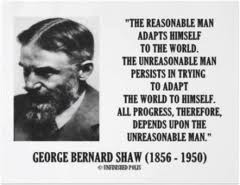
Become Unreasonable

Being reasonable gets you mediocrity.  Being reasonable gets you the status quo.  Nothing great has ever been achieved by men and women who were reasonable.  Every major (and most minor) human achievement has been accomplished by unreasonable people.

It was unreasonable of Thomas Edison to fail over 10,000 times before creating the incandescent electric light bulb.

It was unreasonable to think that a man could walk on the moon until Neil Armstrong stepped onto its surface in July of 1969.

It was unreasonable to think the 4 minute mile could be broken until Roger Bannister broke it on May 6, 1954.

In the world of Bujinkan Martial Arts, it was unreasonable of Stephen K. Hayes to think he would be accepted as the first American to study the mysterious art of Japanese Ninjutsu, yet today he is known all over the world.

Unreasonable (1)

Over and over again, unreasonable people are succeeding, accomplishing great things, and leaving their mark on the world.  So tell me again, why would you want to be reasonable?

Do you ever get the feeling you were destined for greatness?  It starts like a slight nagging feeling in your gut that there’s something missing.  That you don’t quite fit in with the status quo.  It’s a dissatisfaction with ordinary or mediocre.  It’s the fleeting thought on the fringes of your consciousness that maybe, just maybe there’s something more than this for you.

“You take the blue pill, the story ends, you wake up in your bed and believe whatever you want to believe.  You take the red pill, you stay in Wonderland, and I show you how deep the rabbit hole goes.” – Morpheus

Unfortunately for the world, the majority of people out there will ignore that feeling.  They will make excuses why they can’t act on it.  They will be too busy, too tired, too involved in something or someone else, too lazy, too scared.  But not you.  You will act.  You will feel the fear just like all the rest of them, but your desire for greatness will allow you to overcome it.  You will have all the same excuses and rationales, maybe more, but the restlessness inside will not let you rest.

“Most men lead lives of quiet desperation and go to the grave with the song still in them” – Henry David Thoreau

To bring this from the general to the specific, how do we become unreasonable in our training?

For starters, I have never believed that any highly skilled martial arts master was special.  Never will.  You and I have the ability to be as great as any one of them.  What one man can do, another can do.  The only way to insure you never succeed is to put them up on a pedestal and tell yourself they are special.  That they are geniuses.  That they are a rare, unusual breed.  That they are set apart.  Nonsense!  You want it?  Train harder.  Train more.  Train better.  Become unreasonable in your training.

You must train yourself to be so good that they won’t be able to ignore your skill, no matter who you are and no matter what your rank – or lack of!

Learn the ancient warrior’s methods of building an unbreakable body HERE.

unreasonable