How Warriors Train for ENDURANCE

Warriors Need to HIIT!

High Intensity Interval Training (HIIT) is one of the best ways to train for endurance. It will enhance all 3 energy systems in the body, as well as prime the nervous system to recover automatically during lulls in activity.

Simply put, HIIT alternates periods of high intensity exercise with periods of rest and recovery. It can be performed with almost any exercise and can be utilized both with and without equipment.

The variety and adaptability of this style of training is second to none in results.

How else does improving your endurance through this type of conditioning aid your martial arts training?

I’m glad you asked!

If the benefits discussed above weren’t enough, consider that having a high level of conditioning also aids in learning new skills.

How’s that possible?

To put it simply, when the central nervous system (CNS) is fatigued, the body cannot effectively process new skills, especially technically advanced skills. So, in essence your lack of a general level of fitness and conditioning will actually impede your learning process as you will tire more readily and not have the ability to recover quickly enough during training.


  • Want to train more, at a higher level, for a longer period of time?

  • Want to get more out of your training time both at home and in the dojo?

  • Want to build new skills and enhance your technical arsenal?

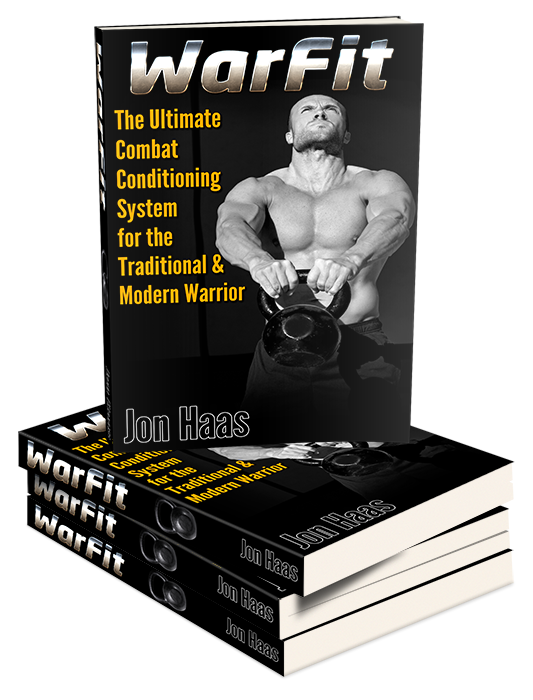
    My brand new WarFit Combat Conditioning Program will show you how!

warfit3d3

Top 5 Fat Loss Strategies

Today, let’s take a look at my top 5 favorite, no-brainer strategies for losing fat like a champ.

If you are not seeing the results you want with your current fat loss plan, implement some, or preferably all of the following strategies and watch the fat literally fall off you! Continue reading

Warrior Fitness is Going Primal!


Reprogram Your Genes for Effortless Weight Loss
There are quite literally hundreds of different diet books lining the shelves of bookstores coast to coast.  Each one with a slightly, or radically, different approach than the next to helping its reader shed unwanted pounds, improve body composition, tighten up their waist line, and increase health and longevity.  And do this all quickly and painlessly to boot!  But what if I told you that even though all these numerous programs, approaches, ideas, and methods are valid and do work, to a point, for some individuals some of the time, there is actually only one diet that is suitable for us all?  This is exactly what author Mark Sisson asserts in his book, The Primal Blueprint.  You see, prior to the Agricultural Revolution some 10,000 years ago (give or take), all humans – everyone on the planet – ate basically the same diet.  Of course there were some variations due to geography, climate, and seasons, yes, but basically the same diet.  And what if I told you that this one diet kept our caveman (and woman) ancestors leaner, stronger, fitter, and even healthier than we are today?  It enabled them to survive and thrive for over 2 million years.

Enter the Primal Blueprint.  According to Sisson (and considerable research), our genes have remained virtually unchanged since pre-agricultural times.  We are quite literally cavemen in business suits – some of us more so than others!  The Primal Blueprint premise is that our current genetic expression is influenced, positively or negatively, by our lifestyle.  So that how we eat, how we exercise (or don’t), how we rest, play, and sleep all combine to create the body we have today.  This means that we literally have the ability to optimize our genetic potential one forkful at a time.  Sisson lays out 10 Primal Blueprint Laws to help us begin reprograming our genes by changing our lifestyle behaviors.

Law #1: Eat Lots of Plants and Animals

This is pretty self-explanatory.  Vegetables, fruits, and meat should make up the bulk of your diet.  Round it out with nuts and seeds.  These foods formed the diet that fueled human evolution for 2 million years.  The whole plan is laid out in the book.

Law #2: Avoid Poisonous Things

You’ll notice grains and other processed foods at the top of this list.  Yes, even the supposedly healthy, whole grains.  Why?  Simply because humans did not evolve to digest grains properly.  They make us fat and unhealthy.  Remember our genes have not changed since pre-Agricultural times.  Want to know more?  Read the book.

Law #3: Move Frequently at a Slow Pace

Hunter Gatherers spent a lot of time walking.  This very low intensity aerobic exercise provides a great base upon which to build physical fitness.

Law #4: Lift Heavy Things

Brief intense muscular efforts to climb, lift, carry, drag, pull, etc. were required by our caveman ancestors.  These functional, full body movements prompt improvements in muscular size and strength.

Law #5: Sprint Once in a While

Whether running for your life or sprinting to take down a kill, the ability to run fast was definitely a skill needed 10,000 years ago and today.

Law #6: Get Adequate Sleep

This is a hard one for us.  Studies constantly tell us Americans do not get enough sleep.  Usually 8 hours is recommended as the average, but how many of us get more than 6 hours a night?  Find out why sleep is so important in the book!

Law #7: Play

Hunter Gatherers had much more down time than we do today.  Take some time to get outside in the fresh air and enjoy yourself.

Law #8: Get Adequate Sunlight

Regardless of the term, Caveman, our prehistoric ancestors did not spend much of their time in caves.  They were outdoors most of the day.  Adequate sunlight exposure is one of the best ways to obtain sufficient Vitamin D.

Law #9 Avoid Stupid Mistakes

Back before emergency rooms and doctors for that matter, a careless injury which would sideline us for a short time today would be deadly to a caveman.  They had to maintain awareness – zanshin anyone?

Law #10: Use Your Brain

Creative expression for mental health and well being.

Does It Work? My Primal Experience

Let’s get down to the real question though – does it work and how difficult is it to implement?  Well, I’m half Italian so I love my pasta and bread, and my wife is Filipino so we love our rice and noodles.  I’ve always been taught grains are a staple and necessary for energy not to mention healthy – bottom of the food pyramid, right?  However after reading The Primal Blueprint and understanding why grains are not necessary for you and really not as healthy as we’ve been led to believe, I was more than willing to take Sisson at his word and give it a try.  Dropping grains out of my diet wasn’t as hard as I thought it would be.  Many of us, me included, have strong emotional attachments to our food.  The Italian part of me was literally screaming – no bread?  No pasta?  Are you nuts???  But once I got over the initial hump, it was actually pretty easy.  The fact is though no matter how much I tell you about my own experience you won’t really know until you try it for yourself.  I went cold turkey on the grains – can you?  Give it a shot.  You’ll be surprised at what your body can do! 

What about my results so far?  I’ve been following the Primal Blueprint laws, as laid out above for about 2 weeks now.  I feel great!  Energy levels are high and steady, no post meal crashes.  I’ve already begun to lean out some more and am looking forward to even greater fat loss while increasing lean muscle mass.  The best part for me is that I’m not constantly hungry.  Usually, as those who know me can attest, I’m the first one to be ready to eat at meal times.  Now I hardly even notice what time it is, I just eat when I’m hungry.  I am even able to skip meals with no sluggish side effects.  Warrior Fitness workouts align very well with Primal Fitness concepts (brief high intensity sessions, no chronic cardio) so I have not really made too many modifications there.  Although, I am definitely looking to add some sprinting in to round out my training week now.  It just seems like too much fun not to do it. 

My opinion?  The Primal Blueprint is intelligently written, well researched, and also quite entertaining to read, and it just might save your life.  Highly recommended!! 

For more information, check out Mark Sisson’s blog, Mark’s Daily Apple – HERE!
Sample Exercise from Warrior Fitness Guide to Striking Power

A Word on Strike Conditioning

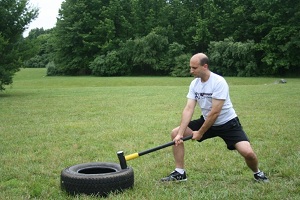
Swinging your sledge hammer at an old tire is an excellent old school conditioning exercise for anaerobic strength and work capacity.  It will insure your strikes have not only power, but endurance and as well.  Old tires are fairly easy to come by, usually any Tire and Auto place will have a bunch of old tires sitting in a pile outside waiting for disposal.  If you ask nicely, they are pretty happy to give you a couple for free.

There are a few different protocols that I like to use for this exercise:

Density training is one option. The concept of Density Training is pretty simple.  Do more work in the same amount of time or do the same amount of work in less time.  So, for example using hitting the tire with a sledge hammer as the exercise and the last time you used this protocol you managed to do 100 swings in 5 minutes, then this session you would either try to increase the number of swings you can do in 5 minutes or strive to do 100 swings in less than 5 minutes.  Not rocket science, right?  What if this is your first time attempting this type of training?  Pick an amount of time, say 5 minutes.  Then try to do as many hammer swings as you possibly can in those 5 minutes.  Crank them out.  Push yourself.  Remember the time limit used and amount of reps achieved, or preferably write it down, and the next time do more.

High Intensity Interval Training (HIIT) is another one.  It is perhaps one of the best ways to train for endurance.  It will enhance all 3 energy systems in the body (2 anaerobic and 1 aerobic – see here for an overview), as well as prime the nervous system to recover automatically during lulls in activity.  Simply put, HIIT alternates periods of high intensity exercise with periods of rest and recovery.  It can be performed with almost any exercise and can be utilized both with and without equipment.  The variety and adaptability of this style of training is second to none in results.

No discussion of interval training would be complete without touching on the Tabata Protocol.  Dr. Izumi Tabata at the National Institute of Fitness and Sports in Tokyo, Japan performed perhaps the most well known study on interval training.   A group exercising with moderate intensity endurance training was compared to another group using high intensity intermittent training.  Each group exercised 5 days a week.  The moderate intensity group exercised for 60 minutes, at 70% VO2 max.  The high intensity group did 8 intervals of 20 seconds, followed by 10 seconds of recovery.  They operated at 170% VO2 max.

After 6 weeks, both groups experienced improvements in maximal oxygen uptake.  The biggest difference between them was that only the high intensity group gained improvement in anaerobic capacity.  The high intensity group actually realized a 28% increase in anaerobic capacity AND a 14% increase in VO2max.  So, the study concluded that high intensity intermittent training can improve both the anaerobic and aerobic systems simultaneously.  Very impressive results!

I know that after reading the amazing results achieved by Dr. Tabata you’ll be ready to try using his protocol, I sure was!  The protocol itself is pretty simple, in theory.  Choose an exercise – say sledge hammer swings, for example (since we’re talking about them).  Perform the exercise for 20 seconds as fast as possible while still keeping good form.  Rest 10 seconds.  Complete 8 rounds.

There are several different ways to swing the sledge hammer.  I don’t care which way you do it – vertically, diagonally, hands apart, hands together, all are fine.  Just make sure that no matter which way you choose, you do not bend your back – we do not train bad habits!

In this particular example, notice the slight turn of the spine where I store energy (SEE) in my lower back.  The hammer swing is powered by the release of that energy, not by my arms.  Also, notice the knees bend as I squat down to hit the tire and not bend my back.  Keep good structure throughout the movement.

Like this exercise?  This one and many more sledge hammer, medicine ball, resistance band, and body weight exercises are described in detail along with sample workouts in the Warrior Fitness Guide to Striking Power Pick up your copy today!!


Ninja Endurance – Part II

In part one of Ninja Endurance called,  How to Train for the Endurance of a Ninja, we discussed strength endurance and I provided a sample workout to help you build yours.  Here in part 2, I ‘d like to delve a little deeper into the whys of endurance training and how specifically high intensity interval training is an excellent choice for it.

What is Endurance?

Endurance is defined as being able to keep going without fatigue setting in, or being able to push oneself through fatigue.  Essentially, it is the ability to resist or bear fatigue.  What is fatigue?  Fatigue is weariness or exhaustion from exertion, or the temporary loss of power to respond.  An equally critical corollary to the definition of endurance, especially for the warrior,  is that your level of endurance also determines how quickly you are able to recover between bouts of activity.  Combat, like life, does not happen at one constant rate of speed.  It is multi-faceted in nature.  There will be periods of brutally intense activity followed by lulls in the action, again followed by another flurry of activity.  Being able to use those lulls in action to recover is a critical ability for the warrior.

Steady state cardio, Long Slow Distance (LSD) training simply will not cut it.  Running on a treadmill may be appropriate for a hamster in a cage, but human beings require more.  Long distance running can be beneficial for mental toughness and/or active recovery, but it should not be the primary focus of a warrior’s endurance training.  So then how should we train to maximize our ability to endure?

Warriors Need to HIIT!

High Intensity Interval Training (HIIT) is one of the best ways to train for endurance.  It will enhance all 3 energy systems in the body (2 anaerobic and 1 aerobic – see here for an overview), as well as prime the nervous system to recover automatically during lulls in activity.  Simply put, HIIT alternates periods of high intensity exercise with periods of rest and recovery.  It can be performed with almost any exercise and can be utilized both with and without equipment.  The variety and adaptability of this style of training is second to none in results.

How else does improving your endurance through this type of conditioning aid your martial arts training?  I’m glad you asked!  If the benefits discussed above weren’t enough, consider that having a high level of conditioning also aids in learning new skills.  How’s that possible?  To put it simply, when the central nervous system (CNS) is fatigued, the body cannot effectively process new skills, especially technically advanced skills.  So, in essence your lack of a general level of fitness and conditioning will actually impede your learning process as you will tire more readily and not have the ability to recover quickly enough during training.  Want to train more, at a higher level, for a longer period of time?  Want to get more out of your training time both at home and in the dojo?  Want to build new skills and enhance your technical arsenal?  Get yourself in shape!

There are several sample conditioning workouts here on the Warrior Fitness site.  Here are a few examples:

Workout of the Week #1


Workout of the Week #5


Stay tuned for more Warrior Fitness style conditioing workouts to help you get and stay in fighting shape!

16 Minutes of Pure Torture

Hope the catchy title got your attention!

Today we’re going to do a fun workout based on the Tabata Protocol.  If you are not familiar with Tabata, please check out the Warrior Fitness Tabata Primer found here, What’s Tabata You?

I highly suggest you warm up before doing this workout.  In fact, I insist on it.  What’s a good way to warm-up?  I’m glad you asked.  One of my favorite warm-ups is found here in my Morning Wake Up Routine.  Don’t let the fact that it says morning dissuade you.  It’s a quick, highly effective recharge/warm-up that can be used anytime of day.

Now, onto the workout.  Warmed up?  OK.  Here we go –

Remember, Tabata is 8 rounds of exercise, 20 seconds on, 10 seconds off, for a total of 4 minutes for each exercise.  Take one minute rest upon completion of each set of 8 rounds.

Exercise 1 – Bodyweight Squats

 1 minute Rest

Exercise 2 – Hindu Push-ups

 1 minute Rest

Exercise 3 – Sit Thrus

 1 minute Rest

Exercise 4 – Burpees

Out of breath?  Want to learn how to recover your breathing in between exercises and at the end of the conditioning session?  Check out the section on restoring breath in Evolve Your Breathing.

Enjoy!

Breathing 101

I was planning to title this post, “Breathing for Dummies” after the famous how-to guides, but I realized most dummies aren’t interested in bettering their health, fitness, and extending longevity in their sports, martial arts, or activities.  Plus, I dislike the subtle insult of refering to my readers as “dummies”.  Nor would I want dummies for readers anyway.  So instead today we will go over Breathing 101.  These are what I consider to be the most effective ways to integrate breathing exercises into your daily training, and use them to increase lung capacity and efficiency of how your body processes oxygen.  We will look at several different exercises that will enable you to lower your heart rate, blood pressure, and stress levels, as well as to increase energy.

Breathing as a Bridge

You may not be aware that breathing is a bridge between our voluntary and autonomic nervous systems.  Meaning breath is plugged into both.  The autonomic system will keep you breathing continuously without your conscious control, or sometimes, without even your awareness of it going on.  But, you also have the power to override that control and decide at any moment to take a deep breath or hold your breath.  What does this mean to you though, right?  Well, here’s what it means, you have the power, at any time, to consciously choose to influence things like your heart rate and blood pressure which are not under your conscious control.  Now that’s fascinating to me!  Because breath is tied into both systems it can be used like a bridge to gain access to aspects of your body that you cannot directly control.  How do we do this?

Try This Experiment

Take your pulse.  Count beats for 10 seconds then multiply by 6.  If you’re sitting and relaxed, that number should be your resting heart rate.  Now, inhale as deeply as possible and hold your breath and tense your whole body for a few seconds.  Are you red in the face?  Take your pulse again.  What happened?  Your hear rate jumped up and your blood pressure spiked right along with it, right?  Now try exhaling for a count of 6, but don’t inhale yet.  Extend the pause before the inhale a little bit.  Feel more relaxed?  Check your pulse.  It should have dropped.  Pretty cool, eh?  And this is just the beginning.

The Exercises


Relaxing Breath (Square Breathing)

This is very similar to the experiment we did above.  The basic premise of our ability to influence the autonomic nervous system is that inhalation increases heart rate, which subsequently increase blood pressure, to a slight degree, while exhalation lowers heart rate and blood pressure to a slight degree.  During our normal cycle of breathing, these changes are too minute to register, or even notice.  But, by gradually lengthening our breath and extending the pause before inhaling and exhaling, we compound the effect.

  1. Begin by exhaling through the mouth for 5 seconds.
  2. Do not inhale.  Try to extend the breath pause for 5 seconds.
  3. Before tension begins to creep in, inhale for 5 seconds.
  4. Hold the breath on the inhale for 5 seconds.
  5. Repeat the cycle 10 times.
  6. As this becomes easier, and your capacity expands, try increasing the duration to 6, 7, 8 seconds.


Energizing Breath

In this breathing exercise we will utilize a protocol founded by yoga and improved upon by Russian sport science and martial art.  Here we will divide the breath into 3 levels: clavicular (upper level), intercostal (mid level), Diaphragmatic (lower level).  This exercise will focus only on the clavicular, or upper level.  I first learned this exercise, and several others including the next one below, about 10 years ago from my good friends Dave Rusin and Oleg Yakimovich who are ROSS Russian Martial Art instructors.  More information about ROSS can be found at their website here.  Check it out!

  1. Exhale through the mouth in a short, quick burst by compressing the upper chest.
  2. Do not actively inhale.  Allow the inhale to happen by relaxing the muscles in the chest.
  3. Repeat rapidly 20 to 40 times.
  4. Build up to where you can perform continuously for 60 seconds.
  5. If you become dizzy, stop and sit down!

Restoring Breath

Here again we will depend on Russian sport science and martial art for our technique.  This one is literally a life saver when doing high intensity anaerobic workouts!  It can be used in between exercises as well as in between sets, during the rest period, and at the end of the workout to normalize breathing and dramatically lower heart rate.

  1. Forcefully exhale as deeply as possible by rolling your shoulders forward, tilting the pelvis up, and contracting the core strongly.
  2. Pause before the inhale for a few seconds.
  3. As stated above, do not actively inhale.  Allow the breath to be sucked back in through the nose as your body returns to a natural standing posture.
  4. Repeat for about 60 seconds, or as long as needed.

Try these out and let me know how they work for you.  Any questions, please feel free to contact me here.

What’s Tabata You?

If you have been keeping up with the latest trends in conditioning research then you probably already know that interval training is the most efficient way to train.  Interval training alternates periods of high intensity exercise with periods of rest to produce gains in both aerobic and anaerobic systems.  Forget about those long slow distance runs to improve aerobic fitness!

The Body’s 3 Energy Systems

To briefly summarize, the body has three energy systems, 2 anaerobic, or non-oxidative, and 1 aerobic, that serve to create ATP (adenosine triphosphate).  ATP is utilized by every cell in your body; it fuels muscular contractions, cognitive processes, and internal regulatory functions.   Both anaerobic systems fuel maximally intensive activity, while the aerobic system fuels sustained low to moderate level activity.

The ATP-PC system provides immediately available energy for high intensity efforts from ATP stored within the muscles.  This system is the most powerful, but least enduring of the three, lasting only about 10 to 30 seconds max.

The Glycolytic system, the second most powerful, is only slightly more enduring than the ATP-PC system.  It derives energy from glycogen stored in the muscles and liver converting it to ATP in a process called glycolysis.  Its capacity is approximately 90 to 120 seconds.  Rest intervals allow the body to recuperate and restore ATP.

Lastly, the Aerobic system uses proteins, fats, and carbohydrates to produce ATP.  As the intensity of the effort increases, the aerobic system relies more on glycogen for energy.  If the intensity continues to increase, the anaerobic systems must kick-in to provide energy.  The important idea to realize here is that all 3 energy systems are always supplying the body with the energy it needs for any activity, at any level of intensity.  It’s just that one may be more dominant than the other 2 at a specific time.

If Anaerobic is ‘Without Oxygen’, Why am I Sucking Wind?

If you have been following any of the Warrior Fitness Training Programs, you are already familiar with examples of anaerobic exercises and how they affect the body.  Have you noticed how after even a brief, but intense anaerobic session you are breathing heavily?

If anaerobic really means ‘without oxygen’, how come you are so out of breath?

What happens is that your aerobic system is trying like heck to help restore your anaerobic systems.  All that extra oxygen is being used to metabolize the lactate that’s accumulated in the muscles during the bout of intense activity.  In order to continue to supply energy for all-out, intense efforts, the anaerobic system must be replenished.  Excess Post-exercise Oxygen Consumption (EPOC) is the term used to identify this process of extra oxygen being taken in to restore all systems.  So, basically, as the intensity of your exercise increases, so does your EPOC.  And, that’s why you’re sucking wind!

Tabata Protocol

No discussion of interval training would be complete without touching on Tabata.  Dr. Izumi Tabata at the National Institute of Fitness and Sports in Tokyo, Japan performed perhaps the most well known study on interval training.   A group exercising with moderate intensity endurance training was compared to another group using high intensity intermittent training.  Each group exercised 5 days a week.  The moderate intensity group exercised for 60 minutes, at 70% VO2 max.  The high intensity group did 8 intervals of 20 seconds, followed by 10 seconds of recovery.  They operated at 170% VO2 max.

After 6 weeks, both groups experienced improvements in maximal oxygen uptake.  The biggest difference between them was that only the high intensity group gained improvement in anaerobic capacity.  The high intensity group actually realized a 28% increase in anaerobic capacity AND a 14% increase in VO2max.  So, the study concluded that high intensity intermittent training can improve both the anaerobic and aerobic systems simultaneously.  Very impressive results!

How Can I Use Tabata?

I knew that after reading the amazing results achieved by Dr. Tabata you’d be ready to try using his protocol, I sure was!  The protocol itself is pretty simple, in theory.  Choose an exercise – say sprints, for example.  Perform the exercise for 20 seconds as fast as possible while still keeping good form.  Rest 10 seconds.  Complete 8 rounds.  Sprints are an easy example, but really the Tabata Protocol can be applied to almost any exercise.  Try some of these:

  • Bodyweight squats
  • Burpees
  • Kettlebell swings or snatches
  • Sledgehammer swings
  • Push-ups
  • Sprawls
  • Renegade Rows
  • Sandbag Shouldering
  • Mountain climbers
  • Jumping

These are just a few examples of exercises that can be used with Tabata. Just make sure you don’t overly complicate it because you do have to be able to perform several reps within the 20 seconds!!

Additionally, try grouping together 4 to 6 different exercises to increase the effectiveness of the workout and create a synergistic effect where the total combined effect is greater than the sum of the individual exercises.  This, I think, is where the real fun begins!

To seriously amp up your conditioning, learning how to use various breathing techniques to restore yourself quicker, lower your heart rate, and increase the effectiveness of your conditioning sessions is a MUST!

warfit3d3

Warrior Fitness for Kids!

This will be the first in a continuing series of posts chronicling my thoughts and discoveries on Warrior Fitness for Kids.  As the father of 2 young girls, ages 9 and 1, I have a very vested interest in assuring my daughters are among the healthiest, fittest, and most well-informed kids out there.  Follow along and yours will be too!

It doesn’t take a genius to see that America has become a nation of over weight, physically lazy, comfort-seekers.  The saddest part is the effect this perverse attitude has had on our children.  How can we call ourselves responsible parents when our kids consume more McDonald’s than broccoli, and watch more TV than play outside?  What happened to running, jumping, playing tag, climbing trees and fences, or riding bikes as fast as you can just for the sheer thrill of it?  Has watching Sponge Bob and playing video games replaced playing outside from the time school lets out until dinner is ready?  I remember my mother having to shout for my brothers and me almost on a daily basis to call us home for supper.  And, in the summertime, we were playing outside until well after dark!

What Can We Do to Reverse This Trend?

To me, the answer is simple: Lead from the front!  What impetus do your children have to eat healthy and exercise if you do not?  You, as a parent, must set the example for your kids.  My daughters constantly see me exercising, whether it’s stretching, working on the technical details of an exercise, practicing martial arts, or a full-blown conditioning routine, I’m setting an example for them on a daily basis.  Coming home from work and sitting on our butts in front of the television while we “relax” and “unwind” is more than just detrimental to your health.  It sets up a poor pattern of conditioning that you’re children will follow for a lifetime.

Train With Your Kids

Want to spend some quality time with your kids and help them become fitter in the process?  Workout with them.  Make it fun, not drudgery.  That means stay out of the commercial gym and away from the damn treadmills!  You’re people, not hamsters.  One of the ways my oldest daughter and I spend time together during the warmer weather is to go on walks after dinner, while the sun is still up.  But just walking around the block is boring, so we found a couple ways to spice it up:

  • Pick a landmark – mailbox, telephone pole, tree – and race to it.  Recover by walking a little bit, then race again.
  • Leap like a frog until you get tired – see who gets tired first!
  • Crawl on hands and feet (be careful of the terrain), then get up and run.
  • Let your child ride their bike and you try to keep up, or you ride a bike and let them keep up!

These are just a few examples of how you can change a simple walk around the block to a fun workout for you and the kids.  Shhh… don’t tell them they’re doing High Intensity Interval Training (HIIT)!

As this series continues, I’ll be sharing more ideas about how to workout with you kids in ways that are fun and effective for both of you.  Additionally, I have workouts that I’ve designed for my 9 year old daughter that I’ll be sharing here as well – stay tuned!

How about you?  Do you workout with your kids?  What are some of the things you do to help keep them inspired and keep going?

User Guide to the Workouts of the Week

I received several emails this morning after yesterday’s post on Warrior Fitness Workout of the Week #1 from people who wanted more information on how to implement and program the workouts of the week.  So here it is!

The Workout of the Week section is designed to give you insight into the Warrior Fitness training method.  We will cover topics such as joint mobility, high intensity interval training (HIIT) and the Tabata Protocol for conditioning, strength endurance, explosive strength, core work, yoga, and martial arts. 

1.  How often should I do the Workout of the Week (WOW)? 

This depends on the intensity level of the prescribed workout.  For example, if the WOW is an illustration of a yoga compensatory routine, you can do it daily, but if it’s a high intensity conditioning workout, you may only be able to perform it 2-3 times a week, depending on your recovery levels.   These workouts are short; usually, under 30 minutes.   You should have plenty of time to squeeze them into a busy schedule!

2.  Should I change my workout every week to correspond to the WOW? 

Not necessarily, no.  The workouts change weekly in order to showcase various aspects of our training methodology, but that doesn’t mean you need to change it up on a weekly basis.  Workout programs should be designed with specific goals in mind and crafted to meet individual needs.  Your body needs time to adapt to your exercise selection for it to elicit the planned response, usually about 4 to 6 weeks.  If you find a something that you like, stick with it.  If you have a more detailed question about how to program a specific workout, or even a series of workouts, let me know.  I can help you.  That’s why I’m here.

3.  What if I already have a workout program?  How can incorporate the WOWs? 

 If you currently have a training regimen that you are happy with, but want to give one of our workouts a try, you can definitely do that.  Simply replace one of your conditioning days with one of our conditioning workouts.  Or, add in our joint mobility exercises as a warm-up.  Remember, you receive a sample chapter on joint mobility  from the book, Warrior Fitness, when you sign up for our mailing list.

4.  I am just starting to exercise, can I still use the WOWs? 

Absolutely!  Start slowly.  Begin by doing our joint mobility exercises on a daily basis to prime your body and help you regain lost range of motion.  Each of our workouts contains instructions on modifying the workout to scale it for any level of conditioning.  Also, if you have further questions about modifying workouts, or programming workouts, contact me.  I’ll be glad to help you.

5.  Will I lose weight with these workouts? 

 Yes!  Our conditioning workouts are designed to turn on your body’s metabolic furnace and torch unwanted fat, while building lean muscle. 

6.  How can I find out more?

My ebook, Warrior Fitness: Conditioning for Martial Arts, is available for direct download.  It contains the background, philosophy, and methodology behind Warrior Fitness, as well as an ample exercise selection and a chapter on program design.

Want to know more?  Just ask!

 I hope this has been a helpful introduction to the Warrior Fitness Workouts of the Week.  What other questions do you have?