Fitness Requirements for Bujinkan Martial Arts Training – part 2

In part one of this series, here, we discussed why it makes sense for Bujinkan practitioners, and indeed all martial artists, to include a fitness regimen as part of their training.

We also reviewed the basics of General Physical Preparedness (GPP), and why it is necessary.

Today, I’d like to talk about some specific examples of GPP type exercises and how to incorporate them into an overall training plan for both martial arts and fitness.

If you are attending classes and training on your own outside of dojo (highly recommended by the way), then you probably already have a pretty full schedule.  Add in a full-time job, spouse and kids to the mix and any extra time you may have dwindles down fairly quickly.  What is required is a way to obtain the benefits of this supplementary training without consuming more time you just don’t have. 

Therefore, let’s make it easy and eliminate a few of the top time-consuming excuses right off the bat:

Time Saving Strategies


1.  No gym will be required.  Right here you save the time it takes to commute to and from the gym, waiting for equipment, and the general socializing chit-chat around the water cooler.

2.  Virtually no space required.  We can do these exercises anywhere from a park and backyard to a small apartment living room or hotel room.

3.  No (or minimal) equipment required.  We can begin training right now with only our bodyweight as resistance and obtain amazing results.  Adding in portable equipment like clubs, sandbags, kettlebells and dumbbells will also add to the results!

So, we have pretty much eliminated time constraints, space constraints, and financial constraints from the equation.  No more excuses!  Let’s get down to work!

Oh, did I forget to mention that this workout will be brief, but intense,  and help to build whole-body functional strength?  Another time management function brought to you by Warrior Fitness.  The only caveat I have is this – remember that GPP exercises are not sexy.  Yes, they will help you to look sexy, but the exercises themselves don’t get seriously cool until we move up to Specific Physical Preparedness and beyond.

Exercise One

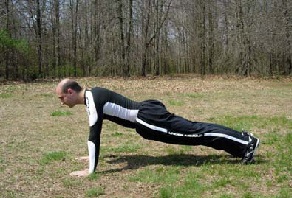
Push-ups.  Do them on your fists to strengthen the structural alignment for striking.  We will be incorporating the Dynamic Effort Method here, which is basically lifting a non-maximal load (your bodyweight) as fast as possible.  Begin in the top portion of the push-up.  Descend in a slow, controlled manner.  At the bottom portion of the exercise, explode upwards as fast as possible.  Do 10-25 repetitions.  Rest 60 seconds, then move on to exercise two.
Exercise Two

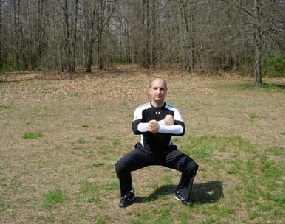
Bodyweight Squats.  Do them in Jumonji no Kamae, as shown below.  Utilize the same protocol as above.  Descend in a slow, controlled manner.  At the bottom of the squat, explode back to standing.  Do 25 repetitions.  Rest for one minute, then move on to exercise three.
Exercise Three

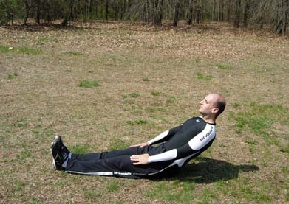
Straight Leg Sit-up.  Lie flat on your back.  Exhale, contract the core, and begin to sit up slowly keeping your spine straight.  Inhale at the top of the movement.  Exhale again and slowly lie back down.  Perform 5 repetitions of the straight leg sit-up.  Rest for 60 seconds and return to exercise one.  Continue until you have completed 5 sets of all 3 exercises.
How Often?

This workout can be performed 3 times a week, depending on your schedule and your fitness needs.  If you are including conditioning work as well, for an example see the WarFit Combat Conditioning System then this strength based GPP workout should only be done twice a week.  Here is an example of what a weekly schedule may look like:


Monday
  • Joint mobility warm-up
  • GPP Workout
  • Class training
Tuesday
  • Joint mobility warm-up
  • Solo Training
Wednesday
Thursday
  • Joint mobility warm-up
  • Solo Training
Friday
  • Joint mobility warm-up
  • WarFit Conditioning Workout
  • Yoga for compensatory movement


This is just one option of how fitness and marital arts can be combined in a weekly schedule.  If you have the luxury of being able to do a conditioning workout after your martial arts class instead of on a separate day, you can save more time.  Or, try getting up earlier and doing the workouts in the morning so your evenings are free for family time or more budo.

Future articles in the series will look at Specific Physical Preparedness, as well as Activity (martial art) Specific Exercises for Bujinkan training.  Additionally, I will expand on GPP, showing new exercises, and how to increase the difficulty levels of the exercises discussed today.

To learn more about the Warrior Fitness training method, exercises, and programming options, check out Warrior Fitness: Conditioning for Martial Arts.


Jack Hoban on Fitness

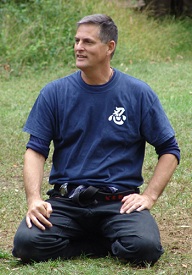
The interviews conducted here at Warrior Fitness will highlight people who have significantly influenced my thinking and training on fitness, who are leaders in their particular fields of expertise, and whom I admire.  Jack Hoban happens to fit all three.  Through his unwavering commitment to martial arts and fitness, Jack has inspired me to keep going over the past 20 years down the dual path of martial arts and fitness.

 Jack Hoban is a former active duty U.S. Marine Corps Captain and long time practitioner of martial arts.  He is Shidoshi Senior Instructor in the Bujinkan Budo Taijutsu and Togakure Ryu Ninjutsu systems under Grand Master Masaaki Hatsumi in Japan and has authored three books on warriorship.  Mr. Hoban also holds an MBA and is an executive in the healthcare industry.    Jack’s full biography, and further information, can be found on his website here


1.  Can you please describe your current philosophy on physical fitness?

I have been serious about physical fitness for most of my life, first as an athlete in grammar school, high school and college, and then as a Marine, and martial artist.  That hasn’t changed, just become more refined and age-appropriate as the years have gone by.  Humans are physical beings and have been so for millions of years; I think we should acknowledge and honor that fact by maintaining a high level of physicality in our lives.  That’s my philosophy.  Until fairly recently, being physically fit, for most of us, was just a part of being human—and staying alive through hunting and gathering, farming, work, or other physical endeavors.  That has changed, and there is a greater risk of falling into a sedentary lifestyle today.  But our basic nature as physical animals has not changed.  We have to be careful not to stray too far from our nature, or certainly unhappiness and ill health may result.

2.  How has your outlook changed over the years?

It really hasn’t changed.  It has just become more refined.  I have tried some of the new fitness technologies—for example I run barefoot now using the new Vibram footwear.  I also think I use cross-training more effectively than in the past.  But I pretty much do the kinds of things I have always done.  I do have to worry more about “overdoing it,” because injuries take longer to heal.

3.  Do you have a daily fitness regimen that you follow?

Yes and no.  I have a range of things that I do, but it changes according to my schedule, the season, the weather and how I am feeling.

4.  Can you briefly tell us what it consists of?

Again, it is not a daily thing in that I don’t do the same thing every day.   But over the course of a week I typically fit in a few runs (45 minutes to an hour), I lift weights, I do a lot of core training, and I do various calisthenics.  In the winter I use the gym for the rowing machine, treadmill and elliptical.  In the summer I swim in the ocean almost every day.  I practice martial arts daily by myself, and have a class between 2 and 5 times a week.

5.  How do you think fitness and budo (martial arts) are related?

Inseparably, although martial artists might take care to explore a regimen that is complimentary to martial arts—one that increases strength and endurance, but also promotes flexibility and relaxation.

6.  How has your being in excellent physical condition enhanced your martial arts training?

Simple, it helps me to “keep going” longer and more consistently without being tired or sick.  And by the way, real fights are very physical—tiring and punishing. 

7.  How does your being in excellent physical condition help your work with the Marine Corps Martial Arts Program (MCMAP)?

When I first meet a new class of students, the unspoken question is “Is he one of us?  Can he do what we do?  If he can’t, why should we do what he does?”  That’s just the nature of young, competitive men.  Because I can pretty much keep up with them “for an old guy,” I gain a certain measure of respect.  That way, they are open to the other physical and ethical lessons I am there to share.

8.  Has the Marines Combat Conditioning program influenced your personal exercise program, and if so, how?

Yes, in at least two ways.  It has made me more aware of the value of cross training, and two, it has made me more creative in using training aides of opportunity.  By that I mean, you can design your own training regimens and make your own training apparatuses just by using your brain and common items and structures.  You don’t need fancy equipment; an old tire works just fine as an exercise apparatus.

9.  The last, but most important question, how do you keep going?

I enjoy it!  Find a method of physical exercise that you enjoy and pursue that.  Find other people who like it as well, and do it together.  That will help too.

Thanks Jack!