Did you do the basic level of my Ninja 300 Warm-up? How did you like it? I’ve had several positive responses to the basic version, along with requests for the next level, so here you go! Continue reading
The Ninja 300 – Next Level
1

Did you do the basic level of my Ninja 300 Warm-up? How did you like it? I’ve had several positive responses to the basic version, along with requests for the next level, so here you go! Continue reading
Recently I was asked about how to use a single kettlebell to train footwork for Bujinkan martial arts. Here is a video I put together showing a couple different exercises to enhance stability and mobility for footwork training using the kettlebell. Enjoy!! Continue reading
Sometimes the lines between martial artist and martial hobbyist get blurred. How do you determine whether you are a true martial artist or just a martial hobbyist? Here is a quick and easy way to find out…
If you answered YES to one or more of these questions, then congratulations, you are a Martial Hobbyist. Not that there’s anything wrong with that.

If you answered YES to 3 or more of these questions, then congratulations, you are a Martial Artist.

This post was inspired by reading about a dedicated yoga practice earlier this morning and what it takes to achieve a committed, dedicated practice. Hopefully no egos were bruised in the reading of this post!
By the way, if you want to move from hobbyist status to artist status, here is great article on How to Train More Every Day. Enjoy!
How can we train for the friction and chaos of battle when following a set fitness routine?
Physical preparation for combat readiness must be, by its very nature, a multifaceted approach. If the combatants have to be ready for anything, shouldn’t their fitness regimen reflect that? Surely the idea of training random workouts each and every day must help better prepare the person to face any challenge, right?
As with all things, fitness is a skill. The body must be adequately prepared at a baseline level through rigorous training AND practice to establish a solid foundation of GPP. To suddenly subject a trainee to an onslaught of arbitrarily selected workouts is only a recipe for creating a shallow level of skill in a bunch of random areas. It is also a great way to cause injury rather than seek to prevent it. Random training produces random, haphazard results.
The Warrior Fitness Training methodology follows the Shu-Ha-Ri model of teaching prevalent in schools of traditional Japanese martial arts. Shu-Ha-Ri translates to “protect the form, break the form, leave the form behind”.
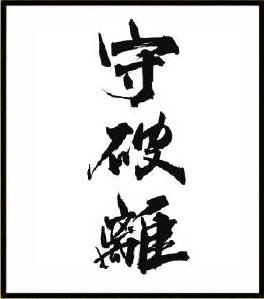
Usually within schools of traditional Japanese Budo this is a linear model where at the beginning of training the student is taught to carefully protect the form without deviation so as to template themselves to the teacher and to the martial system. After becoming proficient in the exact techniques of the school the student is then encouraged to begin breaking the form. And then slowly, very, very slowly, after decades of practice the student finally begins to transcend the form and leave it behind thus moving at the level of principle.
The Shu-Ha-Ri model is slightly different in the Bujinkan tradition that I study. Rather than a strict linear progression, the model is not quite as fixed. It may be Shu-Ha-Ri, Ri-Ha-Shu, Ha-Shu-Ri, or any combination of the three. In this way, the student does not have to wait until he has trained for decades to learn how to break the form, nor does he always leave the form behind. Instead the training progresses in an upward spiral where the teacher may start with the basics, circle up to breaking the form, and finally leave the form behind, followed by working again on the basics. The same material is always looked at with fresh, new perspective and greater depth each time it is taught no matter where in the cycle it falls. This allows for better all-around development and faster progression while still inculcating the basic forms and instilling a respect for technique. It also gives the student the freedom to adapt to the friction and chaos of combat by learning how to both break and throw away the form when required yet still conforming to the strategic and tactical principles of the art.
What I have done is take the Shu-Ha-Ri model as taught within the Bujikan martial arts tradition and apply it to the programming in my Warrior Fitness Training System. This means that within a complete training program, the student will undergo GPP (general physical preparation), SPP (specific physical preparation), TS (technical skills), and MT (mental/emotional toughness) to fully and completely prepare them for the task, goal, or mission at hand (For a more detailed description of each, please see my post on The 4 Levels of Preparation).
Following the Bujinkan model then, the progression of training may not necessarily be a straight line. Depending on the level of the student, GPP will most likely form the bulk of the training but it will be cycled out of and back into throughout the duration of the program. As the student progresses and increases in the skill of fitness, their training becomes blended at a higher level of SPP maybe only cycling back into GPP to shore up certain weaknesses and then coming right back out again. This insures that the student is constantly progressing and also constantly prepared without having to resort to a random workout generator model of training.

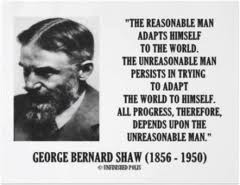
Being reasonable gets you mediocrity. Being reasonable gets you the status quo. Nothing great has ever been achieved by men and women who were reasonable. Every major (and most minor) human achievement has been accomplished by unreasonable people.
It was unreasonable of Thomas Edison to fail over 10,000 times before creating the incandescent electric light bulb.
It was unreasonable to think that a man could walk on the moon until Neil Armstrong stepped onto its surface in July of 1969.
It was unreasonable to think the 4 minute mile could be broken until Roger Bannister broke it on May 6, 1954.
In the world of Bujinkan Martial Arts, it was unreasonable of Stephen K. Hayes to think he would be accepted as the first American to study the mysterious art of Japanese Ninjutsu, yet today he is known all over the world.
Over and over again, unreasonable people are succeeding, accomplishing great things, and leaving their mark on the world. So tell me again, why would you want to be reasonable?
Do you ever get the feeling you were destined for greatness? It starts like a slight nagging feeling in your gut that there’s something missing. That you don’t quite fit in with the status quo. It’s a dissatisfaction with ordinary or mediocre. It’s the fleeting thought on the fringes of your consciousness that maybe, just maybe there’s something more than this for you.
“You take the blue pill, the story ends, you wake up in your bed and believe whatever you want to believe. You take the red pill, you stay in Wonderland, and I show you how deep the rabbit hole goes.” – Morpheus
Unfortunately for the world, the majority of people out there will ignore that feeling. They will make excuses why they can’t act on it. They will be too busy, too tired, too involved in something or someone else, too lazy, too scared. But not you. You will act. You will feel the fear just like all the rest of them, but your desire for greatness will allow you to overcome it. You will have all the same excuses and rationales, maybe more, but the restlessness inside will not let you rest.
“Most men lead lives of quiet desperation and go to the grave with the song still in them” – Henry David Thoreau
To bring this from the general to the specific, how do we become unreasonable in our training?
For starters, I have never believed that any highly skilled martial arts master was special. Never will. You and I have the ability to be as great as any one of them. What one man can do, another can do. The only way to insure you never succeed is to put them up on a pedestal and tell yourself they are special. That they are geniuses. That they are a rare, unusual breed. That they are set apart. Nonsense! You want it? Train harder. Train more. Train better. Become unreasonable in your training.
You must train yourself to be so good that they won’t be able to ignore your skill, no matter who you are and no matter what your rank – or lack of!
Learn the ancient warrior’s methods of building an unbreakable body HERE.
There are 3 Paths of the Warrior, along with the 4 Levels of Preparation, that form the basis of the entire training system. While each path is unique with its own individual strategies, methods, and characteristics, they are also so deeply interconnected that the sum of the whole system of training is far greater than its individual parts.
The 3 paths are…
Strength is not only about unleashing our innate physical supremacy, but comprised of mental fortitude and spiritual power as well. The aim of this trifold path of strength is to forge the strongest version of yourself on all 3 levels of human ability.
The Path to Strength utilizes tools such as Russian kettlebells, Indian Clubs, old objects, and a considerable variety of unique bodyweight exercises to generate strength throughout the entire body in all ranges of motion. Physical strength is not confined to merely muscle alone, but focuses on training the tendons, ligaments, and fascia as well. This provides a much more stable and connected body.

Health is not merely the absence of disease, but the allowing of the human body to operate at full capacity all of the time. Rejuvenation increases the resilience of the body through restoration and compensation for the work of Strength.
The Path to Rejuvination is comprised of joint mobility work to keep the body well lubricated and injury free, yoga asana to systematically increase flexibility and act as compensatory movement, breathing and vibration training to flush the system with oxygen, remove residual tension, and energize the body.
Martial skill is not simply the ability to regurgitate dogma and technique, but the ability to spontaneously use the conditioned budo body to its utmost level and ability in a combative engagement.
Although the considerable bulk of my martial training over the past 30 years has been in the Japanese warrior arts of Bujinkan Budo Taijutsu, I have studied, and continue to study, several other martial arts from around the world as well. The main arts, aside from the Bujinkan, from which I draw my experience are: Russian Systema – both Ryabko Systema and Systema ROSS, Chinese Yiquan, and the Aiki of Dan Harden.
How do you get started down the Warrior’s Path? START HERE <<===
Ever feel like everything is spiraling out of control? Like the only thing that actually responds to you the way you want it to is your TV remote, and lately even that is on the fritz?
How do you reign it all in?
The answer is simpler than you think…

Your locus of control determines everything. Where you source your control is what governs how you live your life. According to psychology, those people who have allow their lives to be dictated by outside forces have an external locus of control. These people are all over the map. They are blown by the wind, allowing whatever happens on the outside to move their thoughts, their moods, their actions. Because these people allow themselves to be pushed around by external forces they constantly feel as if they are out of control. And they are.
Conversely, those with an internal locus of control are much more stable and steadfast. They understand that it is not what happens to them that determines how they respond, but how they choose to feel about it. The only thing you control in this life, aside from the temperature on your thermostat, is your ability to choose how to respond to external situations. What happens on the outside, happens to pretty much everyone. We all get sick. We all have bad days. The sun set on all of us last night. What differentiates these people is their ability to choose how to feel about, and respond to (if they do at all), the bad things that happen to them. They are in control.
In Japanese budo (martial arts), we have a very similar concept called, Fudoshin. Fudoshin means “immovable spirit”. Basically it says that the warrior maintains a calm in the very heart of the storm. He is not moved by external events and situations, but is able to bring his full capabilities to bear because of this immense mental and emotional stability. He is in control.
Does this mean that warriors are heartless, unfeeling people? No, not at all. Quite the opposite, actually. They feel anger, sadness, bitterness, regret, frustration, happiness, joy, ecstasy, and yes, even depression. But, they do not allow these emotions to rule their lives running them up and down like a roller coaster at Six Flags. They stay the course.
It’s very easy to allow outside events and circumstances to push us around and dictate the course of our lives. We’ve all experienced it and allowed it to happen at some point. The key is recognizing it and moving your locus of control back to inside yourself.
People have all sorts of excuses and rationalizations for being swayed by every outside force. We even have a very philosophical, quasi-intelligent sounding way of putting it; we say – “go with the flow”. You’ve heard this, right? You’ve probably even said it to someone, I know I have. But here are 2 very important things to remember about why you should NOT go with the flow:
1) You cannot drift to the top. You’ll never achieve your goals and dreams by going with the flow.
2) Only dead bodies float downstream.
Remain steadfast, Warriors. Stay the course, my friends!!
In The Law of Threes – Part 1, we discussed the 3 physical components of Alignment, Movement, and Breathing, which form the basis for technique in the Warrior Fitness Training System. The next trinity of principles we will look at is the sanshin no kata, or Form of 3 Hearts.
The 3 hearts I am referring to here are body, mind, and spirit. While the prior 3 components make up the internal physical expression of technique, these 3 represent a unified metaphysical approach to technique. It is the integrated use of mind, body, and spirit which brings life to and actualizes the practice of Warrior Fitness.
The following is how I distinguish the 3 Hearts:
Mind – Intent, concentration and focus along with an understanding of the interrelationship of the exercises and how they integrate with and enhance the way we move in the world.
Body – Forging a strong body to carry us through the challenges we face.
Spirit – Pushing the edge to consistently increase resistance to failure.
When just one of the 3 hearts is absent or somehow out of balance, the technique itself becomes just a shallow, superficial representation of its true, powerful form.
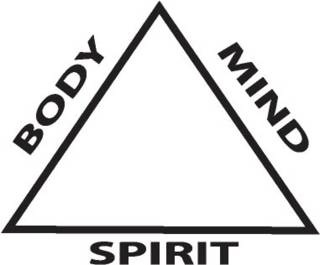
The techniques of both fitness and martial art must, by definition (at least the Warrior Fitness definition) engage the complete human being – body, mind, and spirit – to have the most lasting and transformative effect. Without full commitment of the 3 Hearts not only is the technique itself a weak expression of its true power, but the person executing it, by default, does not receive the comprehensive benefit of the exercise.
“It is much better to deeply practice an exercise just 3-4 times while being fully engaged than to practice it 100 times without.” – Jon Haas
In the following 3 (or more) part series I will begin to lay out the specific philosophies of training in the Warrior Fitness System. In each segment we will examine a particular set of principles, all of which happen to come in groups of 3; thus the entire series together is named, “The Law of Threes”. These principles are the beginning of how to teach and train technique within the Warrior Fitness System.
In additional upcoming articles, I will also begin to delineate the 3 Paths of Warrior Fitness Training, as well as the 4 Levels of Training Preparation.
Today though, let’s begin with…
Within the Warrior Fitness Training System, there are 3 main components which must be present in order to express the correct form for each physical technique. These 3 components are:
“It is the breath that gives life to and actualizes the techniques” – Masaaki Hatsumi, Bujinkan Soke
Each of these 3 components must be taught correctly and integrated within the body of the trainee before they can be said to be executing the correct form of the technique.
The components of Alignment, Movement, and Breathing relate to both fitness and martial art techniques. For example, skills like the kettlebell swing, bodyweight squat, or push-up in fitness, as well as martial techniques like throwing a punch, striking with a stick, or cutting with a sword.
No matter what particular outer expression of the technique takes, these 3 physical elements of Alignment, Movement, and Breathing must be united within the practitioner to create whole body power and maximum efficiency. Only in this way can one be said to be doing the techniques of Warrior Fitness accurately.
You may have heard the news that I am closing the physical location of Warrior Fitness Gym this week. This is not a bad thing. The Warrior Fitness Training System existed prior to the gym location (I wrote the original Warrior Fitness book in 2008), and it will go on after it.
Now that I am no longer shackled to a brick and mortar location I have the ability to expand my global reach and provide even more coaching, teaching, and results to you.
This change allows me much greater adaptability and mobility to train my local clients here at home and also frees me to teach more workshops, seminars, and classes in other locations, both here in the US and abroad.
With that preface, I am introducing 3 brand new services from Warrior Fitness:
There are 3 new options here: Weekly Warrior Bootcamps in the park (see Class Schedule HERE) and Warrior Personal Training at your home, office, or other location. Corporate Warrior Training is also available – short, intense, highly effective workouts for the busy executive and employees to train both mind AND body!
Email me for details on scheduling and pricing.
Topics include:
Email me for details on scheduling and pricing.
I will put together an individualized program specifically tailored to you and your training goals. Check HERE for all the details.