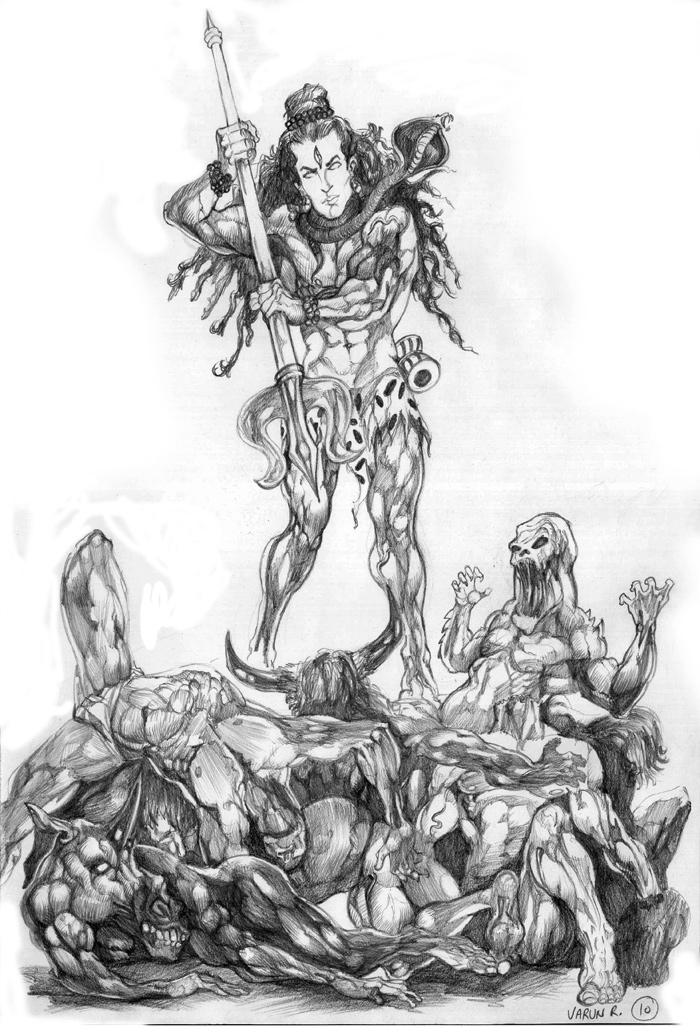
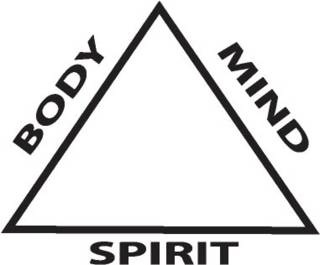
A short introduction may be necessary for those readers not familiar with Bujinkan Budo Taijutsu. Sanshin no kata is a basic training exercises within the system that templates movement patterns for Bujinkan Budo Taijutsu. In English, it translates to “form of three hearts”. These three hearts are mind, body, and spirit. All three must be united for technique to come alive for the martial arts practitioner. Without all three aspects of body, mind, and spirit unified the kata become empty shells of movement, devoid of essence.
Bujinkan martial arts are the wellspring from which my concept of Warrior Fitness sprung as a natural outcropping. So as my philosophy of Warrior Fitness continues to evolve, it naturally gravitates to this type of structure for me to express it. In keeping with the trinity of mind, body, and spirit, here is how I see it for Warrior Fitness:
Mind –Concentration and focus along with an understanding of the interrelationship of the exercises and how they integrate with and enhance the way we move in the world.
Body – Forging a strong body to carry us through the challenges we face.
Spirit – Pushing the edge to consistently increase resistance to failure.
The Sanshin no kata consist of 5 forms which are called, Chi no kata (earth form), Sui no kata (water form), Ka no kata (fire form), Fu no kata (wind form), and Ku no kata (void form). Those who have read Miyamoto Musashi’s famous work, Go Rin No Sho – A Book of 5 Rings, are most likely familiar with the terminology as well. Here is how each is expressed in Warrior Fitness:
Earth – Building strength, stability, and structure in movement and stillness
Water – Freedom of movement through all ranges of motion, flow state
Fire – Metabolic conditioning to ignite fat loss and sculpt lean muscle
Wind – Breathing exercises to vitalize every cell in the body
Void – Pushing the edge of our limitless potential
Hone Your Mind, Invigorate Your Spirit, and Make Fierce the Body with Warrior Fitness!
If you’re like me and can’t stand to waste any amount of time no matter how short, you’ll love how isometrics can fill in some strength gaps. Nowadays, my days are jam-packed full with work, meetings, conference calls, networking, family time, training time, teaching time, writing time, and oh yeah – a little sleeping in my spare time. Since there are never enough hours in the day to accomplish all the things I want to do (not to mention those pesky things I have to do!), I try to make the most of those few free minutes of downtime in between tasks so I can be just a little more productive.
The only way to constantly improve is to consistently work on improving your self. One of my favorite quotes of all time is from Calvin Coolidge:
“Nothing in this world can take the place of persistence. Talent will not; nothing is more common than unsuccessful people with talent. Genius will not; unrewarded genius is almost a proverb. Education will not; the world is full of educated derelicts. Persistence and determination alone are omnipotent.”
And, since I don’t consider myself particularly talented, or even all that smart, it’s a good thing I am persistent!
So, let’s talk isometrics.
Isometrics are a great way to work on increasing strength, or shoring up a strength deficiency in a certain movement or exercise, with virtually no equipment and very little time. They are both effective and efficient – good news for us!
So what exactly are isometrics? Basically, isometric exercise is exerting force against an immovable object. The idea is that the length of the muscle does not change, but the tension remains constant during the exercise. There are 2 general types of isometric exercise:
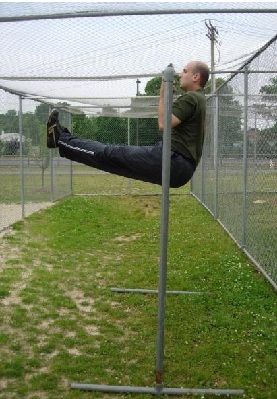
1. Holding yourself (or a weight) in a static state. For example holding the mid-point of a push-up position or the mid-point of a squat. Or, holding yourself statically on a pull-up bar.
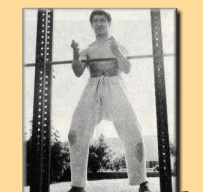
2. The other type of isometric exercise consists of pushing or pulling against an immovable object. This picture of Bruce Lee is a great example of just one of the ways he used to train isometrics.
For our purposes, when training the first type of isometric drill, try holding the mid-range or hardest point of the exercise for 30 to 60 seconds. Make sure to keep breathing! Then shake it out – see the vibration exercises here – and go again.
We will use much shorter time frames for the second type of isometric exercise. Here we will be pushing or pulling against an immovable object as hard as possible (maximal contraction) for 1 to 3 seconds each rep. Exert force as quickly as possible to improve speed strength. Studies have found that the intention to move fast was more important for speed development than the actual speed of the the movement. Interesting, eh? Train about 4 to 6 reps per set and use the vibration exercises referenced above to remove residual muscle tension between sets. Since there are innumerable variations here – pushing with the arms (one or both), pushing with the legs (one of both), pulling with the arms (one or both), pulling with the legs (one or both), not to mention the number of different joint angles one can use with either push or pull, I will leave it up to your creativity to determine how to best apply it in your training. Let me know what you find works best for you.
I hope you enjoyed this short primer on isometrics. We will be exploring them in more depth, as well as showing how isometrics can be used to not only increase strength, but increase power for your strikes in my upcoming book… Stay tuned!
This is an article I wrote last year for my friend, Josh Sager’s kick-ass guitar blog, Fretterverse. I hope my Warrior Fitness readers enjoy it as well!
Every guitar player knows that consistent practice is the key to becoming great. But what happens when your daily practice is causing you daily aches and pains? Give up? No way. Scale back your practice? Not a chance. Live with it? Some do. You shouldn’t have to.
Every activity that we repeat consistently causes an adaptation in the body. The critical thing to note here is that it does not matter at all how we value this adaptation. It can be something that we want like how healthy exercise increases lean muscle mass and burns excess fat, or it can be something we do not want like how eating junk food to an extreme causes our body to adapt by putting on weight. Both of these are examples of activities that cause adaptations in the body. Sitting and playing guitar for extended periods of time also causes specific adaptations in the body. Some we value highly, like the enhanced neural connections in our nervous system that adapt to increase our skill level. Others, like hunching over a classical guitar for example, may cause our body to adopt this rounded back, slumped shoulders posture while standing and performing activities other than practicing guitar. In order to bring our bodies back to balance, while retaining the adaptations we value, ie the skill in playing that our practice is supposed to generate, we must compensate specifically for the typical posture used while shredding.
Yoga is designed to bring your body back to balance. Don’t worry, I’m not about to ask you to jump into a Power Yoga class. Not unless you want to, anyway. What I am going to have you do is take about 10 minutes after your practice and use just a few simple yoga postures (illustrated below) to help bring your body back to balance and prevent, or relieve, the back and neck pain that tend to be associated with long term sitting, whether due to working on a computer, sitting in an office, or sitting while practicing guitar. An added benefit is that we will also open up your chest and lungs to improve your breathing pattern and help reduce stress.
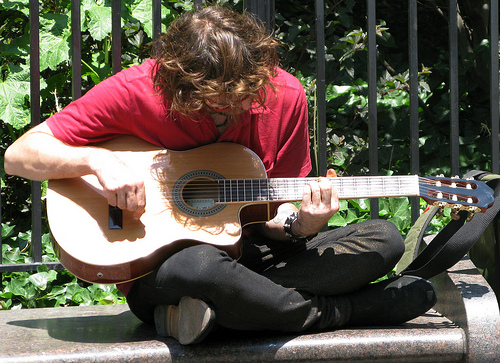
Note in the picture above how his back is rounded and his head looking down. Over time, this will contribute to low back pain, neck pain, and hunched, rounded shoulders. His posture is not optimal for breathing either. The effect of rounding the back concaves the chest and compresses the lungs making it difficult to achieve a full, deep breath.
Postures
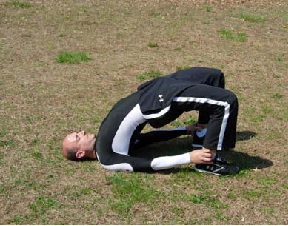
1. Shoulder bridge
Lay on your back and bend your knees
Pull your heels in as close to your butt as possible
Exhale and lift your hips up, driving with the middle part of your feet
Squeeze your glutes and lift a little higher
Exhale and pull your belly to your spine
Hold for 20 to 30 seconds
Relax for a few breaths and then do it again
Bring your knees into your chest and squeeze them tight to release any excess tension
Straighten out your legs and then move onto the next posture
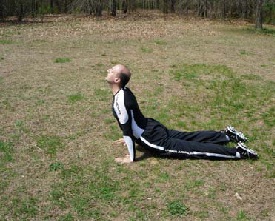
2. Upward Facing Dog
From the end position of the last posture, laying on your back, roll over onto your stomach
Lift from the crown of your head and drive with the palm heels
Make sure your elbow pits are facing forward
Drop your shoulder down, so they are not up by your ears
Lift your hips and legs off the ground
Inhale, expanding the chest, lifting it up at a 45 degree angle
Hold for 20 to 30 seconds
Lay down flat on your stomach and rest for a few breaths
Repeat and then finish by moving into Sleeping Warrior
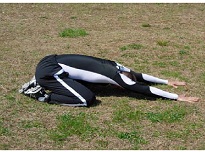
3. Sleeping Warrior
From a kneeling position, exhale and pull your belly to your spine.
Fold your torso forward over your knees and place your forehead on the ground.
Extend your arms straight out in front of you.
As you extend and reach with the hands, draw the shoulder blades down so they are not coming out of joint.
Continue to extend and pull back to stretch and release the tension stored in your shoulders.
As you inhale, you will find it difficult to expand the abdomen and the chest due to the compression. Try to find the free spaces on the sides and back where you can inhale into and expand slightly.
As you exhale, again pull belly to spine and contract your core moving deeper into the posture.
What About My Hands?
Although the following are not particularly yoga exercises, they can be of benefit to guitar player’s hands. The repetitive motion of strumming and chord changing can cause problems similar to the repetitive keyboard typing of the desk jockey and thus special attention needs to be paid to the hands, wrists, and fingers.
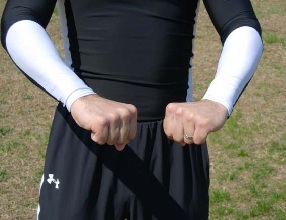
Releasing the Wrists
Hold both hands in loose fists, make circles clockwise for 5 to 10 reps and counter-clockwise for 5 to 10 reps
Next, starting with left wrist, hold in fist as above, lift wrist up, to the outside, down, to the inside, reverse direction and repeat with right wrist for 5 to 10 reps each direction
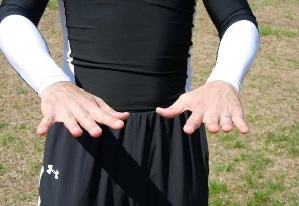
Releasing the Fingers
Begin circling fingers with thumbs (5 times each) then continue with each additional finger
Circle fingers from pinkies back to the thumbs in the opposite direction
Shaking the Hands
Shake the hands vigorously keeping them very loose for about 10 to 20 seconds. This has the effect of releasing residual tonus and relaxing the muscles.
The above exercises, if performed consistently, will act as compensation for long periods of sitting and help you to abate any type of chronic muscle tension and pain that comes as a result of your practice. There are, of course, many other yoga postures that can be utilized with the same type of success to help compensate for any type of activity, including inactivity! Hopefully this brief introduction on yoga for guitar players will enable you to practice longer and pain free – shred on!
About the Author: Jon Haas is a NJ based fitness trainer, writer, and martial artist. He can be reached at www.warriorfitness.org
Today we’re going to do a fun workout based on the Tabata Protocol. If you are not familiar with Tabata, please check out the Warrior Fitness Tabata Primer found here, What’s Tabata You?
I highly suggest you warm up before doing this workout. In fact, I insist on it. What’s a good way to warm-up? I’m glad you asked. One of my favorite warm-ups is found here in my Morning Wake Up Routine. Don’t let the fact that it says morning dissuade you. It’s a quick, highly effective recharge/warm-up that can be used anytime of day.
Now, onto the workout. Warmed up? OK. Here we go –
Remember, Tabata is 8 rounds of exercise, 20 seconds on, 10 seconds off, for a total of 4 minutes for each exercise. Take one minute rest upon completion of each set of 8 rounds.
Exercise 1 – Bodyweight Squats
1 minute Rest
Exercise 2 – Hindu Push-ups
1 minute Rest
Exercise 3 – Sit Thrus
1 minute Rest
Exercise 4 – Burpees
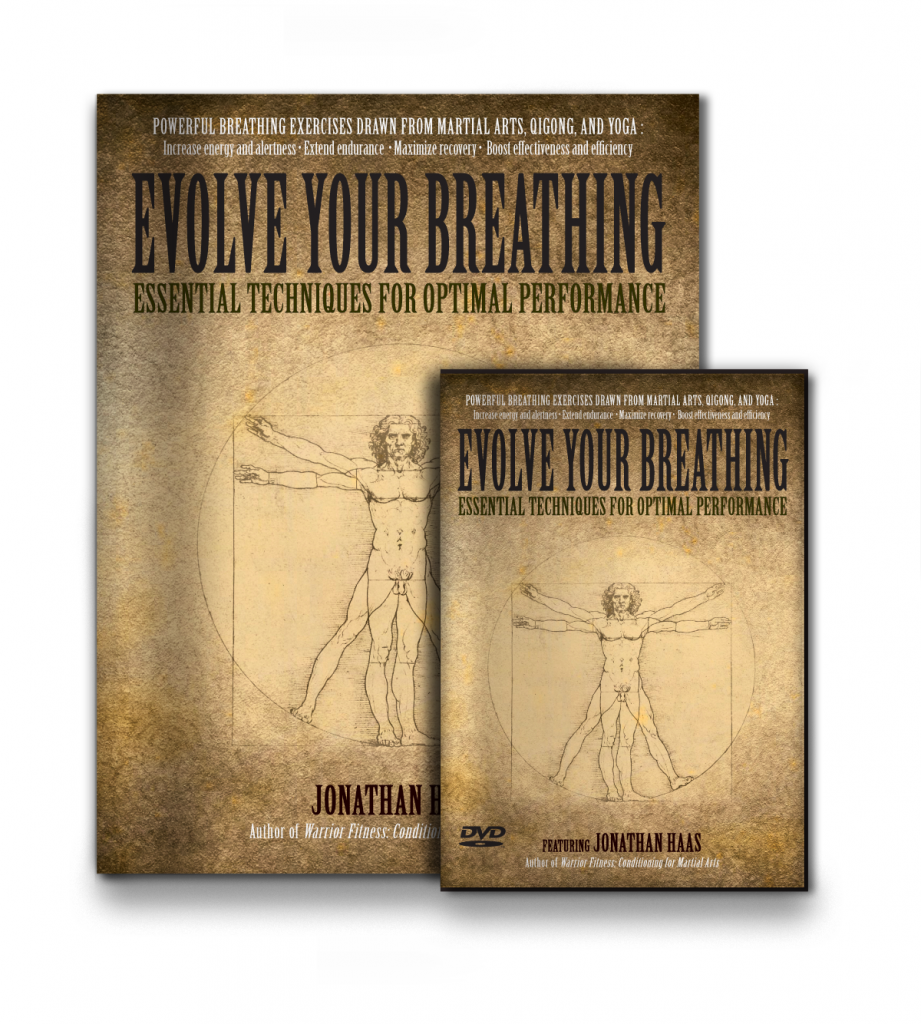
Out of breath? Want to learn how to recover your breathing in between exercises and at the end of the conditioning session? Check out the section on restoring breath in Evolve Your Breathing.
What’s sapping your energy and, unbeknownst to you, hindering your performance in martial arts, athletics, or simply the daily art of living, working, and taking care of your family? Residual muscle tension, or tonus, is the continuous, passive partial contraction of muscles in the body that aids in posture and support. Unfortunately, any type of exercise, stress, fear, and trauma, all cause an unwanted and unnecessary increase in the normal residual muscle tension of the body. Usually this extra tonus goes unnoticed, or worse is simply deemed an acceptable and natural side effect of living. The problem with this added tension is that the continuous contraction of muscle throughout the day, ever day, is using up energy. Energy that can, and should, be available to us is being siphoned off thereby putting the brakes on our performance. It’s like driving a car around all day with the emergency brake on. You can still get where you need to go, but that extra, unnecessary drag is killing the car’s performance and guzzling gas.
So how do we remove these insidious restrictive forces on our body? Besides a daily dose of joint mobility, which has been covered extensively in Warrior Fitness: Conditioning for Martial Arts, and in various other posts, I have come across 2 methods that work wonders:
1. Tension/Relaxation Exercises
At first glance, it may seem odd to increase tension in order to relieve tension, but remember, residual muscle tension is held unconsciously while these exercises will intentionally increase muscular tension for the purposes of identifying and releasing it. Stand naturally and lift your shoulders as high as possible up to your ears while simultaneously squeezing them as tight as possible. Hold for a couple seconds then drop with an exhale. Do it again. Feel the tension in your shoulders, neck, and upper back start to release? You can do this locally with any area of the body, or the whole body all together. For example, tense your left arm as tight as possible on an inhalation, hold for 3 seconds, then completely relax on an exhale. Do this with the legs, the abdomen, chest, back, shoulders. Tense each area while inhaling, hold for 3 seconds, then release and relax on the exhale.
2. Vibration Exercises
These are very simple, yet highly effective exercises which have been used for centuries in yoga and qigong to shake out and release residual muscle tension in the body. So how do you do them? Stand naturally, feet shoulder-width apart, knees slightly bent. Spine straight. Lift up from the crown of your head. Begin to bounce gently with the legs shaking the whole body up and down. On each down bounce allow the body to exhale – don’t force it. Don’t try to breath, just let the motion breath the body. Slightly round the shoulders and tuck the pelvis to help the motion push air out. Continue shaking the body up and down for about 30 seconds to a minute. Stay loose. Stay relaxed. Shake out the tension.
These 2 simple exercises, done on a daily basis, will go a long way toward helping you recover the energy that’s been bound up in holding residual muscle tension. Let me know how they work out for you!
In our last article on breathing exercises, here, we introduced the concept of using the basic push-up form as a vehicle for training the breath. Today we will continue with the push-up as the outward expression, but take a look at different types of breathing patterns to increase the depth and complexity of the the exercise.
4 Phases of Breathing
The breath cycle can be broken down into 4 distinct phases of breathing:
Inhale
Pause after inhale (full hold)
Exhale
Pause after exhale (empty hold)
Each of these phases can be manipulated within the framework of our exercise to create variation and change the focus of the exercise. Previously we had discussed how to use the inhale and exhale phases of breathing to increase capacity by fitting more movement into each breath. Today we will focus on the other 2 phases, pause after inhale and pause after exhale. These breath holds will allow us to teach the body how to utilize the oxygen it already has more effciently by working longer in a state of oxygen deprivation.
As a side note, please be aware of your body’s physiological response to breathing exercises. In general, inhalation causes a slight increase in tension and blood pressure, while exhalation causes a relaxation response and an accompanying lowering of blood pressure. These effects can be magnified by holding the breath after inhalation and holding the breath after exhalation. Therefore, please proceed with caution.
Inhale and Hold
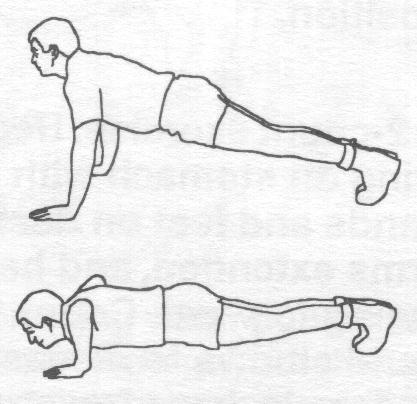
In this exercise we will be working with the pause after inhalation. Assume the push-up position. Inhale deeply by expanding the belly. Don’t force it. Just inhale as much as comfortable for you. Pause. Do not exhale.
Perform 1 push-up.
Exhale at the top and inhale again. Perform 2 push-ups on the full hold. Exhale at the top portion and then inhale and hold. Perform 3 push-ups on the full hold.
How does it feel?
Can you do 4? 5?
Make sure you are not trying to move faster just because you’re holding the breath.
Perform the push-ups smoothly and in a relaxed manner. A side benefit of this type of work is that it helps you to work under stress. When you can’t breathe, the body begins to panic. Even though your mind knows it’s just an exercise and you can breathe at any time, your body is responding to the lack of air and begins to sound the alarm. Understand this and work with it to teach yourself to remain calm in difficult situations.
Exhale and Hold
Now let’s look at the pause after exhale, or empty hold. You know the drill by now – assume the position!
Inhale and exhale in the top portion of the push-up. Hold on the exhale and do 1 push-up. Inhale and exhale. Do 2 push-ups. Inhale at the top, exhale. Do 3 push-ups.
What do you notice about holding on the exhale versus holding on the inhale?
Much more difficult, right?
Again, note the reaction your body is having to the exercise. Are you speeding up to get through it? Are you using more muscle tension than necessary? How does the increased muscle tension affect your body’s oxygen usage? Relax and slow down. You’ll be able to handle more.
Hip to be Square Breathing
Okay. Time to put it all together. Square breathing means that each of the 4 segments or phases of the breath cycle will be of equal length. For example, inhale to a count of 5, hold on the inhale for a count of 5, exhale for a count of 5, then hold on exhale for a count of 5. The count itself doesn’t matter as long as each part is equal. Obvioudly, the difficultly level can be increased with a higher count and decreased with a lower count. For our purposes, let’s stick with the 5 count for one push-up. Begin in the up portion of the push-up. Don’t move yet, but inhale for a count of 5. Now hold the breath and slowly lower down to a count of 5. At the bottom portion of the push-up, exhale in position for a count of 5. Hold on the exhale and raise yourself back up slowly to a count of 5. Make sense?
Let me know how you make out with the above exercises and if there are any questions you have.
Since Top 10 lists have been so overused of late, especially in the internet blog area, here are 7 and a 1/2 reasons why the Warrior Fitness program is for you.
1. No gym memberships required! Still paying for a gym membership you don’t use, or not getting the results you want from your gym? Start thinking outside the gym with Warrior Fitness!
2. Low-tech fitness solutions. Don’t have the budget for expensive training equipment? Warrior Fitness offers a complete body-weight workout for strength and conditioning.
3. Quality workouts that work around your schedule. It doesn’t take hours in a gym to achieve the results you’re looking for. Our program encourages quality over quantity. Got 15 minutes? Then you have time for a workout.
4. Lose fat, gain lean muscle. Our workouts are short, but intense to encourage lean muscle growth while stimulating fat loss. No more boring hours of mindless cardio!
5. Sample workouts and programing guidance. Do some fitness training manuals you’ve purchased in the past leave you wondering how to put it all together or how to fit into your schedule? Warrior Fitness provides sample workouts you can follow or use as templates to create your own.
6. Ongoing support and new ideas. Got questions? Send me an email. Post a question in the comments section. I’m here to make sure you are successful!
7. Fully integratable with your martial arts training. Ever wonder which fitness programs make sense to use within the context of your martial arts training? Ever feel like you may be hindering your progress by the type of workouts you’re doing instead of enhancing it? Since the program is designed by a martial artist with 30 years of experience and a fitness training background, Warrior Fitness provides a clear path to integrating your fitness and martial arts.
7.5 Comprehensive! Warrior Fitness covers supremely functional strength and conditioning drills, joint mobility, flexibility, breathing exercises, workout recovery, performance enhancement for martial arts, internal strength development, and more!
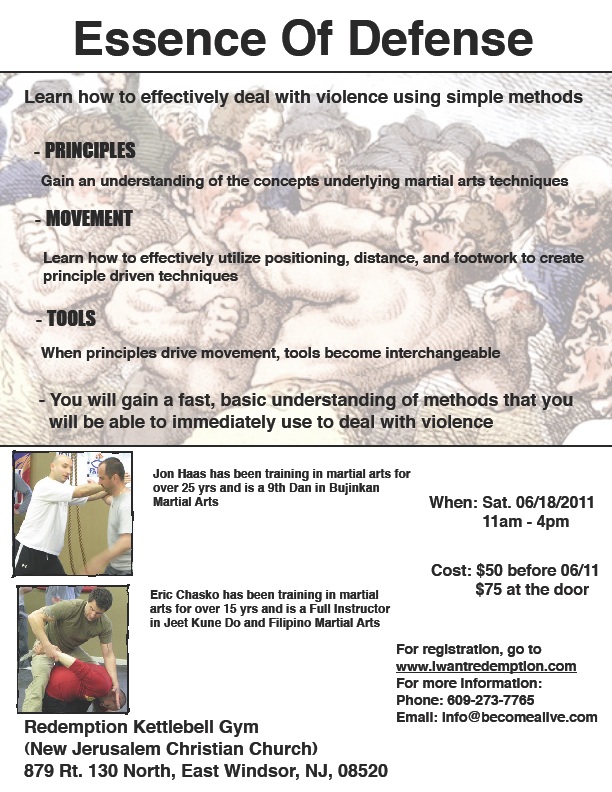
What exactly is the essence of defense? Suppose you took a martial art(s) and stripped it down to its core principles and functional movements to allow it to be employable with any tool whether it be empty-hand, blunt weapon, edged weapon, long weapon, hidden weapon, or improvised weapon? What you would have is a fast, effective, no-nonsense approach to communicate years of martial arts training in a short span of time. This approach would make self defense methods immediately accessible to people who may not want, or have time, to devote decades to becoming effective at defending themselves. Suppose you want to have the confidence and ability to protect yourself and your family from sudden violence, but don’t want the trappings of tradition and the hours of perfecting forms and kata? What if the essence of defense could be extracted by 2 highly experienced martial arts practitioners, refined, distilled, and communicated not over years, but in the course of a seminar?
Principles:
Get off the line of attack
Counter-attack
Intercept/destroy the attack
Unbalance the opponent
Continuous movement
Escape
Much more….
Movement:
Positioning
Footwork – angles, distancing
Safe space
3 dimensional movement
Much more…
Tools:
Body weapons
Blunt objects
Edged weapons
Improvised weapons
Hidden weapons
Much more…
Who should attend The Essence of Defense seminar?
Military
Law Enforcement Officers
Anyone who wants a working knowledge of practical martial arts principles that allows them to create their own techniques in response to a specific threat of violence.
When: Saturday, September 8th from 11 AM to 4 PM
Where: Redemption Kettlebell Gym in Robbinsville, NJ
Cost: $65
Who: Eric Chasko is a fully licensed instructor in Jeet Kune Do/Filipino Martial Arts with over 15 years experience.
Jon Haas is a 9th dan in Bujinkan Budo Taijutsu with over 30 years experience.
Today we are going to talk about push-ups. I can hear the groans already.
But these aren’t the dull, boring, uninspired push-ups you had to do in grade school gym class for some lame physical fitness challenge. Nor are these the repetitious calisthenics you had to do by the hundreds in Army Boot Camp.
Today, we are using the basic push-up as a tool, a vehicle to study and work our breath. The push-up is simply the form our breathing exercise will take, nothing more.
Sound a little more interesting now?
Let’s explore a little more…
Usually, breathing exercises are done in a very relaxed, non-stressful manner in a seated, or even lying down position.
Not today.
Breathing push-ups will help us explore our breath while moving and while under load.
Why is this important, you ask?
Consider that it’s pretty easy to control your breath while comfortably seated on the mat, and easy to relax while lying down. But how much carryover do those types of breathing exercises have to helping you withstand pressures in real life or stress in fighting? Some, certainly, but their emphasis is different. Please don’t misunderstand here though. We need a myriad of exercises to be able to influence and control physiological processes. The stationary relaxed breathing exercises absolutely do have a place in your tool kit and are important for health, stress relief, and relaxation, but are just not the focus of our discussion today.
The Structure of a Push-Up
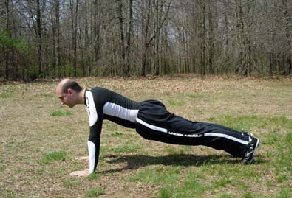
Let’s begin in the up portion of the push-up position. Hands should be about shoulder-width apart, elbow pits facing forward. Back is straight, aligned from crown to coccyx. Very important with all the exercises here, do not use any more muscle tension than absolutely necessary to accomplish the exercise. As you progress, you’ll find less and less muscle power is needed for the same result. We’re working toward efficiency here. So, relax as much as possible and remember that the push-up is just the form, the real goal is the breath work.
Begin to inhale slightly before starting the push-up this way your breath leads the way. As you lower down, continue to inhale by expanding your belly.
No chest breathers here!
Pause at the bottom portion, then begin to exhale again slightly before initiating the upward push. The breath should guide the movement.
Play with this for several repetitions trying to really get the feel of the breath leading and supporting the movement.
Now reverse the breathing pattern. Exhale on the way down and inhale on the way up. Same rules apply.
If you feel excessive muscle tension being used, stop. Stand up and lean against a wall or a staircase in the push-up position. This will greatly reduce the demand of the exercise allowing you to concentrate on the breathing aspect while still performing the movement of a push-up. When you feel comfortable with the movement, drop back down to the floor and try again. Keep the same light feeling you had while doing the push-ups against the wall or stairs.
Building Capacity
Once you get the hang of the breath leading the movement of the push-up, we will begin to work on expanding your breathing capacity. Here we will stretch out the inhale and exhale to fit more movements into each breath cycle.
For example, begin again in the upward portion of the push-up position. Exhale completely without moving. Begin the inhale slightly before the lowering movement and continue to inhale all the way down and all the way back up. Exhale. Now try to do 2 push-ups on one inhale. If you can do 2, try 3. See how many movements you can fit into one inhale, it’s not easy! Make sure you don’t rush that will only add tension and gas you out even quicker. Maintain relaxation and an even pace throughout.
Once you’ve done a few reps by expanding your inhale, try to do the same thing on an exhale. Start in the top portion of the push-up, inhale completely without moving. Begin your exhale slightly before the downward movement and continue through the whole push-up. Try 2, 3, 4, see how many reps you can do on one exhale.
One way to do this in a set is to do a breathing ladder. Do one push-up on one inhale. Exhale at the top. Then do 2 push-ups on one inhale. Exhale at the top. Then do 3 push-ups on one inhale. Exhale at the top. Try to do 4 on one inhale. Now, reverse it, inhale at the top and do 4 push-ups on one exhale. Then 3 on one exhale. Then 2. Then one push-up on one exhale. Get the idea?
Hopefully this is a fun and productive exercise for you. Let me know how it works and if you have any questions!
Stay tuned for Part 2 of this article where we’ll discuss breath holding.
To get good at any discipline, you must practice every day. To become great, you must practice all the time. The problem is, with so many pressures, responsibilities, and draws on our time in daily life, how does one manage to train every day?
For me, it’s a daily battle with my demons. These are the insidious little creatures that lurk in the dark recesses of my mind. Their sole purpose being to distract me from becoming the person I want to be. They rationalize and cajole to pull me off the path of self improvement. The path of training. For others, the path may be their daily struggle to make good food choices and lose weight, or it may be the daily battle to study at night while working a full-time job in order to earn that MBA. The path is personal. The demons are universal.
Currently I train for a few minutes every morning which provides the dual function of waking me up and setting me on the right path for the day. It primes my muscles, movements, and nervous system for the more involved training I will perform later that night. Additionally, I will train during the day at odd intervals when I have a few minutes of down time. These little periods provide the consistency I need to help me keep going. But, as I stated above, the bulk of my training is done at night after putting the kids to bed. Usually around 9 pm or so I head down the basement to my home gym. This is my dedicated training spot. For me, it helps to focus my efforts since the only thing I do there is train. It’s minimalist with very few distractions. Perfect for doing the work. For the most part, I beat the demons by just getting downstairs and setting foot in the gym. Getting there is the most difficult part, but once there, the demons are beat and the daily training progresses.
Sometimes, like last night, the battle isn’t won by just getting to the gym. Last night was different. I was tired. I was comfortable sitting on the couch watching TV with my wife. The kids were asleep. The house was quiet. Peaceful. I thought that the demons hadn’t even shown up to fight because getting down there was so easy. Once I was in the gym though, they attacked. It was a sudden, violent onslaught that took me by surprise! “You’re tired,” they told me.
“You don’t need to train anymore today…”,
“You did enough over the weekend. Relax. Take it easy.”,
“Why don’t you just go to bed early for a change? You need your rest!”
On and on it went, not just verbal but real feelings of being sleepy. Feeling like I should go upstairs and go to sleep. I almost gave in. Almost succumbed. Almost quit.
But mental fortitude kicked in. Training kicked in. The battle was on! I heard myself talking to one of my training buddies saying – “you have to train every day. You have to want it bad enough. How do I do it? Well, it’s like brushing your teeth, Dude. You just do it every day (usually twice!) no matter what.” This began the rally. But it was far from won. What won the battle once and for all (at least for last night) was the fact that I just started doing my solo conditioning exercises. I was in the right place. My mindset was returning. But the way to win the battle is to simply begin doing the work. Understand that your training is a necessary part of becoming who you want to be. Understand that daily training is a necessary part of that process. And get it done.
 A short introduction may be necessary for those readers not familiar with Bujinkan Budo Taijutsu. Sanshin no kata is a basic training exercises within the system that templates movement patterns for Bujinkan Budo Taijutsu. In English, it translates to “form of three hearts”. These three hearts are mind, body, and spirit. All three must be united for technique to come alive for the martial arts practitioner. Without all three aspects of body, mind, and spirit unified the kata become empty shells of movement, devoid of essence.