Awaken The Man

Comfortably slumbering under the influence of the drug that is modern society, the true power of man lies dormant.

Too much of the wrong foods have made him sluggish and their excesses have made him round.

Too much sitting, whether it be in an office laboring behind a keyboard, or on a couch relaxing from that labor in front of a television, has made him weak and brittle.

Too much time indoors has taken the natural healthy glow and replaced it with a pasty, snow white tan gained under the glare of a fluorescent sun.

Too many worries and stresses about how to have more, or keep it, have robbed him of his real sleep and etched artificial lines across his forehead and bags under his eyes.  (Are we still worried about the zombie apocalypse?  Hell, it may already be happening and we don’t even know it!) Continue reading

How Capable Are YOU?

It’s a good question to ask yourself – how capable am I?  What are my physical, mental, and spiritual strength limits?  How far can I really go?  What can I actually accomplish during this all too short ride called life? Continue reading

Muscle Confusion Got Ya Confused?

If muscle confusion has you confused, don’t worry because you’re not alone.  There has been a lot of misinformation regarding this pseudo-scientific training method bandied about the past couple years over the Internet, as well as in local personal training studios, gyms,  and bootcamps.  Hopefully this article will help clear up some of the major myths and misconceptions surrounding muscle confusion. Continue reading

7 Mistakes You May Be Making at the Gym

Here are some simple ideas to help you maximize the use of your gym time.  I’ve found that many hardcore gym goers routinely make the same simple mistakes in their training over and over again.  This is a short list that highlights some of the big ones I see regularly.  If you can avoid them, you’ll be far ahead of the curve.

Remember – results matter! Continue reading

Warning! Read This Before Exercising Again!

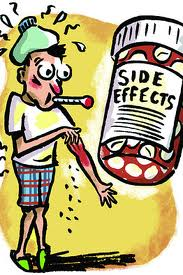
Research has recently revealed that exercising may indeed have serious side effects for those involved.

Individuals who exercise are advised to proceed with extreme caution when handling a tool this powerful and capable of creating extreme effects on its users.  Highly transformative qualities have been reported when using exercise.

The following is a list of possible side effects as a result of exercise.  Please remember that exercise should not be taken without a prescription. Continue reading

Embrace the Suck!

No one wants to work hard for anything anymore.  It’s true.  Take a look around at our modern culture.  Instant satisfaction is everywhere from fast food to movies on demand.  We literally have to wait for nothing.  And, while the convenience is great and quite useful for the most part, it has also has had a deleterious effect on our lives that is sometimes overlooked or unseen.  It has eroded our patience and destroyed our work ethic – at least when it comes to the really hard stuff like physical development and skill acquisition.  Why?  Because these things are not and cannot be had instantaneously.  They require consistent practice and drive.  I mean, c’mon they now have pills to take that burn fat while you sleep?  Are you kidding me?  How lazy can we be?  By the way though, if you get your diet correct and even skip a meal once in a while, you will burn fat while you sleep without the damn pills, but that’s another blog post….

As you may have noticed, martial arts training and conditioning to develop the proper levels of fitness, mechanics, technique, attributes, and that  all elusive sense of flow can be difficult, repetitious, and sometimes downright boring, to be honest.  So how do we keep going in our daily training?  How do we push ourselves through the plateaus and dry spots with enough intensity and consistency to break through to our own personal greatness? (See what some of the historical martial greats had to say about it in this article here.)  My advice is to embrace the suck – yeah, the suck.  Learn to love it.  Crave it.  Become friends with it.  So when it hits, you not only can push through it, but actually embrace it.

Dostoyevsky said to “love your suffering.”

The Chinese martial artists call it, “eating bitter.”

We here at Warrior Fitness call it “embracing the suck!”

Does this make you weird?  Well, yes, but only in some circles.  But for the most part it earns you respect.  Why?  Because most people can’t do it.  Being able to embrace the suck and keep going  distinguishes you.  It differentiates you from the pack.  It makes you a leader.  If you want to be a leader, there’s only one way to do it – lead from the front.  That’s the only way to inspire people – by your own example.  What example do you set for your students, your family, your friends, your kids?

Learning to embrace the suck allows you to, as the great method acting coach Stanislavsky once wrote, “make the difficult habitual: what is habitual will become easy, and what is easy will become agreeable.”  So even embracing the suck is a process which allows us to continue to train with greater intensity and focus, and thus push through even greater levels of suck.

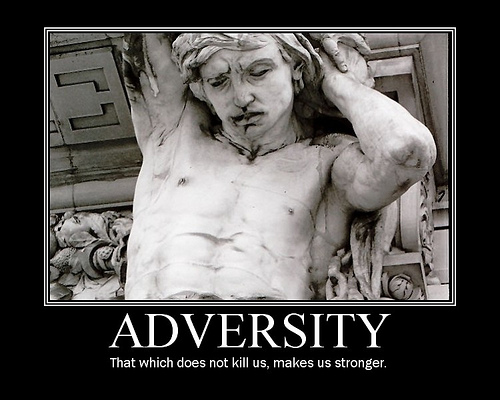
However, the best part about embracing the suck is when the suck ends and you come out on the other side.  You’ve fought the good fight, pushed through the barrier, and overcome the adversity once again.  You’re a stronger person for it.  You know it.  I know it.  So go out and live it!

The Sanshin of Warrior Fitness

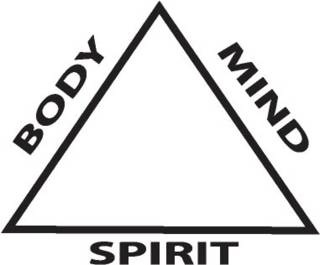
A short introduction may be necessary for those readers not familiar with Bujinkan Budo Taijutsu.  Sanshin no kata is a basic training exercises within the system that templates movement patterns for Bujinkan Budo Taijutsu.  In English, it translates to “form of three hearts”.  These three hearts are mind, body, and spirit.  All three must be united for technique to come alive for the martial arts practitioner.  Without all three aspects of body, mind, and spirit unified the kata become  empty shells of movement, devoid of essence.

Bujinkan martial arts are the wellspring from which my concept of Warrior Fitness sprung as a natural outcropping.  So as my philosophy of Warrior Fitness continues to evolve, it naturally gravitates to this type of structure for me to express it.  In keeping with the trinity of mind, body, and spirit, here is how I see it for Warrior Fitness:

Mind Concentration and focus along with an understanding of the interrelationship of the exercises and how they integrate with and enhance the way we move in the world.

Body Forging a strong body to carry us through the challenges we face. 

Spirit Pushing the edge to consistently increase resistance to failure.

The Sanshin no kata consist of 5 forms which are called, Chi no kata (earth form), Sui no kata (water form), Ka no kata (fire form), Fu no kata (wind form), and Ku no kata (void form).  Those who have read Miyamoto Musashi’s famous work, Go Rin No Sho – A Book of 5 Rings, are most likely familiar with the terminology as well.  Here is how each is expressed in Warrior Fitness:

Earth Building strength, stability, and structure in movement and stillness

Water Freedom of movement through all ranges of motion, flow state

Fire Metabolic conditioning to ignite fat loss and sculpt lean muscle

Wind Breathing exercises to vitalize every cell in the body

Void Pushing the edge of our limitless potential


Hone Your Mind, Invigorate Your Spirit, and Make Fierce the Body with Warrior Fitness!

Create Your Own Adversity!

“Let me embrace thee, sour adversity, for wise men say it is the wisest course.”  ~William Shakespeare

Philosophers and sages throughout the ages have consistently extolled the virtues of facing adversity for the purposes of becoming a better, stronger person.

No matter what form this adversity takes, wisdom dictates that it must be faced head-on, weathered through, and successfully beaten by coming out the other side, maybe scarred, but assuredly battle-hardened and spiritually tougher.

Oftentimes, adversity comes to us unbidden simply due to the path we choose to follow, or even for no fathomable reason at all.  It tends to be one of those things life throws at us unexpectedly to “help” us prove our mettle and forge our character.

It has been said that “God comforts the disturbed and disturbs the comfortable”.  If this is so, perhaps creating your own adversity isn’t a bad thing at all.

The goal in creating your own adversity is to design a challenge that will push the limits of your physical strength, mental toughness, and spiritual fortitude in order to propel you forward to the next level in your training.  For the warrior, this process is known as Shugyo.  Shugyo (修行) may be defined as “conducting oneself in a way that inspires mastery”.  These periods of severe training were usually undertaken by warriors to achieve a type of enlightening experience which opened their minds by destroying their concept of previously perceived limits.  It is the same for us today.

Ueshiba Morihei, the founder of Aikido, was well known for taking his students up into the mountains for periods of Shugyo.

“Once a year, Morihei took several of his best disciples to train with him on Mount Kurama, located near Kyoto. The small group lived on rice, pickles, miso soup, and wild herbs. Morihei would rise at five AM to pray. After morning prayers and misogi, they would swing heavy swords five hundred times and then practice footwork. From ten AM to noon they trained in body techniques. Afternoon training ran from three to five PM; the disciples took turns acting as Morihei’s partner as he ran through series after series of techniques. In the evenings the disciples would review the day’s training. Every three days, Morihei would announce at midnight ‘time for night training’…”
Excerpt from “Invincible Warrior”, by John Stevens pg. 125

Now, do you have to seclude yourself in the mountains for several days in order to practice Shugyo?

No.  For most of us, that’s not realistic or practical, but that doesn’t mean we can’t create the same type of experience for ourselves.

So, how do we do it?

Create Your Own Adversity!

Caution:This type of training is not for everyone.  Before you begin, there are a few common sense type precautions you should take.  First, prepare adequately.  For example, you would not go out to run the NY Marathon tomorrow if you’ve never run more than 5 miles.  Second, if you decide to conduct your Shugyo outdoors, let someone know where you’re going, what you’re doing, and how long you’ll be gone, or better yet, take them with you!  Third and most importantly, think before you do and plan accordingly.

1.  Pick a time or day that has personal significance to you – it can be your birthday, New Years Day, or the anniversary of something important in your life.  Is this absolutely necessary?  No.  You can pick next Tuesday if you’d like, but I think tying your Shugyo to a significant day makes it more special.

2.  Decide what form your Shugyo will take.  This must be unique to your goals and capabilities.  Choose something that is currently beyond your reach, but not so far as to make it completely unattainable.  You want to focus and hone your physical, mental, and spiritual abilities, not your imagination.  Some examples are:

  • Run a marathon
  • Run a Spartan Race or Tough Mudder
  • Climb a mountain
  • 1000 cuts with a heavy bokken (wooden sword)
  • 1000 Kettlebell snatches
  • 1000 Kettlebell Swings
  • 1000 reps of any basic techniques or combination of techniques
  • Sparring 20 opponents in a row, nonstop
  • 1000 Push-ups/Squats/Sit-ups

While any of the above would more than qualify as Shugyo, my personal preference is to plan an entire day where the whole becomes greater than the sum of the individual parts.  Some recommendations for the parts are:

Junan Taiso warm-up, run (distance TBD by you), practice the basic strikes, kicks, and footwork of your particular martial art, Bujinkan Budo Taijutsu for me (high reps to push your limits, of course!), weapons practice (sword cuts, spear thrusts, bo swinging, etc.), high repetition bodyweight exercise(s) or workout with weights (dumbbells, kettlebells, clubbells, sandbags), end with an extra long yoga session to wring out all the tension accumulated throughout the day followed by meditation and rest.

3.  Create a training program to get you there.  Let’s face it, most of the above examples are not something most people can decide to do in a day, they take time, preparation, and work to bring the goal within reach.  Remember the “6 P’s”: Proper Prior Planning Prevents Poor Performance!

4.  Get to work!!

Creating your own adversity through Shugyo has the effect of focusing not just your mind, but your entire being for the purposes of expanding your potential.  Push yourself harder than you ever thought possible and blow through your preconceived limitations – remember, the only limits that truly exist are those set up in your own mind – there are no limits!
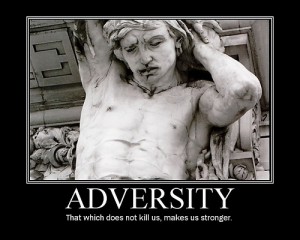
“God brings men into deep waters, not to drown them, but to cleanse them.”  ~John Aughey
So Ya Wanna Be a Ninja?

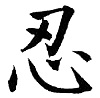
Masaaki Hatsumi, Grandmaster of the Bujinkan Dojo, once stated, “endurance is of primary importance for the ninja.”  One definition of endurance is the ability to resist fatigue.  Looking at the kanji (Chinese character) for Nin, there is the ideogram for “sword” over the ideogram for “heart” giving Nin a meaning of, “even though you hold a sword over my heart, I will endure.” 

How many of us training in the Bujinkan, or any other martial art, can truthfully claim that ability?  How long can you train?  How far can you push yourself?  In martial art, endurance, or the ability to “keep going” is defined in years, not minutes, hours, or days.  How can we create an effective training program that will instill in us the ability to continue, to endure?

Physical Endurance

Let’s begin by examining the concept of physical endurance.  There are 3 basic types of physical endurance:

  1. Aerobic endurance
  2. Anaerobic endurance
  3. Strength endurance

We discussed the body’s 3 energy systems and how using the Tabata Protocol can effectively improve both the aerobic and anaerobic systems here.  Strength endurance is defined as the ability to effectively maintain muscular functioning under work conditions of long duration.  There are two basic ways to increase the ability of your body to do more physical work.  One is the continuous adding of weights, sets, reps, and time to push the body to create an adaptation to allow it to perform more work for a longer duration.  As we discussed previously in the article on GPP, the body’s capacity is expanded.  Progress is incremental and continuous for as long as one is able to keep increasing driving forces in the body.  The next one, however, is often overlooked in our “just add more volume” culture.  More is always better, right?  If one vitamin is good for you, take 4, that’s even better (please don’t!).  But, there is another way to allow the body to continue training in addition (no pun intended) to adding more work.  By removing restrictions in your body, like unnecessary tension or extra body weight or lack of flexibility/mobility in a particular area, you then free up resources in your body that were spent holding that tension that you weren’t even aware of on a conscious level.  These restrictions, once removed, allow even greater leaps in performance than simply adding more work.  When the 2 are combined, it’s a powerful combination!

How Do We Program It?

By programming our workouts so that we effectively build in both the removal of restrictive forces, while also increasing driving forces, we can maximize our progress.  This idea is present in traditional methods of Hatha Yoga in the form of balancing strength and surrender.  Contrary to popular opinion, yogi’s do not simply work to become more flexible.  They actively work to increase both strength and flexibility as complimentary opposites in order to achieve a state of balance.  Now, I’m not asking you to become a yogi here, merely pointing out that this is not a new concept at all, but has been used by traditional arts for thousands of years.  Our program for developing ninja-like endurance will utilize both joint mobility exercises and yoga asana (poses), as well as breathing exercises, to aid in the removal of restrictive forces binding your training and slowing your progress.  Next week I will be putting out an article on breathing exercises that can be used for relaxation, stress management, removing residual tension, and also for increasing energy – keep your eyes out!

For an example of some easy yoga postures that can start helping you right now, head over to my good friend Josh Sager’s excellent blog, Fretterverse, and check out my article on Yoga for Guitarists.   A free sample joint mobility training program can be obtained simply by signing up for the Warrior Fitness Mailing List at the top right of the page.  Sign up now and begin working on removing restrictive forces today!

And, don’t forget to check out Warrior Fitness: Conditioning for Martial Artists for more exercises, options, explanations, and program design!

Stay tuned for a sampleStrength Endurance Workout coming soon!

Training as You Grow Older

 One of the greatest challenges a long term fitness enthusiast faces is the debilitating impact of age.  Certainly everyone understands the concept but what does it actually mean?  The average person has a higher metabolism when they are younger, a faster recovery rate, greater use of energy stores and suppleness around the joints.  So why exactly do we age? Well did you know that for the average person the maximum heart rate is 220 – age?  That means when you are 20 your heart can go up to 200 bpm, whereas at 60 your max is 160bpm.  That’s a big difference.  Essentially like all human tissue the heart is constantly in a state or recreation, cells die and new ones are created.  However as the body gets older this ability to replace old cells with new ones becomes less efficient.  In a sense it is not the body that ages, but the ability to rejuvenate decreases over time.

That is the bad news.  The good news is that a lot can be done to counter-act the effects of ageing via exercise.  This can be divided into circulatory, respiratory, structural and the nerves.

How Does Exercise Help?

As mentioned the heart output decreases with age, generally a very fit endurance athlete has developed a large heart capacity.  That is the volume of blood per pump has increased as a result of training.  If age means that the heart will pump less frequently and become less powerful then what can be done?  Quite simply the best thing to do is make better use of the blood that is being sent around the body.  Exercises that improve blood circulation to the extremities are extremely beneficial at all ages and very useful for combating age.  Joint rotations, light resistance frequent repetition exercises are excellent for this.  Walking is perhaps the best of all.

As many biology students know, a major purpose of blood is to transfer oxygen around the body so focus should also be paid to the respiratory system.  It should also be mentioned that the oxygen in the body is very useful for cell reproduction too.  Breathing exercises not only help with good quality respiration but also assist with the structural stability of primarily the upper body but also the body as a whole.

Structurally speaking the body may be divided into bones, connective tissue and muscles for simplification.  As stated good blood flow and breathing will already provide a boost to these systems.  Perhaps we must accept that due to age repetitive actions will not be maintained to the same count as was possible in youth.  But what about strength?  Scientists have been studying muscle strength and age for at least the last 15 years and concluded that muscles can grow and remain strong at any age.  This means resistance exercises such as moderate and heavy weights will be very useful for maintaining structural strength.  Also bone mass is related to muscle mass directly, so strengthening muscles reduces the risk of damage to bones and increases calcium absorption.  Studies have shown that laboring women in areas with limited calcium in the diet have less cases of Osteoporosis than sedentary women with high calcium diets. In other words resistance exercise not only maintains more youthful strong muscles but also increase the utilization of chemicals like calcium in bone tissue.  Joining the muscles and the bones are connective tissues which get stiffer and less elastic if under utilized.  Lack of flexibility results in lack of mobility, this in turn impacts the benefits of exercise and increases the risk of injury.  Flexibility training such as Yoga or Makko-ho is very useful for combating decreased flexibility and also rejuvenating connective tissue.

Stretching and structural organization is beneficial not only for maintaining mobility but also because it opens up an often forgotten part of the body called the nervous system.  It is not possible to strengthen nerves directly and again age will deteriorate nerve function.  But, by using muscles and working on flexibility the nerves can be stimulated to be more effective in function.  This is important for not just general co-ordination but also the non-voluntary nervous system which is responsible for among many things, yes, the heart.

Taking the Holistic Approach

We have come full circle and this is an important point.  When we are younger we can focus on weights, or marathons and any kind of activity we like.  This is because our general health is fine and we simply pursue excellence in whatever activity we choose.  As we get older however the general health starts to decline if not maintained.  That is why aging persons should take a holistic approach to training to ensure all the important body systems are being stimulated.  The circulation, the breath, the structure and the nerves must all be improved upon.  It is very tempting to wait until the effects of age are experienced before reacting to change.  Of course it is fine to start exercising and focusing on health at any time.  However the best solution to aging is to prepare early on for the kind of body you will need as you do age.  Combine light exercises and breathing with heavy exercises and stretching now and save making major adjustments tomorrow.

About the Author

Tony Notarianni has been training in martial arts since the age of 12.  Up to this point, although quite active, he had very little interest in sports and fitness but that all changed over the coming years.  He started studying Sport as a subject at school and finally graduated with a Bachelors Degree in Sport and Exercise Science in 1998.  Although not a typical sportsman and not a great fan of any one sport, Tony was always keen to try new activities and considers the world to be literally full of physical experiences to explore.  Before graduation he was working at a sports complex where he was a lifeguard and could join and observe many different forms of exercise.  He also taught circuit classes and was a qualified personal fitness instructor.  After graduation he chased the dollar and ended up working in Software Development.  Although becoming more sedentary he still has a deep rooted interest in improving himself physically and developing his knowledge.