Top 5 Mistakes When Starting an Exercise Program

In my experience there are several things that can contribute to failure in an exercise program, or any other goal for that matter.

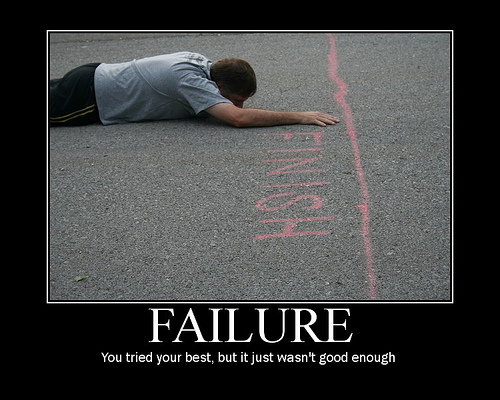
In the past when I would fail to achieve a specific fitness goal or suffer a setback, minor or major, I’d chalk it up to fate and just try harder the next time.

As I grew older, and smarter, I began to see a pattern emerge.  These things didn’t just happen, there were particular sets of circumstances, most often at the outset of an exercise program, that combined to allow them to happen.

The list below comprises what I consider to be the top 5 mistakes.

You may have discovered others, and I would encourage you to share them in the Comments section below, but in my mind these are the most critical errors.  As Saint Thomas Aquinas rightly taught many times, “An error in the beginning is an error indeed.” 

An Error in the Beginning

1.  Too much too soon.

Everyone wants results NOW!  The problem here is that when talking about results, incremental progression reigns supreme.  Let’s face it, if you are trying to lose weight, for example, it took a long time, maybe years, to get to be over-weight.  Losing fat is not going to happen overnight, no matter what the TV ads tell you.  It took time to condition yourself to be out of shape, it will take time to re-condition your body to be in shape.  Be patient.  Focus on the process – you’ll get there!

2.  Lack of a training plan.

In my mind, it is essential to have some knowledge of how to program an exercise selection to correlate with the goals to be achieved.  Without this it’s pretty much hit or miss as to whether you achieve your goals, or even remain consistent.

3.  Lack of effective warm-up and cool-down strategies.

This goes hand-in-hand with lack of a training plan above.  DOMS, or Delayed Onset Muscle Soreness, is a significant contributor to people actively deciding to not pursue their fitness program.  When joint mobility as a warm-up, and yoga postures, as a cool-down, are effectively combined with the exercise selection needed to be successful, they tend to reduce or eliminate DOMS.

4.  Nutrition that does not support the exercise program.

While the diet OR exercise approach has some merrits, it’s simply not enough.  Get your eating in line with your workouts, and in line with your goals.  Diet AND exercise is a powerhouse combination.

5.  Quitting.

Yes, this will really ruin an exercise program.  But seriously, how many people begin a regimen with the best intentions yet due to other life pressures, lack of motivation, lack of results, or lack of interest, fail to be consistent? What’s the best, most effective way to prevent quitting? Have a coach who will hold your feet to the fire!

Check out the elite Warrior Fitness Distance Coaching Program HERE!

How about you?  What things contribute to derailing you from the fitness track?  And, more importantly, how do you remain focused?  I’d love to hear from you!

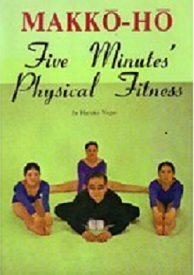
Makko-ho: Five Minutes Physical Fitness Book Review

Special thanks to guest author, Tony Notarianni for another excellent contribution!

Recently I read a book called, Makko-ho: Five Minutes Physical Fitness, by Mr. Haruka Nagai.

Summary:

Makkō-Hō is a system which through regular practice can produce a huge range of benefits for just about anybody at any age.  This book gives a good clear breakdown of the four main exercises and also some detail on the science behind the purpose and results of the exercises.  Although not a complete guide to the system (which would be an impossible feat anyway) the material provides a great opportunity to begin study and try for yourself. 

So first of all what is it?  Makkō-Hō is a complete system of exercises for wellbeing created in Japan during the mid 1900’s by the father of the book’s author.  The main benefits of this system are: increased flexibility, symmetrical skeletal alignment, nerve stimulation, improved circulation, overall good health, and even increased libido.  The founder invented this system after having been paralyzed across half of his body and seriously ill after a stroke.  He was told that he would probably never work again and would need constant care for the rest of his life even though he was only 42.  Being a very independent character he was not ready to accept this future of boredom or to be a burden upon his family.  He obtained the idea of certain postures from Buddhist prayer positions which he maintained regularly.  Over time these prayer poses developed into four main exercises which are the core of Makkō-Hō today and at the same time he managed to heal himself dramatically.  In other words the system is on first glance extremely simple and capable of remarkable regeneration.  The exercises themselves are probably familiar to students of Yoga or Japanese martial arts.  In fact I have personally seen and practiced these exercises several times in the past in different settings.  However this book clearly demonstrates that in order to really get the full benefits the student needs to study very hard and if possible find a qualified teacher to help them have the correct form.  This book is in fact not just a list of exercises.

What is in the book? Chapter Breakdown

Two Kinds of Love: Overprotection and Discipline

The introductory chapter highlights all that is wrong with many aspects of society, such as our lack of willingness to experience hardship for the sake of long term benefit.  Essentially this early truth sets up the reader for the arduous nature of what will be required later.

Lack of Use Leads to Aging and Functional Failure

In this section Mr. Nagai describes much that most of us should now know. Perhaps the most remarkable thing is that this was written in 1972 describing trends of modern living and predictions that have since born out.

God Planned the Human Body as a Delicately Balanced Machine

For me this was quite an important section of the book.  Looking at the body as a whole system with constantly regenerating living cells creates a perspective that helps the reader to get an understanding of how Makkō-Hō actually works.
Maintaining Good Circulation

At this point the book introduces some basic concepts about the major role of healthy circulation and nerve tissue in the body.  Using common analogies these concepts are clearly presented to generate recognition of the importance of these systems.

The joints: Inspecting and correcting
In reading this area I had an epiphany of study.  Quite bluntly Mr. Nagai points out that if you can’t demonstrate full hip flexibility then you are, in a sense, out of shape.  I had to re-read this several times while I internally argued that only a small percentage of the population can do these stretches however I soon had to concede that going by averages in fitness is not going to get us all very far.

Structure of the pelvic zone and the hips
This section through diagrams gives some rudimentary understanding of the lower body.  It seems that a key component of Makkō-Hō is the importance of maintaining a healthy, aligned and supple structure in this area.

Makkō-Hō Exercises

 
This section includes the 4 main exercises of Makkō-Hō.  There are photographs and diagrams demonstrating both correct and incorrect form.  The information is extremely clear and well written.  It left me with little doubt as to the intended objective however I did find the exercises very hard to perform even with the constant encouragement that repetition would work eventually.

Some Rules for Practicing Makkō-Hō Exercises

Here the author again covers the strict nature of doing the Makkō-Hō correctly, but also provides some guidelines on how and when to practice.  The basic rule of course being “Keep doing it right, and keep doing it daily”.

Effects of Makkō-Hō Exercises

The effects range from physical to psychological benefits.  Obviously when dealing with exercises that improve stability, flexibility and circulation the noticeable changes will be small but accumulative.  They will also benefit in a wide range of situations.

What is Missing?

For some of us even the beginning postures may be very difficult to get into.  You may have bad form before you even begin to perform the movement in which case the exercise may seem impossible.  Mr Nagai does give us some clues about using cushions in some of the exercises but unless you have some confidence and imagination you may get stuck.  There are other books I have seen in Japanese that show progressions for all of the exercises and it is a shame that these are not included in this English book.  Also, although essential, I think these exercises need to be supplemented with other activities.  Five minutes a day may not make you ‘fit’ but they certainly can give you a solid base of fitness.

Real Makkō-Hō?

As with all systems it is easy to get fooled by those who do not have the required qualification to teach.  This book is from the son of the founder of the system and quite legit.  If you do pursue a study of Makkō-Hō then be sure of where you get your knowledge from.  The Makkō-Hō headquarters website is here (Japanese only so use Google translator at your peril).

In the US there are two qualified instructors listed there.

Overseas
New York 多田 千恵子 Tada Tieko   212-980-0088  
Chicago 堀川 智子 Horikawa Tomoko  312-545-8221  


I have personally met and had a lot of great advice (plus encouragement) from Tomoko Horikawa.  She has a website that canbe found here, and is extremely knowledgeable.

Hopefully this relatively unknown art will spread more globally in the coming years.

About the Author

Tony Notarianni has been training in martial arts since the age of 12.  Up to this point, although quite active, he had very little interest in sports and fitness but that all changed over the coming years.  He started studying Sport as a subject at school and finally graduated with a Bachelors Degree in Sport and Exercise Science in 1998.  Although not a typical sportsman and not a great fan of any one sport, Tony was always keen to try new activities and considers the world to be literally full of physical experiences to explore.  Before graduation he was working at a sports complex where he was a lifeguard and could join and observe many different forms of exercise.  He also taught circuit classes and was a qualified personal fitness instructor.  After graduation he chased the dollar and ended up working in Software Development.  Although becoming more sedentary he still has a deep rooted interest in improving himself physically and developing his knowledge.
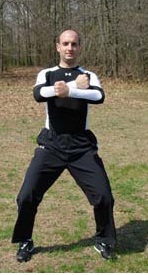
Fitness Requirements for Bujinkan Martial Arts Training

As a 25 year veteran of Bujinkan martial arts training, as well as being the creator of Warrior Fitness Training Systems, one of the things I pride myself on is my ability to access the fitness needs of my fellow martial artists, particularly those who train in the Bujinkan.

A common misconception that you’ll hear bandied about from dojo to dojo all across the world is that strength, and by association overall, general fitness, is not required.

I think this has to do with a fundamental misunderstanding of how we train.  In class, when practicing techniques, it is imperative to be as efficient in one’s movement as possible, and thus avoid using excess, unnecessary power (read – strength).

In order to isolate the study of distance, timing, angling, and space management, one must put strength on the back burner in the dojo to avoid powering through the movements and missing all the wonderful subtleties that taijutsu has to offer.

However, in an actual conflict, you can and in fact, you must, use all your power, including strength, to survive.  As Jack Hoban said in his interview here, “real fights are very physical – tiring and punishing”.  Anyone who thinks physical fitness isn’t required in the traditional martial arts is really just kidding themselves.

Bujinkan Practitioners and Fitness

Why do Bujinkan practitioners need fitness training?

Optimal physical conditioning provides the platform from which the skills can be used.”  

– Fred Hatfield, aka Dr. Squat

Meaning that the specific physical skills of taijutsu MUST be built upon a solid foundation of basics, like sanshin no kata and kihon happo, and even more fundamental, a strong budo-body.  Without this platform in place your martial art skills are like a house built on sand.

From my book, Warrior Fitness: Conditioning for Martial Arts:

 “Since combat occurs in a volatile and unpredictable atmosphere, training must prepare the warrior to adapt. Remember that the goal of all the exercises in this manual is to develop the ability to control the degree of tension in our body and be able to utilize just the right amount of force at the appropriate moment. This way we may be able to sustain activity for longer and longer periods of time without exhausting ourselves.”
 

The first step in ensuring you are building skill on top of a solid foundation is General Physical Preparedness (GPP).  The goal of GPP is enhanced work capacity.  This is the ability to run faster, jump higher, and hit harder.

When work capacity increases, it allows the budding warrior to adapt more easily to increases in both mental and physical demands.  In other words, it increases your capacity and level of readiness to absorb higher levels of specificity.  In a martial art as seemingly limitless as Budo Taijutsu, one must possess the endurance to “keep going!”

In Part 2 of this series on fitness for Bujinkan practioners, we’ll look at some examples of GPP type exercises and how to incorporate them into an overall training program.

  • Looking to increase your level of readiness for martial arts training and fitness?


Want to train more, at a higher level, for a longer period of time?


Want to get more out of your training time both at home and in the dojo?


Want to build new skills and enhance your technical arsenal?

My brand new program, The Power Protocol, will show you how!

Warrior Fitness Workout of the Week #3

Let’s change it up a little bit this week and spend some time focusing on our core.  Since all movement originates from the core of the body, it makes good sense to target it specifically and ensure our cores are strong, mobile, and integrated with the rest of our body.  Instead of wasting time doing endless crunches, or spending crazy amounts of money on relatively useless tummy flattening gimmicks (as sold on late night TV), try this functional core workout instead! 

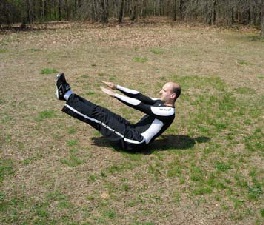
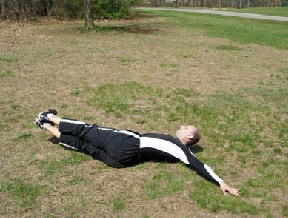
V-up

  • 10 V-ups 

Lie flat on your back with arms stretched out over your head.  Exhale, contract the core and lift arms and legs together.  Inhale as you lay back.  Repeat. 

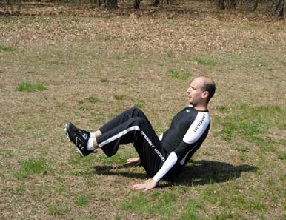
  • 10 Knees to Chest 

Sit with legs extended straight.  Lean back slightly and lift legs, bringing knees to chest.  Exhale as you contract, inhale as you straighten. 

Knees to Chest

  • 10 Crunches with 3 second isometric hold

Yes, sometimes even crunches can be useful.  Just depends on how you do them!  In this case, perform a normal crunch, but as you lift off the ground exhale, contract the core tightly and hold for 3 seconds before descending.

  • 10 Pendulum Leg Lifts (side-to-side) 

Pendulums

 Lie flat on your back with your legs straight up in the air, knees locked.  Exhale and slowly drop your feet to the left side, back to center, then the right side.  This is one rep.  

Instructions

Complete 5 rounds. Rest 90 seconds between each round; no rest between exercises.  

Need a Finisher?

Finishers are used to squeeze just a little bit extra out of the workout.  They are awesome for increasing mental toughness as well!

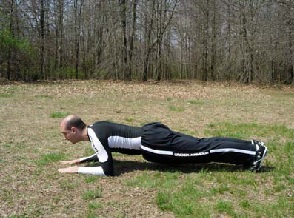
  • Finisher Exercise: Plank hold for time – get in position and hold as long as you can.  See if you can last 5 minutes!

Plank Hold


For more information on the Warrior Fitness Workouts of the Week, please see our User Guide.  And, as always, please let me know if you have any questions or comments.  Reach me here or leave a comment below. 

Want to know more?  Check out Warrior Fitness: Conditioning for Martial Arts!


Warrior Fitness for Kids!

This will be the first in a continuing series of posts chronicling my thoughts and discoveries on Warrior Fitness for Kids.  As the father of 2 young girls, ages 9 and 1, I have a very vested interest in assuring my daughters are among the healthiest, fittest, and most well-informed kids out there.  Follow along and yours will be too!

It doesn’t take a genius to see that America has become a nation of over weight, physically lazy, comfort-seekers.  The saddest part is the effect this perverse attitude has had on our children.  How can we call ourselves responsible parents when our kids consume more McDonald’s than broccoli, and watch more TV than play outside?  What happened to running, jumping, playing tag, climbing trees and fences, or riding bikes as fast as you can just for the sheer thrill of it?  Has watching Sponge Bob and playing video games replaced playing outside from the time school lets out until dinner is ready?  I remember my mother having to shout for my brothers and me almost on a daily basis to call us home for supper.  And, in the summertime, we were playing outside until well after dark!

What Can We Do to Reverse This Trend?

To me, the answer is simple: Lead from the front!  What impetus do your children have to eat healthy and exercise if you do not?  You, as a parent, must set the example for your kids.  My daughters constantly see me exercising, whether it’s stretching, working on the technical details of an exercise, practicing martial arts, or a full-blown conditioning routine, I’m setting an example for them on a daily basis.  Coming home from work and sitting on our butts in front of the television while we “relax” and “unwind” is more than just detrimental to your health.  It sets up a poor pattern of conditioning that you’re children will follow for a lifetime.

Train With Your Kids

Want to spend some quality time with your kids and help them become fitter in the process?  Workout with them.  Make it fun, not drudgery.  That means stay out of the commercial gym and away from the damn treadmills!  You’re people, not hamsters.  One of the ways my oldest daughter and I spend time together during the warmer weather is to go on walks after dinner, while the sun is still up.  But just walking around the block is boring, so we found a couple ways to spice it up:

  • Pick a landmark – mailbox, telephone pole, tree – and race to it.  Recover by walking a little bit, then race again.
  • Leap like a frog until you get tired – see who gets tired first!
  • Crawl on hands and feet (be careful of the terrain), then get up and run.
  • Let your child ride their bike and you try to keep up, or you ride a bike and let them keep up!

These are just a few examples of how you can change a simple walk around the block to a fun workout for you and the kids.  Shhh… don’t tell them they’re doing High Intensity Interval Training (HIIT)!

As this series continues, I’ll be sharing more ideas about how to workout with you kids in ways that are fun and effective for both of you.  Additionally, I have workouts that I’ve designed for my 9 year old daughter that I’ll be sharing here as well – stay tuned!

How about you?  Do you workout with your kids?  What are some of the things you do to help keep them inspired and keep going?

Jack Hoban on Fitness

The interviews conducted here at Warrior Fitness will highlight people who have significantly influenced my thinking and training on fitness, who are leaders in their particular fields of expertise, and whom I admire.  Jack Hoban happens to fit all three.  Through his unwavering commitment to martial arts and fitness, Jack has inspired me to keep going over the past 20 years down the dual path of martial arts and fitness.

 Jack Hoban is a former active duty U.S. Marine Corps Captain and long time practitioner of martial arts.  He is Shidoshi Senior Instructor in the Bujinkan Budo Taijutsu and Togakure Ryu Ninjutsu systems under Grand Master Masaaki Hatsumi in Japan and has authored three books on warriorship.  Mr. Hoban also holds an MBA and is an executive in the healthcare industry.    Jack’s full biography, and further information, can be found on his website here


1.  Can you please describe your current philosophy on physical fitness?

I have been serious about physical fitness for most of my life, first as an athlete in grammar school, high school and college, and then as a Marine, and martial artist.  That hasn’t changed, just become more refined and age-appropriate as the years have gone by.  Humans are physical beings and have been so for millions of years; I think we should acknowledge and honor that fact by maintaining a high level of physicality in our lives.  That’s my philosophy.  Until fairly recently, being physically fit, for most of us, was just a part of being human—and staying alive through hunting and gathering, farming, work, or other physical endeavors.  That has changed, and there is a greater risk of falling into a sedentary lifestyle today.  But our basic nature as physical animals has not changed.  We have to be careful not to stray too far from our nature, or certainly unhappiness and ill health may result.

2.  How has your outlook changed over the years?

It really hasn’t changed.  It has just become more refined.  I have tried some of the new fitness technologies—for example I run barefoot now using the new Vibram footwear.  I also think I use cross-training more effectively than in the past.  But I pretty much do the kinds of things I have always done.  I do have to worry more about “overdoing it,” because injuries take longer to heal.

3.  Do you have a daily fitness regimen that you follow?

Yes and no.  I have a range of things that I do, but it changes according to my schedule, the season, the weather and how I am feeling.

4.  Can you briefly tell us what it consists of?

Again, it is not a daily thing in that I don’t do the same thing every day.   But over the course of a week I typically fit in a few runs (45 minutes to an hour), I lift weights, I do a lot of core training, and I do various calisthenics.  In the winter I use the gym for the rowing machine, treadmill and elliptical.  In the summer I swim in the ocean almost every day.  I practice martial arts daily by myself, and have a class between 2 and 5 times a week.

5.  How do you think fitness and budo (martial arts) are related?

Inseparably, although martial artists might take care to explore a regimen that is complimentary to martial arts—one that increases strength and endurance, but also promotes flexibility and relaxation.

6.  How has your being in excellent physical condition enhanced your martial arts training?

Simple, it helps me to “keep going” longer and more consistently without being tired or sick.  And by the way, real fights are very physical—tiring and punishing. 

7.  How does your being in excellent physical condition help your work with the Marine Corps Martial Arts Program (MCMAP)?

When I first meet a new class of students, the unspoken question is “Is he one of us?  Can he do what we do?  If he can’t, why should we do what he does?”  That’s just the nature of young, competitive men.  Because I can pretty much keep up with them “for an old guy,” I gain a certain measure of respect.  That way, they are open to the other physical and ethical lessons I am there to share.

8.  Has the Marines Combat Conditioning program influenced your personal exercise program, and if so, how?

Yes, in at least two ways.  It has made me more aware of the value of cross training, and two, it has made me more creative in using training aides of opportunity.  By that I mean, you can design your own training regimens and make your own training apparatuses just by using your brain and common items and structures.  You don’t need fancy equipment; an old tire works just fine as an exercise apparatus.

9.  The last, but most important question, how do you keep going?

I enjoy it!  Find a method of physical exercise that you enjoy and pursue that.  Find other people who like it as well, and do it together.  That will help too.

Thanks Jack!

User Guide to the Workouts of the Week

I received several emails this morning after yesterday’s post on Warrior Fitness Workout of the Week #1 from people who wanted more information on how to implement and program the workouts of the week.  So here it is!

The Workout of the Week section is designed to give you insight into the Warrior Fitness training method.  We will cover topics such as joint mobility, high intensity interval training (HIIT) and the Tabata Protocol for conditioning, strength endurance, explosive strength, core work, yoga, and martial arts. 

1.  How often should I do the Workout of the Week (WOW)? 

This depends on the intensity level of the prescribed workout.  For example, if the WOW is an illustration of a yoga compensatory routine, you can do it daily, but if it’s a high intensity conditioning workout, you may only be able to perform it 2-3 times a week, depending on your recovery levels.   These workouts are short; usually, under 30 minutes.   You should have plenty of time to squeeze them into a busy schedule!

2.  Should I change my workout every week to correspond to the WOW? 

Not necessarily, no.  The workouts change weekly in order to showcase various aspects of our training methodology, but that doesn’t mean you need to change it up on a weekly basis.  Workout programs should be designed with specific goals in mind and crafted to meet individual needs.  Your body needs time to adapt to your exercise selection for it to elicit the planned response, usually about 4 to 6 weeks.  If you find a something that you like, stick with it.  If you have a more detailed question about how to program a specific workout, or even a series of workouts, let me know.  I can help you.  That’s why I’m here.

3.  What if I already have a workout program?  How can incorporate the WOWs? 

 If you currently have a training regimen that you are happy with, but want to give one of our workouts a try, you can definitely do that.  Simply replace one of your conditioning days with one of our conditioning workouts.  Or, add in our joint mobility exercises as a warm-up.  Remember, you receive a sample chapter on joint mobility  from the book, Warrior Fitness, when you sign up for our mailing list.

4.  I am just starting to exercise, can I still use the WOWs? 

Absolutely!  Start slowly.  Begin by doing our joint mobility exercises on a daily basis to prime your body and help you regain lost range of motion.  Each of our workouts contains instructions on modifying the workout to scale it for any level of conditioning.  Also, if you have further questions about modifying workouts, or programming workouts, contact me.  I’ll be glad to help you.

5.  Will I lose weight with these workouts? 

 Yes!  Our conditioning workouts are designed to turn on your body’s metabolic furnace and torch unwanted fat, while building lean muscle. 

6.  How can I find out more?

My ebook, Warrior Fitness: Conditioning for Martial Arts, is available for direct download.  It contains the background, philosophy, and methodology behind Warrior Fitness, as well as an ample exercise selection and a chapter on program design.

Want to know more?  Just ask!

 I hope this has been a helpful introduction to the Warrior Fitness Workouts of the Week.  What other questions do you have?

5 Ways to Help Decrease the Stress

Today’s corporate warriors are often besieged with too many tasks, meetings, email, cell phone calls, pagers going off, Blackberrys buzzing, etc. Individually, these things are not significant, but when combined together in a constant barrage, all day long, they produce a cacophony of stimulation which, if not addressed through specific countermeasures, can cause a significant stress response in the brain. This stress response emanates from our primal, survival oriented center of the brain which, in times of crisis, can overload and over run the higher brain functions – i.e., those that allow us to plan, prioritize, manage time and people, and be creative.

Article in Harvard Business Review

 According to an article in Harvard Business Review, when busy executives begin to experience symptoms of this stress response in the brain, they often forget important details, lose the ability to prioritize tasks, and generally feel overwhelmed. Overall tension in the body increases, as well as other important markers such as heart rate and blood pressure.

The ability to reduce and manage stress is a key issue in the overcoming of these symptoms in busy workers. Stress can be reduced in various ways such as relaxation, meditation, vacation, diet, and exercise. It is the last two, diet and exercise, that I am focusing on in my recommendations today.

5 Ways to Help Decrease the Stress

  1. Begin to increase complex carbohydrates at every meal. (Complex carbohydrates are whole wheat, multi-grain, etc.)
  2. As you increase complex carbohydrates, begin to eliminate simple carbohydrates. (Simple carbohydrates are white flour, white sugar, and white rice)
  3. Eat protein and vegetables (or fruit) with every meal.
  4. Exercise at least 3 days a week for a 1/2 hour or more.
  5. Daily short exercise breaks – this can be done at your desk or standing up in the office. It is a quick “10 Minute Recharge” for stress reduction and to increase energy throughout the day. This consists of moving all the joints in the body in circles or waves to increase mobility, increase blood flow in muscles and prevent stagnation. These joint mobility exercises coupled with active exhalation breathing aid in the reduction of stress and help to lower blood pressure.

These exercises can be taught quickly and easily, but the benefits are enormous.

For all the aspiring Corporate Warriors out there, how do you deal with stress?

Warrior Fitness Book FAQs

1. Are the Warrior Fitness workouts applicable to beginners?

Absolutely! The workouts in the Warrior Fitness program are completely scalable based on your level of fitness.  Each exercise is explained step-by-step.

2. Is nutrition covered in the book?

Nutrition is an important aspect of a complete, healthy lifestyle, but is not discussed in the Warrior Fitness book. My own personal ideas about nutrition can be summed up fairly simply though. Eat lean proteins, lots of fruit and vegetables, and some complex carbohydrates. Eliminate or reduce white sugar, white rice, and white flour from your diet. Drink plenty of clean water and green tea.

3. Does the Warrior Fitness program teach Amatsu medicine , a traditional system of Japanese Natural Medicine taught by Hatsumi Soke?

No. I have not been taught any Amatsu medicine within the context of my Bujinkan training.

4. Is this program just Junan Taiso (basic stretching exercises used as warm-ups for martial arts practice)?

No. The Warrior Fitness book provides a comprehensive program consisting of joint mobility, flexibility, strength, conditioning, breath work, and recovery. Much more than simply junan taiso exercises.

5. Do I have to workout every day?

You do not need to do a full workout, but I highly recommend doing some movement everyday! Joint mobility work, combined with breathing exercises can take as little as 15 to 20 minutes in the morning. It’s a great way to start your day!

6. How much time do the Warrior Fitness strength and conditioning workouts require?

The workouts contained in the Warrior Fitness book are designed to be fast and effective. You can achieve a quality workout in 15 minutes, if you are short on time. Longer workouts can also be programmed, depending on how much time is available.

7. Do I need a gym membership for this program to work?

Definitely not! Warrior Fitness workouts are designed to be done anywhere with little to no equipment necessary.

8. How do I fit in working out and the skill training for my martial art?

Excellent question. This is where scheduling and time management skills come in handy. Time will not simply appear out of thin air. You must make time. However, the most important advice I can give on this topic is that if you do not have time for both skill work (martial art training) and conditioning, skill work must take the priority! You are training to be a martial artist after all.

9. Is this book applicable only for those training in the martial arts?

No. This book is certainly not just for people in the martial arts. The exercises and ideas contained within are applicable to anyone of any range of fitness and ability. Pick up a copy today and see for yourself!

Please feel free to email me here with any additional thoughts or questions concerning the book.