What’s Hindering Your Performance?

What’s sapping your energy and, unbeknownst to you, hindering your performance in martial arts, athletics, or simply the daily art of living, working, and taking care of your family?  Residual muscle tension, or tonus, is the continuous, passive partial contraction of muscles in the body that aids in posture and support.  Unfortunately, any type of exercise, stress, fear, and trauma, all cause an unwanted and unnecessary increase in the normal residual muscle tension of the body.  Usually this extra tonus goes unnoticed, or worse is simply deemed an acceptable and natural side effect of living.  The problem with this added tension is that the continuous contraction of muscle throughout the day, ever day, is using up energy.  Energy that can, and should, be available to us is being siphoned off thereby putting the brakes on our performance.  It’s like driving a car around all day with the emergency brake on.  You can still get where you need to go, but that extra, unnecessary drag is killing the car’s performance and guzzling gas.

So how do we remove these insidious restrictive forces on our body?  Besides a daily dose of joint mobility, which has been covered extensively in Warrior Fitness: Conditioning for Martial Arts, and in various other posts, I have come across 2 methods that work wonders:

1.  Tension/Relaxation Exercises

At first glance, it may seem odd to increase tension in order to relieve tension, but remember, residual muscle tension is held unconsciously while these exercises will intentionally increase muscular tension for the purposes of identifying and releasing it.  Stand naturally and lift your shoulders as high as possible up to your ears while simultaneously squeezing them as tight as possible.  Hold for a couple seconds then drop with an exhale.  Do it again.  Feel the tension in your shoulders, neck, and upper back start to release?  You can do this locally with any area of the body, or the whole body all together.  For example, tense your left arm as tight as possible on an inhalation, hold for 3 seconds, then completely relax on an exhale.  Do this with the legs, the abdomen, chest, back, shoulders.  Tense each area while inhaling, hold for 3 seconds, then release and relax on the exhale.

2.  Vibration Exercises

These are very simple, yet highly effective exercises which have been used for centuries in yoga and qigong to shake out and release residual muscle tension in the body.  So how do you do them?  Stand naturally, feet shoulder-width apart, knees slightly bent.  Spine straight.  Lift up from the crown of your head.  Begin to bounce gently with the legs shaking the whole body up and down.  On each down bounce allow the body to exhale – don’t force it.  Don’t try to breath, just let the motion breath the body.  Slightly round the shoulders and tuck the pelvis to help the motion push air out.  Continue shaking the body up and down for about 30 seconds to a minute.  Stay loose.  Stay relaxed.  Shake out the tension.

These 2 simple exercises, done on a daily basis, will go a long way toward helping you recover the energy that’s been bound up in holding residual muscle tension.  Let me know how they work out for you!
EVOLVE_SPOT-1 (2)

Push-ups as Breathing Exercises – Part 2

In our last article on breathing exercises, here, we introduced the concept of using the basic push-up form as a vehicle for training the breath.  Today we will continue with the push-up as the outward expression, but take a look at different types of breathing patterns to increase the depth and complexity of the the exercise.

4 Phases of Breathing

The breath cycle can be broken down into 4 distinct phases of breathing:

  1. Inhale
  2. Pause after inhale (full hold)
  3. Exhale
  4. Pause after exhale (empty hold)

Each of these phases can be manipulated within the framework of our exercise to create variation and change the focus of the exercise.  Previously we had discussed how to use the inhale and exhale phases of breathing to increase capacity by fitting more movement into each breath.  Today we will focus on the other 2 phases, pause after inhale and pause after exhale.  These breath holds will allow us to teach the body how to utilize the oxygen it already has more effciently by working longer in a state of oxygen deprivation.

As a side note, please be aware of your body’s physiological response to breathing exercises.  In general, inhalation causes a slight increase in tension and blood pressure, while exhalation causes a relaxation response and an accompanying lowering of blood pressure.  These effects can be magnified by holding the breath after inhalation and holding the breath after exhalation.  Therefore, please proceed with caution. 

Inhale and Hold

In this exercise we will be working with the pause after inhalation.  Assume the push-up position.  Inhale deeply by expanding the belly.  Don’t force it.  Just inhale as much as comfortable for you.  Pause.  Do not exhale.

Perform 1 push-up.

Exhale at the top and inhale again.  Perform 2 push-ups on the full hold.  Exhale at the top portion and then inhale and hold.  Perform 3 push-ups on the full hold.

How does it feel?

Can you do 4?  5?

Make sure you are not trying to move faster just because you’re holding the breath.

Perform the push-ups smoothly and in a relaxed manner.  A side benefit of this type of work is that it helps you to work under stress.  When you can’t breathe, the body begins to  panic.  Even though your mind knows it’s just an exercise and you can breathe at any time, your body is responding to the lack of air and begins to sound the alarm.  Understand this and work with it to teach yourself to remain calm in difficult situations.

Exhale and Hold

Now let’s look at the pause after exhale, or empty hold.  You know the drill by now – assume the position!

Inhale and exhale in the top portion of the push-up.  Hold on the exhale and do 1 push-up.  Inhale and exhale.  Do 2 push-ups.  Inhale at the top, exhale.  Do 3 push-ups.

What do you notice about holding on the exhale versus holding on the inhale?

Much more difficult, right?

Again, note the reaction your body is having to the exercise.  Are you speeding up to get through it?  Are you using more muscle tension than necessary?  How does the increased muscle tension affect your body’s oxygen usage?  Relax and slow down.  You’ll be able to handle more.

Hip to be Square Breathing

Okay.  Time to put it all together.  Square breathing means that each of the 4 segments or phases of the breath cycle will be of equal length.  For example, inhale to a count of 5, hold on the inhale for a count of 5, exhale for a count of 5, then hold on exhale for a count of 5.  The count itself doesn’t matter as long as each part is equal.  Obvioudly, the difficultly level can be increased with a higher count and decreased with a lower count.  For our purposes, let’s stick with the 5 count for one push-up.  Begin in the up portion of the push-up.  Don’t move yet, but inhale for a count of 5.  Now hold the breath and slowly lower down to a count of 5.  At the bottom portion of the push-up, exhale in position for a count of 5.  Hold on the exhale and raise yourself back up slowly to a count of 5.  Make sense?

Let me know how you make out with the above exercises and if there are any questions you have.

EVOLVE_SPOT-1 (2)

The Top 7.5 Reasons Warrior Fitness is for You

Since Top 10 lists have been so overused of late, especially in the internet blog area, here are 7 and a 1/2 reasons why the Warrior Fitness program is for you.

1.  No gym memberships required!  Still paying for a gym membership you don’t use, or not getting the results you want from your gym?  Start thinking outside the gym with Warrior Fitness!

2.  Low-tech fitness solutions.  Don’t have the budget for expensive training equipment?  Warrior Fitness offers a complete body-weight workout for strength and conditioning.

3.  Quality workouts that work around your schedule.  It doesn’t take hours in a gym to achieve the results you’re looking for.  Our program encourages quality over quantity.  Got 15 minutes?  Then you have time for a workout.

4.  Lose fat, gain lean muscle.  Our workouts are short, but intense to encourage lean muscle growth while stimulating fat loss.  No more boring hours of mindless cardio!

5.  Sample workouts and programing guidance.  Do some fitness training manuals you’ve purchased in the past leave you wondering how to put it all together or how to fit into your schedule?  Warrior Fitness provides sample workouts you can follow or use as templates to create your own.

6.  Ongoing support and new ideas.  Got questions?  Send me an email.  Post a question in the comments section.  I’m here to make sure you are successful!

7.  Fully integratable with your martial arts training.  Ever wonder which fitness programs make sense to use within the context of your martial arts training?  Ever feel like you may be hindering your progress by the type of workouts you’re doing instead of enhancing it?  Since the program is designed by a martial artist with 30 years of experience and a fitness training background, Warrior Fitness provides a clear path to integrating your fitness and martial arts.

7.5  Comprehensive!  Warrior Fitness covers supremely functional strength and conditioning drills, joint mobility, flexibility, breathing exercises, workout recovery, performance enhancement for martial arts, internal strength development, and more!

What is the Essence of Defense?

What exactly is the essence of defense?  Suppose you took a martial art(s) and stripped it down to its core principles and functional movements to allow it to be employable with any tool whether it be empty-hand, blunt weapon, edged weapon, long weapon, hidden weapon, or improvised weapon?  What you would have is a fast, effective, no-nonsense approach to communicate years of martial arts training in a short span of time.  This approach would make self defense methods immediately accessible to people who may not want, or have time, to devote decades to becoming effective at defending themselves.  Suppose you want to have the confidence and ability to protect yourself and your family from sudden violence, but don’t want the trappings of tradition and the hours of perfecting forms and kata?  What if the essence of defense could be extracted by 2 highly experienced martial arts practitioners, refined, distilled, and communicated not over years, but in the course of a seminar?

Principles:

  • Get off the line of attack
  • Counter-attack
  • Intercept/destroy the attack
  • Unbalance the opponent
  • Continuous movement
  • Escape
  • Much more….

Movement:

  • Positioning
  • Footwork – angles, distancing
  • Safe space
  • 3 dimensional movement
  • Much more…

Tools:

  • Body weapons
  • Blunt objects
  • Edged weapons
  • Improvised weapons
  • Hidden weapons
  • Much more…


Who should attend The Essence of Defense seminar?

  • Military
  • Law Enforcement Officers
  • Anyone who wants a working knowledge of practical martial arts principles that allows them to create their own techniques in response to a specific threat of violence. 

When:  Saturday, September 8th from 11 AM to 4 PM

Where: Redemption Kettlebell Gym in Robbinsville, NJ

Cost: $65

Who:  Eric Chasko is a fully licensed instructor in Jeet Kune Do/Filipino Martial Arts with over 15 years experience.  

Jon Haas is a 9th dan in Bujinkan Budo Taijutsu with over 30 years experience.

For more information and to sign up, please go to http://www.iwantredemption.com/

See you there!!

Push-ups as Breathing Exercises

Today we are going to talk about push-ups.  I can hear the groans already.

But these aren’t the dull, boring, uninspired push-ups you had to do in grade school gym class for some lame physical fitness challenge.  Nor are these the repetitious calisthenics you had to do by the hundreds in Army Boot Camp.

Today, we are using the basic push-up as a tool, a vehicle to study and work our breath.  The push-up is simply the form our breathing exercise will take, nothing more.

Sound a little more interesting now?

Let’s explore a little more…

Usually, breathing exercises are done in a very relaxed, non-stressful manner in a seated, or even lying down position.

Not today.

Breathing push-ups will help us explore our breath while moving and while under load.

Why is this important, you ask?

Consider that it’s pretty easy to control your breath while comfortably seated on the mat, and easy to relax while lying down.  But how much carryover do those types of breathing exercises have to helping you withstand pressures in real life or stress in fighting?  Some, certainly, but their emphasis is different.  Please don’t misunderstand here though.  We need a myriad of exercises to be able to influence and control physiological processes.  The stationary relaxed breathing exercises absolutely do have a place in your tool kit and are important for health, stress relief, and relaxation, but are just not the focus of our discussion today.

The Structure of a Push-Up

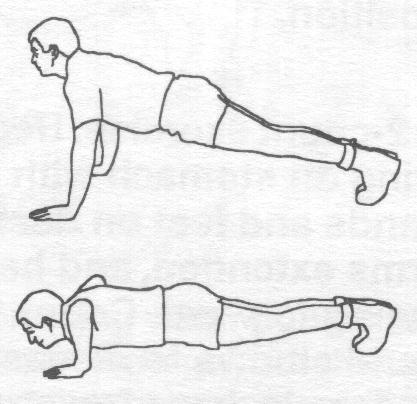
Let’s begin in the up portion of the push-up position.  Hands should be about shoulder-width apart, elbow pits facing forward.  Back is straight, aligned from crown to coccyx.  Very important with all the exercises here, do not use any more muscle tension than absolutely necessary to accomplish the exercise.  As you progress, you’ll find less and less muscle power is needed for the same result.  We’re working toward efficiency here.  So, relax as much as possible and remember that the push-up is just the form, the real goal is the breath work.

Begin to inhale slightly before starting the push-up this way your breath leads the way.  As you lower down, continue to inhale by expanding your belly.

No chest breathers here!

Pause at the bottom portion, then begin to exhale again slightly before initiating the upward push.  The breath should guide the movement.

Play with this for several repetitions trying to really get the feel of the breath leading and supporting the movement.

Now reverse the breathing pattern.  Exhale on the way down and inhale on the way up.  Same rules apply.

If you feel excessive muscle tension being used, stop.  Stand up and lean against a wall or a staircase in the push-up position.  This will greatly reduce the demand of the exercise allowing you to concentrate on the breathing aspect while still performing the movement of a push-up.  When you feel comfortable with the movement, drop back down to the floor and try again.  Keep the same light feeling you had while doing the push-ups against the wall or stairs.

Building Capacity

Once you get the hang of the breath leading the movement of the push-up, we will begin to work on expanding your breathing capacity.  Here we will stretch out the inhale and exhale to fit more movements into each breath cycle.

For example, begin again in the upward portion of the push-up position.  Exhale completely without moving.  Begin the inhale slightly before the lowering movement and continue to inhale all the way down and all the way back up.  Exhale.  Now try to do 2 push-ups on one inhale.  If you can do 2, try 3.  See how many movements you can fit into one inhale, it’s not easy!  Make sure you don’t rush that will only add tension and gas you out even quicker.  Maintain relaxation and an even pace throughout.

Once you’ve done a few reps by expanding your inhale, try to do the same thing on an exhale.  Start in the top portion of the push-up, inhale completely without moving.  Begin your exhale slightly before the downward movement and continue through the whole push-up.  Try 2, 3, 4, see how many reps you can do on one exhale.

One way to do this in a set is to do a breathing ladder.  Do one push-up on one inhale.  Exhale at the top.  Then do 2 push-ups on one inhale.  Exhale at the top.  Then do 3 push-ups on one inhale.  Exhale at the top.  Try to do 4 on one inhale.  Now, reverse it, inhale at the top and do 4 push-ups on one exhale.  Then 3 on one exhale.  Then 2.  Then one push-up on one exhale.  Get the idea?

Hopefully this is a fun and productive exercise for you.  Let me know how it works and if you have any questions!

Stay tuned for Part 2 of this article where we’ll discuss breath holding.