Sample Exercise from Warrior Fitness Guide to Striking Power

A Word on Strike Conditioning

Swinging your sledge hammer at an old tire is an excellent old school conditioning exercise for anaerobic strength and work capacity.  It will insure your strikes have not only power, but endurance and as well.  Old tires are fairly easy to come by, usually any Tire and Auto place will have a bunch of old tires sitting in a pile outside waiting for disposal.  If you ask nicely, they are pretty happy to give you a couple for free.

There are a few different protocols that I like to use for this exercise:

Density training is one option. The concept of Density Training is pretty simple.  Do more work in the same amount of time or do the same amount of work in less time.  So, for example using hitting the tire with a sledge hammer as the exercise and the last time you used this protocol you managed to do 100 swings in 5 minutes, then this session you would either try to increase the number of swings you can do in 5 minutes or strive to do 100 swings in less than 5 minutes.  Not rocket science, right?  What if this is your first time attempting this type of training?  Pick an amount of time, say 5 minutes.  Then try to do as many hammer swings as you possibly can in those 5 minutes.  Crank them out.  Push yourself.  Remember the time limit used and amount of reps achieved, or preferably write it down, and the next time do more.

High Intensity Interval Training (HIIT) is another one.  It is perhaps one of the best ways to train for endurance.  It will enhance all 3 energy systems in the body (2 anaerobic and 1 aerobic – see here for an overview), as well as prime the nervous system to recover automatically during lulls in activity.  Simply put, HIIT alternates periods of high intensity exercise with periods of rest and recovery.  It can be performed with almost any exercise and can be utilized both with and without equipment.  The variety and adaptability of this style of training is second to none in results.

No discussion of interval training would be complete without touching on the Tabata Protocol.  Dr. Izumi Tabata at the National Institute of Fitness and Sports in Tokyo, Japan performed perhaps the most well known study on interval training.   A group exercising with moderate intensity endurance training was compared to another group using high intensity intermittent training.  Each group exercised 5 days a week.  The moderate intensity group exercised for 60 minutes, at 70% VO2 max.  The high intensity group did 8 intervals of 20 seconds, followed by 10 seconds of recovery.  They operated at 170% VO2 max.

After 6 weeks, both groups experienced improvements in maximal oxygen uptake.  The biggest difference between them was that only the high intensity group gained improvement in anaerobic capacity.  The high intensity group actually realized a 28% increase in anaerobic capacity AND a 14% increase in VO2max.  So, the study concluded that high intensity intermittent training can improve both the anaerobic and aerobic systems simultaneously.  Very impressive results!

I know that after reading the amazing results achieved by Dr. Tabata you’ll be ready to try using his protocol, I sure was!  The protocol itself is pretty simple, in theory.  Choose an exercise – say sledge hammer swings, for example (since we’re talking about them).  Perform the exercise for 20 seconds as fast as possible while still keeping good form.  Rest 10 seconds.  Complete 8 rounds.

There are several different ways to swing the sledge hammer.  I don’t care which way you do it – vertically, diagonally, hands apart, hands together, all are fine.  Just make sure that no matter which way you choose, you do not bend your back – we do not train bad habits!
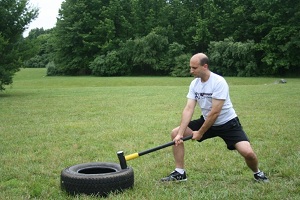
In this particular example, notice the slight turn of the spine where I store energy (SEE) in my lower back.  The hammer swing is powered by the release of that energy, not by my arms.  Also, notice the knees bend as I squat down to hit the tire and not bend my back.  Keep good structure throughout the movement.

Like this exercise?  This one and many more sledge hammer, medicine ball, resistance band, and body weight exercises are described in detail along with sample workouts in the Warrior Fitness Guide to Striking Power Pick up your copy today!!


16 Minutes of Pure Torture

Hope the catchy title got your attention!

Today we’re going to do a fun workout based on the Tabata Protocol.  If you are not familiar with Tabata, please check out the Warrior Fitness Tabata Primer found here, What’s Tabata You?

I highly suggest you warm up before doing this workout.  In fact, I insist on it.  What’s a good way to warm-up?  I’m glad you asked.  One of my favorite warm-ups is found here in my Morning Wake Up Routine.  Don’t let the fact that it says morning dissuade you.  It’s a quick, highly effective recharge/warm-up that can be used anytime of day.

Now, onto the workout.  Warmed up?  OK.  Here we go –

Remember, Tabata is 8 rounds of exercise, 20 seconds on, 10 seconds off, for a total of 4 minutes for each exercise.  Take one minute rest upon completion of each set of 8 rounds.

Exercise 1 – Bodyweight Squats

 1 minute Rest

Exercise 2 – Hindu Push-ups

 1 minute Rest

Exercise 3 – Sit Thrus

 1 minute Rest

Exercise 4 – Burpees

Out of breath?  Want to learn how to recover your breathing in between exercises and at the end of the conditioning session?  Check out the section on restoring breath in Evolve Your Breathing.

Enjoy!

Tabata for Kids!

Usually my favorite place for the kids to exercise is outside.  There’s nothing like running around, climbing on the jungle gym at the local playground, or just enjoying a walk on a beautiful day in the  fresh air and sunshine to fulfill your children’s daily recommended allowance of exercise.  But how about those dull, rainy days when the kids are cooped up indoors?  For some reason, indoor activities always seem to lend themselves to sedentary type things, like: video games, watching tv, surfing the Internet, playing cards or boardgames, and reading (although my kids and I all love to read, and it is fundamental, of course), for example. 

Break Up a Boring Day with Exercise!

One way I’ve found to insert a daily dose of exercise that’s fun for the kids and short enough to hold thier attention span is working on Tabata Intervals with them.  Click here for a more in-depth discussion on Tabata.  These don’t require a lot of space so they are a perfect indoor, rainy day workout to get the kids moving.  Check it out –

The Exercises:

  • Jumping Jacks
  • Lunges
  • Base Switches(Start from all fours on hands and balls of feet. Lift right hand and left foot together.  Switch to crab walk position.  Pick up left hand and right foot. Switch back to base position. Continue.)
  • Mountain Climbers

Per the Tabata Protocol, each exercise is performed for 20 seconds on, 10 seconds rest for 8 rounds.  Rest for one minute and then move onto the next exercise.  Try not to push them too much or provide too much instruction.  Just enough for them to get the form down.  Let them move at their own speed through the exercises and they will gradually pick up the pace on their own  This workout provides 16 minutes of high intensity exercise for any kid.  Get them off the couch and away from the TV to get their daily dose of exercise!

What’s Tabata You?

If you have been keeping up with the latest trends in conditioning research then you probably already know that interval training is the most efficient way to train.  Interval training alternates periods of high intensity exercise with periods of rest to produce gains in both aerobic and anaerobic systems.  Forget about those long slow distance runs to improve aerobic fitness!

The Body’s 3 Energy Systems

To briefly summarize, the body has three energy systems, 2 anaerobic, or non-oxidative, and 1 aerobic, that serve to create ATP (adenosine triphosphate).  ATP is utilized by every cell in your body; it fuels muscular contractions, cognitive processes, and internal regulatory functions.   Both anaerobic systems fuel maximally intensive activity, while the aerobic system fuels sustained low to moderate level activity.

The ATP-PC system provides immediately available energy for high intensity efforts from ATP stored within the muscles.  This system is the most powerful, but least enduring of the three, lasting only about 10 to 30 seconds max.

The Glycolytic system, the second most powerful, is only slightly more enduring than the ATP-PC system.  It derives energy from glycogen stored in the muscles and liver converting it to ATP in a process called glycolysis.  Its capacity is approximately 90 to 120 seconds.  Rest intervals allow the body to recuperate and restore ATP.

Lastly, the Aerobic system uses proteins, fats, and carbohydrates to produce ATP.  As the intensity of the effort increases, the aerobic system relies more on glycogen for energy.  If the intensity continues to increase, the anaerobic systems must kick-in to provide energy.  The important idea to realize here is that all 3 energy systems are always supplying the body with the energy it needs for any activity, at any level of intensity.  It’s just that one may be more dominant than the other 2 at a specific time.

If Anaerobic is ‘Without Oxygen’, Why am I Sucking Wind?

If you have been following any of the Warrior Fitness Training Programs, you are already familiar with examples of anaerobic exercises and how they affect the body.  Have you noticed how after even a brief, but intense anaerobic session you are breathing heavily?

If anaerobic really means ‘without oxygen’, how come you are so out of breath?

What happens is that your aerobic system is trying like heck to help restore your anaerobic systems.  All that extra oxygen is being used to metabolize the lactate that’s accumulated in the muscles during the bout of intense activity.  In order to continue to supply energy for all-out, intense efforts, the anaerobic system must be replenished.  Excess Post-exercise Oxygen Consumption (EPOC) is the term used to identify this process of extra oxygen being taken in to restore all systems.  So, basically, as the intensity of your exercise increases, so does your EPOC.  And, that’s why you’re sucking wind!

Tabata Protocol

No discussion of interval training would be complete without touching on Tabata.  Dr. Izumi Tabata at the National Institute of Fitness and Sports in Tokyo, Japan performed perhaps the most well known study on interval training.   A group exercising with moderate intensity endurance training was compared to another group using high intensity intermittent training.  Each group exercised 5 days a week.  The moderate intensity group exercised for 60 minutes, at 70% VO2 max.  The high intensity group did 8 intervals of 20 seconds, followed by 10 seconds of recovery.  They operated at 170% VO2 max.

After 6 weeks, both groups experienced improvements in maximal oxygen uptake.  The biggest difference between them was that only the high intensity group gained improvement in anaerobic capacity.  The high intensity group actually realized a 28% increase in anaerobic capacity AND a 14% increase in VO2max.  So, the study concluded that high intensity intermittent training can improve both the anaerobic and aerobic systems simultaneously.  Very impressive results!

How Can I Use Tabata?

I knew that after reading the amazing results achieved by Dr. Tabata you’d be ready to try using his protocol, I sure was!  The protocol itself is pretty simple, in theory.  Choose an exercise – say sprints, for example.  Perform the exercise for 20 seconds as fast as possible while still keeping good form.  Rest 10 seconds.  Complete 8 rounds.  Sprints are an easy example, but really the Tabata Protocol can be applied to almost any exercise.  Try some of these:

  • Bodyweight squats
  • Burpees
  • Kettlebell swings or snatches
  • Sledgehammer swings
  • Push-ups
  • Sprawls
  • Renegade Rows
  • Sandbag Shouldering
  • Mountain climbers
  • Jumping

These are just a few examples of exercises that can be used with Tabata. Just make sure you don’t overly complicate it because you do have to be able to perform several reps within the 20 seconds!!

Additionally, try grouping together 4 to 6 different exercises to increase the effectiveness of the workout and create a synergistic effect where the total combined effect is greater than the sum of the individual exercises.  This, I think, is where the real fun begins!

To seriously amp up your conditioning, learning how to use various breathing techniques to restore yourself quicker, lower your heart rate, and increase the effectiveness of your conditioning sessions is a MUST!

warfit3d3

User Guide to the Workouts of the Week

I received several emails this morning after yesterday’s post on Warrior Fitness Workout of the Week #1 from people who wanted more information on how to implement and program the workouts of the week.  So here it is!

The Workout of the Week section is designed to give you insight into the Warrior Fitness training method.  We will cover topics such as joint mobility, high intensity interval training (HIIT) and the Tabata Protocol for conditioning, strength endurance, explosive strength, core work, yoga, and martial arts. 

1.  How often should I do the Workout of the Week (WOW)? 

This depends on the intensity level of the prescribed workout.  For example, if the WOW is an illustration of a yoga compensatory routine, you can do it daily, but if it’s a high intensity conditioning workout, you may only be able to perform it 2-3 times a week, depending on your recovery levels.   These workouts are short; usually, under 30 minutes.   You should have plenty of time to squeeze them into a busy schedule!

2.  Should I change my workout every week to correspond to the WOW? 

Not necessarily, no.  The workouts change weekly in order to showcase various aspects of our training methodology, but that doesn’t mean you need to change it up on a weekly basis.  Workout programs should be designed with specific goals in mind and crafted to meet individual needs.  Your body needs time to adapt to your exercise selection for it to elicit the planned response, usually about 4 to 6 weeks.  If you find a something that you like, stick with it.  If you have a more detailed question about how to program a specific workout, or even a series of workouts, let me know.  I can help you.  That’s why I’m here.

3.  What if I already have a workout program?  How can incorporate the WOWs? 

 If you currently have a training regimen that you are happy with, but want to give one of our workouts a try, you can definitely do that.  Simply replace one of your conditioning days with one of our conditioning workouts.  Or, add in our joint mobility exercises as a warm-up.  Remember, you receive a sample chapter on joint mobility  from the book, Warrior Fitness, when you sign up for our mailing list.

4.  I am just starting to exercise, can I still use the WOWs? 

Absolutely!  Start slowly.  Begin by doing our joint mobility exercises on a daily basis to prime your body and help you regain lost range of motion.  Each of our workouts contains instructions on modifying the workout to scale it for any level of conditioning.  Also, if you have further questions about modifying workouts, or programming workouts, contact me.  I’ll be glad to help you.

5.  Will I lose weight with these workouts? 

 Yes!  Our conditioning workouts are designed to turn on your body’s metabolic furnace and torch unwanted fat, while building lean muscle. 

6.  How can I find out more?

My ebook, Warrior Fitness: Conditioning for Martial Arts, is available for direct download.  It contains the background, philosophy, and methodology behind Warrior Fitness, as well as an ample exercise selection and a chapter on program design.

Want to know more?  Just ask!

 I hope this has been a helpful introduction to the Warrior Fitness Workouts of the Week.  What other questions do you have?