The Law of Threes – Part 2

Form of the 3 Hearts


In The Law of Threes – Part 1, we discussed the 3 physical components of Alignment, Movement, and Breathing, which form the basis for technique in the Warrior Fitness Training System.  The next trinity of principles we will look at is the sanshin no kata, or Form of 3 Hearts.

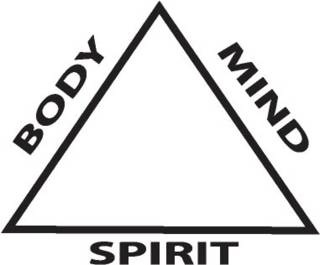
The 3 hearts I am referring to here are body, mind, and spirit.  While the prior 3 components make up the internal physical expression of technique, these 3 represent a unified metaphysical approach to technique.  It is the integrated use of mind, body, and spirit which brings life to and actualizes the practice of Warrior Fitness.

The following is how I distinguish the 3 Hearts:

Mind Intent, concentration and focus along with an understanding of the interrelationship of the exercises and how they integrate with and enhance the way we move in the world.

Body Forging a strong body to carry us through the challenges we face.

Spirit Pushing the edge to consistently increase resistance to failure.

When just one of the 3 hearts is absent or somehow out of balance, the technique itself becomes just a shallow, superficial representation of its true, powerful form.

body-mind-spirit

The techniques of both fitness and martial art must, by definition (at least the Warrior Fitness definition) engage the complete human being – body, mind, and spirit – to have the most lasting and transformative effect.  Without full commitment of the 3 Hearts not only is the technique itself a weak expression of its true power, but the person executing it, by default, does not receive the comprehensive benefit of the exercise.

“It is much better to deeply practice an exercise just 3-4 times while being fully engaged than to practice it 100 times without.” – Jon Haas


How to Train More Every Day

The only way to go from average martial artists to outstanding is to train more.  You may be limited in how many classes you can attend on a weekly basis or how many seminars you can attend on a monthly basis, but you are not limited in how much solo training you can do on a day to day basis.  The key to greatness lies in solo training.  This is how you build yourself up to mastery.  Step by step, session by session, day by day.  There is no other way.

That being said, I humbly offer the following 4 suggestions on how to train more every day.


1)      Awareness, Awareness, Awareness

Keep your eyes, ears, and senses open to your surroundings.  Make it a habit to not allow anyone to sneak up on you or surprise you.  Make a game out of knowing where people around you are, even if you can’t “see” them.

ZanshinKanji

2)      Don’t Just Walk, Ninja Walk!

Take the opportunity no matter where you are to practice your balance, footwork, and movement skills.  This doesn’t mean you have to stalk your boss in the company restroom – unless you want to get fired!  But when you move, whether it’s in the office, walking down the street, in the grocery store, or out in the woods, pay attention to your balance, body control, and coordination.  Raise and lower each foot purposefully.  Do not let your walking be “controlled falling”.

3)      Mini Training Sessions

All of us seem to think that if we can’t dedicate a solid hour or so to solo training than we just don’t have the time to do it.  My solution for you is this – train in 5 minute increments.  No matter who you are and what type of work you do, you have 5 minutes to spare during your day.  If you look for it, you probably have many blocks of 5 minute increments during your day.  Don’t waste them!  Use them to train.  In 5 minutes you can practice all the Sanshin No Kata 5 times each side.  In 5 minutes you can do 100 push-ups (maybe!). In 5 minutes you can practice ukemi.  In 5 minutes you can do a flow drill.  Be creative, figure it out!  All those mini blocks of 5 minute training sessions add up to huge amounts of time over a week, month, year, and decade.  You’re in this for the long haul, aren’t you?

4)      Set a Goal

Figure out what your own personal training goals are and write them down.  Give yourself a deadline to achieve them.  Add actions steps to help you reach each one.  Develop a plan of attack and hold yourself accountable.  Need help developing a plan?  Ask me.  I can help you.  It’s what I do.


This is Dangerous to YOUR Training

Alright.  Strap in, kids because this is gonna be a bumpy one.

There is a huge problem that affects many people training in martial arts today that needs to be addressed because it is severely inhibiting their progress and skill.  It applies to fitness training as well, so if you don’t train martial art read this with whatever type of training you do in mind. Continue reading

The Sanshin of Warrior Fitness

A short introduction may be necessary for those readers not familiar with Bujinkan Budo Taijutsu.  Sanshin no kata is a basic training exercises within the system that templates movement patterns for Bujinkan Budo Taijutsu.  In English, it translates to “form of three hearts”.  These three hearts are mind, body, and spirit.  All three must be united for technique to come alive for the martial arts practitioner.  Without all three aspects of body, mind, and spirit unified the kata become  empty shells of movement, devoid of essence.

Bujinkan martial arts are the wellspring from which my concept of Warrior Fitness sprung as a natural outcropping.  So as my philosophy of Warrior Fitness continues to evolve, it naturally gravitates to this type of structure for me to express it.  In keeping with the trinity of mind, body, and spirit, here is how I see it for Warrior Fitness:

Mind Concentration and focus along with an understanding of the interrelationship of the exercises and how they integrate with and enhance the way we move in the world.

Body Forging a strong body to carry us through the challenges we face. 

Spirit Pushing the edge to consistently increase resistance to failure.

The Sanshin no kata consist of 5 forms which are called, Chi no kata (earth form), Sui no kata (water form), Ka no kata (fire form), Fu no kata (wind form), and Ku no kata (void form).  Those who have read Miyamoto Musashi’s famous work, Go Rin No Sho – A Book of 5 Rings, are most likely familiar with the terminology as well.  Here is how each is expressed in Warrior Fitness:

Earth Building strength, stability, and structure in movement and stillness

Water Freedom of movement through all ranges of motion, flow state

Fire Metabolic conditioning to ignite fat loss and sculpt lean muscle

Wind Breathing exercises to vitalize every cell in the body

Void Pushing the edge of our limitless potential


Hone Your Mind, Invigorate Your Spirit, and Make Fierce the Body with Warrior Fitness!

Your Sanshin No Kata Under a Microscope

Sanshin no Kata (form of the three hearts) forms the basis for movement in the Bujinkan. These five foundational exercises cannot be overlooked, especially with regard to solo training.

When I first began training in the Bujinkan over 20 years ago there were very few training resources.  There was no Internet!  In a way it was much easier for a beginner since there weren’t a lot of distractions.  Today we are bombarded by information and perhaps sometimes even overwhelmed by it.  Back in the day, practicing alone was easy.  You had kamae.  You had some basic strikes.  You had ukemi.  You had basic hanbo movements.  And, you had Sanshin No Kata.  In the early days of my training, Jack Hoban used to drill us in these basics virtually every class.  I remember many a hot, sweaty night in the old gym dojo back in Asbury Park, NJ where the small class would work Sanshin No Kata in front of full length mirrors for the entire class, usually followed by basic kicking and punching an ancient heavy bag in the corner.  This kind of practice may seem boring or at least unsexy these days, but I assure you it built a very strong foundation.

How to Practice

Today, one of the best ways to practice these kata is still in front of a full-length mirror. This way, you will be able to notice all the little “hitches” and inconsistencies in your movement. Use the mirror as a training device to evaluate your posture and movement. For each kamae, and especially including the transitory movements between kamae, make sure that:

  • back is straight (crown lifted up),
  • shoulders are down,
  • head is not transposed forward over the neck,
  • chest is relaxed,
  • butt not sticking out,
  • hips are open,
  • knees are over the toes,
  • weight evenly distributed (50/50)
  • no leaning forward or backward

These are the very obvious, glaring errors that will be easily noticed as you start this practice. Chronic tension and tightness when in transition between kamae will be abated with continued practice – the key to eliminating the excess tension in your movement is first being aware of it! With consistency and patience, you will gradually shape your body to conform to the characteristics of good taijutsu. This is not an easy process and can be painstakingly difficult due to the constant attention to detail working to chip away at all the unnecessary, inefficient movement built up over years of chronic tension and unnatural movement. You may also notice a particular lack of flow between movements because you are concentrating so much. Build efficiency in steps. First, work on the static kamae. Next begin to add the steps and strikes. Finally, work the entire kata in a flow with no pauses or breaks in the movement. This process will gradually streamline your movement and eliminate the unwanted tension and imbalances. It takes a lot of practice, dedication, and hard work to move with ease!

Chi No Kata as an Example

Let’s take a look at the first kata, Chi no Kata, as an example.

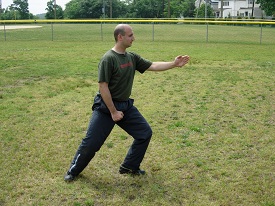
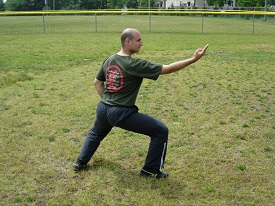
To begin, start in Boubi No Kamae, left hand straight out in front with a natural bend in the elbow, pointed at the opponent’s heart, right hand held in a fist in the crook of your right hip. Move with exaggerated slowness as if practicing a Tai Chi version of the kata.

Drop the weight from your hips, shift over the front knee, and let your rear elbow straighten, dropping the hand in front of the hip to create a slight tension in the spine. This point here about creating torque or stored elastic energy (SEE) in the spine is essential in being able to move powerfully without winding up or telegraphing the movement. If you are having trouble feeling it, try to exaggerate the movement. Make it much larger than necessary to study the feeling. It should feel like a tension in the lower back near the bottom of the spine.

When this tension (torque) is relaxed (released), the movement happens. See if you can figure out where the energy is stored and how it’s released in the rest of the San Shin no Kata!

Be very careful when transferring your weight that you do not bob up and down; move smoothly through the same plane by shifting your weight laterally. Another point to be mindful of during the weight transfer is that you should be in balance (kamae) at all times. If you were to stop the movement at any point in the transition, you should not lose your balance.

Try it.  Practice it.  Create a strong foundation upon which to build, expand, and grow so that all the information and knowledge being handed down to you today takes root.

You can pick up my video tutorial on how to use Sanshin No Kata to create stability and power in your movement as a FREE Bonus with my Martial Power Program. OR, you can click HERE and get the Sanshin No Kata video separately for just $7!

Martial Power Cover1

Unlocking Flow in Your Taijutsu Practice

Here’s another one for all my Bujinkan Budo Taijutsu friends out there.

The following set of exercises is specifically designed to increase flow (nagare) in your taijutsu. However, before we get into the exercises themselves we should address the question, what is flow?

Flow is efficiency and continuity in movement. Flow is smoothness of movement that is unencumbered by mechanical, jerky actions. Moving at a faster pace and working harder, does not necessarily mean that the movement is flowing. In fact, if you are working harder, I can almost guarantee the movement is not flowing.


Get Out the Way – Move!

Flow is not something you do; it is something you get out of the way of!

What types of internal distractions, tensions, hitches in movement are preventing you from getting out of your own way?

The following flow exercises are culled from basic exercises of Bujinkan Budo Taijutsu, but can be utilized by anyone to expand your movement potential and increase flow.

When training these exercises, the idea is, of course, continuous movement. Begin with a slow and smooth protocol, working on keeping a good technique level and efficient transition between the movements. One discovers the key to developing flow by examining the in between stages of movement. Often, we see the kamae (structure) and then we see the roll, but what we miss is the essence of flow – the small, transitory movements between them.

Do not attempt to “accomplish” the exercise; that is not the point. Use it as a vehicle to unlock the flow in your movement. Try to keep moving. Don’t pause to think in the middle. Increase the speed as you begin to feel comfortable, but if the technique begins to get sloppy or the movements begin to look mechanical, drop down the intensity level until you are once again performing the flows with good technique. Remember, there is zero training value in simply trying to do the exercises for a “cardio” workout. Go buy a treadmill!

Chi No Kata

1. Step back from a natural posture into left leg forward Ichimonji No Kamae. Do Chi No Kata. From the end point of the kata, continue lowering your center of gravity and extend the right arm to effectively blend the transition from Chi No Kata into a front roll. Allow the momentum of the front roll to carry you to your feet, lifting up from the crown of your head and using your spine, into right Ichimonji No Kamae and, without stopping in the kamae, leap forward landing again in right Ichimonji No Kamae. Continue the movement by reaching forward with the left hand with a feeling of the body being pulled by the hand into left Ichimonji No Kamae. Repeat on the other side.

Sui No Kata

2. Step back from a natural posture into left Ichimonji No Kamae. Do Sui No Kata. From the omote shutou strike at the end of the kata, continue lowering the body with the weight on the front leg, simultaneously stepping through with the back leg to transition from the strike into a back roll. Allow the momentum of the back roll to carry you to your feet, lifting up from the crown of your head and using your spine, into right Ichimonji No Kamae and, without stopping in the kamae, leap backward landing again in right Ichimonji No Kamae. Repeat on the other side.

Ka No Kata

3. Step back from a natural posture into left Ichimonji No Kamae. Do Ka No Kata. From the ura shutou strike at the end of the kata, bring your left foot forward next to the right foot a little more than shoulder width apart to transition into Hira No Kamae. Without stopping in the kamae, lower your center of gravity and flow into a side roll to the right. Roll right back into Hira No Kamae and leap sideways to the right, landing again in Hira No Kamae. Repeat on the other side.

Fu No Kata

4. Step back from a natural posture into left Ichimonji No Kamae. Do Fu No Kata. Immediately transition to Hoko No Kamae and flow into a cartwheel. Land back in Hoko No Kamae and leap down into a kneeling Ichimonji No Kamae. Repeat on the other side.

Ku No Kata

5. Step back from a natural posture into left Ichimonji No Kamae. Do Ku No Kata. Immediately transition to a forward break-fall followed by a forward roll into Jumonji No Kamae. Leap directly upwards. Repeat on the other side.

Enjoy!

Flow drills from the book, Warrior Fitness: Conditioning for Martial Arts
WFBookcover3d