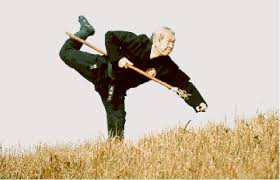
 Masaaki Hatsumi, Grandmaster of the Bujinkan Dojo, once stated, “endurance is of primary importance for the ninja.” One definition of endurance is the ability to resist fatigue. Looking at the kanji (Chinese character) for Nin, there is the ideogram for “sword” over the ideogram for “heart” giving Nin a meaning of, “even though you hold a sword over my heart, I will endure.”
How many of us training in the Bujinkan, or any other martial art, can truthfully claim that ability? How long can you train? How far can you push yourself? In martial art, endurance, or the ability to “keep going” is defined in years, not minutes, hours, or days. How can we create an effective training program that will instill in us the ability to continue, to endure?
Physical Endurance
Let’s begin by examining the concept of physical endurance. There are 3 basic types of physical endurance:
- Aerobic endurance
- Anaerobic endurance
- Strength endurance
We discussed the body’s 3 energy systems and how using the Tabata Protocol can effectively improve both the aerobic and anaerobic systems here. Strength endurance is defined as the ability to effectively maintain muscular functioning under work conditions of long duration. There are two basic ways to increase the ability of your body to do more physical work. One is the continuous adding of weights, sets, reps, and time to push the body to create an adaptation to allow it to perform more work for a longer duration. As we discussed previously in the article on GPP, the body’s capacity is expanded. Progress is incremental and continuous for as long as one is able to keep increasing driving forces in the body. The next one, however, is often overlooked in our “just add more volume” culture. More is always better, right? If one vitamin is good for you, take 4, that’s even better (please don’t!). But, there is another way to allow the body to continue training in addition (no pun intended) to adding more work. By removing restrictions in your body, like unnecessary tension or extra body weight or lack of flexibility/mobility in a particular area, you then free up resources in your body that were spent holding that tension that you weren’t even aware of on a conscious level. These restrictions, once removed, allow even greater leaps in performance than simply adding more work. When the 2 are combined, it’s a powerful combination!
How Do We Program It?
By programming our workouts so that we effectively build in both the removal of restrictive forces, while also increasing driving forces, we can maximize our progress. This idea is present in traditional methods of Hatha Yoga in the form of balancing strength and surrender. Contrary to popular opinion, yogi’s do not simply work to become more flexible. They actively work to increase both strength and flexibility as complimentary opposites in order to achieve a state of balance. Now, I’m not asking you to become a yogi here, merely pointing out that this is not a new concept at all, but has been used by traditional arts for thousands of years. Our program for developing ninja-like endurance will utilize both joint mobility exercises and yoga asana (poses), as well as breathing exercises, to aid in the removal of restrictive forces binding your training and slowing your progress. Next week I will be putting out an article on breathing exercises that can be used for relaxation, stress management, removing residual tension, and also for increasing energy – keep your eyes out!
For an example of some easy yoga postures that can start helping you right now, head over to my good friend Josh Sager’s excellent blog, Fretterverse, and check out my article on Yoga for Guitarists. A free sample joint mobility training program can be obtained simply by signing up for the Warrior Fitness Mailing List at the top right of the page. Sign up now and begin working on removing restrictive forces today!
And, don’t forget to check out Warrior Fitness: Conditioning for Martial Artists for more exercises, options, explanations, and program design!
Stay tuned for a sampleStrength Endurance Workout coming soon!