Ninja Endurance – Part II

In part one of Ninja Endurance called,  How to Train for the Endurance of a Ninja, we discussed strength endurance and I provided a sample workout to help you build yours.  Here in part 2, I ‘d like to delve a little deeper into the whys of endurance training and how specifically high intensity interval training is an excellent choice for it.

What is Endurance?

Endurance is defined as being able to keep going without fatigue setting in, or being able to push oneself through fatigue.  Essentially, it is the ability to resist or bear fatigue.  What is fatigue?  Fatigue is weariness or exhaustion from exertion, or the temporary loss of power to respond.  An equally critical corollary to the definition of endurance, especially for the warrior,  is that your level of endurance also determines how quickly you are able to recover between bouts of activity.  Combat, like life, does not happen at one constant rate of speed.  It is multi-faceted in nature.  There will be periods of brutally intense activity followed by lulls in the action, again followed by another flurry of activity.  Being able to use those lulls in action to recover is a critical ability for the warrior.

Steady state cardio, Long Slow Distance (LSD) training simply will not cut it.  Running on a treadmill may be appropriate for a hamster in a cage, but human beings require more.  Long distance running can be beneficial for mental toughness and/or active recovery, but it should not be the primary focus of a warrior’s endurance training.  So then how should we train to maximize our ability to endure?

Warriors Need to HIIT!

High Intensity Interval Training (HIIT) is one of the best ways to train for endurance.  It will enhance all 3 energy systems in the body (2 anaerobic and 1 aerobic – see here for an overview), as well as prime the nervous system to recover automatically during lulls in activity.  Simply put, HIIT alternates periods of high intensity exercise with periods of rest and recovery.  It can be performed with almost any exercise and can be utilized both with and without equipment.  The variety and adaptability of this style of training is second to none in results.

How else does improving your endurance through this type of conditioning aid your martial arts training?  I’m glad you asked!  If the benefits discussed above weren’t enough, consider that having a high level of conditioning also aids in learning new skills.  How’s that possible?  To put it simply, when the central nervous system (CNS) is fatigued, the body cannot effectively process new skills, especially technically advanced skills.  So, in essence your lack of a general level of fitness and conditioning will actually impede your learning process as you will tire more readily and not have the ability to recover quickly enough during training.  Want to train more, at a higher level, for a longer period of time?  Want to get more out of your training time both at home and in the dojo?  Want to build new skills and enhance your technical arsenal?  Get yourself in shape!

There are several sample conditioning workouts here on the Warrior Fitness site.  Here are a few examples:

Workout of the Week #1


Workout of the Week #5


Stay tuned for more Warrior Fitness style conditioing workouts to help you get and stay in fighting shape!
Knowing is Not Enough!

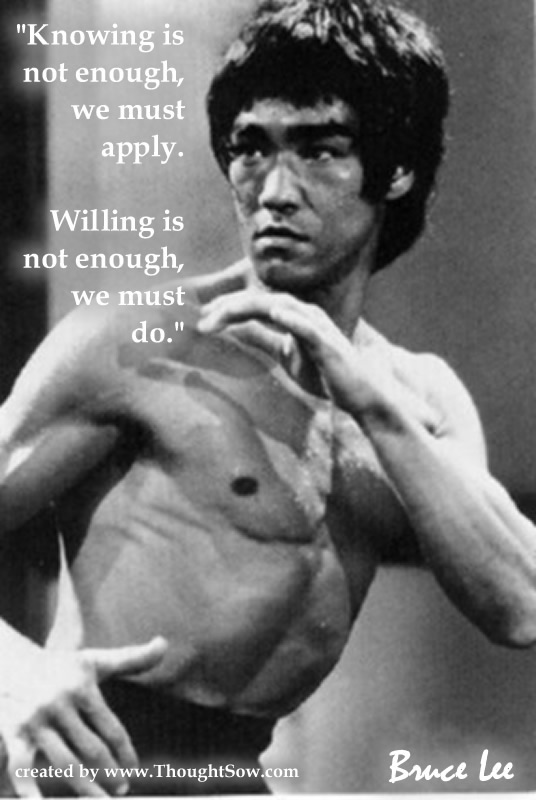
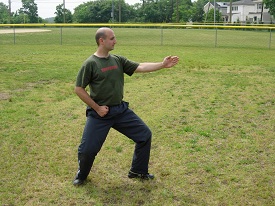
With the proliferation of the Internet and the incredible wealth of resources available in book, DVD, and digital formats, many of us already know more than enough to be martial arts masters!  Yep.  You heard me right – you know more than enough right now to be a master martial artist.  Cool, eh?  Heck, some of us even have more disposable information on budo history, lineage, techniques, kata, and principles at our fingertips than all of the past generations of Bujinkan Soke combined!  Think about that for a second.  Now, at this time in history, the sheer amount of knowledge in the form of information available to us is greater than at any other time, and it’s only going to continue.  Yet, with all of this knowledge, why aren’t we all amazingly skilled?  Why do the legendary feats of past budoka seem so remote and unachievable to us today?  Why are there so few with real skill among the millions of people practicing martial arts worldwide?  Because knowing is not enough, that’s why!  Hatsumi Sensei has emphatically stated on many occasions, that “budo is not an academic subject.”  Why then do we continue to view it as such?  There has only ever been one way to become as highly skilled at a craft as to be called a master.  “Knowing is not enough, we must apply.  Willing is not enough we must do.”    

Is Your Cup Already Full?

Another way we limit ourselves is by equating knowing with being able to do.  For example, when your teacher demonstrates a fundamental principle of movement for the hundredth, or maybe hundred thousandth time, do you smile smugly to yourself and think, “I know that already”?  Maybe you have.  I know I have.  I admit it.  But this type of attitude makes us lazy.  It lowers our skill level because it allows us to hold fast to the superficial without the hard work of plumbing the depths.  It lets us check those basic movement(s) or principles of movement off our mental list and move on to something more advanced; more worthy of our time (we may think)… big mistake.  If we were truly honest with ourselves, we’d be asking a different question.  The better, more appropriate question to be asking ourselves is -”how well can I do that?” or “How well do I truly understand those movement(s) bodily, not intellectually?”   This is hard though because most often the most authentic answer we can give ourselves is, not well enough.   Watch your teacher closely.  Look deeper.  Pay attention because there’s always more.  Be careful.  Practice.  Practice.  Practice!

Your Sanshin No Kata Under a Microscope

Sanshin no Kata (form of the three hearts) forms the basis for movement in the Bujinkan. These five foundational exercises cannot be overlooked, especially with regard to solo training.

When I first began training in the Bujinkan over 20 years ago there were very few training resources.  There was no Internet!  In a way it was much easier for a beginner since there weren’t a lot of distractions.  Today we are bombarded by information and perhaps sometimes even overwhelmed by it.  Back in the day, practicing alone was easy.  You had kamae.  You had some basic strikes.  You had ukemi.  You had basic hanbo movements.  And, you had Sanshin No Kata.  In the early days of my training, Jack Hoban used to drill us in these basics virtually every class.  I remember many a hot, sweaty night in the old gym dojo back in Asbury Park, NJ where the small class would work Sanshin No Kata in front of full length mirrors for the entire class, usually followed by basic kicking and punching an ancient heavy bag in the corner.  This kind of practice may seem boring or at least unsexy these days, but I assure you it built a very strong foundation.

How to Practice

Today, one of the best ways to practice these kata is still in front of a full-length mirror. This way, you will be able to notice all the little “hitches” and inconsistencies in your movement. Use the mirror as a training device to evaluate your posture and movement. For each kamae, and especially including the transitory movements between kamae, make sure that:

  • back is straight (crown lifted up),
  • shoulders are down,
  • head is not transposed forward over the neck,
  • chest is relaxed,
  • butt not sticking out,
  • hips are open,
  • knees are over the toes,
  • weight evenly distributed (50/50)
  • no leaning forward or backward

These are the very obvious, glaring errors that will be easily noticed as you start this practice. Chronic tension and tightness when in transition between kamae will be abated with continued practice – the key to eliminating the excess tension in your movement is first being aware of it! With consistency and patience, you will gradually shape your body to conform to the characteristics of good taijutsu. This is not an easy process and can be painstakingly difficult due to the constant attention to detail working to chip away at all the unnecessary, inefficient movement built up over years of chronic tension and unnatural movement. You may also notice a particular lack of flow between movements because you are concentrating so much. Build efficiency in steps. First, work on the static kamae. Next begin to add the steps and strikes. Finally, work the entire kata in a flow with no pauses or breaks in the movement. This process will gradually streamline your movement and eliminate the unwanted tension and imbalances. It takes a lot of practice, dedication, and hard work to move with ease!

Chi No Kata as an Example

Let’s take a look at the first kata, Chi no Kata, as an example.

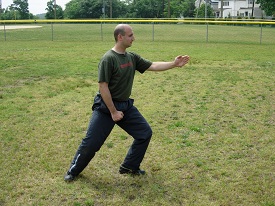
To begin, start in Boubi No Kamae, left hand straight out in front with a natural bend in the elbow, pointed at the opponent’s heart, right hand held in a fist in the crook of your right hip. Move with exaggerated slowness as if practicing a Tai Chi version of the kata.

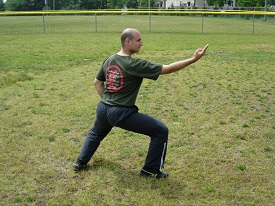
Drop the weight from your hips, shift over the front knee, and let your rear elbow straighten, dropping the hand in front of the hip to create a slight tension in the spine. This point here about creating torque or stored elastic energy (SEE) in the spine is essential in being able to move powerfully without winding up or telegraphing the movement. If you are having trouble feeling it, try to exaggerate the movement. Make it much larger than necessary to study the feeling. It should feel like a tension in the lower back near the bottom of the spine.

When this tension (torque) is relaxed (released), the movement happens. See if you can figure out where the energy is stored and how it’s released in the rest of the San Shin no Kata!

Be very careful when transferring your weight that you do not bob up and down; move smoothly through the same plane by shifting your weight laterally. Another point to be mindful of during the weight transfer is that you should be in balance (kamae) at all times. If you were to stop the movement at any point in the transition, you should not lose your balance.

Try it.  Practice it.  Create a strong foundation upon which to build, expand, and grow so that all the information and knowledge being handed down to you today takes root.

You can pick up my video tutorial on how to use Sanshin No Kata to create stability and power in your movement as a FREE Bonus with my Martial Power Program. OR, you can click HERE and get the Sanshin No Kata video separately for just $7!

Martial Power Cover1

Unlocking Flow in Your Taijutsu Practice

Here’s another one for all my Bujinkan Budo Taijutsu friends out there.

The following set of exercises is specifically designed to increase flow (nagare) in your taijutsu. However, before we get into the exercises themselves we should address the question, what is flow?

Flow is efficiency and continuity in movement. Flow is smoothness of movement that is unencumbered by mechanical, jerky actions. Moving at a faster pace and working harder, does not necessarily mean that the movement is flowing. In fact, if you are working harder, I can almost guarantee the movement is not flowing.


Get Out the Way – Move!

Flow is not something you do; it is something you get out of the way of!

What types of internal distractions, tensions, hitches in movement are preventing you from getting out of your own way?

The following flow exercises are culled from basic exercises of Bujinkan Budo Taijutsu, but can be utilized by anyone to expand your movement potential and increase flow.

When training these exercises, the idea is, of course, continuous movement. Begin with a slow and smooth protocol, working on keeping a good technique level and efficient transition between the movements. One discovers the key to developing flow by examining the in between stages of movement. Often, we see the kamae (structure) and then we see the roll, but what we miss is the essence of flow – the small, transitory movements between them.

Do not attempt to “accomplish” the exercise; that is not the point. Use it as a vehicle to unlock the flow in your movement. Try to keep moving. Don’t pause to think in the middle. Increase the speed as you begin to feel comfortable, but if the technique begins to get sloppy or the movements begin to look mechanical, drop down the intensity level until you are once again performing the flows with good technique. Remember, there is zero training value in simply trying to do the exercises for a “cardio” workout. Go buy a treadmill!

Chi No Kata

1. Step back from a natural posture into left leg forward Ichimonji No Kamae. Do Chi No Kata. From the end point of the kata, continue lowering your center of gravity and extend the right arm to effectively blend the transition from Chi No Kata into a front roll. Allow the momentum of the front roll to carry you to your feet, lifting up from the crown of your head and using your spine, into right Ichimonji No Kamae and, without stopping in the kamae, leap forward landing again in right Ichimonji No Kamae. Continue the movement by reaching forward with the left hand with a feeling of the body being pulled by the hand into left Ichimonji No Kamae. Repeat on the other side.

Sui No Kata

2. Step back from a natural posture into left Ichimonji No Kamae. Do Sui No Kata. From the omote shutou strike at the end of the kata, continue lowering the body with the weight on the front leg, simultaneously stepping through with the back leg to transition from the strike into a back roll. Allow the momentum of the back roll to carry you to your feet, lifting up from the crown of your head and using your spine, into right Ichimonji No Kamae and, without stopping in the kamae, leap backward landing again in right Ichimonji No Kamae. Repeat on the other side.

Ka No Kata

3. Step back from a natural posture into left Ichimonji No Kamae. Do Ka No Kata. From the ura shutou strike at the end of the kata, bring your left foot forward next to the right foot a little more than shoulder width apart to transition into Hira No Kamae. Without stopping in the kamae, lower your center of gravity and flow into a side roll to the right. Roll right back into Hira No Kamae and leap sideways to the right, landing again in Hira No Kamae. Repeat on the other side.

Fu No Kata

4. Step back from a natural posture into left Ichimonji No Kamae. Do Fu No Kata. Immediately transition to Hoko No Kamae and flow into a cartwheel. Land back in Hoko No Kamae and leap down into a kneeling Ichimonji No Kamae. Repeat on the other side.

Ku No Kata

5. Step back from a natural posture into left Ichimonji No Kamae. Do Ku No Kata. Immediately transition to a forward break-fall followed by a forward roll into Jumonji No Kamae. Leap directly upwards. Repeat on the other side.

Enjoy!

Flow drills from the book, Warrior Fitness: Conditioning for Martial Arts

WFBookcover3d

Ukemi Flow Conditioning Workout

This one is for all the martial artists out there –  I created the following ukemi conditioning workout for myself a few years ago to specifically target the transitions between my rolls and begin to unlock flow.  Additionally, it has the effect of really getting your heart pumping and makes a great workout!  Start out slowly and smoothly by practicing for the first few rounds.  Groove the movement and then begin to increase the speed.  Remember, you do yourself and your training a disservice if you rush through the movements simply to say you accomplished the workout.  Flow is not something you do, it’s something you allow – you have to be able to get out of your own way!  That being said, give this a try and let me know how it works for you.

Ukemi Flow

  1. Begin in Shizen No Kamae (natural stance), squat down to ball of foot squat
  2. Zenpo Kaiten (front roll) over the right shoulder
  3. Ushiro Kaiten (back roll)
  4. Stand up into Shizen No Kamae (natural stance), squat down to ball of foot squat
  5. Zenpo Kaiten (front roll) over the left shoulder
  6. Ushiro Kaiten (back roll)
  7. Stand up into Shizen No Kamae (natural stance)
  8. Yoko Nagare (side roll) with the leg crossing in front to the right
  9. Yoko Nagare (side roll) with the leg crossing in front to the left
  10. Stand up into Shizen No Kamae (natural stance)
  11. Zempo Ukemi (forward break fall)
  12. Stand up into Shizen No Kamae (natural stance)
  13. Yoko Nagare (side roll) with the leg crossing behind to the right
  14. Yoko Nagare (side roll) with the leg crossing behind to the left
  15. Stand up into Shizen No Kamae (natural stance) – repeat!

Start out with 4 rounds of 3 minutes each with a 1 minute break between rounds.  Use the minute break to get your breathing back under control and shake out the tension.  When this becomes easier, decrease the rest period to 30 seconds between rounds. Finally, try to perform the Ukemi Flow continuously for 12 minutes.  You can also adjust the difficulty level of the flow by adding directional leaps at the end of each roll.  Or, it can be made easier by performing it from kneeling in Seiza no Kamae instead of standing.

Notes: Make sure you warm-up with brief joint mobility session prior to the workout.

Got your own version of an ukemi-specific workout?  Please share with us in the comments section below!

Jack Hoban on Fitness

The interviews conducted here at Warrior Fitness will highlight people who have significantly influenced my thinking and training on fitness, who are leaders in their particular fields of expertise, and whom I admire.  Jack Hoban happens to fit all three.  Through his unwavering commitment to martial arts and fitness, Jack has inspired me to keep going over the past 20 years down the dual path of martial arts and fitness.

 Jack Hoban is a former active duty U.S. Marine Corps Captain and long time practitioner of martial arts.  He is Shidoshi Senior Instructor in the Bujinkan Budo Taijutsu and Togakure Ryu Ninjutsu systems under Grand Master Masaaki Hatsumi in Japan and has authored three books on warriorship.  Mr. Hoban also holds an MBA and is an executive in the healthcare industry.    Jack’s full biography, and further information, can be found on his website here


1.  Can you please describe your current philosophy on physical fitness?

I have been serious about physical fitness for most of my life, first as an athlete in grammar school, high school and college, and then as a Marine, and martial artist.  That hasn’t changed, just become more refined and age-appropriate as the years have gone by.  Humans are physical beings and have been so for millions of years; I think we should acknowledge and honor that fact by maintaining a high level of physicality in our lives.  That’s my philosophy.  Until fairly recently, being physically fit, for most of us, was just a part of being human—and staying alive through hunting and gathering, farming, work, or other physical endeavors.  That has changed, and there is a greater risk of falling into a sedentary lifestyle today.  But our basic nature as physical animals has not changed.  We have to be careful not to stray too far from our nature, or certainly unhappiness and ill health may result.

2.  How has your outlook changed over the years?

It really hasn’t changed.  It has just become more refined.  I have tried some of the new fitness technologies—for example I run barefoot now using the new Vibram footwear.  I also think I use cross-training more effectively than in the past.  But I pretty much do the kinds of things I have always done.  I do have to worry more about “overdoing it,” because injuries take longer to heal.

3.  Do you have a daily fitness regimen that you follow?

Yes and no.  I have a range of things that I do, but it changes according to my schedule, the season, the weather and how I am feeling.

4.  Can you briefly tell us what it consists of?

Again, it is not a daily thing in that I don’t do the same thing every day.   But over the course of a week I typically fit in a few runs (45 minutes to an hour), I lift weights, I do a lot of core training, and I do various calisthenics.  In the winter I use the gym for the rowing machine, treadmill and elliptical.  In the summer I swim in the ocean almost every day.  I practice martial arts daily by myself, and have a class between 2 and 5 times a week.

5.  How do you think fitness and budo (martial arts) are related?

Inseparably, although martial artists might take care to explore a regimen that is complimentary to martial arts—one that increases strength and endurance, but also promotes flexibility and relaxation.

6.  How has your being in excellent physical condition enhanced your martial arts training?

Simple, it helps me to “keep going” longer and more consistently without being tired or sick.  And by the way, real fights are very physical—tiring and punishing. 

7.  How does your being in excellent physical condition help your work with the Marine Corps Martial Arts Program (MCMAP)?

When I first meet a new class of students, the unspoken question is “Is he one of us?  Can he do what we do?  If he can’t, why should we do what he does?”  That’s just the nature of young, competitive men.  Because I can pretty much keep up with them “for an old guy,” I gain a certain measure of respect.  That way, they are open to the other physical and ethical lessons I am there to share.

8.  Has the Marines Combat Conditioning program influenced your personal exercise program, and if so, how?

Yes, in at least two ways.  It has made me more aware of the value of cross training, and two, it has made me more creative in using training aides of opportunity.  By that I mean, you can design your own training regimens and make your own training apparatuses just by using your brain and common items and structures.  You don’t need fancy equipment; an old tire works just fine as an exercise apparatus.

9.  The last, but most important question, how do you keep going?

I enjoy it!  Find a method of physical exercise that you enjoy and pursue that.  Find other people who like it as well, and do it together.  That will help too.

Thanks Jack!