This Mistake will Tank Your Fitness Training

We all know people who think they can continue to grow and continue to make gains indefinitely by simply pushing harder and harder in their training day in and day out.


But what always happens to them?


Injury, burn out, sickness, stagnation.


Then what?


Well, once they get back on their feet they start the same cycle all over again.

Why?

Because maybe, just maybe they weren’t pushing hard enough or using enough brute force last time to succeed and this time will be different.


Riiigghhht… How about this instead?


Train Smarter AND Harder.


Bring the intensity every workout, yes.  Push the limits, hell yes.  Keep moving forward, always.  But not always in a straight line.


What do I mean?


Training smarter involves the usage of planned back-off workouts and deload weeks which, in effect, allow the body to take a step back in order to spring forward again with greater energy and intensity.


Additionally, it is of paramount importance to have a properly structured strategy in place for recovery and restoration.


Continued progression and development demands it.  Without a recovery strategy, the gains in fitness slow, plateaus are hit and NOT overcome, injuries occur, and as we said earlier, progress sputters to a screeching halt.


Learn how to train smarter AND harder here <<==


The WarFit Combat Conditioning program is on sale for just $4. Nope that’s not a typo.
Get all the details HERE.

How Warriors Train for ENDURANCE

Warriors Need to HIIT!

High Intensity Interval Training (HIIT) is one of the best ways to train for endurance. It will enhance all 3 energy systems in the body, as well as prime the nervous system to recover automatically during lulls in activity.

Simply put, HIIT alternates periods of high intensity exercise with periods of rest and recovery. It can be performed with almost any exercise and can be utilized both with and without equipment.

The variety and adaptability of this style of training is second to none in results.

How else does improving your endurance through this type of conditioning aid your martial arts training?

I’m glad you asked!

If the benefits discussed above weren’t enough, consider that having a high level of conditioning also aids in learning new skills.

How’s that possible?

To put it simply, when the central nervous system (CNS) is fatigued, the body cannot effectively process new skills, especially technically advanced skills. So, in essence your lack of a general level of fitness and conditioning will actually impede your learning process as you will tire more readily and not have the ability to recover quickly enough during training.


  • Want to train more, at a higher level, for a longer period of time?

  • Want to get more out of your training time both at home and in the dojo?

  • Want to build new skills and enhance your technical arsenal?

    My brand new WarFit Combat Conditioning Program will show you how!

warfit3d3

Top 7 Exercises for Warriors

Here is the list I put together of my Top 7 Exercises for Warrior Training.  Not that these are the ONLY exercises you should do or would ever need but, if I were forced to narrow down my selection to my top 7, these would be my picks.

The great thing about this list is that if you were to just do these 7 exercises combined into a progressive training program, you would get amazing results of strength building, metabolic conditioning, fat loss, and endurance.  The side benefits would also include greater core strength, agility, and coordination.  So go forth and add these to your training program!


1. Clubbell Mills / Reverse Mills

2. Jumping

Burpee 4

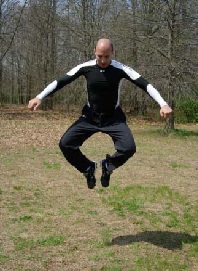
Any type of jumping is not only excellent conditioning for explosive strength, but also mandatory for a warrior.  You must be able to leap out the way of a sword strike or over an obstacle!  So, whether it’s box jumps, tire jumps, broad jumps, lateral jumps, etc, they are all important and necessary training.

3. Pull-ups

Warriors need pulling strength.  Get on the bar, the rope, the tree branch, or even the monkey bars at the local playground and start pulling!  Change up your grip each set.

4. Push-ups

Most people consider push-ups a basic exercise and only know a handful of variations.  I consider push-ups an amazing developer of whole body strength, coordination, and agility with almost limitless variations – ask my clients! 🙂

5. Tire Flips

Whole body strength and power plus the added satisfaction of flipping a 400 lb tire.  Simply badass!

6. Ground up lift

This can be any lift from the ground up to overhead.  Use a barbell, dumbbells, kettlebell, sandbag, keg, small child, whatever!  Clean and press it.  Snatch it.  Jerk it. Turkish Get Up it!  Just lift it!

7. Sledge hammer swings


These are simply awesome for conditioning, developing striking power, and super-transferable nonstop core power.  Plus they are fun as hell and great for stress relief after a bad day!

Bonus exercise – KB Swings

You are your weakest link!  For most people their posterior chain is a weak area on the body.  This exercise will fix it.  Oh yeah, if you still think you need to do more cardio, try banging out a few hundred reps of these bad boys!


What exercises would you include as part of your top 7?  Drop a comment below!

Martial Power


  • Ready for a 6 week program that will explode your development as martial artist?

  • Ready to take strength and conditioning to a whole new level?

  • Ready to become agile, mobile, and hostile?

  • Ready to blow away all your former training plateaus?

  • Ready to build insane mental toughness and work capacity?

Then the Martial Power Coaching Program is for you!  Spots are limited so ACT now!

Holiday Belly-Busting Met Con

If you’re like many people perhaps you’ve over indulged a little bit this holiday season.  Too many great meals and even greater desserts maybe?  Well here’s a quick metabolic conditioning workout to help you out.  The great thing about metabolic conditioning workouts is that, unlike traditional aerobics, they stoke the fat burning furnace and keep it burning for hours after your workout is completed. Continue reading

What’s Tabata You?

If you have been keeping up with the latest trends in conditioning research then you probably already know that interval training is the most efficient way to train.  Interval training alternates periods of high intensity exercise with periods of rest to produce gains in both aerobic and anaerobic systems.  Forget about those long slow distance runs to improve aerobic fitness!

The Body’s 3 Energy Systems

To briefly summarize, the body has three energy systems, 2 anaerobic, or non-oxidative, and 1 aerobic, that serve to create ATP (adenosine triphosphate).  ATP is utilized by every cell in your body; it fuels muscular contractions, cognitive processes, and internal regulatory functions.   Both anaerobic systems fuel maximally intensive activity, while the aerobic system fuels sustained low to moderate level activity.

The ATP-PC system provides immediately available energy for high intensity efforts from ATP stored within the muscles.  This system is the most powerful, but least enduring of the three, lasting only about 10 to 30 seconds max.

The Glycolytic system, the second most powerful, is only slightly more enduring than the ATP-PC system.  It derives energy from glycogen stored in the muscles and liver converting it to ATP in a process called glycolysis.  Its capacity is approximately 90 to 120 seconds.  Rest intervals allow the body to recuperate and restore ATP.

Lastly, the Aerobic system uses proteins, fats, and carbohydrates to produce ATP.  As the intensity of the effort increases, the aerobic system relies more on glycogen for energy.  If the intensity continues to increase, the anaerobic systems must kick-in to provide energy.  The important idea to realize here is that all 3 energy systems are always supplying the body with the energy it needs for any activity, at any level of intensity.  It’s just that one may be more dominant than the other 2 at a specific time.

If Anaerobic is ‘Without Oxygen’, Why am I Sucking Wind?

If you have been following any of the Warrior Fitness Training Programs, you are already familiar with examples of anaerobic exercises and how they affect the body.  Have you noticed how after even a brief, but intense anaerobic session you are breathing heavily?

If anaerobic really means ‘without oxygen’, how come you are so out of breath?

What happens is that your aerobic system is trying like heck to help restore your anaerobic systems.  All that extra oxygen is being used to metabolize the lactate that’s accumulated in the muscles during the bout of intense activity.  In order to continue to supply energy for all-out, intense efforts, the anaerobic system must be replenished.  Excess Post-exercise Oxygen Consumption (EPOC) is the term used to identify this process of extra oxygen being taken in to restore all systems.  So, basically, as the intensity of your exercise increases, so does your EPOC.  And, that’s why you’re sucking wind!

Tabata Protocol

No discussion of interval training would be complete without touching on Tabata.  Dr. Izumi Tabata at the National Institute of Fitness and Sports in Tokyo, Japan performed perhaps the most well known study on interval training.   A group exercising with moderate intensity endurance training was compared to another group using high intensity intermittent training.  Each group exercised 5 days a week.  The moderate intensity group exercised for 60 minutes, at 70% VO2 max.  The high intensity group did 8 intervals of 20 seconds, followed by 10 seconds of recovery.  They operated at 170% VO2 max.

After 6 weeks, both groups experienced improvements in maximal oxygen uptake.  The biggest difference between them was that only the high intensity group gained improvement in anaerobic capacity.  The high intensity group actually realized a 28% increase in anaerobic capacity AND a 14% increase in VO2max.  So, the study concluded that high intensity intermittent training can improve both the anaerobic and aerobic systems simultaneously.  Very impressive results!

How Can I Use Tabata?

I knew that after reading the amazing results achieved by Dr. Tabata you’d be ready to try using his protocol, I sure was!  The protocol itself is pretty simple, in theory.  Choose an exercise – say sprints, for example.  Perform the exercise for 20 seconds as fast as possible while still keeping good form.  Rest 10 seconds.  Complete 8 rounds.  Sprints are an easy example, but really the Tabata Protocol can be applied to almost any exercise.  Try some of these:

  • Bodyweight squats
  • Burpees
  • Kettlebell swings or snatches
  • Sledgehammer swings
  • Push-ups
  • Sprawls
  • Renegade Rows
  • Sandbag Shouldering
  • Mountain climbers
  • Jumping

These are just a few examples of exercises that can be used with Tabata. Just make sure you don’t overly complicate it because you do have to be able to perform several reps within the 20 seconds!!

Additionally, try grouping together 4 to 6 different exercises to increase the effectiveness of the workout and create a synergistic effect where the total combined effect is greater than the sum of the individual exercises.  This, I think, is where the real fun begins!

To seriously amp up your conditioning, learning how to use various breathing techniques to restore yourself quicker, lower your heart rate, and increase the effectiveness of your conditioning sessions is a MUST!
warfit3d3