
Battling Demons

To get good at any discipline, you must practice every day.  To become great, you must practice all the time.  The problem is, with so many pressures, responsibilities, and draws on our time in daily life, how does one manage to train every day?

For me, it’s a daily battle with my demons.  These are the insidious little creatures that lurk in the dark recesses of my mind.  Their sole purpose being to distract me from becoming the person I want to be.  They rationalize and cajole to pull me off the path of self improvement.  The path of training.  For others, the path may be their daily struggle to make good food choices and lose weight, or it may be the daily battle to study at night while working a full-time job in order to earn that MBA.  The path is personal.  The demons are universal.

Currently I train for a few minutes every morning which provides the dual function of waking me up and setting me on the right path for the day.  It primes my muscles, movements, and nervous system for the more involved training I will perform later that night.  Additionally, I will train during the day at odd intervals when I have a few minutes of down time.  These little periods provide the consistency I need to help me keep going.  But, as I stated above, the bulk of my training is done at night after putting the kids to bed.  Usually around 9 pm or so I head down the basement to my home gym.  This is my dedicated training spot.  For me, it helps to focus my efforts since the only thing I do there is train.  It’s minimalist with very few distractions.  Perfect for doing the work.  For the most part, I beat the demons by just getting downstairs and setting foot in the gym.  Getting there is the most difficult part, but once there, the demons are beat and the daily training progresses.

Sometimes, like last night, the battle isn’t won by just getting to the gym.  Last night was different.  I was tired.  I was comfortable sitting on the couch watching TV with my wife.  The kids were asleep.  The house was quiet.  Peaceful.  I thought that the demons hadn’t even shown up to fight because getting down there was so easy.  Once I was in the gym though, they attacked.  It was a sudden, violent onslaught that took me by surprise!  “You’re tired,” they told me. 

“You don’t need to train anymore today…”,

“You did enough over the weekend.  Relax.  Take it easy.”, 

“Why don’t you just go to bed early for a change?  You need your rest!”

On and on it went, not just verbal but real feelings of being sleepy.  Feeling like I should go upstairs and go to sleep.  I almost gave in.  Almost succumbed.  Almost quit.

But mental fortitude kicked in.  Training kicked in.  The battle was on!  I heard myself talking to one of my training buddies saying – “you have to train every day.  You have to want it bad enough.  How do I do it?  Well, it’s like brushing your teeth, Dude.  You just do it every day (usually twice!) no matter what.”  This began the rally.  But it was far from won.  What won the battle once and for all (at least for last night) was the fact that I just started doing my solo conditioning exercises.  I was in the right place.  My mindset was returning.  But the way to win the battle is to simply begin doing the work.  Understand that your training is a necessary part of becoming who you want to be.  Understand that daily training is a necessary part of that process.  And get it done.

Why Sitting All Day is Slowly Killing You

There’s more to leading an active lifestyle than just getting in a workout a few times a week.  Check out this Men’s Health article on Why Sitting All Day is Slowly Killing You.  Think your 45 minute exercise session 3-4 times a week is protecting you from heart disease?  Think again.

For some ideas on how to add beneficial movement to your sedentary office worker life, check out the Corporate Warriors section of Warrior Fitness.

You Have No Idea What Being Fat is Costing You

Special thanks to guest author, Alan Livelsberger for this insightful post!

I have a secret to share with you; I used to carry a few extra pounds with me.  Almost fifty, actually.  But that’s not the secret.  Anyone looking at me could have told you that.  You’ll have to keep reading to learn my secret. 

Several months ago, I decided to do something about the extra weight.  It wasn’t easy and I am certainly not perfect with regard to adherence to my weight loss plan, but I’m halfway to my goal weight.  One of the reasons I am so far along is the Warrior Fitness blog and my access to Jon.  The blog keeps me motivated and Jon is great for keeping me honest about working out.  He’s part of my support system that is so crucial to success and I urge you to make him part of yours.

This brings me to my secret, “Looking thin is cool, but being thin is awesome.” It is a hard feeling to describe, almost like waking up from a drug induced stupor.  The best way that I’ve found to describe it is that it’s like when you’re not getting enough sleep.  Any parent knows what that is like with a new born in the house.  Months of getting up one, two, or three times a night.  You’re grumpy, you can’t focus and then . . . you get two great nights of sleep in a row.  All of a sudden you notice how you are supposed to function and what you have been missing. 

Well that is what losing 20 pounds of fat is like.  You have more energy.  I used to struggle to finish my Muay Thai class.  Now, not only can I finish the class, I can jump rope or lift weights afterward.  You can think more clearly.  I feel I am retaining more of what I read and also making those connections among seemingly unconnected data pieces.  I’ve also noticed that I have more confidence and less aches and pains. 

One of the most surprising benefits is that you feel like a winner.  You are literally piling up victories.  Every time you forgo an unapproved food or get a workout in, you are instilling a culture of winning within yourself.  Not a bad thing to have in life, for sure.

Those are some great benefits to dropping a few pounds, and I urge you to examine how you feel each and every day.  If you think there is something more to life, there is – go find it.

About the Author

Ever since being inspired by Kung Fu Theatre, Alan has been a martial arts enthusiast.  Over the course of 20 years, he has dabbled in Judo, BJJ, and Russian Martial Art.  He is currently an Instructor Candidate in ROSS and a Muay Thai practitioner.

How Dense are You?

In today’s hectic world it seems we are all continually struggling to fit more and more into less and less time.  Whether it’s squeezing more work into a 9 to 5 day, cramming more activities into a 2-day weekend, or condensing a week’s worth of email posts into a digestible digest version, it seems we are all trying to become more dense.  In that spirit, I’d like to offer the option of Density Training.  This is by no means the only way to train, nor is it recommended to use it as your sole form of conditioning, but when you are short on time and are looking for ways to do more with less, Density Training is definitely a viable option.

Density Training Concept

The concept of Density Training is pretty simple.  Do more work in the same amount of time or do the same amount of work in less time.  So, for example if you were using  push-ups as the exercise and the last time you used this protocol you managed to do 100 push-ups in 10 minutes, then this session you would either try to increase the number of push-ups you can do in 10 minutes or strive to do 100 push-ups in under 10 minutes.  Not rocket science, right?  What if this is your first time attempting this type of training?  Pick your exercise, let’s stick with push-ups for continuity’s sake, and pick an amount of time, say 10 minutes.  Then try to do as many push-ups as you possibly can in that 10 minutes.  Crank them out.  Push yourself (pun intended).  Remember the time limit used and amount of reps achieved, or preferably write it down, and the next time do more.  Simple as that.

More Options

Density Training can be used with almost any exercise.  Here are some additional examples:

  • Sprints – pick a relatively short distance, maybe 30 to 50 yards, and see how many sprints you can complete in 10 minutes
  • Rope Skipping – not my thing really, but hey, who’s discriminating?
  • Heavy Bag punching, kicking, elbowing, kneeing, or any combination – how many strikes can you throw in 10 minutes (Yes I know I keep using 10 minutes, but you don’t have to.  Find something that works for you.)
  • Any Bodyweight exercise – Burpees are great for this!
  • Make it martial arts specific and see how many sword cuts you can do in 10 minutes.  Just remember to keep the technique level high or you’re wasting your time!!

Remember, this is not the only option out there for those short on time, but it is a good one.  Give it a try and let me know how it works out for you.  Try it with different exercises.  Experiment.  Have fun!

8 Ways to Fit in Your Fitness

It’s often been said that if you want something done you should give it to a busy person.  While this may be true of some busy people, namely the ones who are highly motivated, highly productive, and highly efficient, what about all the other busy people?

What about those who are busy through poor time management skills, or maybe those who are simply overwhelmed?  How about them?  Does the task they are given merely get thrown on top of a growing pile of “To-Do’s”, or even worse, shuffled to the bottom?  What if the task they are given, or give themselves, is directly related to increasing their quality of life and most likely longevity as well?  What if that task will help them be more productive at all their other tasks by reducing stress levels, increasing energy, and their overall sense of well being?  What if that task would help them to reduce, remove, or otherwise prevent a host of daily aches, pains, and illnesses that are stoically (or sometimes not so) suffered as things that “just happen” as we grow older?


Here’s a list of 8 ways for these busy people to fit in their fitness and reclaim a healthy lifestyle:

1.  Plan it out.

Scheduling is the key to successful time management.  Look at your weekly calendar and plan to exercise just as you would plan an important client meeting, a lunch with an old friend, or coaching your kid’s Little League team.

2.  Exercise wherever you are.

Joint mobility sessions can be done at your desk – see here.

3.  Take the Stairs.

Work in an office building?  Take the stairs instead of the elevator.  See how fast you can make it to your floor – beat those lazy suckers in the elevator to your floor!

4. Get outside.

Have a lunch break?  Go outside and go for a walk.  10 minutes in the fresh air will do wonders for you.  Eat at your desk while you work and then go for a walk.  Want to make your walk more productive?  Try inhaling for 5 steps, holding you breath on the inhale for 5 steps, exhaling for 5 steps, then holding the breath after the exhale for 5 steps.  When you can comfortably do that for the entire duration of your walk, increase to 6, 8, 10 steps!

5. Get up earlier.

Get up earlier and workout **warning – this one requires effort and commitment!!**

6.  Exercise together.

Spend quality time with your kids.  Exercise together – see Warrior Fitness for Kids.

7.  Brief workouts.

Got a spare 15 minutes?  Bring the intensity and lose the long, boring workouts.  See the Warrior Fitness WOWs for some ideas.

8.  Isometrics.

These require very little time to be effective, need no equipment, and can be done literally anywhere.

Obviously, this list is neither exhaustive nor all inclusive,  but I do hope it has helped you and sparked some ideas to help you fit in your fitness no matter how busy you are.  What ideas do you have?

Warrior Fitness Workout of the Week #3

Let’s change it up a little bit this week and spend some time focusing on our core.  Since all movement originates from the core of the body, it makes good sense to target it specifically and ensure our cores are strong, mobile, and integrated with the rest of our body.  Instead of wasting time doing endless crunches, or spending crazy amounts of money on relatively useless tummy flattening gimmicks (as sold on late night TV), try this functional core workout instead! 

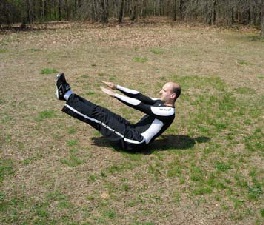
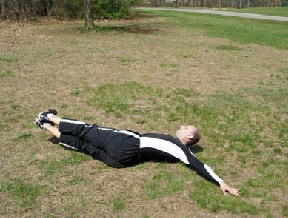
V-up

  • 10 V-ups 

Lie flat on your back with arms stretched out over your head.  Exhale, contract the core and lift arms and legs together.  Inhale as you lay back.  Repeat. 

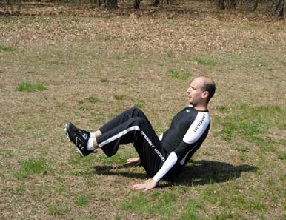
  • 10 Knees to Chest 

Sit with legs extended straight.  Lean back slightly and lift legs, bringing knees to chest.  Exhale as you contract, inhale as you straighten. 

Knees to Chest

  • 10 Crunches with 3 second isometric hold

Yes, sometimes even crunches can be useful.  Just depends on how you do them!  In this case, perform a normal crunch, but as you lift off the ground exhale, contract the core tightly and hold for 3 seconds before descending.

  • 10 Pendulum Leg Lifts (side-to-side) 

Pendulums

 Lie flat on your back with your legs straight up in the air, knees locked.  Exhale and slowly drop your feet to the left side, back to center, then the right side.  This is one rep.  

Instructions

Complete 5 rounds. Rest 90 seconds between each round; no rest between exercises.  

Need a Finisher?

Finishers are used to squeeze just a little bit extra out of the workout.  They are awesome for increasing mental toughness as well!

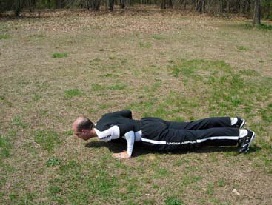
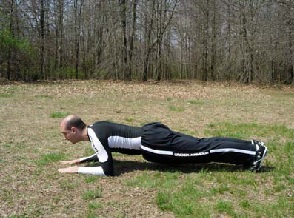
  • Finisher Exercise: Plank hold for time – get in position and hold as long as you can.  See if you can last 5 minutes!

Plank Hold


For more information on the Warrior Fitness Workouts of the Week, please see our User Guide.  And, as always, please let me know if you have any questions or comments.  Reach me here or leave a comment below. 

Want to know more?  Check out Warrior Fitness: Conditioning for Martial Arts!


Top 10 Things to Look for in a Kid’s Martial Arts Class

One of the first things fellow parents tend to ask me after they find out I’ve been involved in the martial arts for over 25 years is, how do I find a good martial arts class for my kids?  Well, after years of answering this question, I realized my answers tend to follow a certain pattern.  They may be expressed in slightly different terms and the order of the points may change each time I’m asked, but the answers remain the same.  So, for all those parents out there who are looking to involve their child(ren) in the martial arts (a highly recommended pursuit, by the way),  I’ve formulated my own “top 10” list:

1.  Is the school a franchise? 

 These typically have cookie-cutter, one size fits all programs and tend to be belt factories.  Steer clear!  There may be franchises out there that do not fall into this category, but I haven’t run into them.

2.  Do the kids in class fear the teacher or respect him? 

This is very telling.  As a kid, I was afraid of my first karate teacher and even though I loved the art and practiced like crazy at home, I’d try to get out of going to class almost every week. 

3.  Are the parents sitting in the waiting room comfortable with the teacher and happy with the class? 

When you visit a school, talk to the parents who have been there awhile.  Do they constantly complain about the teacher, the atmosphere, or even the cost?  Do their kids love the program or simply tolerate it?  Also, what is the vibe you pick up when walking into the school – listen to your gut!

4.  Variety! 

Kids get bored very easily.  And, when they are bored, they don’t learn very well.  Classes should have a wide variety of drills to show children principles and techniques from many different perspectives.  Remember, martial arts are not academic subjects!

5.  Tons of physical exercise. 

Kids have a lot of energy.  Exercises that teach physical skills, as well as give them an outlet for their energy are the best.  Also, in case no one has told you, we have a growing childhood obesity problem in this country.  Exercise, along with a focus on a healthy diet, is key to resolving this issue and giving our kids the tools to ensure a lifetime of health.

6.  Do they teach self-defense applications of kata, or just the forms?

This is essential, not only for the correct transmission of the art, but also for the students to understand how to actually apply the techniques.  Obviously, this must be tempered to make some aspects of practice age appropriate, but it must be taught.

7.  Do they teach rolling and falling techniques?

 Not only are these fun for the kids to practice, but they can, and do, prevent injuries.  Very important both in the dojo and out in real life.  Additionally, they help to develop coordination, agility, and kinesthetic awareness!

8.  Is situational awareness stressed?

This is, without a doubt, the most important aspect of self-defense and must be continuously stressed and communicated.  Bad things do not “just happen” to kids.  There are always pre-incident cues that are present, if one is paying attention.

9.  Do the kids in class appear to be motivated or just going through the motions?

Watch carefully when you visit the class.  Are they lackadaisical in their practice?  Do they look like they don’t want to be there?  Or, are the kids energized and focused throughout the class? 

10.  Leadership. 

A school does not need to have a specific, defined class program on “Leadership” (these are usually a colossal waste of money for parents… hint, hint!).  It should, however, endow the students with leader qualities through the example of the teacher and by getting the kids involved in the class room (dojo) instruction.  This can be done by rotating who leads various drills and allowing children to teach their peers by explaining and demonstrating certain kata, techniques, or exercises.  This is not only good for the child’s self confidence, but also for their overall and long term development.

Applying Six Sigma Principles to Your Fitness Plan

Six Sigma is a process improvement methodology that has its origins in the manufacturing business.  It has been adapted and expanded to cover a wide variety of business products, services, and help foster solutions in terms of reducing costs, removing defects, and continuously increasing efficiency.

Today, we are moving from the boardroom to the gym and looking at ways to apply a scaled-down version of Six Sigma methodology to improving your health and fitness.  Right now, you are the product and we are looking for ways to foster continuous improvement in you!

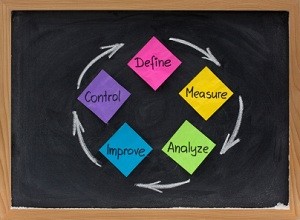
What is DMAIC?

Let’s look at one of the basic methodologies for Six Sigma projects called DMAIC and see how it can be applied to improve your fitness program.

DEFINE the problem and project goals specifically.

  • What are your fitness goals, right now, today?  Whether it’s to lose a certain number of pounds in an allotted time-frame, or be able to do a one-arm push-up at 40, it doesn’t matter.  Here is where we define our objective.

MEASURE key aspects and collect data.

  • What is your current weight or dress size or waist size?
  • How many push-ups can you do in one session?
  • How many calories, carbohydrates, and grams of protein do you eat daily?
  • How many servings of fruits and vegetables do you eat daily?
  • What is your resting heart rate?  Blood pressure?  Cholesterol numbers?
  • How fast can you run a mile?
  • Or, any other measurements that pertain specifically to the goal you outlined in the Define section above.

ANALYZE the data to investigate and verify cause and effect relationships.  Determine the root cause of the problem.

  • Do you have 3 sausage, egg and cheese breakfast sandwiches from Dunkin Donuts daily and notice that your cholesterol has sky-rocketed, your blood pressure is too high, and your waist line has expanded?
  • Do you run out of breath climbing a flight of stairs?
  • Or, not have enough energy to play with you kids in the park?
  • Do you aspire to run a marathon this year, but can’t get motivated?
  • Look closely at the data you gathered above and figure out what is holding you back from achieving your goal.

IMPROVE or optimize the process based on the analysis.

Here is where all the real work gets done, but also where you may encounter a stumbling block.  You’ve defined your goal, measured key aspects as they relate to your goal, analyzed all the data and determined the root cause of the problem, but what do you do now?

This is where having a knowledgeable and highly experienced Coach comes into play

(Book a Strategy Session Call with me HERE).

You need someone who can review the findings above and determine the best possible solution for you.  This includes:

  1. Knowledge and understanding of exercise methodologies and how to apply them on a case-by-case basis.
  2. Ability to design an individualized fitness plan for you.
  3. Ability to effectively and efficiently get you the maximum results in the minimum amount of time.
  4. Ability to communicate, break things down, and respond accordingly to questions and concerns.
  5. Ability to motivate and keep you on the path.

CONTROL future state process to ensure any deviations from the target are corrected before they result in defects.

  • Here is where your progress is charted and tracked to make sure slippage does not occur.  If slippage does occur, it can be noticed and corrected for immediately to assure the project – a fit and healthy you – remains on track!

Many companies and organizations have applied these principles to better their businesses, increase production, reduce costs, and improve their overall business processes.  Why shouldn’t you be able to take the same ideas and apply them to your health and fitness?

Warrior Fitness Executive Coaching Program

Book a Free Strategy Session call with me HERE to see if you are a good fit.

The Morality of Fitness

FatherJohn Corapi is a well known Catholic preacher, scholar, and theologian.  He also happens to be a black belt in karate, a former competitive boxer, and football player.  In this video he addresses concerns over his health and his startling weight loss.  He begins by assuring the people who care about him that he is not sick at all; in fact he is healthier than ever!  Father then goes on to remind us that fitness is a moral obligation we all have.  As Fr. Corapi states in his video address, “we are all precious, unique, and unrepeatable.”   Take care of yourselves!

You do not have to be Catholic to benefit from Father Corapi’s thoughts on fitness.  In fact, his words transcend religion and get to the heart of being human.  As he says, if you know there’s action you can take to improve your health, such as diet and exercise, you must do it. 

Stay healthy and strong!

Want to know more?  Check out Warrior Fitness: Conditioning for Martial Arts!

Warrior Fitness for Kids!

This will be the first in a continuing series of posts chronicling my thoughts and discoveries on Warrior Fitness for Kids.  As the father of 2 young girls, ages 9 and 1, I have a very vested interest in assuring my daughters are among the healthiest, fittest, and most well-informed kids out there.  Follow along and yours will be too!

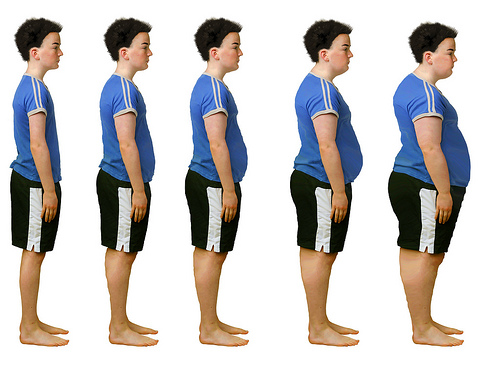
It doesn’t take a genius to see that America has become a nation of over weight, physically lazy, comfort-seekers.  The saddest part is the effect this perverse attitude has had on our children.  How can we call ourselves responsible parents when our kids consume more McDonald’s than broccoli, and watch more TV than play outside?  What happened to running, jumping, playing tag, climbing trees and fences, or riding bikes as fast as you can just for the sheer thrill of it?  Has watching Sponge Bob and playing video games replaced playing outside from the time school lets out until dinner is ready?  I remember my mother having to shout for my brothers and me almost on a daily basis to call us home for supper.  And, in the summertime, we were playing outside until well after dark!

What Can We Do to Reverse This Trend?

To me, the answer is simple: Lead from the front!  What impetus do your children have to eat healthy and exercise if you do not?  You, as a parent, must set the example for your kids.  My daughters constantly see me exercising, whether it’s stretching, working on the technical details of an exercise, practicing martial arts, or a full-blown conditioning routine, I’m setting an example for them on a daily basis.  Coming home from work and sitting on our butts in front of the television while we “relax” and “unwind” is more than just detrimental to your health.  It sets up a poor pattern of conditioning that you’re children will follow for a lifetime.

Train With Your Kids

Want to spend some quality time with your kids and help them become fitter in the process?  Workout with them.  Make it fun, not drudgery.  That means stay out of the commercial gym and away from the damn treadmills!  You’re people, not hamsters.  One of the ways my oldest daughter and I spend time together during the warmer weather is to go on walks after dinner, while the sun is still up.  But just walking around the block is boring, so we found a couple ways to spice it up:

  • Pick a landmark – mailbox, telephone pole, tree – and race to it.  Recover by walking a little bit, then race again.
  • Leap like a frog until you get tired – see who gets tired first!
  • Crawl on hands and feet (be careful of the terrain), then get up and run.
  • Let your child ride their bike and you try to keep up, or you ride a bike and let them keep up!

These are just a few examples of how you can change a simple walk around the block to a fun workout for you and the kids.  Shhh… don’t tell them they’re doing High Intensity Interval Training (HIIT)!

As this series continues, I’ll be sharing more ideas about how to workout with you kids in ways that are fun and effective for both of you.  Additionally, I have workouts that I’ve designed for my 9 year old daughter that I’ll be sharing here as well – stay tuned!

How about you?  Do you workout with your kids?  What are some of the things you do to help keep them inspired and keep going?