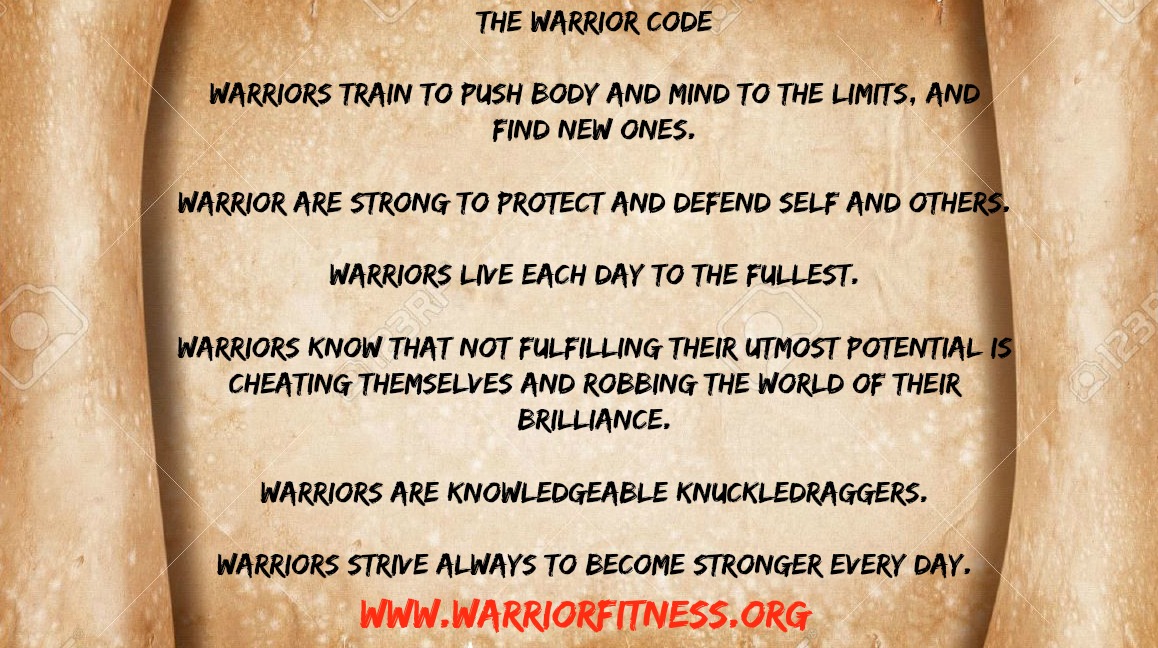
The Warrior Code

Every warrior society throughout history from the Spartans, the Samurai,and the Apache, to the modern day warriors like the SEALs all possess a strong code of ethics that they live by.

The Warrior Fitness Tribe is no different.

When you belong to this tribe, there is a code that must be adhered to.

the-warrior-code

This is the code of the Warrior Fitness Tribe.

Learn it.

Live it.

Share it!

How Warriors Train for ENDURANCE

Warriors Need to HIIT!

High Intensity Interval Training (HIIT) is one of the best ways to train for endurance. It will enhance all 3 energy systems in the body, as well as prime the nervous system to recover automatically during lulls in activity.

Simply put, HIIT alternates periods of high intensity exercise with periods of rest and recovery. It can be performed with almost any exercise and can be utilized both with and without equipment.

The variety and adaptability of this style of training is second to none in results.

How else does improving your endurance through this type of conditioning aid your martial arts training?

I’m glad you asked!

If the benefits discussed above weren’t enough, consider that having a high level of conditioning also aids in learning new skills.

How’s that possible?

To put it simply, when the central nervous system (CNS) is fatigued, the body cannot effectively process new skills, especially technically advanced skills. So, in essence your lack of a general level of fitness and conditioning will actually impede your learning process as you will tire more readily and not have the ability to recover quickly enough during training.


  • Want to train more, at a higher level, for a longer period of time?

  • Want to get more out of your training time both at home and in the dojo?

  • Want to build new skills and enhance your technical arsenal?

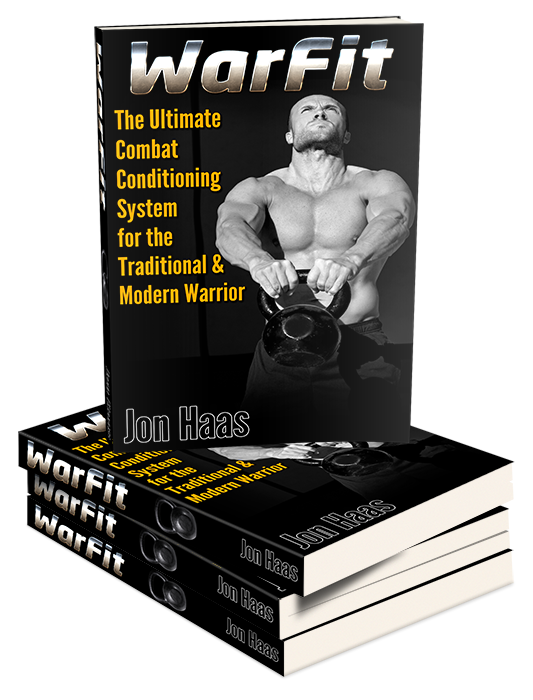
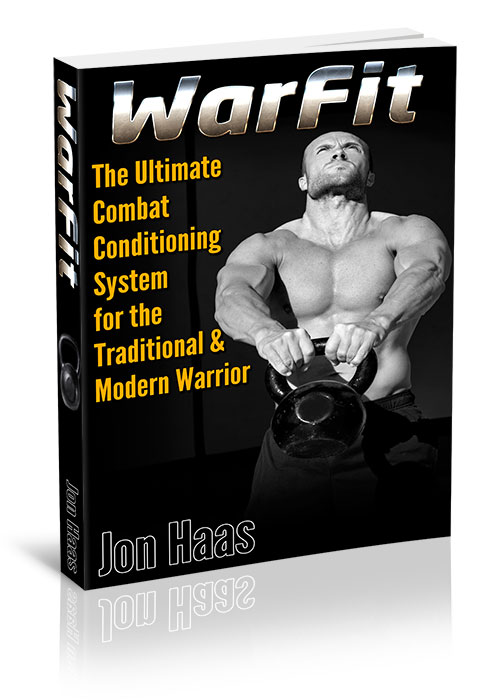
    My brand new WarFit Combat Conditioning Program will show you how!

warfit3d3

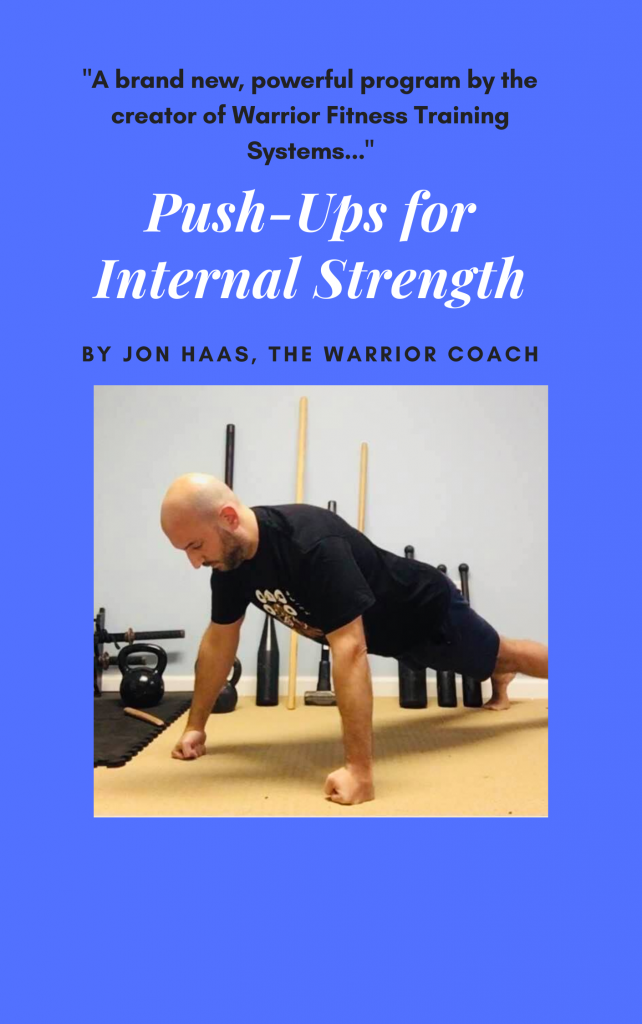
The Aiki Push-Up

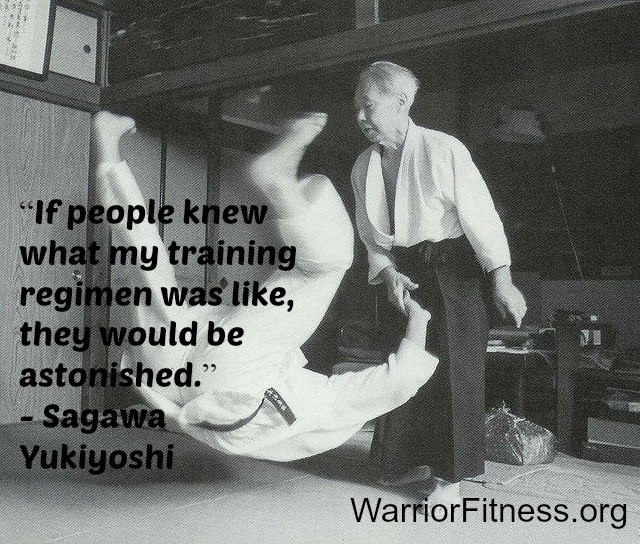
The Aiki Push-up is a literally a one-stop-shop in the study of internal power building. It was rumored to be part of Daito Ryu master, Yukiyoshi Sagawa’s secret training regimen.

Sagawa Training
Here’s a video where I explain the purpose and it and how to do it.

Watch carefully as the Aiki Push-up may look similar to what you already know, but the entire engine driving it is different!

Don’t fall prey to the common idea of thinking you know something just because you know about something! Be diligent in your study and your training – go deep!

“A little knowledge is a dangerous thing…”

Learn all the fundamental building blocks to the Aiki Push-up, as well as creating Internal Power (plus much more!) HERE!

New Exercise – The Sword and Shield Protocol

Let’s talk about what it takes to achieve success in your fitness and martial art training…

Here is the Warrior Fitness simple formula for training success:

Specific Training + Frequent Practice = RESULTS

Here’s an example of my Daily Personal Practice from earlier in the week that works on specific movement patterns I am trying to enhance and strengthen…

Which culminated in a new exercise I created based on those skills and movement patterns… 🙂

The Sword and Shield Protocol

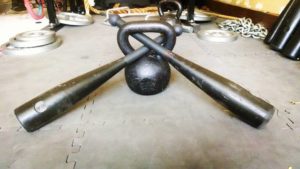
To perform the exercise, snatch a kettlebell and hold in overhead carry. Clean a club with the other hand and perform mills while stabilizing the kettlebell overhead. Give it a try and let me know how you do.

KB & CB

Balance Training Drills

Balance is an essential quality for the warrior to develop.  It directly affects our ability to move with grace, coordination, agility, and power.  Yet direct balance training exercises seem to be a neglected area in many people’s training programs unless they are recovering from an injury or trying to fix a specific weakness.  Personally, I think they should be an integral part of training.

The following is an introduction to the balance drills I use to train myself as well as my martial arts students and fitness clients.  I hope you find them as useful as we do.

There are 3 Systems the Body Uses to Orient Itself in Space

1. Visual – Relying on sight is the second fastest and most efficient mechanism in our balance (unless we are in a dark room!).  Most people tend to rely on visual cues for balance, to the detriment of the other 2 systems.  The visual system relies on a physiological reflex called the Ocular Gyro Cephalic reflex which creates tension chains that reflexively cause the body to orient toward whatever the eyes see.

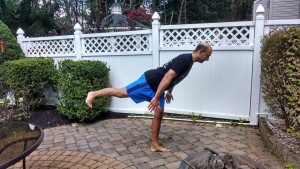
Balance Drill Leg back

2. Vestibular – This system relies on the fluid within the ears to sense balance.  As we move, the fluid sloshes around.  If we are not used to a particular pattern of movement, we may begin to feel dizzy. The brain works to process this information and integrate it with the information coming in from both the visual and proprioception systems.

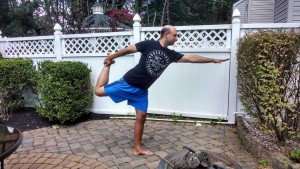
Balance Drill Leg back hold

3. Proprioception – This our sense of position and movement of the limbs and the sense of muscular tension.  Proprioception utilizes information derived from sensory receptors in our muscles, tendons, and joints to inform us of changes in movement, position, and tension.  Proprioception is plugged directly into our nervous systems making it possibly the fastest and most efficient mechanism for balance, as long as we train it.

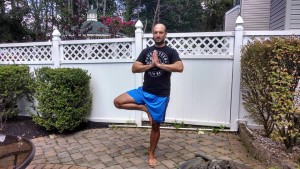
Balance Drill Tree

The balance drills shown in the video below will allow you to train all 3 systems concurrently.


For more information on balance and proprioception training, check out my new program:

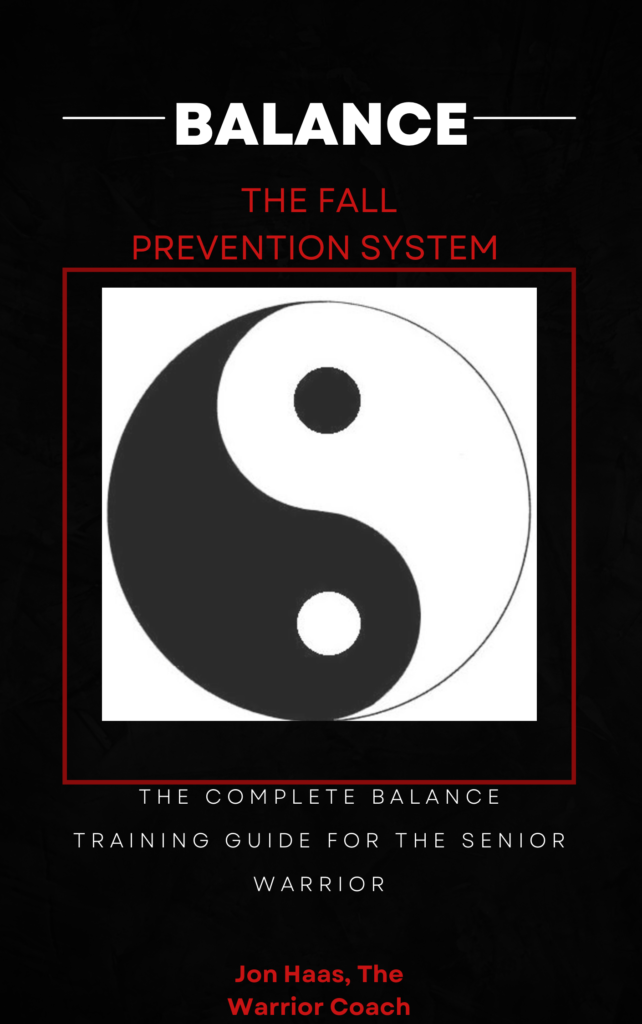
Balance: The Fall Prevention System <<==

How to Train for Chaos without Making Training Chaotic

The current rage in conditioning training, especially when talking about combat conditioning, is to completely change up the workout for each and every session. This has the advantage of keeping the training fresh and throwing the body into chaos each time so it never knows what hit it.

The hardcore advocates of this type of conditioning stress that this environment will create a very broad and general fitness that prepares the trainee for almost every physical contingency, both known and unknowable.

This enables one to prepare for the chaos and uncertainty of combat by training in an uncertain and chaotic environment.

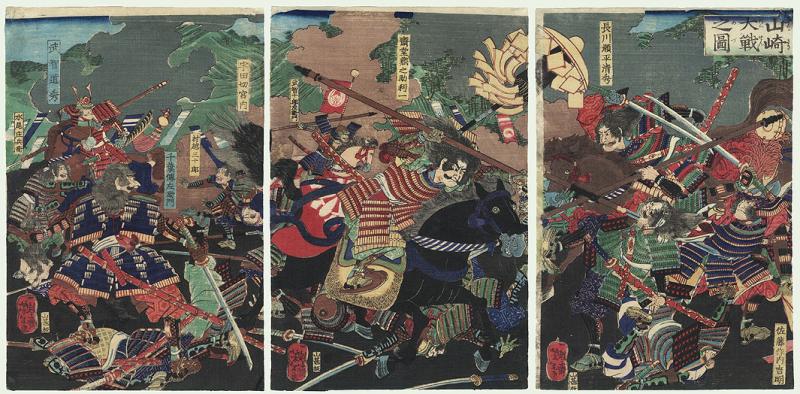
samurai

Seems to make a lot of sense on the surface, right?

However, one of the glaring problems with this type of training is that random training yields random results. It’s difficult to measure progress when the parameters are constantly shifting.

In order for the body to produce an adaptation for improved performance in life, sport, or martial art, we must apply specific stimulus as per the SAID Principle (Specific Adaptation to Imposed Demand). This basically means that the body adapts with a specific type of fitness to any demand which is imposed on it. When the same exercise is performed for too long, the body adapts to the stresses of each set and the adaptations or returns get smaller and smaller. Once it has adapted to the stress, then it’s time to change or increase the stress or else we fall into that trap of diminishing returns.

Usually though it takes the body a period of 4-to-6 weeks to adapt and then it is advisable to begin changing exercises. This does not mean that we need to completely throw away everything we have been doing; far from it. An exercise or drill can be changed by increasing intensity, increasing volume, decreasing rest periods, or increasing complexity or sophistication.

What this suggests is that a properly organized training program with incremental progression of increasing complexity and sophistication may actually prepare the body better than a set of random skills strewn together with a nebulous outcome in mind.

Yet we still crave the chaos, right?

So why not have it both ways?

Let’s program chaos into our training to instill the element of surprise and shock to the body. But, and this is key, we will ONLY do it once a week. This is enough to add the benefits of chaos training without suffering the negative aspects. The rest of the time you must follow a properly programmed training regimen to ensure all the multifaceted fitness qualities required to keep you strong, agile, mobile, and hostile are being met.

How do we program the chaos?

One of my favorite ways to do this is by picking 5-6 different exercises and setting an interval timer for 5 rounds of 3 minutes or 5 rounds of 5 minutes (depending on your fitness level). Instead of setting a rep scheme, move from one exercise to the next in any order you like performing as many or as little reps of each exercise.

If you need active recovery during the round or simply can’t figure out what to do for a few seconds – do Jumping Jacks. The only caveat is that you must not stop for the duration of the round. Take a 1 minute break between rounds to recover your breathing, then go again.

Here’s an example Chaos Training Workout:

1. Kettlebell Swings or Snatches
2. Jab/Cross Combo on Wave Bag
3. Sit Thrus
4. Med Ball Slams
5. Sandbag Burpees

My brand new WarFit Combat Conditioning Program is perfect for the warrior athlete who wants to build superhuman strength, endurance, and conditioning…

warfit3d1


Kata (Alone) Will Never Build Internal Power

Trying to develop Internal Power by training kata (alone) in martial art is problematic.  On one hand, you may inadvertently have minor success in creating some internal connection over the course of 20-30 years of training, but you will most likely have no idea how you did it, no idea why it worked (minimally at best), and most importantly, no idea how to correctly transmit it to the next generation.

The only advice you will be able to offer your students and fellow seekers is to keep doing this (kata training) and somehow you *might* get the correct result.  This is insufficient and irresponsible, at best, on the part of the teacher.

Assuming that you want to stand out from the crowd as a powerful martial artist, and Internal Power/Aiki is your goal, then the scatter approach to trying (and for the most part, failing) to build IP through kata alone is a waste of a career.  I say this because there exist clearly defined, step-by-step processes that rewire the body for Internal Power specifically for martial arts.

Solo Training Precedes Kata Training

Power building models as solo training exercises have existed for hundreds (if not thousands) of years  throughout the martial arts from India to China to Japan.  Why anyone would try to reinvent the wheel by attempting to create their own hodgepodge of exercises or think that merely training kata would develop real Internal Power is a mystery to me.  The reality is that solo training exercises burn in specific ways of moving that are not normal which create a very stable, powerful structure capable of absorbing, re-translating, and projecting incoming force.
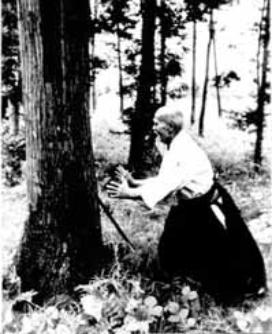
osensei_tree_kokyu1-272x334

Internal Power training is a type of General Physical Preparedness (GPP) for budo.  The goal of regular GPP for fitness, athletics, or martial arts is enhanced work capacity. This is the ability to run faster, jump higher, and hit harder. When work capacity increases, it allows the budding warrior to adapt more easily to increases in both mental and physical demands. In other words, it increases your capacity and level of readiness to absorb higher levels of specificity.

The solo training exercises for internal power training change the way outside forces act on the body.  The structure becomes dynamically stable so that applied force can either be distributed throughout the chain and dissipated or, at a higher level, simply reflected right back onto the opponent.  When force is reflected back this is what is known in Japanese as Yamabiko, or Mountain Echo.

Just to help further differentiate the two practices, solo training exercises for building internal power (there are other types of solo training exercises, obviously) are always made up of the following: standing, open/close, winding, spiraling, and breathing – all supported by Yin/Yang Theory (the union of opposites) and 6 directions (Heaven Earth Man).

Kata are for the purposes of patterning correct martial movement.

These solo training exercises are trained BEFORE kata to condition the body for powerful martial movement. They are not martial movement drills in and of themselves like sanshin no kata, kihon happo, and kata.

Kata – The Slow Boat to China

The reason it is so difficult to train IP via kata is that the vast majority of students get caught up in learning the movements of the kata correctly.  They get caught up in the application of technique and the idea of trying to make it work correctly.  What they don’t realize is that having a correctly trained body built by solo Internal Power exercises makes all the kata work much better and easier.
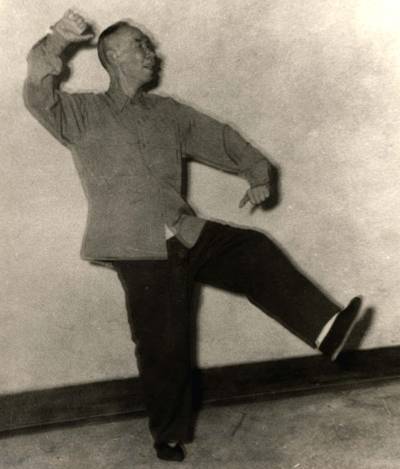
If you have a choice – why not learn a proven step-by-step method of developing unusual strength and Internal Power?


Join My New 21 Lessons on Internal Power Coaching Program <<==

Following a clearly defined path up the mountain is much faster and more effective than wandering around the base working on kata for 30 years and thinking you will somehow magically arrive at the summit.

Caution – While I did just say “more effective and faster” I by no means meant easier!!  Internal Power takes a lot of dedicated work.  Do not think it is a shortcut!
Stronger Than Fear

Are you stronger than your fear?

Or do you stay in your comfort zone and allow fear to get the better of you?  You can tell every time when you start to push against the edge of your comfort zone – you begin to feel afraid.  Maybe you don’t call it fear.  Maybe it’s resistance.  Maybe it’s discomfort.  Maybe it’s just a queasy feeling in the pit of your stomach that goes away if you you stop pushing forward.  Call it what ever you want.  I know what it is.  I call it by it’s true name – fear.

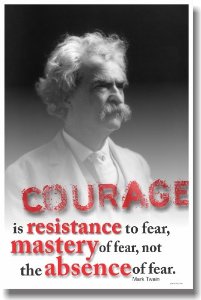
How do you become stronger than fear?  By feeling it, acknowledging it, and doing the thing you fear anyway.  As Mark Twain once said, “Courage is resistance to fear, mastery of fear, not the absence of fear.”

Mark Twain Courage

One way to face fear and push past it is by enduring brutal physical training.  This type of training is NOT for the faint of heart.  However, when you go through it, face it, and come out on the other end, you are a stronger person – mentally, physically, and spiritually.

Here is a sample of one conditioning workout with an MMA fighter I am currently training:

The Secret to Motivation is ____________

A few weeks ago I sent a question out to my email list (HINT – if you haven’t signed up yet, subscribe on the right!) asking what topics they had questions about and wanted to see more blog posts on.  Several great questions and suggestions came back.  One that was repeated often was the question of motivation – “How do I motivate myself to train more?  How do you motivate yourself?”

Here’s my answer to both questions.


What are your thoughts?  Drop me some comments below!

2 pains

The UN-Natural Athlete

I was never what you would call a natural athlete growing up.  In fact, I pretty much sucked at every sport I tried – baseball, basketball, soccer, kickball, tennis… you name it, I sucked at it.  To make things worse I was also ridiculously shy and introverted as a kid, so that combination, on top of having little to no athletic skill, made things even worse! Continue reading